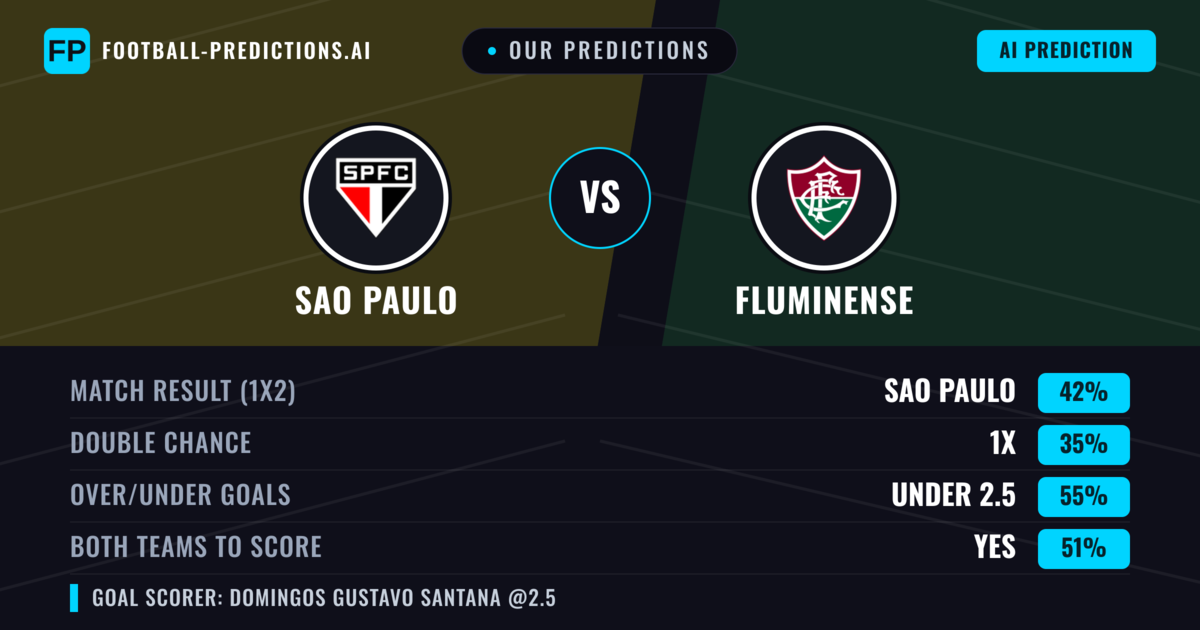







São Paulo vs Fluminense: The MorumBIS Test That Could Define Both Seasons
John Kennedy may be the name most likely to decide this Serie A contest, but the pressure of an away match at the Estadio Do MorumBIS belongs first to Luciano. The São Paulo forward has two goals in the data supplied, while Kennedy has scored three and added an assist for Fluminense; with the home side ranked 10th in Serie A and the visitors sitting fourth, the difference between finishing around the middle and securing a stronger position could come down to one decisive touch. São Paulo need an answer at both ends of the pitch, while Fluminense have to show that their attacking production can survive the pressure of a difficult venue and a compressed schedule.
This is a regular-season meeting in Round 35, and the stakes are substantial even without a cup setting. São Paulo are 10th in Serie A with 44 points from 34 matches, while Fluminense are 4th in Serie A with 57 points from the same number of games. Both sides are described as chasing promotion, but their routes have begun to diverge in the recent results: São Paulo’s form string is DLDWW, whereas Fluminense’s is WWLLL. The table position, however, still gives Fluminense the stronger platform from which to work, and the team that handles the evening’s changing momentum should finish this fixture with the more convincing position.
The timing adds a further layer. For readers in the target market, kickoff is 00:30 GMT, London time, on Friday 20 November 2026. Neither side has a meaningful rest disadvantage, with São Paulo having 15 days and Fluminense 13 days, but Fluminense will play again in three days. That could influence selection and sharpness, particularly if the visitors rotate players while protecting key individuals for the next fixture. It also makes the prospect of an away team trying to protect a point particularly difficult: the incentive is to secure the result, yet preserving energy for a game three days later could become equally important.
Why This Serie A Meeting Carries Weight Beyond the Initial Three Points
São Paulo enter this match with 12 Serie A wins, eight draws and 14 defeats in 34 games. Their points total leaves them in 10th place, and the recent DLDWW sequence shows that they have found enough consistency to finish stronger than their season-long record alone might suggest. The home crowd and familiarity with the Estadio Do MorumBIS are meaningful, but neither should be treated as a substitute for performance. São Paulo still need to turn their attacking potential into more consistent scoring and make the most of the spaces available against Fluminense’s 4-2-3-1 structure.
Fluminense’s fourth-place position conceals a more complicated recent picture. They have won 16 matches, drawn nine and lost nine in Serie A, yet their most recent form is WWLLL. The supplied ten-match sample contains four wins, no draws and six defeats, with an average of 1.7 goals scored and 1.4 conceded per match. That profile suggests a team that can produce goals but has also been unable to preserve leads or maintain defensive control. The 70% BTTS rate in that sample reinforces the sense that Fluminense’s matches have often contained goals for both sides, although the narrow number of clean sheets—20%—also exposes vulnerability.
São Paulo’s ten-match sample is more stable by comparison: four wins, two draws and four losses, with an average of one goal scored and 1.1 conceded. Their BTTS rate is 40%, and their clean-sheet rate is 40%. That profile points towards fewer open exchanges and greater emphasis on preventing the opposition from creating a high-quality chance. It also means Fluminense’s stronger attacking numbers may not be enough on their own if the visitors become frustrated and the home side can maintain defensive discipline.
There is motivation on both sides, but it functions differently. São Paulo’s late-season aim is to move upward from 10th in Serie A and strengthen their position in the promotion picture. Fluminense, 4th in Serie A, have a higher points platform and are chasing a place at the top end of the table. The visitors may also have to balance that objective with the fact that they face another match in three days. São Paulo, by contrast, have had no game in the last 10 days and can prepare without the same immediate scheduling pressure.
That contrast creates a particularly interesting betting and tactical question: does Fluminense’s greater technical output overcome the difficult venue and possible rotation, or does São Paulo’s defensive structure and greater preparation time become decisive? The evidence points to a close match rather than a straightforward home result, with the likely contest hinging on whether either side can win the period immediately after a goal.
Recent Momentum: São Paulo Have Found Stability, Fluminense Have Lost It
São Paulo’s DLDWW form is the clearest positive signal in the team data. The full sequence contains a draw, two defeats and two wins, but its direction matters: the side has finished the run with consecutive victories. Without the individual match results, it would be unsafe to describe how those wins were achieved or where the momentum came from. Even so, the movement in the sequence supports the broader conclusion that São Paulo currently possess more stability than their 10th-place position might indicate.
Their season statistics explain why they remain outside the leading group. São Paulo have scored 11 goals and conceded 12 over 34 matches, while recording two clean sheets. The scoring total gives them just over three goals per game at the series level, while their defensive record has kept matches relatively close but has not delivered a consistently dominant goal difference. In a game where Fluminense’s BTTS rate is 70%, São Paulo cannot rely solely on containment; if they concede first, they must still possess a credible route back into the contest.
Fluminense’s scoring output presents the opposite issue. They have scored nine in 34 Serie A matches despite averaging 1.7 per match in the supplied ten-match form sample. Their season record therefore looks less explosive than the recent attacking average might suggest, while their nine goals are only two fewer than São Paulo’s total. The away side has also conceded only five in 34 matches and has two clean sheets. On paper, that is the stronger defensive record, and it gives Fluminense a reason to believe that the match can remain controlled even if the home team has spells of pressure.
Recent form complicates that reading. The WWLLL sequence contains consecutive losses at the end, while the ten-match totals show no draws. Fluminense have either won or lost each match in that broader run, which can be interpreted as evidence of volatility rather than one-dimensional dominance. Their 70% BTTS rate indicates that goals are frequently expected when they play, but a loss-heavy recent run shows that attacking presence alone has not guaranteed points.
For São Paulo, the important tactical objective is to stop this from becoming a match decided by Fluminense’s preferred rhythm. The home team can use their 3-4-1-2 shape to create numerical and positional questions, then look for one of their listed scorers to exploit any hesitation. For Fluminense, the solution may lie not in immediately matching the home side’s defensive ambition, but in accepting that goals are likely and structuring the game so that their own attacking quality has a chance to determine the result.
Tactical Preview: Two Formations, One Crucial Balance
São Paulo’s 3-4-1-2 gives them the clearest route to unsettling Fluminense’s 4-2-3-1. The three defenders provide central protection, while the attacking midfield position can offer a connection point between midfield and the two forwards. Their principal danger is that they have scored only 11 times in 34 Serie A matches. The structure may create access to opportunities, but the final execution must improve if they are to convert home advantage into three points against a team with a superior attacking rating.
Fluminense’s 4-2-3-1 is built for greater positional balance across the pitch. Four defenders can control width, two midfielders can protect the central channel and shield the defenders, and the attacking three can occupy different areas behind the forward line. The challenge is that a back four must remain alert to the runs that can emerge from São Paulo’s three-man defensive structure. If the home team can draw one of Fluminense’s wide attackers out of position, the central combination between Luciano and G. Tapia becomes more consequential.
Set pieces could also carry unusual weight. A three-defensive formation often gives the attacking team more available bodies in and around the penalty area, while Fluminense’s back four may need to defend deeper and more compactly. Yet no set-piece statistics are provided, so it would be speculative to claim which side is more dangerous from dead balls. The responsible tactical conclusion is simply that São Paulo’s numerical advantage in central areas could be especially valuable if the game becomes slow, physical and decided by one delivery.
Fluminense’s principal concern is the transition after losing possession. Their defensive record is strong enough to justify caution, but the combination of a 70% BTTS rate and a 1.4 goals-conceded average in the ten-match sample reveals that their matches can become stretched when the opposition gets into attacking positions. São Paulo’s attackers should not be judged solely by their modest scoring total; one well-timed run can disrupt a game that Fluminense had controlled.
The secondary duel inside Fluminense’s 4-2-3-1 will be crucial. If the attacking three are forced deep, Kennedy may be isolated and Fluminense may struggle to progress through the middle. If they remain advanced, São Paulo’s midfield must protect the space behind the wing-backs and ensure that the home team does not create repeated central overloads. This is where the match could be won: not through one isolated tactical flourish, but through the team that better manages the spaces between its lines.
The Players Who Could Swing the Evening
For São Paulo, Luciano represents the most direct attacking threat based on the figures supplied. His two goals provide evidence of his finishing contribution, but there are no assist numbers or appearance totals to establish the wider breadth of his influence. The same restraint applies to J. Calleri and G. Tapia, who have also scored twice. Their value in this preview lies not in an invented statistical profile, but in the attacking positions their selection implies within the 3-4-1-2 structure.
- J. Calleri: São Paulo’s leading listed scorer with three goals, he is the natural reference point for the home attack. His ability to occupy central defenders can create room for Luciano and the supporting midfield line.
- Luciano: With two goals, he offers a second credible source of a breakthrough. In a match where Fluminense possess greater attacking strength, São Paulo may require him to produce in decisive moments rather than rely on sustained territorial superiority.
- G. Tapia: His two goals add another finishing option. The important tactical question is how he combines with the attacking midfield role, especially if Fluminense’s midfield pair holds its position.
For Fluminense, John Kennedy is the clearest figure in the supplied player data. He has three goals and one assist, giving him the most complete listed attacking contribution. As the visitors face a team with only two clean sheets in 34 Serie A matches, his movement and ability to connect with the attacking midfield line could create the highest-quality chances in the game.
- John Kennedy: Three goals and one assist make him Fluminense’s principal listed attacking influence. He can benefit if São Paulo’s defenders become stretched by the 4-2-3-1.
- K. Serna: With three goals, he provides another route to a goal and may be particularly valuable if Fluminense need an alternative attacking approach.
- Everaldo: He has one listed goal and can represent a deeper source of attacking value, although the available data does not justify assigning him a more specific role beyond that contribution.
Danilo is also a significant name in Fluminense’s team news. Globo reported that the defender suffered a serious facial injury with two jaw fractures in October. The report is material because defensive stability has been one of the visitors’ statistical strengths, even though it cannot be assumed that his absence alone changes the tactical balance. His absence may limit Fluminense’s options at the back, but the exact replacement and consequent effects cannot be established from the information provided.
Globo also reported that Fluminense will play without several players because of FIFA international duty. The number, identities and positions of those unavailable players are not supplied, so their impact should not be exaggerated. The report nevertheless reinforces the rotation-risk angle: Fluminense have 13 days of rest, no match in the last 10 days and another fixture in three days, yet international absences and scheduling demands may still shape their selection.
Head-to-Head Evidence: Competitive, Tight and Frequently Goal-Filled
The last 20 meetings provide a closely balanced historical picture: São Paulo have seven wins, Fluminense eight and five matches ended in a draw. The average total is 2.8 goals,