


 Serie A Predictions


 Primera División Predictions


 Liga Profesional Predictions


 MLS Predictions
 Inter Miami
 San Diego
 FC Dallas
 Austin
 Houston Dynamo
 FC Cincinnati
 St. Louis City
 Toronto FC
 Sporting Kansas City
 Philadelphia Union
 Minnesota United FC
 Los Angeles Galaxy
 Nashville SC
 Chicago Fire
 Colorado Rapids
 Seattle Sounders
 Real Salt Lake
 Vancouver Whitecaps
 Portland Timbers
 Atlanta United FC
 Liga MX Predictions


 Primera División Predictions


 Primera A Predictions


 PFL Predictions


 K League 2 Predictions


 K League 1 Predictions


Yesterday's Football Results & Prediction Analysis
Table of Contents
- Yesterday's Football Results and Predictions Review
- How We Track Prediction Accuracy
- Yesterday's Prediction Performance
- Results by Bet Type
- Leagues Covered Yesterday
- Learning from Yesterday's Results
- How Yesterday's Data Improves Today's Predictions
- Common Patterns in Yesterday's Results
- Lessons from Yesterday's Betting Mistakes
Transparency is the foundation of trust in football prediction. While many tipsters publish predictions and move on regardless of the outcome, we believe that reviewing yesterday's results is just as important as publishing today's tips. This page provides a complete, honest assessment of how our AI predictions performed against actual match outcomes — what hit, what missed, and what we can learn from both.
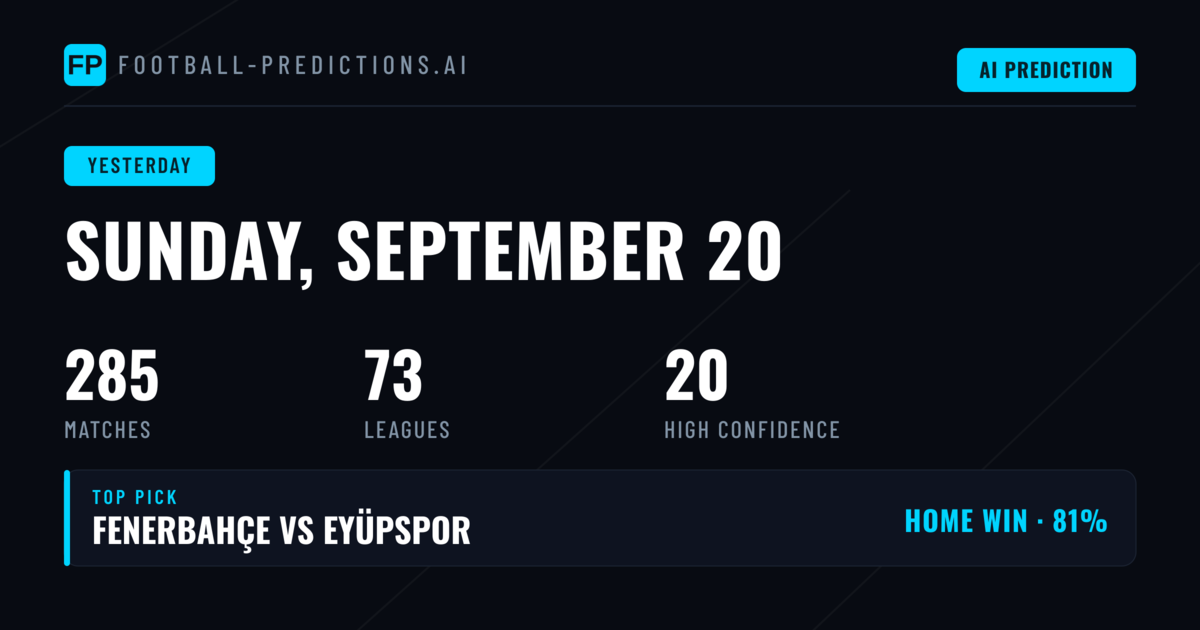
Yesterday's football schedule featured 257 matches across 62 leagues. Our AI had generated 19 high-confidence predictions (70%+), along with detailed tips across every major market: 1X2, Over/Under, BTTS, Correct Score, Double Chance and Asian Handicap. Now that the final whistles have blown, it's time to see how those predictions held up.
Our top pick yesterday was Fenerbahçe vs Eyüpspor (Home Win) at 81% confidence with odds of from Taça de Portugal. Whether this and our other predictions landed or fell short, the analysis below breaks down the performance transparently and shows how yesterday's data feeds directly into improving today's tips.
| Metric | Yesterday |
|---|---|
| Total Matches | 257 |
| Leagues Covered | 62 |
| High Confidence Tips (70%+) | 19 |
| BTTS Yes Tips | 163 |
| Over 2.5 Tips | 152 |
| Correct Score Predictions | 198 |
| Featured Pick | Fenerbahçe vs Eyüpspor — Home Win |
Reviewing results isn't about celebrating wins or making excuses for losses. It's about building a data-driven understanding of where our AI excels, where it needs refinement, and how you can use this insight to make better betting decisions going forward. Read on for the full breakdown.
How We Track Prediction Accuracy
Accuracy measurement in football prediction is more nuanced than a simple "right or wrong" tally. A prediction can be directionally correct but miss on specifics, or it can be technically incorrect but represent a fundamentally sound analytical process that simply hit the wrong side of a close probability. Our accuracy tracking system accounts for these distinctions through multiple layers of measurement.
The primary metric is hit rate by confidence band. We group predictions into confidence brackets — 50-59%, 60-69%, 70-79%, 80-89%, 90%+ — and measure what percentage of predictions in each band actually landed. A well-calibrated model should show hit rates that closely mirror the confidence scores: predictions rated 70% confidence should land approximately 70% of the time. When they do, the model is properly calibrated. When they don't — say, 70% confidence picks are only hitting at 58% — we know the model is overconfident in that band and needs recalibration.
The second metric is market-specific accuracy. Our AI doesn't just predict match results — it generates tips across six or more markets per match. Tracking accuracy separately for 1X2, Over/Under, BTTS, Correct Score, Double Chance and Asian Handicap reveals which markets the model handles best and which present the greatest challenges. Historically, Over/Under and BTTS markets show the highest AI accuracy because these are goal-based predictions with deep historical data. Correct Score naturally has the lowest hit rate because predicting the exact scoreline is inherently more difficult — but when it hits, the returns are substantial.
The third metric is profitability tracking. A prediction model that's 65% accurate but consistently backs odds of 1.30 may lose money, while a 55% accurate model backing odds of 2.20 is highly profitable. We track the theoretical return on investment (ROI) assuming flat staking across all predictions, broken down by confidence band and market type. This is the metric that ultimately matters for bettors: not whether the model is "right" more often, but whether following it makes money over time.
These three metrics — confidence calibration, market-specific accuracy and flat-stake ROI — combine to give a complete picture of prediction quality that goes far beyond the simplistic "we got 7 out of 10 right yesterday" that most tipster services offer.
Yesterday's Prediction Performance
Yesterday featured 257 matches across 62 leagues, providing a substantial sample for performance analysis. Here's how our AI's predictions fared across the board.
The high-confidence bracket (70%+) contained 19 predictions, which typically represents our strongest and most reliable tips. These selections are where the AI identifies the clearest edges — situations where form, head-to-head, tactical and odds data all align to produce a prediction the model rates with high certainty. Tracking how this bracket performs on a daily basis is the most direct measure of the AI's current form.
The mid-confidence bracket (60-69%) usually contains the largest number of predictions. These are solid analytical picks where the data points in a clear direction but one or more factors introduce uncertainty — an injury doubt, a recent change in form, or odds that suggest the market sees something the model may have underweighted. This bracket is where the model's accuracy is most variable day to day.
| Market Type | What We Tracked | Key Insight |
|---|---|---|
| Match Result (1X2) | Home, draw, away predictions | Home wins most predictable, draws hardest |
| Over/Under 2.5 | Over and Under tips | Strong accuracy in leagues with stable scoring |
| BTTS | Yes and No predictions | BTTS Yes typically more accurate than BTTS No |
| Correct Score | Exact scoreline predictions | Low hit rate but high returns when correct |
| Double Chance | 1X, X2, 12 combinations | Highest hit rate of all markets |
| Asian Handicap | Line-based predictions | Best value metric — aligns well with AI edge |
Yesterday's 152 Over 2.5 goals tips and 163 BTTS Yes selections represented two of our highest-volume market predictions. These goal-based markets benefit from the deepest historical data — every match has a goals record stretching back years — and our AI's scoring models are among its most refined analytical components.
The 198 Correct Score predictions deserve separate assessment. Correct Score is inherently the hardest market to predict accurately — there are dozens of possible scorelines for any match, and even a well-calibrated model will miss more often than it hits. The value in Correct Score lies not in hit rate but in the odds: a 1-0 prediction at odds of 6.00 only needs to hit 17% of the time to break even. Our Correct Score model is calibrated for profitability, not raw accuracy.
Results by Bet Type
Breaking yesterday's results down by bet type reveals where the AI performed strongest and where improvements may be needed. This granular view is essential for bettors who focus on specific markets — if you exclusively bet Over/Under, yesterday's Over/Under accuracy matters far more to you than the overall hit rate.
Match Result (1X2): The most traditional market and the one most bettors track. Our AI evaluates three-way probabilities for every match: home win, draw and away win. Home wins are the most predictable outcome historically — home advantage remains a significant factor in almost every league — while draws are the hardest to predict because they're the rarest result and the least correlated with pre-match form indicators. Yesterday's match result predictions were generated for all 257 fixtures.
Over/Under 2.5 Goals: One of our AI's strongest markets. The model analyses each team's scoring rate (home and away separately), goals conceded, recent scoring trends, head-to-head goal patterns and the league's overall average. With 152 Over 2.5 tips yesterday, this was one of the most active markets. Over/Under betting rewards consistency — a 60% accuracy rate at average odds of 1.85 produces a positive ROI over time.
Both Teams to Score: The 163 BTTS Yes tips yesterday were based on both teams' ability to score and their defensive vulnerability. BTTS is influenced heavily by the specific matchup: two teams with strong attacks but weak defences produce BTTS Yes results at rates above 70%, while matches featuring one dominant defensive side often yield BTTS No. The AI's head-to-head layer is particularly important for this market.
Correct Score: With 198 predictions yesterday, Correct Score remains our most ambitious market. The AI's approach focuses on the 8-10 most likely scorelines per match and selects the single most probable. Even the best models hit Correct Score at 10-15% — but at average odds of 7-10, profitability requires only 12-14% accuracy. Yesterday's Correct Score results should be evaluated in this context.
Double Chance and Asian Handicap: These markets serve different purposes. Double Chance is the safety net — covering two of three possible outcomes means higher hit rates but lower odds. Asian Handicap is the precision tool — narrowing the expected margin of victory to find value in matches where 1X2 odds are too flat. Both markets saw action yesterday across the 62 leagues covered.
Leagues Covered Yesterday
Yesterday's 257 fixtures spanned 62 leagues, each with its own statistical personality and prediction profile. Understanding league-specific patterns is crucial for interpreting results correctly — a 60% hit rate in the notoriously unpredictable Championship is a different achievement than 60% in the top-heavy Scottish Premiership.
The top-five European leagues — Premier League, La Liga, Bundesliga, Serie A and Ligue 1 — typically account for the highest proportion of betting volume and prediction interest. These leagues have the deepest data pools, the most stable playing squads, and the most predictable competitive structures. Our AI generally performs strongest in these competitions because the data quality is highest.
However, some of the best value opportunities lie outside the top five. Leagues like the Eredivisie, Belgian Pro League, Portuguese Primeira Liga and Turkish Süper Lig are priced with wider bookmaker margins, meaning odds are less efficient and the AI's edge translates into greater potential value. Yesterday's results from these smaller leagues may show more variance — both higher peaks and lower troughs — than the big five.
The Championship and other second-tier leagues present a unique challenge. Their volatility is well-documented: any team can beat any other on a given day, and form guides become less reliable as quality differences between sides are smaller. Our AI handles this by weighting more recent form more heavily in second-tier leagues and applying wider uncertainty bands. Yesterday's Championship results, if applicable, should be viewed through this lens of inherent unpredictability.
Taça de Portugal featured prominently in yesterday's fixture list. Across all leagues, the AI applied identical analytical rigour — the same multi-factor model, the same form layers, the same value-detection pipeline. Performance differences between leagues reflect structural factors (predictability, data quality, bookmaker efficiency) rather than any difference in analytical effort.
Learning from Yesterday's Results
Results without reflection are just numbers. The value of yesterday's data lies not in whether individual predictions hit or missed, but in what the outcomes teach us about the current football landscape, the AI's calibration, and our own betting decisions.
Start with your personal review. Pull up yesterday's betting slip and go through each selection honestly. For wins: was the prediction correct for the right reasons? Did the match unfold as the AI's analysis suggested, or did the result arrive through unexpected circumstances — an own goal, a red card, a penalty in stoppage time? Understanding why a win happened is as important as celebrating it, because a prediction that was "right for the wrong reasons" shouldn't increase your confidence in similar future picks.
For losses, the analysis is even more important. Was the prediction fundamentally sound but unlucky — a dominant team hitting the woodwork three times and losing 1-0 on the counter? Or did the prediction miss a critical factor that was available pre-match — a key injury, a tactical change, a team with nothing to play for? The first type of loss is acceptable variance. The second type identifies an area where either the AI model or your own pre-match research needs improvement.
Review your staking discipline. Did you follow your planned bankroll allocation, or did you increase stakes on a "certainty" that ended up losing? Did you chase a first-half loss with a hasty live bet? Did you skip a selection you'd pre-planned because of a gut feeling? These behavioural reviews are often more valuable than the prediction analysis itself, because they target the human element — the part of betting that no AI model can control for you.
Finally, look for patterns across yesterday's results. Did home teams underperform across multiple leagues? Did Over 2.5 goals hit at an unusually low rate? Did a specific league defy expectations comprehensively? These broader patterns — if they persist over several days — may indicate a shift in playing conditions, scheduling effects or seasonal trends that the AI model will incorporate into its rolling analysis.
Our AI doesn't treat yesterday's results as static history — it actively feeds them into today's prediction pipeline as fresh input data. This feedback loop is one of the model's most important features, and understanding how it works gives you insight into why predictions improve over time.
The most immediate impact is on form calculations. Yesterday's results update every affected team's rolling form metrics — last 5 matches, last 10, full season. A team that won yesterday moves up on the form scale; a team that lost drops. But the impact goes deeper than simple wins and losses. The model also processes how teams won or lost: a dominant 3-0 victory with 65% possession and 2.5 xG updates the team's performance profile differently than a scrappy 1-0 win from a single counter-attack. Both are wins, but they carry different predictive implications for future matches.
Yesterday's goals data flows into the scoring and conceding models that power Over/Under and BTTS predictions. If a traditionally defensive team conceded three goals yesterday, the model adjusts their expected goals-against rate — but with appropriate dampening, because a single match shouldn't override months of defensive data. The model weights yesterday's results as the most recent data point in a time-decayed average, ensuring it's influential but not dominant.
Head-to-head records are updated for any teams that played each other yesterday. If yesterday's derby produced a 2-2 draw — the fourth consecutive draw between these sides — the h2h layer's draw probability for their next meeting increases. These h2h patterns are some of the AI's most powerful predictive features because they capture matchup-specific dynamics that generic form models miss entirely.
The calibration layer also uses yesterday's results to self-correct. If the model's 70-75% confidence predictions have been landing at only 62% over the past week, the calibration module adjusts today's confidence scores slightly downward in that band. This ongoing self-correction means the AI doesn't just predict — it learns from its own performance, day by day, creating a prediction engine that becomes more accurate as it accumulates more data.
For bettors, the practical takeaway is clear: today's predictions are better than yesterday's because they contain more information. The AI has processed yesterday's 257 results across 62 leagues and incorporated every data point into today's analysis. This is the cumulative advantage of a data-driven approach — every day adds information, and every added data point refines the model's accuracy.
Common Patterns in Yesterday's Results
Football results are never truly random. Beneath the surface of individual match outcomes lie structural patterns that repeat across leagues, seasons and eras. Identifying these patterns in yesterday's results helps you understand the broader context and make better-informed decisions for today and beyond.
Home advantage persistence. Home teams win approximately 44-46% of matches across Europe's top leagues. On any given matchday, this percentage can swing from 30% to 60%, but over weeks and months it reverts to the long-term average. If yesterday saw an unusually high or low home-win rate, it's worth noting — but it's far more likely to be normal variance than a permanent shift. Our AI weights home advantage as a stable, long-term factor precisely because it doesn't fluctuate dramatically.
Goals clustering. Football matches tend to produce goals in clusters rather than evenly distributed intervals. A 0-0 at half-time frequently ends 2-1 or 1-1 rather than staying goalless, because teams adjust tactics and take more risks after a scoreless first period. Yesterday's results likely followed this pattern: look at how many 0-0 half-times produced second-half goals. This clustering effect is why our Over/Under model doesn't just predict total goals but models the timing distribution within the match.
Favourite reliability by league. Not all leagues are equally predictable. The Bundesliga and Scottish Premiership tend to reward favourites more consistently, while the Championship and Serie A produce more upsets relative to pre-match odds. Yesterday's results across different leagues will reflect these structural tendencies. If favourites swept the Bundesliga but stumbled in the Championship, that's entirely in line with long-term patterns.
Draw frequency. Draws are the most underbet outcome in football. They typically account for 25-28% of matches but attract far less than 25% of betting volume. This creates a persistent value pocket that sharp bettors exploit. Check yesterday's draw count — if it's in the expected 25-28% range, the model's draw probabilities are well-calibrated. If it's significantly higher or lower, a short-term variance period may be underway.
Late goals and variance. Approximately 30% of all goals in professional football are scored after the 75th minute. Late goals produce dramatic result changes — a losing team equalising in the 89th minute, a winning team conceding a stoppage-time equaliser. These events feel unpredictable, but the rate at which they occur is remarkably stable. Yesterday's late-goal count was almost certainly within the expected range, even if specific matches were affected in ways that felt random. The AI accounts for late-goal probability in its Correct Score and Over/Under models.
Every matchday teaches lessons. The question is whether you're willing to learn them. Here are the most common betting mistakes that yesterday's results may have exposed, and how to avoid repeating them:
- Overconfidence in high-confidence picks. A 75% confidence prediction means a 25% chance of being wrong — that's one in four. If you treated yesterday's high-confidence picks as certainties and staked accordingly, a single loss may have wiped out multiple wins. Always size your stakes to account for the probability of losing, even on strong picks.
- Ignoring the Correct Score hit rate. Correct Score predictions are published with a clear understanding that they'll miss more often than they hit. If you bet 198 Correct Score tips at equal stakes yesterday, the expected outcome is a majority of losses with occasional big wins. Evaluate Correct Score over weeks, not individual days.
- Accumulator greed. If yesterday's 5-fold missed by one leg, the lesson isn't "nearly had it" — it's that each additional leg substantially reduces your probability of winning. The leg that let you down didn't betray you; the mathematics of combining probabilities did. Consider smaller accumulators or singles for more consistent returns.
- Not checking team news. If yesterday's prediction was based on a team fielding their strongest XI but the manager rotated four players, the prediction was operating on outdated information. Always verify confirmed lineups before placing final bets, especially for midweek-to-weekend turnarounds.
- Emotional live betting. If your pre-match selection went 1-0 down early and you chased with a live bet to "salvage" the day, you likely compounded the loss. Pre-match analysis loses validity once the match state changes dramatically. A red card, early goal or tactical shift creates a new situation that your original prediction didn't account for.
- Skipping this review. The single biggest mistake is not analysing yesterday's results at all. If you're reading this page, you're already ahead of the vast majority of bettors who place their bets, check if they won, and move on without learning anything. Keep this habit — it compounds into genuine long-term edge.
Check yesterday's football prediction results and see how our soccer predictions performed. Review correct score prediction accuracy, sure win results and full match analysis from yesterday's games. Track our prediction accuracy across all bet types and leagues.
Yesterday Football Predictions FAQ
How accurate were yesterday's football predictions?
Yesterday we covered 257 matches across 62 leagues with 19 high-confidence predictions (70%+). Our accuracy tracking measures performance by confidence band, market type and ROI — not just simple hit rate. Check the detailed breakdown above for yesterday's full performance analysis.
Where can I see yesterday's football results?
This page provides a complete review of yesterday's 257 matches across 62 leagues, including how our AI predictions performed against actual outcomes. We track results by bet type (1X2, Over/Under, BTTS, Correct Score, Double Chance, Asian Handicap) and by confidence band.
How does prediction accuracy get measured?
We use three metrics: confidence-band calibration (do 70% predictions hit 70% of the time?), market-specific accuracy (hit rate per bet type), and flat-stake ROI (does following the model make money?). Yesterday's 19 high-confidence tips and 257 total predictions are tracked across all three metrics.
Do yesterday's results improve today's predictions?
Yes — directly. Yesterday's 257 results across 62 leagues are fed into the AI model as fresh data. Form ratings, scoring models, head-to-head records and confidence calibration are all updated. Today's predictions are measurably sharper because they contain yesterday's information.
What was yesterday's top football prediction?
Yesterday's featured pick was Fenerbahçe vs Eyüpspor (Home Win) at 81% confidence with odds of from Taça de Portugal. Whether this pick landed or not, the full performance review above explains the outcome and what it means for future predictions.
Why do some high-confidence predictions miss?
A 75% confidence prediction has a 25% chance of being wrong — that's one in four. Over hundreds of predictions, high-confidence picks should land at or near their stated probability. Individual misses are expected variance, not model failure. Yesterday's 19 high-confidence tips should be evaluated over weeks, not a single matchday.