


 Premier League

 Primera División
 Copa Do Brasil


 Pro League

 Liga I

 Primera A

 Scottish Premiership

 MLS Predictions
 Inter Miami
 Toronto FC
 FC Cincinnati
 Seattle Sounders
 CF Montreal
 Los Angeles Galaxy
 New York Red Bulls
 Chicago Fire
 Orlando City SC
 Real Salt Lake
 USL Super League Predictions
 Brooklyn W
 DC Power W
 Sporting JAX W
 Tampa Bay Sun W
 Dallas Trinity W
 Carolina Ascent W
 CONMEBOL Libertadores Predictions
 LDU de Quito
 Mirassol
 Corinthians
 Rosario Central
 Independiente del Valle
 Deportes Tolima
 Flamengo
 Cruzeiro
 UEFA Champions League Predictions
 Sabah FA
 Hapoel Beer Sheva
 Bodo/Glimt
 NEC Nijmegen
 Lask Linz
 Celtic
 Celje
Celje Slovan Bratislava
 AEK Athens FC
 Levski Sofia
 UEFA Conference League Predictions
 Inter Turku
 FC Copenhagen
 Lincoln Red Imps FC
 Larne
Larne FC Midtjylland
 HNK Rijeka
 FC Nordsjaelland
 FC ST. Gallen
 Tromso
 Brighton
 UEFA Europa League Predictions
 Kairat Almaty
 Anderlecht
 Jagiellonia
 Saburtalo
 Mjallby AIF
 Red Bull Salzburg
 Beşiktaş
 Kauno Žalgiris
 Egnatia Rrogozhinë
 Lillestrom
 Premier League Predictions
 Arsenal
 Coventry
 Hull City
 Manchester United
 Everton
 Crystal Palace
 Ipswich
 Sunderland
 Nottingham Forest
 Leeds
Leeds Serie A Predictions
 Inter
Inter Monza
Monza Udinese
 Como
Como Genoa
Genoa Napoli
 Parma
Parma Cagliari
 Frosinone
 Juventus
 La Liga Predictions
 Rayo Vallecano
 Alaves
 Real Betis
 Real Sociedad
 Athletic Club
 Sevilla
 Valencia
 Celta Vigo
 Espanyol
 Real Madrid
 Ligue 1 Predictions
 Marseille
 Strasbourg
 Lens
Lens Auxerre
 Le Mans
 Stade Brestois 29
 Nice
Nice Lorient
 Toulouse
 Lyon
LyonPast Predictions
Los Angeles Galaxy San Jose Earthquakes
 Vancouver Whitecaps
 Houston Dynamo
 Portland Timbers
 San Diego
 Colorado Rapids
 Los Angeles FCSeattle Sounders
 AustinReal Salt Lake
 FC Dallas
 Minnesota United FC
 Atlanta United FCFlamengoCruzeiro
 Sporting Kansas City
 St. Louis City
 Philadelphia UnionInter MiamiFC Cincinnati
 New York City FC
 Columbus CrewCF MontrealNew York Red Bulls
 Nashville SCOrlando City SCChicago FireToronto FC
 Charlotte
 DC United
 New England Revolution
 Cerro Porteno
 Palmeiras
 Coquimbo Unido
 PlatenseHapoel Beer ShevaSabah FANEC NijmegenBodo/Glimt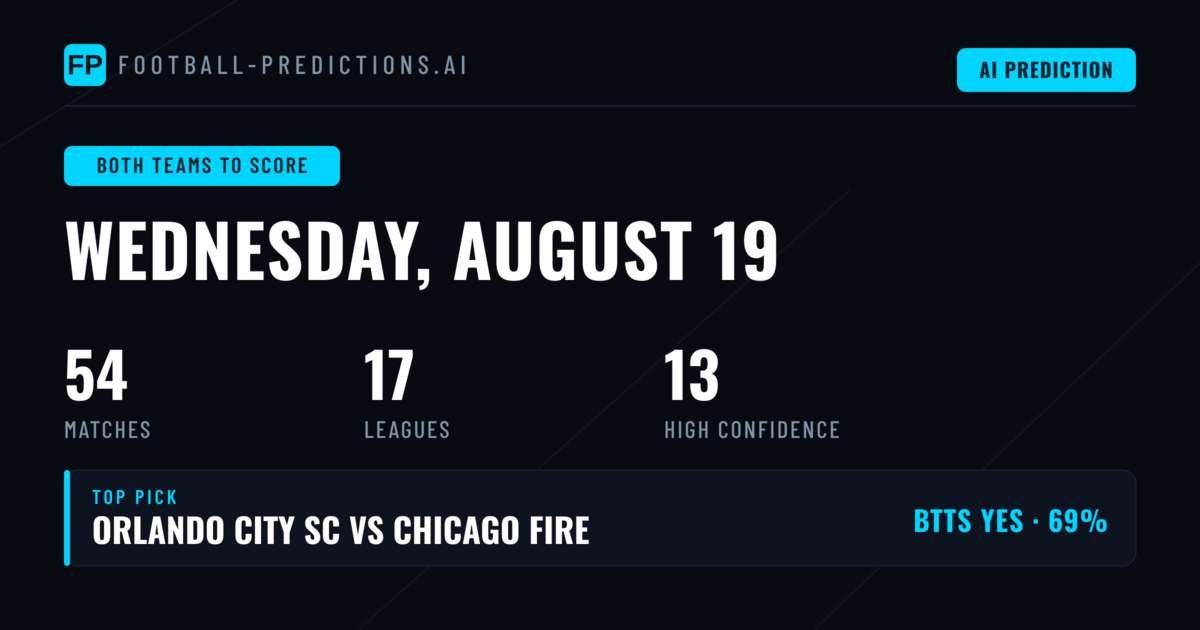

Football Predictions & Betting Tips: Aug 17 – Aug 23, 2026
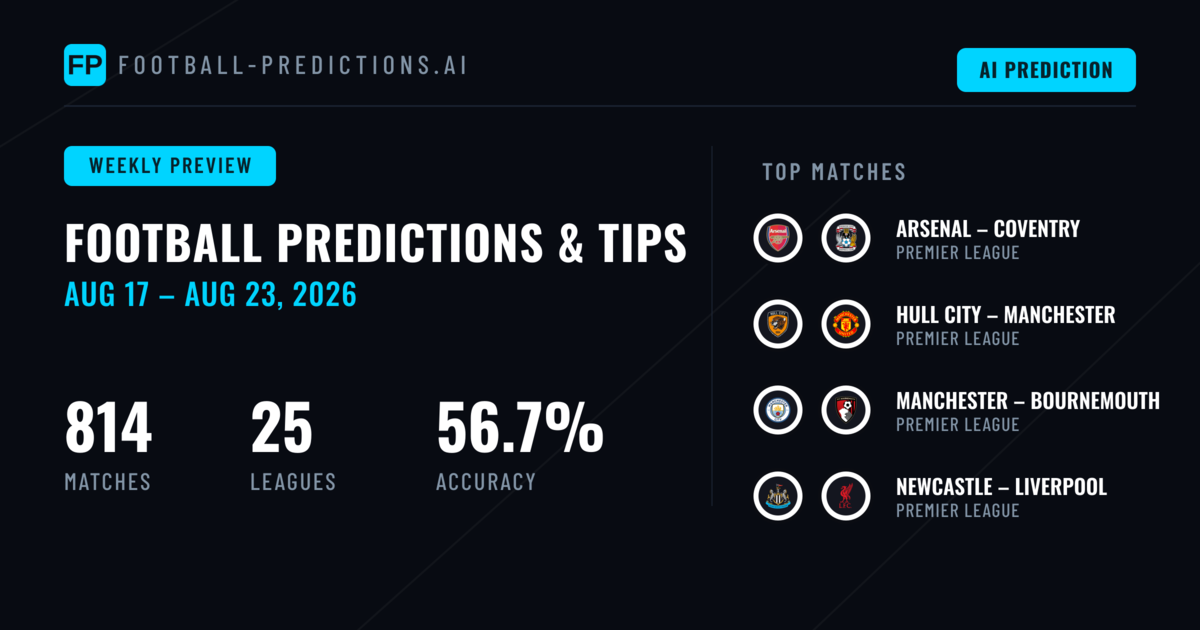
The Week Ahead: 814 Matches Signal a High-Density Phase Across Global Football
The global football calendar ramps up significantly from August 17 to August 23, 2026, with 814 matches scheduled across competitions spanning five continents. This fixture volume represents a substantial increase from the previous week, driven by the convergence of league regular seasons entering full swing, cup competitions beginning early rounds, and continental tournaments reaching decisive qualifying stages. The density of matches demands a methodical approach, as bettors and analysts face simultaneous action across time zones and competition formats.
Four major competitions warrant focused attention during this cycle. The UEFA Champions League enters its second qualifying round, with 12 clubs remaining in contention for group stage places. The CONMEBOL Libertadores continues its round of 16 stage, featuring high-stakes encounters between South American clubs with rich histories in continental competition. Domestically, Germany's DFB Pokal begins first-round action, pitting professional clubs against semi-professional and amateur opposition. Italy's Coppa Italia enters first-round qualifying, with Serie A and Serie B clubs entering the competition alongside lower divisions.
Historical data from previous seasons indicates that cup competition first rounds yield home wins at a rate of approximately 58-62%, though upset frequencies vary by league depth and resource gaps between professional and amateur sides. Continental qualifying rounds present different dynamics, with away form historically stronger than in regular league play due to extended preparation periods and squad rotation patterns. The 814-match sample provides sufficient data points for trend analysis, though individual matchups require evaluation of specific team circumstances including recent form, squad availability, and competitive priorities across multiple competitions.
Top Matches to Watch This Week
Cerro Porteno vs Palmeiras
 vs
vs 
Wednesday, Aug 19 | CONMEBOL Libertadores
Palmeiras travel to face Cerro Porteno on Wednesday as the away side ranked first in their domestic league against a third-placed opponent. Historical data from eight previous encounters strongly favors the visitors, who secured victory in six of those matches. The under 2.5 total goals option carries 59% confidence, with both teams failing to find the net together in 55% of prior meetings. Palmeiras have dominated this fixture with a 75% away win rate historically. The Cerro Porteno vs Palmeiras match prediction is 2 with 54% confidence.
Flamengo vs Cruzeiro
 vs
vs 
Thursday, Aug 20 | CONMEBOL Libertadores
Flamengo host Cruzeiro on Thursday with a commanding head-to-head record supporting a home victory. Across ten prior meetings, Flamengo won seven matches while Cruzeiro claimed just one victory, resulting in a 70% win rate for the home side. The average goals per match in this fixture stands at 2.2, with under 2.5 goals slightly favored at 52% confidence. A clean sheet for Flamengo appears likely based on 52% confidence for the no BTTS outcome. The Flamengo vs Cruzeiro match prediction is 1 with 58% confidence.
Preußen Münster vs Karlsruher SC
 vs
vs 
Friday, Aug 21 | DFB Pokal
Karlsruher SC visit Preußen Münster on Friday in DFB Pokal action, with the away side holding a superior league position at third compared to fifth for the hosts. Analysis of ten historical encounters reveals Karlsruher SC winning six times while Preußen Münster managed just one victory, yielding a 60% away win rate. BTTS: no shows the highest confidence at 62%, suggesting defensive solidity on both sides. The average goals across their head-to-head record is 3.2, though the no BTTS outcome counters that trend. The Preußen Münster vs Karlsruher SC match prediction is 2 with 40% confidence.
U. Catolica vs Estudiantes L.P.
Universidad Catolica host Estudiantes L.P. on Wednesday with the home side positioned third in their league standings against a fifth-placed opponent. The under 2.5 total goals option leads with 61% confidence, reflecting a historical tendency toward lower-scoring affairs in this fixture. No BTTS carries 53% confidence, marginally above the threshold for the over 2.5 alternative. Universidad Catolica hold the edge as the predicted winners based on current form indicators and league positioning. The U. Catolica vs Estudiantes L.P. match prediction is 1 with 38% confidence.
UEFA Champions League Matchday: Celtic Aim to Build Momentum Against Lask Linz


Celtic enter Wednesday's Champions League encounter as league rank #1 domestically, contrasted with Lask Linz sitting at league rank #2. The Scottish champions have built a strong home record this season, with 14 wins from 18 competitive fixtures at their stadium. Celtic will look to impose their high-tempo attacking approach early against an Austrian opponent that has shown resilience on European roads. The 60% confidence in a home win reflects Celtic's domestic dominance and home advantage. Both teams finding the net appears likely at 51%, while over 2.5 goals carries 53% confidence. Celtic's pressing game should create multiple chances, though Lask Linz possesses the quality to trouble even well-organized defenses on transitions.
Dinamo Zagreb Host Viking in Crucial UCL Qualifier

Dinamo Zagreb, sitting at league rank #1 domestically, face Norwegian side Viking occupying league rank #2 in their league. The Croatian champions possess extensive Champions League experience and will leverage their Maksimir stadium record to establish an advantage before the return leg. Dinamo's tactical flexibility allows them to control matches through midfield dominance, while their set-piece efficiency provides an additional scoring avenue. Viking arrives as a capable opponent but will need to demonstrate significant improvement in away European fixtures. The 55% home win confidence aligns with Dinamo's historical home form in qualifiers. Both teams to score sits at 57%, the highest confidence selection for this fixture. Over 2.5 goals at 57% confidence suggests an open contest with multiple scoring opportunities.
Slovan Bratislava Welcome Celje in Slovak-Slovenian UCL Clash


Slovan Bratislava (league rank #2) play host to Celje (league rank #1) in what promises to be a tightly contested Champions League qualifier. The head-to-head record over two previous meetings shows 1 victory for each side with 0 draws, averaging 3.5 goals per encounter. This historical data strongly supports the over 2.5 goals selection at 53% confidence. Both teams scoring carries 54% confidence, reflecting the attacking tendencies shown in prior meetings. Slovan will rely on their organized defensive structure while seeking opportunities through quick counterattacks. Celje's top domestic ranking demonstrates their quality, and they will approach this fixture with confidence despite the away venue. The 55% home win confidence indicates Slovan hold a slight edge, though the quality of the opposition means this remains a highly unpredictable encounter.
Fluminense Travel to Argentina to Face Independ. Rivadavia
 Independ. Rivadavia vs Fluminense
CONMEBOL Libertadores action features Independ. Rivadavia (league rank #9) hosting Brazilian leaders Fluminense (league rank #1). The discrepancy in domestic league standing significantly favors the visitors, yet the 41% confidence in a home win indicates the unpredictable nature of South American competition. The under 2.5 goals selection at 65% confidence represents the strongest analytical signal for this fixture, suggesting a tightly contested match with limited scoring opportunities. Both teams not to score carries 57% confidence, reinforcing expectations of defensive discipline. Historical meetings between these sides produced 1 home win and 1 draw across 2 encounters, averaging 2.5 goals. Independ. Rivadavia will focus on defensive solidity while seeking to exploit set-piece situations. Fluminense must maintain concentration against a side fighting to climb the domestic standings.
League Analysis: Coppa Italia, CONMEBOL Libertadores, DFB Pokal
 Coppa Italia
The Coppa Italia 2025/26 season produced a remarkable statistical outlier in Italian cup football. Across 33 matches contested, 91 goals were recorded at an average of 2.76 per encounter. This scoring rate represents a significant departure from typical cup tournament norms, where tighter defensive approaches often prevail in knockout formats. The attacking intent displayed throughout the competition offers valuable context for stakeholders evaluating goal-related markets in this week's fixture slate.
As the tournament progresses through its later rounds, the prolific scoring trend established in earlier phases provides a baseline for match previews. Teams advancing from this edition carry forward both accumulated fatigue and momentum, factors that influence tactical approaches in subsequent meetings.
 CONMEBOL Libertadores
The 2026/27 CONMEBOL Libertadores campaign has reached 83 percent completion with 118 matches already contested. The group stage enters its decisive phase with multiple clubs demonstrating dominant form. Flamengo and Independ. Rivadavia share the leadership position on 16 points each from 6 matches, both operating at an 83 percent win rate with identical 5-1-0 records. U. Catolica occupies third place on 13 points, maintaining a 67 percent win ratio across their six fixtures. Coquimbo Unido holds fourth with 10 points from a 3-1-2 record, while Corinthians rounds out the top five on 11 points with a 3-2-1 profile. Corinthians has shown particular consistency in recent performances, remaining unbeaten across their last four matches.
The tactical evolution visible in the data suggests increasingly sophisticated defensive structures deployed across South American clubs. With the group stage reaching its critical juncture, the 17 percent of fixtures remaining will determine qualification scenarios and seeding for the knockout rounds. The competitive density in the standings—separated by just 6 points from first to fifth—indicates minimal margin for error in the upcoming matchdays.
 DFB Pokal
The DFB Pokal 2025/26 campaign concluded with 49 matches producing 164 goals at an average of 3.35 per fixture. This figure substantially exceeds typical knockout tournament averages and ranks among the most prolific editions on record. The goal distribution by venue revealed a striking anomaly: away sides contributed 115 goals compared to just 49 for home teams, representing a 70-30 split that fundamentally challenged conventional home advantage assumptions in German cup football.
The 814 total matches scheduled across all competitions this week provide extensive coverage opportunities. Within the DFB Pokal dataset specifically, the away-team scoring dominance correlates with elevated Over/Under totals, a pattern that warrants consideration when evaluating betting markets for cup encounters. The statistical profile established by this edition—particularly the correlation between venue and goal frequency—offers a framework for assessing similar dynamics in future cup competitions.
In-Form Teams to Watch: Aug 17–23, 2026
This week's fixture slate of 814 matches across global competitions presents several teams carrying significant momentum into their upcoming fixtures. The following sides have demonstrated the most compelling recent trajectories, warranting close attention from analysts tracking form-based performance indicators.
Leading the Charge
 Dinamo Zagreb concluded their 2025/26 Croatian First Football League campaign with a dominant 86-point haul from 36 matches, winning 27 of those fixtures for a 75% victory rate. Their goal differential of +65 (93 scored, 28 conceded) reflects the most prolific attack and stingiest defence in the league. D. Beljo finished as their top scorer with 11 goals across 21 appearances. The side enter the UEFA Champions League next with a DWWWW sequence, suggesting they will carry strong competitive rhythm into European competition.
Flamengo sit top of their CONMEBOL Libertadores group with 16 points from 6 matches, boasting a 5-1-0 record that translates to an 83.3% win percentage. Their goal tally of 14 across 6 games (2.33 per match) combined with just 2 goals conceded highlights an exceptional balance between attacking output and defensive solidity. Bruno Henrique has contributed 2 goals and 1 assist from 3 appearances, proving a key creative outlet. Their WWDWW form sequence demonstrates sustained excellence across recent fixtures.
Independ. Rivadavia mirror Flamengo's group stage record with 16 points from 6 matches (5 wins, 1 draw), though they have scored one additional goal, bringing their total to 15 at a 2.5 goals-per-match rate. A. Osella leads their line with 2 goals from 4 appearances. The WWDWW form string positions them as a dangerous outfit capable of converting attacking superiority into consistent results.
MLS Contenders Rising
 Houston Dynamo hold first place in their conference with 35 points from 19 matches, accumulating 11 wins alongside just 2 draws and 6 defeats. Their win rate of 57.9% reflects sustained competitiveness, while 28 goals scored averages 1.47 per fixture. Guilherme has registered 2 goals from his 2 appearances, indicating efficiency in front of goal. A WWWWD sequence over their last five matches demonstrates strong recent returns that should translate into continued points accumulation.
 St. Louis City occupy fifth position with 29 points from 19 matches, recording 8 wins, 5 draws, and 6 losses for a 42.1% win rate. Their goal differential of +2 (27 scored, 25 conceded) points to a balanced profile. M. Hartel has contributed 1 goal across 2 appearances. A WDWWW form string signals an upward trajectory that could see them climb further in the standings if maintained.
Philadelphia Union: Form Reversal in Progress
 Philadelphia Union present an intriguing case as they enter the week in 13th position with 19 points from 19 matches. Despite their lower league standing, a WWWWL sequence over their last five fixtures indicates a significant shift in performance, with three consecutive victories preceding their most recent defeat. I. Vassilev has scored 1 goal from 3 appearances. Their 28 goals scored (1.47 per match) demonstrates continued attacking capability, though 35 goals conceded reveals defensive vulnerabilities requiring attention. The contrast between their 26.3% win rate overall and recent form suggests they may be approaching a turning point in their campaign trajectory.
Expert Betting Picks Round-Up: August 17–23, 2026
Match Result (1X2)
The 1X2 market presents two strong home-side selections this week. Beşiktaş vs Kauno Žalgiris in the UEFA Europa League on August 20 carries 82% confidence for a home win. Arsenal vs Coventry in Premier League action on August 21 follows at 81% confidence.
Over/Under Goals
Two Over 2.5 goals selections rank highest this week. Inter Miami vs Toronto FC in MLS on August 22 carries 72% confidence for Over 2.5 goals. PSV Eindhoven vs Groningen in the Eredivisie on August 23 follows at 71% confidence.
Both Teams to Score
MLS continues to produce reliable BTTS opportunities with two selections above 69% confidence. Orlando City SC vs Chicago Fire on August 19 leads at 70%, while Orlando City SC vs Real Salt Lake on August 22 sits at 69% for Both Teams to Score.
Double Chance
Two double chance selections stand out with identical 95% confidence ratings. Hapoel Beer Sheva vs Hapoel Haifa in Ligat Ha'al on August 22 targets the 1X outcome. ES Metlaoui vs Club Africain in Ligue Professionnelle 1 on August 23 backs the X2 option.
Asian Handicap
One Asian Handicap selection dominates with the highest confidence rating of the week. Motherwell vs SC Freiburg in the UEFA Conference League on August 20 features SC Freiburg -1.50 at 96% confidence.
Half-Time / Full-Time
One HT/FT selection offers value this week. Beşiktaş vs Kauno Žalgiris on August 20 targets the Home/Home outcome at 69% confidence, expecting consistent home-side dominance throughout both halves.
Correct Score
One correct score pick warrants attention despite lower confidence. Huracan vs Deportivo Riestra in Liga Profesional on August 23 targets 1–0 at 25% confidence. Narrow margins and defensive solidity make this a cautious selection.
Half-Time Result
One half-time selection emerges for the week. Benfica vs Aarhus in the UEFA Europa League on August 20 backs Benfica to lead at half-time at 61% confidence.
Corners
One corners selection stands out this week. Barracas Central vs Platense in Liga Profesional on August 23 targets Under 9.5 corners at 67% confidence, indicating a low-corner affair expected between two defensively structured sides.
Cards
One cards market selection appears in the opening days. Internacional vs Remo in Serie A on August 17 backs Over 3.5 cards at 70% confidence, suggesting a physically contested encounter.
Anytime Goalscorer
One anytime goalscorer selection leads the individual player markets. Inter Miami vs Toronto FC in MLS on August 22 features Lionel Messi to score anytime at 74% confidence—the highest individual player confidence rating across all markets this week.
Weekly Performance Review: August 10–16, 2026
The week of August 10–16 delivered a mixed set of results across our prediction categories. Match result (1X2) predictions achieved 50.8% accuracy, converting 242 correct outcomes from 476 total matches. This aligns closely with our longer-term baseline, though it fell marginally short of the 50.9% figure we have maintained across 4,097 predictions in the 90-day sample. Over/Under selections performed more strongly at 59.6%, securing 266 correct calls from 446 selections, while BTTS predictions landed at 56.1% with 267 accurate calls from 476 matches. The sample produced an average of 2.81 goals per match and a BTTS hit rate of 51.5%.
Placing last week within the context of our audited 90-day track record reveals where we outperformed and underperformed relative to established norms. Over/Under predictions exceeded the 90-day average of 58.4% by 1.2 percentage points, while BTTS exceeded its 58.4% benchmark by 2.0 points. Our headline pick, however, dropped to 52.8%, falling 6.9 points below the 59.7% headline accuracy we have recorded across 4,096 predictions. The match result figure for last week, at 50.8%, sits 0.1 points below the 90-day 1X2 mean of 50.9%, indicating relative stability in that category despite the weekly variance.
Double Chance and Best Value figures were not tracked for last week specifically, but our 90-day records show Double Chance at 79.3% from 4,097 predictions and Best Value selections at 60.5% from 3,387 predictions. Looking ahead to this week, we have 814 upcoming matches across our coverage universe. Our model inputs have been refreshed with the latest form data and fixture intelligence, and our predictions for the August 17–23 window will test whether last week's Over/Under and BTTS performance represents a sustainable uptick or short-term noise within our broader prediction framework.
You can study our complete prediction record in detail on our statistics page, where we break down accuracy by bet type, tournament, and time period across every covered league and competition.
Both Teams to Score (BTTS) Predictions Today — AI Tips & Analysis
Table of Contents
What Are BTTS Predictions?
Both Teams to Score (BTTS) is a market where you predict whether both teams will score at least one goal during the match. It doesn't matter who wins or what the final score is — the only question is whether each team finds the net at least once.
BTTS Yes wins if both teams score (e.g., 1-1, 2-1, 3-2, 1-3). BTTS No wins if at least one team fails to score (e.g., 0-0, 1-0, 2-0, 3-0). Any clean sheet in either direction means BTTS No wins.
This market has become hugely popular because it creates excitement throughout the entire match — even if the team you support concedes, you can still win your bet. It's also completely independent of the match result, making it a pure assessment of both teams' attacking and defensive capabilities rather than their relative strength.
Unlike Over/Under betting, BTTS doesn't care about the total number of goals — only that both teams contribute. A 1-1 draw satisfies BTTS Yes just as much as a 4-3 thriller. Conversely, a 5-0 demolition is BTTS No because one team failed to score. This distinction makes BTTS a unique market that requires analyzing each team's scoring potential independently.
Today, our AI predicts BTTS Yes in 47 of 73 analyzed matches across 15 leagues — that's 64% tipping Yes. Our highest-confidence pick is Portland Timbers vs San Diego (BTTS yes) at 69% confidence.
How BTTS Betting Works
The bookmaker offers two options: BTTS Yes and BTTS No. Here's how different results play out:
| Final Score | BTTS Yes | BTTS No |
|---|---|---|
| 0 – 0 | Lost | Won |
| 1 – 0 / 0 – 1 | Lost | Won |
| 2 – 0 / 0 – 2 | Lost | Won |
| 3 – 0 / 0 – 3 | Lost | Won |
| 1 – 1 | Won | Lost |
| 2 – 1 / 1 – 2 | Won | Lost |
| 3 – 2 / 2 – 3 | Won | Lost |
| 4 – 1 / 1 – 4 | Won | Lost |
BTTS Yes typically offers odds of 1.60-1.90, while BTTS No ranges from 1.85-2.30. The slight odds advantage on No reflects that clean sheets (at least one side not scoring) are marginally more common than both teams scoring across most leagues.
BTTS Variants
Many bookmakers also offer expanded BTTS markets that can provide additional value:
- BTTS First Half: Both teams must score in the first half only. Hits less frequently but offers odds of 3.50-5.00 — excellent value when correctly targeted in open, attacking matchups.
- BTTS Second Half: Both teams score in the second half. More common than first half BTTS because teams tend to be more open as the match progresses.
- BTTS in Both Halves: Both teams score in each half separately. Very rare but offers odds of 10.00+ — only viable in extreme cases of attacking, defensively poor teams.
- BTTS + Result: Combines BTTS Yes with a specific match result (Home Win, Draw, or Away Win). Offers odds of 3.00-6.00+ and is one of the most profitable combination markets.
BTTS Statistics Across Top Leagues
| League | BTTS Yes % | Avg Goals | Clean Sheet % |
|---|---|---|---|
| Bundesliga | ~55% | 3.1 | ~22% |
| Eredivisie | ~56% | 3.2 | ~20% |
| Premier League | ~52% | 2.8 | ~26% |
| La Liga | ~48% | 2.6 | ~28% |
| Serie A | ~47% | 2.5 | ~30% |
| Ligue 1 | ~45% | 2.3 | ~32% |
| Primeira Liga | ~51% | 2.8 | ~24% |
| Super Lig | ~50% | 2.7 | ~25% |
View full BTTS statistics across 15+ leagues →
The Bundesliga and Eredivisie are BTTS paradise — both teams score in over half of all matches, with clean sheet rates of just 20-22%. Conversely, Ligue 1 and Serie A are more defensive, with clean sheet rates of 30-32%, making BTTS No the statistically safer default in those competitions.
But league averages only tell part of the story. Within any league, individual teams vary enormously. A team like Borussia Dortmund might have a BTTS rate of 70%+ because they score prolifically but also concede regularly. Meanwhile, a team like Atletico Madrid might be at 35% BTTS because their defensive discipline keeps clean sheets in nearly half their games.
How Our AI Predicts BTTS
Predicting whether both teams will score requires evaluating four distinct components that combine to produce the final BTTS probability. Our model analyzes:
- xG for and against: A team creating 1.8 xG per match but conceding 1.5 xG is a strong BTTS Yes candidate — they attack well but can't keep clean sheets. The model uses rolling xG averages weighted by opponent strength to avoid bias from easy or difficult fixture runs.
- Scoring consistency: Teams that score in 85%+ of their matches (even just one goal) are reliable BTTS contributors. We track this metric separately for home and away, because some teams are prolific at home but struggle to score on the road.
- Clean sheet probability: The inverse of BTTS. Teams that keep clean sheets in 40%+ of matches reduce BTTS Yes probability significantly, even against prolific opponents. When two teams with high clean sheet rates meet, BTTS No becomes the stronger play.
- Match context: Cup matches, relegation deciders, and high-stakes fixtures often deviate from regular patterns. Teams chasing a result tend to leave more gaps, creating chances for both sides. Dead-rubber matches can go either way — sometimes open, sometimes lifeless.
- Pace and tactical style: High-pressing teams create more chaos and chances, making BTTS more likely than low-block counter-attacking teams who are content with 1-0 wins. When two pressing teams meet, BTTS Yes probability increases substantially.
- Set piece quality: Teams with strong set piece delivery can score against any defense. If both teams are dangerous from corners and free kicks, BTTS becomes more likely even in otherwise defensive matchups.
Our model produces a BTTS confidence score that represents the estimated probability. Today, our top BTTS pick is Portland Timbers vs San Diego at 69% confidence for BTTS yes.
Key Factors for BTTS Predictions
Defensive Vulnerabilities
Teams with high goals-conceded averages are the backbone of BTTS Yes predictions. A team conceding 1.5+ goals per match makes BTTS Yes significantly more likely regardless of their own attacking output. When two such teams meet, BTTS Yes probability can exceed 70%. Look for teams with high xG-against figures — they're giving up quality chances that will eventually be converted.
Goalkeeping Form
A goalkeeper in poor form — low save percentage, errors leading to goals, poor command of the penalty area — directly increases the chance of their team conceding. Conversely, a keeper in outstanding form can single-handedly suppress BTTS. A goalkeeper saving 80%+ of shots on target is a significant BTTS No factor, especially if their team also has a solid defense.
Set Piece Threat
Teams dangerous from set pieces (corners, free kicks, throw-ins in dangerous areas) can score against even the best open-play defenses. If both teams have strong set-piece records, BTTS Yes becomes more likely even in otherwise low-scoring, defensive matchups. Set pieces account for approximately 30% of all goals in professional football — they're the great equalizer.
Home vs. Away Scoring Rates
Some teams score consistently at home but struggle away — and vice versa. A team that has scored in 95% of home games is an almost certain scorer, but the away team's ability to score depends heavily on their away-specific record. Always look at venue-adjusted statistics, not just overall numbers. The difference between home and away scoring can be dramatic — 2.1 goals per home game vs. 0.8 away for some teams.
Motivation and Game State
Teams trailing in a match must attack, creating open spaces. This makes late goals more likely for both sides — the chasing team pushes forward while the leading team counters into space. Matches between teams with contrasting motivations (one fighting relegation, one in mid-table comfort) often produce BTTS results as the desperate team throws everything forward while the comfortable team picks them off on the counter.
Weather and Pitch
Poor pitch conditions and heavy rain reduce passing accuracy and create unpredictable bounces — which can lead to unexpected goals from both teams. Conversely, frozen or waterlogged pitches reduce overall goal-scoring. Wind affects goalkeepers' ability to deal with crosses and long shots, potentially increasing BTTS probability.
BTTS Betting Strategies
1. The Reliable Scorer Strategy
Target matches where both teams have scored in 80%+ of their recent games (last 8-10 matches). This simple filter identifies consistent scorers and dramatically increases BTTS Yes probability. Combine with our AI confidence scores for the strongest selections. When both teams have 85%+ scoring rates and neither keeps clean sheets frequently, BTTS Yes becomes almost the default expectation.
2. BTTS No for Defensive Matchups
Don't overlook BTTS No — it often offers better odds and wins slightly more often overall than BTTS Yes. Target matches featuring at least one elite defensive team (40%+ clean sheet rate) or low-scoring matchups where both teams are defensively organized. BTTS No at 2.00+ represents strong value when a top defensive team is involved.
Particularly look for away teams with poor away scoring records (scoring in fewer than 60% of away games). Even a mediocre home defense can keep a clean sheet against an away team that regularly fails to find the net on the road.
3. The Venue Split
Some matches look like clear BTTS Yes on paper, but the venue changes everything. A team might score in 90% of home matches but only 55% of away matches. When they're away, BTTS becomes much less certain. Always check venue-specific statistics before betting BTTS, especially for away teams that travel to defensive fortresses.
Do
- Check both teams' scoring consistency (home/away separately)
- Consider clean sheet rates equally important
- Use BTTS No when conditions favor it
- Target high-scoring leagues for BTTS Yes
- Factor in goalkeeper form and set piece quality
Don't
- Bet BTTS Yes on every match blindly
- Ignore goalkeeper and defensive changes
- Assume high-scoring teams always concede
- Forget about venue-specific statistics
- Overlook the BTTS No market entirely
Combining BTTS with Other Markets
BTTS + Over/Under
BTTS Yes + Over 2.5 is one of the most popular combination bets, typically offering odds of 2.00-2.50. The logic is simple: if both teams score, there are already at least 2 goals — you just need one more. These markets are highly correlated, making the combination more likely than the individual odds suggest. This is the go-to combination for high-scoring matchups in the Bundesliga and Eredivisie.
The inverse — BTTS No + Under 2.5 — is equally valuable for defensive matchups. If one team is expected to keep a clean sheet, the total goal count is also likely to be low. This combination offers odds of 2.50-3.50 and works well in Serie A, Ligue 1, and Turkish Super Lig defensive encounters.
BTTS + Match Result
BTTS Yes + Home Win targets matches where the home team wins but also concedes — think 2-1 or 3-1 results. This combination offers odds of 3.00-4.50 and works best when a strong attacking home team faces a side that scores but can't defend.
BTTS Yes + Draw is another powerful combination at odds of 4.00-6.00, targeting open matches that end level — think 1-1, 2-2. This works particularly well in derby matches where both teams score but neither can establish dominance.
BTTS in Accumulators
BTTS is ideal for accumulators because the yes/no nature provides clear outcomes with consistent odds ranges. Here's how different BTTS accumulator strategies compare:
| Strategy | Legs | Avg Odds/Leg | Combined Odds | Est. Probability |
|---|---|---|---|---|
| BTTS Yes (high-scoring) | 4 | 1.70 | 8.35 | ~12% |
| BTTS No (defensive) | 3 | 2.00 | 8.00 | ~14% |
| Mixed BTTS Yes/No | 4 | 1.75 | 9.38 | ~10% |
| BTTS Yes + O2.5 combo legs | 3 | 2.20 | 10.65 | ~8% |
The sweet spot for BTTS accumulators is 3-4 legs. More than 4 and the probability drops below 10%, making it difficult to sustain profitability. For BTTS Yes accumulators, focus on matches from the Bundesliga, Eredivisie, and Premier League where BTTS rates are highest.
Build a BTTS accumulator with AI-rated picks →
Advanced BTTS Analysis
BTTS and Match Total Goals Correlation
BTTS Yes and Over 2.5 goals are correlated but not identical. A match can finish 3-0 (Over 2.5 Yes, BTTS No) or 1-1 (Over 2.5 No, BTTS Yes). Understanding this distinction is crucial. Approximately 75% of BTTS Yes matches also have Over 2.5, but 25% do not. Conversely, about 80% of Over 2.5 matches are BTTS Yes, but 20% have clean sheets. This partial correlation means combining BTTS with Over/Under in accumulators provides some diversification but not complete independence.
The Clean Sheet Probability Framework
The most analytical approach to BTTS is through clean sheet probabilities. If Team A keeps clean sheets in 35% of matches and Team B keeps clean sheets in 30% of matches, a naive estimate of BTTS No is 1 - (1-0.35)(1-0.30) = 1 - 0.455 = 54.5%. However, this assumes independence, which is not quite true — defensive teams create fewer chances for opponents. Our AI adjusts for this correlation by analyzing each matchup specific attacking and defensive interaction.
Expected Goals as a BTTS Predictor
xG data provides the most reliable input for BTTS predictions. If Team A has xG of 1.8 and Team B has xG of 0.9, the probability of Team A scoring is approximately 83% (1 - e^(-1.8)) and Team B scoring is approximately 59% (1 - e^(-0.9)). The BTTS Yes probability is roughly 0.83 x 0.59 = 49%. Our AI uses a more sophisticated version of this Poisson-based calculation that accounts for team-specific variance, shot quality distribution, and opponent adjustments.
BTTS in Different Game States
The score at half time significantly affects second-half BTTS probability. If the match is 0-0 at half time, BTTS Yes probability drops (both defenses are holding). If the match is 1-0, BTTS probability increases (the trailing team pushes forward, creating space). If the match is 1-1, BTTS is already settled. These game-state dynamics create in-play BTTS value, particularly at half time when bookmakers recalculate odds. Our AI provides pre-match BTTS predictions, but understanding these in-play dynamics helps you adjust your position during live matches.
Seasonal BTTS Patterns
BTTS rates are not constant throughout the season. The opening weeks (August-September) tend to have higher BTTS rates as teams are not yet defensively organized and fitness levels vary. Mid-season (December-February) in leagues with winter weather sees lower BTTS rates as conditions affect attacking play. End-of-season matches between teams with nothing to play for can go either way. Our AI adjusts BTTS probabilities based on the time of season and specific match context.
Best Leagues for BTTS Betting
| League | BTTS Yes % | BTTS No % | Best Strategy |
|---|---|---|---|
| Bundesliga | ~55% | ~45% | BTTS Yes (highest rate in top leagues) |
| Eredivisie | ~56% | ~44% | BTTS Yes (open, attacking style) |
| Premier League | ~52% | ~48% | BTTS Yes (competitive, goals from both sides) |
| La Liga | ~48% | ~52% | BTTS No against top defenses |
| Serie A | ~47% | ~53% | BTTS No (tactical, defensive culture) |
| Ligue 1 | ~46% | ~54% | BTTS No (except PSG matches) |
| Championship | ~53% | ~47% | BTTS Yes (physical, end-to-end) |
The Bundesliga and Eredivisie are BTTS paradise with both teams scoring in over 55% of matches. BTTS Yes at odds of 1.65-1.80 represents near-positive expected value before any analytical edge. Serie A and Ligue 1 offer the opposite: BTTS No is statistically dominant, providing a solid foundation for accumulator building.
The Home Team Concession Strategy
Home teams that concede in 60%+ of their home matches are prime BTTS Yes targets regardless of opponent. Even when facing weak away teams, these leaky-at-home sides create matches where both teams scoring is the most likely outcome.
Clean Sheet Tracking for BTTS No
For BTTS No bettors, track each team clean sheet percentage. A team keeping clean sheets in 40%+ of matches is an excellent BTTS No candidate. When two defensively strong teams meet, BTTS No becomes the dominant outcome. Our AI flags these defensive matchups automatically.
Common Mistakes in BTTS Betting
- Only looking at goals scored: A team scoring 2 goals per match seems like a guaranteed BTTS contributor. But if they keep clean sheets in 50% of their matches, the opposition often fails to score — making BTTS No more likely. Always check both sides of the equation: scoring ability AND defensive vulnerability.
- Ignoring league context: BTTS Yes at 1.70 in the Bundesliga (55% base rate) is very different value from the same odds in Ligue 1 (45% base rate). Always factor in the league's natural BTTS tendency before assessing individual match value.
- Underestimating cup competition dynamics: Cup matches — especially early rounds with mismatches — often produce dominant performances (3-0, 4-0) rather than BTTS results. The quality gap means the weaker team rarely scores against a fully motivated stronger side.
- Forgetting about rotation: Midweek matches often feature rotated squads, which changes scoring dynamics. A B-team striker might be less clinical, reducing scoring probability for that side even if the team's season statistics look strong.
- Chasing BTTS Yes exclusively: BTTS No is profitable too — and often more so. When a match features a strong defensive team (Atletico Madrid, Juventus), BTTS No at 2.00+ offers excellent expected value that most bettors overlook because they find "No" boring.
- Ignoring the goalkeeper factor: A team with their first-choice keeper is a different defensive proposition than one with a backup. Goalkeeper changes aren't always reflected in BTTS odds quickly enough, creating value windows.
Browse today's BTTS tips and both teams to score predictions with AI-powered analysis. Our BTTS predictions today examine each team's scoring consistency, clean sheet records and defensive vulnerabilities. Looking for accurate BTTS tips today? Our model identifies matches where both teams are most likely to score based on form, head-to-head data and attacking stats. BTTS bets today are popular in accumulators — combine high-confidence BTTS win tips for bigger returns.
BTTS Predictions FAQ
What does BTTS mean in betting?
BTTS stands for Both Teams to Score. You bet Yes if you think both teams will score at least one goal, or No if at least one team keeps a clean sheet. Today 47 of 73 matches are predicted BTTS Yes across 15 leagues.
What percentage of football matches have both teams scoring?
Across Europe's top leagues, approximately 48-55% of matches see both teams score. The Bundesliga and Eredivisie have the highest rates (~55%), while Ligue 1 and Serie A are lower (~45-47%). Our model covers 15 leagues with individual team analysis.
Is BTTS Yes or No more profitable?
Both can be profitable with the right selection. BTTS Yes offers odds of 1.60-1.90 and wins ~50% of the time. BTTS No offers 1.85-2.30 and wins slightly more often. Our top pick today is Portland Timbers vs San Diego (BTTS yes) at 69% confidence.
Can I combine BTTS with other bets?
Yes — BTTS pairs excellently with Over/Under and match results. BTTS Yes + Over 2.5 is very popular at odds of 2.00-2.50. With 73 BTTS predictions today across 15 leagues, you have plenty of combination options.
Does BTTS include extra time?
No — BTTS bets settle on the 90-minute result only. Goals in extra time or penalty shootouts don't count. If a match ends 1-0 after 90 minutes, BTTS No wins even if the losing team scores in extra time.
What factors make BTTS Yes more likely?
Both teams scoring consistently, high xG figures, weak defensive records, attacking managers, set piece threats, and rivalry matches all increase BTTS Yes probability. Our AI weighs all these factors for 73 matches today.