


 Liga MX Predictions
 Atlante FC
 Monterrey
 Club Tijuana
 Atlas
Atlas Cruz Azul
 Toluca
 Guadalajara Chivas
 Club Queretaro
 Santos Laguna
 CF Pachuca
 Tigres UANL
 Puebla
 U.N.A.M. - Pumas
 Atletico San LuisTolucaSantos LagunaCF PachucaClub TijuanaClub Queretaro
 Leon
Leon Liga Profesional Predictions


 Primera A Predictions
 Chico
Chico Deportivo Pasto
 Once Caldas
 Bucaramanga
 Deportivo Pereira
 Internacional de Bogota
 Cucuta
 Llaneros
 Junior
 Independiente Medellin
 Jaguares
 Alianza Valledupar
 Fortaleza FC
 Deportes TolimaLlaneros
 Atletico NacionalIndependiente MedellinJaguares
 Santa Fe
 Deportivo Cali
 America de Cali
 Águilas DoradasAtletico Nacional
 Millonarios
 International Friendlies Predictions
 Turkmenistan
 New Zealand
 China
China Palestine
 Australia
 Brazil
 England U19
 Republic of Ireland U19
 Mexico
 Colombia
 USA
USA Peru
Peru Canada
 ChileChinaNew Zealand
 Malta
Malta Liechtenstein
 Bolivia
 Paraguay
 New Caledonia
 Solomon Islands
 Fiji
Fiji Vanuatu
 Japan U18
 Ukraine U18
 Finland U17
 France U17
 Gibraltar
 Sao Tome and Principe
 Azerbaijan
 Tajikistan
 France U21
 Austria U18
 England U17
 Republic of Ireland U17Solomon IslandsVanuatu
 Papua New GuineaNew CaledoniaPalestineNew Zealand
 Japan
Japan Uruguay
 South Korea
 Ecuador
 Netherlands U19
 Belgium U19China
 Maldives
 Uzbekistan
 Iran
Iran Romania U19
 Hungary U19Finland U17France U17
 Poland U17
 Czechia U17
 Poland U19
 Switzerland U19
 India
India Panama
 Second League Predictions
 Rilski Sportist
 Pirin Blagoevgrad
 Lokomotiv G. Oryahovitsa
 Marek
Marek Vihren
 Nesebar
 Beroe
Beroe Yantra 2019
 CSKA Sofia II
 Sportist Svoge
 Chernomorets 1919 Burgas
 Montana
 Ludogorets II
 Etar Veliko Tarnovo
 Fratria
 Spartak Pleven
 Hebar 1918
 DobrudzhaSportist SvogeVihrenDobrudzhaCSKA Sofia IISpartak PlevenLudogorets IIMontanaHebar 1918
 First League Predictions


 Liga I Predictions


 Primera Nacional Predictions
 CA Estudiantes
 San Miguel
 Quilmes
 Club Atlético Güemes
 All Boys
 Colon Santa Fe
 Ciudad de Bolívar
 Chaco For Ever
 Deportivo Madryn
 Central Norte
 Colegiales
 Chacarita Juniors
 Atlanta
 Agropecuario
 Almagro
 Nueva Chicago
 Defensores De Belgrano
 Ferro Carril Oeste
 Almirante Brown
 Acassuso
 Los Andes
 Deportivo Moron
 Atletico Mitre
 San Telmo
 Patronato
 San Martin S.J.
 Midland
 Tristan Suarez
 Deportivo Maipu
 Temperley
 Racing Cordoba
 Godoy Cruz
 Gimnasia Y Tiro
 Atletico DE RafaelaTristan SuarezAtlantaNueva ChicagoPatronato
 Primera B Predictions
 Tigres FC
 Real Santander
 Popayan
 Patriotas
 Envigado
 Depor FC
 Barranquilla
 Real Cundinamarca
 Bogota FCBarranquillaReal Cundinamarca
 Quindio
 Real CartagenaEnvigadoReal Santander
 OrsomarsoDepor FCTigres FC
 Ind. Yumbo
 Internacional Palmira
 Primera División Predictions
 Progreso
 Racing Montevideo
 Cerro Largo
 Club Nacional
 Penarol
 Boston River
 Atletico Torque
 Deportivo Maldonado
 Central Espanol
 Liverpool Montevideo
 Juventud
 Cerro
Cerro Defensor Sporting
 DanubioCentral EspanolAtletico Torque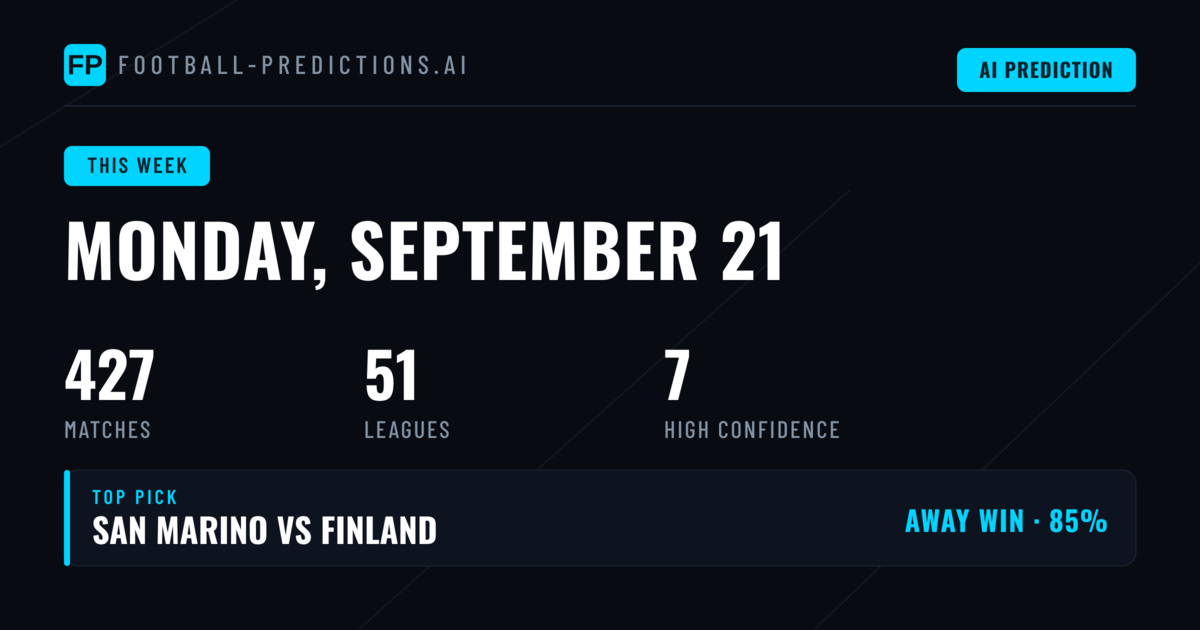
Football Predictions This Week: Plan Betting with AI Insights
Table of Contents
A full week of football stretches from Monday to Sunday, encompassing everything from quiet early-week fixtures and midweek European competition through to the packed weekend schedule. Viewing your betting through a weekly lens — rather than day by day — transforms your approach from reactive punting into planned, strategic wagering with clear bankroll allocation and informed fixture prioritisation.
Our AI generates predictions for every fixture across the entire week, processing team form, head-to-head history, tactical data, injury reports and real-time odds movements for each match regardless of when it takes place. The weekly view lets you see the complete picture: which days offer the most value, where the high-confidence picks cluster, and how to allocate your budget across seven days of football.
This week features 385 matches across 52 leagues, with 22 predictions rated 70%+ confidence. Our strongest pick is San Marino vs Finland (Away Win) at 87% confidence with odds of . The weekly overview gives you the strategic advantage of planning ahead — identifying which fixtures to target, which days to bet heavier, and where to hold your bankroll in reserve.
| Metric | This Week |
|---|---|
| Total Matches | 385 |
| Leagues Covered | 52 |
| High Confidence (70%+) | 22 |
| BTTS Yes Tips | 216 |
| Over 2.5 Tips | 198 |
| Correct Score Predictions | 257 |
| Top Pick | San Marino vs Finland — Away Win |
The week of Monday, September 21, 2026 combines midweek European nights, domestic cup action and a full weekend schedule. Whether you prefer Champions League drama on Tuesday and Wednesday, the tactical intrigue of Europa League on Thursday, or the volume of Saturday's domestic fixture list, the weekly view ensures you're prepared for every opportunity. Read on to understand how our AI handles the full seven-day cycle and how to structure your weekly betting for sustained profitability.
How Our AI Analyzes the Full Week
Predicting an entire week of football requires a model that adapts in real time as results unfold and new data arrives. Unlike a single-day prediction set that's generated and published once, our weekly analysis is a living, evolving process that recalculates throughout the seven days.
On Monday morning, the AI ingests the complete weekly fixture list and opens its initial analysis window. Early-week predictions — Monday and Tuesday matches — receive the same multi-factor treatment as weekend fixtures: form analysis across three timeframes, head-to-head patterns, tactical context, injury data and odds modelling. However, early-week predictions carry a specific caveat: they're based on data available before the weekend's results have fully settled into the model. Our Monday predictions are reliable, but by Wednesday and Thursday, the model has absorbed fresh weekend data and its accuracy measurably improves.
This progressive sharpening is one of the weekly view's greatest advantages. Tuesday Champions League predictions are strong. Wednesday Champions League predictions are marginally stronger because Tuesday's results have updated the model's understanding of current European form. Thursday Europa League predictions benefit from both Tuesday and Wednesday data. By the time Friday and Saturday arrive, the AI has processed an entire midweek's worth of fresh results, confirmed team news for the weekend, and five days of odds movements — producing the most informed predictions of the cycle.
The AI also tracks weekly fixture density for individual teams. A side playing Saturday, Tuesday (Champions League) and the following Saturday faces three matches in eight days. Our model quantifies the fatigue and rotation impact: expect 2-4 lineup changes for the midweek fixture, with performance data adjusted accordingly. This squad-depth analysis is particularly relevant during congested weeks with European and domestic cup commitments running in parallel.
Across 385 matches this week, the model processes over 200 variables per fixture — that's tens of thousands of data points synthesised into clear probability estimates and confidence scores. No human tipster can maintain this analytical depth across a full week of football, which is precisely why the AI-powered weekly view gives you a genuine edge.
Best Bet Types for Weekly Betting
Different bet types perform differently depending on the day and competition. A weekly betting strategy should recognise these patterns and deploy each market where it's statistically strongest:
| Bet Type | Best Weekly Window | Why It Performs Well Then |
|---|---|---|
| Match Result (1X2) | Weekend domestics | Deepest form data, settled odds, maximum information |
| Over/Under Goals | Midweek European nights | CL/EL knockout stages produce decisive, open football |
| Both Teams to Score | Weekend — EPL, Bundesliga | Domestic leagues have higher BTTS rates than European cups |
| Correct Score | Midweek cups | Cup matches often follow predictable scorelines (1-0, 2-0) |
| Double Chance | Thursday Europa League | Away teams perform better in EL — DC covers the draw |
| Asian Handicap | Weekend mismatches | Domestic league mismatches with inflated 1X2 odds |
| Best Value Bets | Throughout the week | Value emerges whenever the market misprices — AI tracks daily |
→ View this week's best value bets across all markets →
The weekly perspective reveals a bet-type rotation that daily bettors miss entirely. Monday and Tuesday offer limited fixtures but focused analysis. Wednesday and Thursday bring European competition where Over/Under and Correct Score markets shine. Friday opens the weekend window with targeted evening fixtures. Saturday delivers volume and accumulator opportunities. Sunday wraps up with premium fixtures and the sharpest predictions of the cycle.
For weekly bettors, the BTTS market deserves particular attention on weekends, where 216 tips are available, while Over/Under becomes especially profitable during midweek European nights when knock-out stage matches and high-stakes group deciders produce open, attacking football. Planning your bet-type selection around the weekly schedule — rather than using the same approach every day — is a significant edge that most casual bettors never develop.
This Week's League Schedule
Understanding the weekly fixture calendar lets you plan your betting activity around the days with the richest opportunities. Here's the typical weekly rhythm of European football:
| Day | Competitions Active | Betting Opportunity |
|---|---|---|
| Monday | Occasional domestic league (La Liga, Serie A) | Focused singles — deep analysis on 1-3 matches |
| Tuesday | Champions League, domestic cups | European group/knockout drama — goals markets |
| Wednesday | Champions League, domestic cups | Updated with Tuesday results — sharpened CL tips |
| Thursday | Europa League, Conference League | Away-team value, Double Chance opportunities |
| Friday | Bundesliga, Ligue 1, Championship | Focused evening fixtures — manageable fixture list |
| Saturday | All major leagues — peak volume | Accumulator building, maximum fixture diversity |
| Sunday | EPL Super Sunday, Serie A, La Liga | Premium fixtures with sharpest weekly predictions |
This week features 385 total matches across 52 leagues. UEFA Nations League leads the fixture count, but every competition from Champions League nights to lower-division Saturday afternoon football receives the same analytical depth from our model.
The midweek European schedule is particularly significant for weekly planners. Champions League Tuesday and Wednesday fixtures often feature the continent's elite clubs, creating matchups with vast amounts of historical data for the AI to process. These midweek predictions benefit from recent domestic weekend results (how did Real Madrid perform on Saturday? Did Liverpool rotate?), making them some of the most data-rich predictions of the entire week.
Thursday's Europa League and Conference League fixtures offer a different profile. These competitions feature a wider range of team quality — from established top-flight clubs to teams from smaller leagues — creating more frequent mismatches and more opportunities for our AI to identify value. The away-team performance data in European competition is distinctly different from domestic leagues, and our model accounts for the travel, fatigue and tactical adjustments that European away days demand.
Weekly Betting Strategies
Thinking in weekly cycles rather than individual matches is the hallmark of a disciplined bettor. Here are five strategies that leverage the full seven-day view:
1. Map the week on Monday morning. Review the complete fixture list and identify which days have the highest concentration of AI-rated high-confidence picks. Some weeks are back-loaded (quiet midweek, packed weekend). Others feature Champions League midweek action that rivals the weekend for quality. Knowing the shape of the week prevents impulsive early bets on thin fixture lists.
2. Allocate daily budgets from a weekly pot. Set a total weekly betting budget, then divide it across the days based on fixture volume and quality. A typical allocation might be: 5% Monday-Tuesday, 10% Wednesday-Thursday, 10% Friday, 40% Saturday, 25% Sunday, 10% reserve for live or late-breaking opportunities. Adjust based on the specific week's schedule.
3. Let midweek results sharpen weekend bets. Don't rush to lock in weekend selections on Monday. Wait until Thursday or Friday when midweek results have updated the model and team news is emerging. The difference between a Monday weekend prediction and a Friday one can be significant — especially for teams that played midweek European matches.
4. Track your weekly performance. Keep a simple record of each day's bets and results. At the end of the week, calculate your overall return. Weekly tracking smooths out the variance of individual matches and gives you a clearer picture of whether your approach is profitable. A losing Saturday means less when Wednesday and Thursday were strong.
5. Identify your strongest day. Over time, most bettors discover they perform better on certain days. Perhaps your Champions League analysis is sharper than your weekend accumulator building, or perhaps you excel at Sunday singles when the model is most data-rich. Track by day and double down on your strengths.
✅ Do
- Set a total weekly budget and divide it across days
- Review the full fixture calendar every Monday morning
- Wait for midweek results before finalising weekend selections
- Track results by day to identify where your edge is strongest
- Use the AI's progressive accuracy improvement through the week
- Reserve 10% of your weekly budget for live or late opportunities
❌ Don't
- Blow your weekly budget on Monday or Tuesday's thin fixture list
- Treat every day identically — midweek and weekend demand different approaches
- Ignore midweek results when planning weekend bets
- Chase daily losses by increasing stakes on subsequent days
- Lock in weekend bets on Monday — wait for fresh data
- Skip the weekly review — it's where long-term patterns emerge
Building Weekly Accumulators
The weekly view opens up accumulator strategies that single-day bettors can't access. While most accumulators are built from simultaneous or near-simultaneous matches, a weekly approach lets you construct accas from the strongest picks across the entire seven-day cycle — though this comes with trade-offs you need to understand.
The advantage of weekly accumulators is selection quality. Instead of choosing your 4 best picks from Saturday's slate, you're choosing the 4 best picks from the entire week — potentially a Tuesday Champions League banker, a Thursday Europa League value pick, a Saturday afternoon home win and a Sunday La Liga headliner. Each leg represents your AI's absolute highest confidence across its respective day.
The disadvantage is psychological. A weekly acca that starts on Tuesday means waiting four or five days for the final leg. If Tuesday and Thursday land, the pressure on Sunday's closing leg becomes immense. Many bettors crack under this pressure, hedging or cashing out at suboptimal moments. If you're prone to emotional decisions, stick to same-day accumulators.
The 22 tips rated 70%+ confidence this week span multiple days and competitions. Use them as your starting pool, but consider the timing carefully. A practical weekly accumulator approach is the "best of each day" method: pick one strong selection per active day (skip quiet days), build a 4-5 leg acca, and let it run across the week. With legs drawn from different days, leagues and competitions, correlation risk is virtually zero — each selection is genuinely independent.
An alternative strategy for bettors who prefer the certainty of same-day resolution: build separate daily accumulators on the two or three busiest days of the week (typically Wednesday European night and Saturday afternoon), and treat each as a standalone unit with its own budget allocation. This gives you the thrill of accumulator betting without the multi-day wait.
→ Build your weekly accumulator with AI-rated picks →
Midweek vs Weekend Football
Midweek and weekend football are fundamentally different environments, and understanding these differences is crucial for weekly betting success. The competitions, team preparation, tactical approaches and market dynamics all shift between the two halves of the week.
Midweek football: European competition and cups. Tuesday through Thursday is dominated by UEFA competition — Champions League, Europa League and Conference League — plus domestic cup matches and occasional rescheduled league fixtures. These matches share common traits that distinguish them from weekend domestics. First, European away trips impose travel fatigue and environmental adjustment that domestic fixtures don't. A team flying to Athens on Tuesday afternoon and playing at 21:00 in 25°C heat faces different conditions to their usual Saturday 3pm kick-off in Manchester. Our AI quantifies this travel impact.
Second, midweek European matches are often tactically conservative, particularly in knockout rounds. Managers prioritise not conceding away goals, leading to lower-scoring first halves and a burst of activity after the 60th minute when the tactical balance shifts. This pattern makes half-time/full-time markets and second-half goals markets particularly interesting on midweek European nights.
Third, squad rotation is a constant factor. Teams with weekend-midweek-weekend schedules will rotate 2-4 players for the midweek fixture, especially if the weekend match carries greater domestic importance. Our model's squad-depth analysis identifies which teams have the bench quality to rotate effectively and which suffer significant performance drops when key players are rested.
Weekend football: domestic leagues at full strength. Saturday and Sunday bring the domestic leagues in full force. Teams field their strongest available XIs, play in familiar surroundings, and compete within a league context where every point carries long-term significance. Weekend football is more predictable in aggregate — home advantage is stronger, form patterns are more reliable, and the AI's historical data is deepest for domestic league matchups.
The Over 2.5 goals rate is typically 2-5% higher on weekends than midweek across most European leagues, driven by the wider quality gaps in domestic football (top vs bottom) and the more attacking approach that home teams adopt in league matches versus European away fixtures. BTTS rates follow a similar pattern, making these markets statistically stronger bets on weekends.
For weekly bettors, the practical implication is clear: adjust your bet-type selection based on the midweek-weekend divide. Midweek European nights favour Correct Score (often 1-0 or 2-1 in knockout ties), Double Chance (covering the away team in unpredictable European fixtures), and second-half Over/Under. Weekends favour Match Result, BTTS, and accumulator building across the full fixture list.
Weekly Bankroll Management
Bankroll management is the single most important factor in long-term betting profitability, and the weekly view is the natural timeframe for managing it effectively. Thinking in weekly cycles smooths out the day-to-day variance that causes emotional decision-making and prevents the catastrophic losses that end betting careers.
Start each week by setting a fixed total budget — typically 5-10% of your overall bankroll. This is the maximum you'll risk across seven days regardless of opportunities, results or emotions. Divide this weekly budget across the days based on the fixture schedule. A practical starting framework for a typical week with midweek European and full weekend action:
| Day | Budget Allocation | Rationale |
|---|---|---|
| Monday | 0-5% | Few fixtures — only bet if high-confidence picks exist |
| Tuesday | 10% | Champions League — quality fixtures, limited volume |
| Wednesday | 10% | Champions League — updated with Tuesday results |
| Thursday | 10% | Europa League / Conference League |
| Friday | 5% | Bundesliga / Championship evening — focused bets |
| Saturday | 35% | Peak volume — accumulators and singles |
| Sunday | 25% | Premium fixtures with sharpest predictions |
The key discipline is treating each day's allocation as sacred. If Tuesday's Champions League bets lose, Wednesday's allocation does not increase to compensate. If Saturday morning brings a stunning opportunity you didn't anticipate, it comes from Saturday's allocation or the reserve fund — not from Sunday's pre-set budget. This structure prevents the escalation cycle that destroys bankrolls: loss → bigger stake → bigger loss → panic → ruin.
Within each day, apply consistent stake sizing. A common approach is the flat-stake method: every bet receives the same unit stake (e.g., 1-2% of the daily allocation). An alternative is the confidence-weighted method: high-confidence AI picks (75%+) receive 2 units, standard confidence (65-74%) receives 1 unit, and lower-confidence value bets receive 0.5 units. The confidence-weighted method aligns stake size with the AI's probability assessment, concentrating capital where the edge is greatest.
At the end of each week, review your total P&L. A winning week means your bankroll has grown and next week's 5-10% allocation will be slightly larger. A losing week means a slightly smaller allocation. This natural scaling — betting more when winning, less when losing — is a built-in risk management mechanism that protects your bankroll through inevitable losing streaks while maximising growth during profitable runs.
One often-overlooked aspect of weekly bankroll management is rest days. Not every day requires a bet. If Monday's fixture list is thin and the AI shows no picks above 65% confidence, skip it entirely. Betting for the sake of action — "there must be something worth backing" — is a bankroll leak that adds up over weeks and months. Discipline means knowing when not to bet as much as knowing when to strike.
Common Weekly Betting Mistakes
Viewing your betting through a weekly lens exposes patterns of error that daily bettors never notice. Here are the most common mistakes that undermine weekly profitability:
- Front-loading the week. Betting heavily on Monday and Tuesday's slim fixture lists because you're eager to get started. The best opportunities almost always come later in the week when more data is available and more matches are in play. Patience is a weekly bettor's most valuable trait.
- Ignoring the midweek-weekend divide. Applying the same bet types and strategies to Tuesday Champions League and Saturday Premier League is a fundamental error. These are different competitive environments with different statistical profiles. Adjust your approach accordingly.
- No bankroll allocation plan. Betting whatever feels right on any given day leads to inconsistent staking and inevitable overexposure. Set a weekly budget, divide it by day, and stick to the plan regardless of results.
- Chasing daily losses across the week. Tuesday's losses should not inflate Wednesday's stakes. Each day operates within its own allocated budget. If you lose three days in a row, the remaining days' allocations stay the same — not larger.
- Locking in weekend bets too early. Placing Saturday selections on Monday means missing four days of data: midweek results, team news, injury updates, odds movements. Wait until Thursday or Friday to finalise weekend bets.
- Skipping the weekly review. A 10-minute end-of-week analysis — what worked, what didn't, which days and bet types performed best — compounds into significant improvement over months. Most bettors never do it, which is precisely why it's such an edge for those who do.
View all football predictions this week from Monday to Sunday. Our soccer predictions for the week cover Champions League predictions this week, midweek football predictions and weekend fixtures. Get the best betting tips, correct score forecasts and sure win predictions for every match this week across 178+ leagues worldwide.
This Week Football Predictions FAQ
How many football predictions are available this week?
This week we have 385 predictions across 52 leagues. Our AI has rated 22 tips at 70%+ confidence, with 198 Over 2.5 tips, 216 BTTS Yes picks and 257 correct score predictions spanning Monday through Sunday.
What is the best football prediction this week?
Our strongest pick this week is San Marino vs Finland (Away Win) at 87% confidence with odds of . This selection comes from UEFA Nations League and has been rated highest by our AI model across all 385 weekly fixtures.
When are weekly football predictions most accurate?
Prediction accuracy improves throughout the week as more data becomes available. Monday predictions use historical data and early odds. By Friday, the model has incorporated midweek results, confirmed lineups and five days of odds movements. Sunday predictions — informed by the entire week's data — are typically the sharpest of the cycle.
Should I bet on midweek or weekend football?
Both have merit. Midweek European competition (Champions League, Europa League) offers focused, high-quality fixtures suited to singles and Correct Score bets. Weekend domestic leagues provide volume for accumulators across 52 leagues. Spread your weekly budget across both periods based on fixture quality and AI confidence levels.
How should I manage my betting bankroll across the week?
Set a total weekly budget (5-10% of bankroll) and allocate it across days: roughly 10% each for Tuesday-Thursday European nights, 5% for Friday, 35% for Saturday and 25% for Sunday. Keep 5-10% as reserve. Never chase daily losses by increasing stakes on subsequent days.
How many matches have high confidence predictions this week?
This week 22 predictions are rated 70%+ confidence across 52 leagues. These high-confidence picks span the full seven days, with the concentration typically heaviest on Saturday and Sunday when the most fixtures are available and the AI has maximum data.