Understanding Yellow Cards Betting Markets
 Alexey Andrianov 5 min read 13229 Jun 2026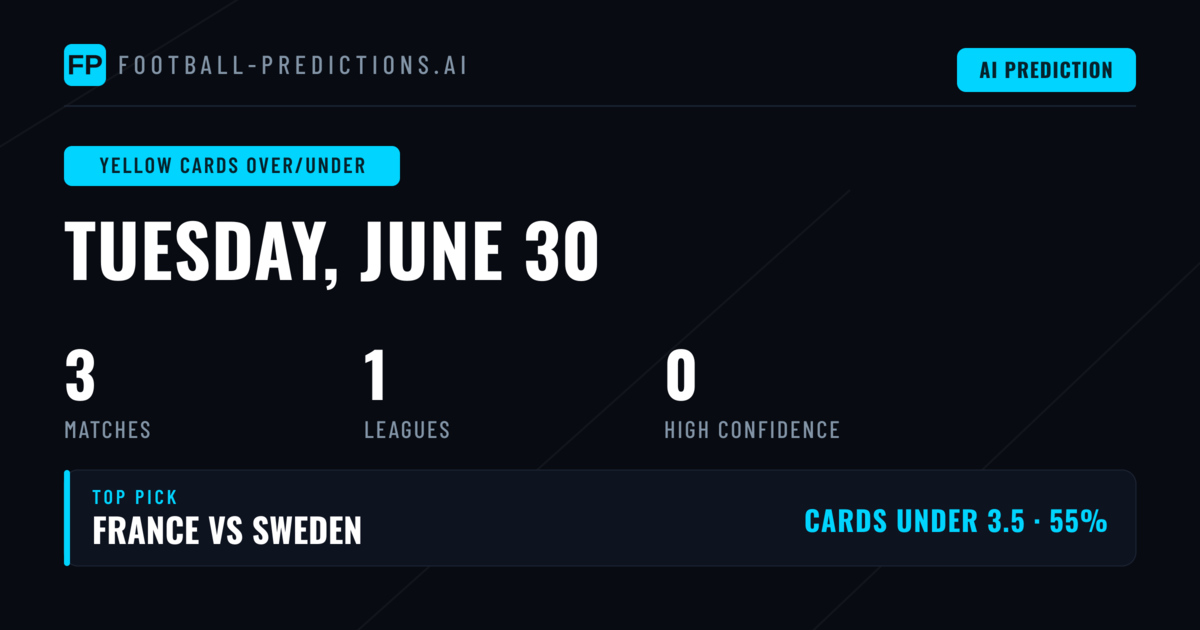
The Yellow Cards Over/Under market offers one of the most consistent betting opportunities in football, where disciplinary records, playing styles, and match dynamics create predictable patterns. Unlike goal-based markets, yellow card predictions rely heavily on understanding how referees officiate specific leagues, the physicality of encounters between certain teams, and the desperation levels of clubs fighting for results. This market rewards patient analysis of data over emotional betting on favorites.
Today's three fixtures present distinct challenges for bettors, with each match carrying its own tactical considerations that could influence the number of bookings. Close matches often see increased tension on the pitch, which translates to higher card counts, while games with clear favorites may see the trailing side commit more cynical fouls to prevent counter-attacks. Successful yellow cards betting requires looking beyond team reputation and examining the actual disciplinary statistics, recent form, and the specific context of each contest.
In-Depth Analysis
France against Sweden presents the strongest case for backing under 3.5 bookings. The market prices reflect a commanding home favourite, with France at 1.17 compared to Sweden's 10. When the favourite carries such short odds, it typically signals a match where the dominant side controls proceedings with technical precision rather than aggressive commitment. French players operating in midfield and defensive areas tend to accumulate cards through tactical fouling when under pressure, yet a side expected to monopolise possession faces fewer scenarios that demand such interventions. Sweden's underdog pricing at 10 suggests they will adopt a structured, compact approach, reducing the high-tackle situations that generate bookings on both sides. At 59% confidence, this is the highest conviction play on the card, and the odds structure validates the narrative that a comfortable home performance limits disciplinary incidents.
The Netherlands against Morocco offers a more nuanced read. The home side sits at 1.89 with the draw at 3 and Morocco at 2.94, creating a genuinely competitive match-up where neither team dominates the market decisively. This balanced pricing often correlates with an even contest where neither side spends prolonged spells defending desperately. Morocco's tactical discipline has been evident in how they manage transitions, while the Netherlands operate with controlled possession football that minimises reckless challenges. At 55% confidence, this selection lacks the conviction of the France fixture, yet the odds suggest a match unlikely to devolve into the physical confrontation that generates multiple yellow cards. The draw price of 3 indicates the market anticipates a close contest decided by fine margins, and tight matches typically see players exercise caution rather than risk a booking that could alter the outcome.
Ivory Coast against Norway rounds out the under 3.5 selections with the lowest confidence rating at 54%, yet the odds present the most compelling value of the three. Norway at 1.72 as the away favourite indicates the market views this as their most straightforward fixture of the three, yet the home side at 3.19 remains competitive. Ivory Coast's tactical approach in World Cup fixtures has historically featured disciplined defensive shapes that force opponents to break them down rather than engaging in open physical battles. Norway's away pricing suggests they will dominate territory, but a side controlling possession without being forced to make last-ditch challenges typically accumulates fewer bookings. The draw price of 3.5 is the highest of the three matches, reinforcing that this fixture is expected to produce a result rather than a stalemate, which again points toward controlled football rather than the chaos that generates high card counts.
Key Factors Influencing Yellow Card Totals
When evaluating Yellow Cards Over/Under markets, several tactical and situational elements deserve careful attention. The officiating crew plays a pivotal role, as referee tendencies vary significantly across competitions and leagues. Some officials prioritize strict enforcement of technical fouls, while others allow more physical engagement before issuing cautions. Researching the assigned match official's historical card averages provides valuable context for setting realistic expectations. Additionally, the competitive stakes of a fixture often dictate intensity levels, with derby matches and high-pressure encounters typically generating elevated disciplinary records.
Team selection and formation strategies also exert considerable influence on yellow card frequency. Squads employing aggressive pressing systems naturally invite more defensive interventions, while teams fielding defensive midfielder roles often see those players accumulate cautions through tactical fouling. The importance of key defensive figures cannot be understated, as their absence through suspension or rotation directly impacts a side's disciplinary profile. Moreover, accumulated bookings approaching suspension thresholds may affect player behavior, though this dynamic varies between competitions with different cut-off points for automatic bans.
Weather conditions and pitch quality occasionally contribute to yellow card patterns, particularly in matches where players struggle with grip or footing. Late-season fixtures contested in challenging conditions sometimes produce unexpected disciplinary outcomes. Successful Over/Under predictions require synthesizing these multiple variables rather than relying on any single factor. Season-long averages provide a baseline, but recent form carries greater predictive weight, making the last five to eight matches a crucial reference point for assessing current team tendencies and officiating adjustments throughout the campaign.
Conclusion
With three matches analyzed for this round, our Over/Under yellow card predictions provide a clear framework for bettors seeking value in the cards markets. Each fixture presents distinct tactical considerations that could influence the volume of bookings, from team disciplinary records to the stakes of individual encounters. While form and motivation play their part, the historical discipline data remains the cornerstone of our forecasting approach.
Bettors should cross-reference these insights with the latest team news and referee appointments before finalizing their wagers, as late changes can shift the expected card count significantly. Good luck with your selections.
Our Track Record Speaks for Itself
Our Yellow Cards Over/Under predictions have hit 57.6% over the last ~90 days across 2413 settled picks. Browse our full stats page to examine accuracy across every market, league and tournament.
Discover comprehensive strategies, tips, and insights on cards betting in football. Learn about over/under booking points, referee impact, league tendencies, and more.
Read Full Guide