Analyzing Yellow Cards Over/Under Betting Opportunities
 Alexey Andrianov 5 min read 11017 Jun 2026 Updated 22 Jun 2026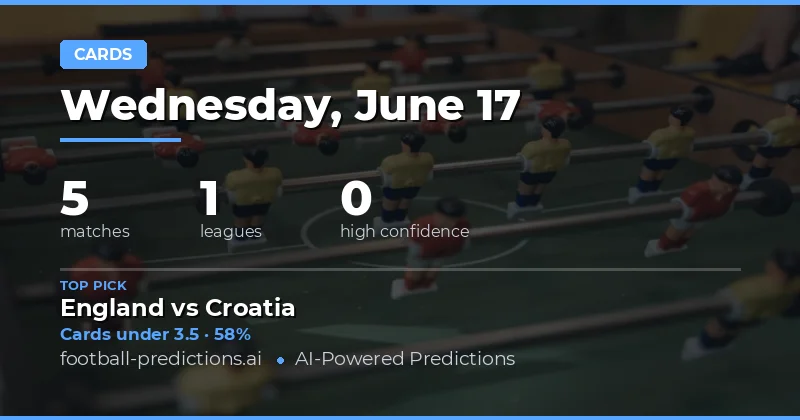
The Yellow Cards Over/Under market provides football bettors with a distinctive alternative to traditional match result wagers. This market centers entirely on the number of yellow cards issued during a fixture, requiring a different analytical approach that focuses on disciplinary tendencies rather than attacking or defensive capabilities. Understanding the factors that influence card counts has become increasingly valuable for bettors seeking value outside conventional markets.
With five matches scheduled for 17 June 2026, our team has examined the key variables that typically drive disciplinary incidents in football. Team playing styles, recent disciplinary records, match importance, and referee appointment histories all play crucial roles in determining whether a fixture will feature a high or low number of yellow cards. The following analysis breaks down each contest to identify the most likely outcomes in the Yellow Cards Over/Under market.
In-Depth Analysis
The two World Cup qualifiers featuring under 3.5 cards at the highest confidence levels present compelling cases rooted in team temperament rather than statistical extremes. Austria versus Jordan carries a notably skewed home price of 1.23, reflecting a gulf in class that typically produces controlled, professional performances where neither side engages in persistent ill-discipline. When heavy favourites maintain control of possession and territory, opposition players find fewer opportunities to commit cynical fouls as a tactical tool, keeping card tallies suppressed. The 58% confidence backing the under 3.5 selection here aligns with the pattern of high-profile qualification matches where the expected dominant team dictates terms and limits the frustrated, last-ditch offences that drive card counts upward.
England against Croatia follows a similar structural logic but with slightly more balanced odds that warrant closer examination. The home price of 1.51 still indicates England as clear favourites, yet the margin between home and away (4.13) suggests Croatia will approach with tactical discipline rather than abandon. European internationals under this profile historically generate modest card tallies when the underdog prioritises defensive shape over aggressive pressing. The 58% confidence rating reflects this situational awareness, though the stronger away price compared to the Austria match indicates a slightly more competitive contest that could introduce marginally more physical exchanges without necessarily breaching the 3.5 threshold.
Argentina versus Algeria presents the strongest case for the over 3.5 position at 56% confidence, with the home favourite odds of 1.28 establishing expectations for a dominant Argentine performance. When South American giants face African opponents in qualifiers, the tactical mismatch often forces the trailing side into increasingly desperate challenges as the match progresses. Algeria would need to defend deep and use aggressive pressing transitions, both of which historically correlate with elevated card counts. The combination of a team expected to control proceedings against an opponent forced into reactive, physical football creates the conditions where 3.5 becomes a vulnerable line rather than a comfortable landing zone.
Portugal hosting DR Congo features the most lopsided odds of the selection (home 1.18), yet the under 3.5 confidence drops to 53%, the lowest in the group. This discrepancy deserves attention. The minimal margin between the under and over prices on the away side (9.5) alongside the substantial confidence difference suggests the model identifies genuine uncertainty despite the scoreline implications. Ghana versus Panama flips the script entirely, with the over 3.5 backed at 52% confidence and the away side priced as the narrow favourite at 2.78. This suggests a matchup between two teams with contrasting styles that combine to produce free-flowing, physical encounters where refereeing leniency or strictness becomes a significant variable. The near-coin-flip confidence across both these lower-confidence selections indicates markets that remain genuinely difficult to separate, where the analytical edge lies in understanding the specific tactical collision rather than broad historical tendencies.
Analyzing the Over/Under 3.5 Cards Line Across Multiple Contests
The Over/Under 3.5 yellow cards market frequently presents value when contrasting teams with divergent tactical philosophies. Matches involving sides that press aggressively from the front tend to generate higher card counts, particularly when opposition defenses are forced into rushed clearances under sustained pressure. Conversely, games where both teams sit deep and prioritize ball retention typically produce fewer disciplinary incidents, making the Under an attractive proposition. Understanding how specific matchups influence decision-making on the pitch remains fundamental to identifying where the line should sit.
Referee selection plays a substantial role that bettors sometimes overlook. Officials who maintain a consistent threshold for issuing cautions create more predictable environments for card totals. Historical data on individual referees reveals meaningful disparities in intervention rates, with some officials averaging over four yellow cards per match while others rarely exceed two. Cross-referencing upcoming fixtures with known officiating tendencies can expose overvalued or undervalued lines in the cards market.
Match context and competitive stakes cannot be ignored when evaluating potential card counts. Derbies and rivalry fixtures consistently generate elevated disciplinary records regardless of tactical approaches, as emotional intensity elevates the likelihood of cynical fouls and confrontational incidents. Similarly, knockout matches or final-day encounters carrying significant consequence often see players committing tactical fouls more readily, pushing totals toward the Over. A disciplined approach to situational factors, combined with form guide analysis, provides the foundation for sustainable decision-making in this market.
Conclusion
The analysis of 5 fixtures from 17 Jun 2026 reveals several tactical patterns that could influence Yellow Cards Over/Under outcomes. Match-specific factors, including team discipline records and officiating tendencies, remain the primary drivers when evaluating these markets.
Punters should consider each matchup individually, balancing historical data with current form to identify the best value opportunities across the card totals available.
Our Track Record Speaks for Itself
Our Yellow Cards Over/Under predictions have hit 57.6% over the last ~90 days across 2667 settled picks. That number reflects a tested sample across multiple tournaments and market types, not a handful of cherry-picked results. Every prediction carries weight in that figure.
Study our full accuracy breakdown across every market and competition at our stats page.
Discover comprehensive strategies, tips, and insights on cards betting in football. Learn about over/under booking points, referee impact, league tendencies, and more.
Read Full Guide