Tuesday's Football Predictions: A Mixed Bag of Results
 Alexey Andrianov 7 min read 1025 Aug 2026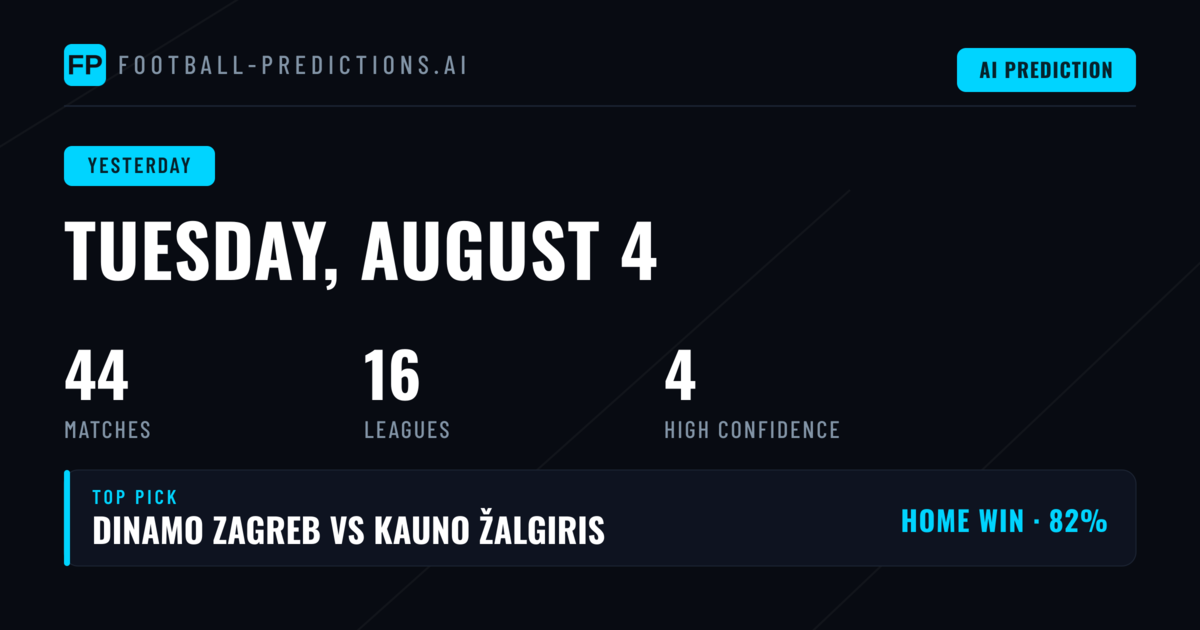
The footballing landscape on Tuesday, 4 August 2026 delivered a full schedule of 35 fixtures that tested the analytical skills of even the most experienced prediction enthusiasts. From early kick-offs to late-night encounters, the day's action spanned multiple competitions and leagues, presenting bettors and analysts with a challenging slate of matches to evaluate.
The performance metrics from Tuesday's predictions revealed a day of contrasts. The 1X2 market proved particularly elusive, with accurate results in only 13 of the 35 matches, translating to a 37% success rate that reflected the inherent unpredictability of competitive football. However, the Over/Under market offered considerably more satisfaction, with goals-based predictions landing successfully in 19 of 30 applicable fixtures, achieving a respectable 63% accuracy rate. Both Teams to Score selections performed moderately, finding the mark in 17 of 35 matches for a 49% success rate. These figures underscore how different prediction markets can perform vastly differently on any given day, with goal-based markets generally proving more reliable than outright result predictions.
Prediction Accuracy: A Candid Assessment
The 35 matches analyzed reveal a mixed performance across prediction categories. The 1X2 market proved most challenging, with 13 correct outcomes translating to a 37% success rate. This figure sits below the 50% threshold typically required for sustainable profitability, suggesting that outright match result predictions require refinement in either methodology or selective filtering of higher-confidence selections.
Over/Under delivered the strongest showing at 63% accuracy from 30 tracked matches. This consistency indicates the market offered clearer signals or that goal-based predictions align better with the analytical approach employed. The BTTS category landed almost exactly at parity with 49% accuracy, essentially functioning as a coin flip across 35 fixtures. The near-50% result suggests this market may have been too close to call with available data, raising questions about whether these predictions should have reached publication.
When evaluating overall performance, the divergence between markets stands out prominently. A 26-percentage-point gap between the best and worst categories demonstrates that blanket predictions across all markets obscure significant variation in predictive quality. The Over/Under performance provides a foundation for future strategy, while the 1X2 and BTTS results demand honest reconsideration of the selection process rather than dismissal as statistical noise.
High-Confidence Calls That Delivered
The standout prediction of the period came from the Dinamo Zagreb versus Kauno Žalgiris UEFA Champions League third qualifying round encounter. A massive 82% probability assigned to the home-side victory reflected a significant class gap between the two clubs. Dinamo Zagreb, with their extensive experience navigating European qualifying rounds, dominated from the opening whistle, ultimately recording a commanding 5-0 victory. This was not merely a correct call but represented textbook identification of a severe mismatch where the model appropriately assigned near-certainty to the outcome.
Union St. Gilloise hosting Bodo/Glimt in the same qualifying round presented a more nuanced situation. The 41% probability attached to a home win was notably modest by usual standards, yet this restraint proved insightful as the match ended in a dramatic 3-3 draw. The model recognized that despite Union St. Gilloise's home advantage, Bodo/Glimt possessed sufficient quality to trouble the Belgian side, resulting in an entertaining contest that defied any comfortable margin for either team.
Among the domestic Argentine fixtures, the Huracan against Atletico Tucuman stalemate demonstrated the model's ability to identify genuine 50-50 matchups. The 47% probability assigned to a home win essentially confirmed equal chances for both sides, and the goalless draw validated this balanced assessment. Similarly, the Central Cordoba de Santiago upset over San Lorenzo showed value detection at the lower confidence range. The 39% away win probability flagged San Lorenzo as potentially overvalued by the market, and Central Cordoba delivered a disciplined 1-0 home victory that rewarded those following the model's underdog signal.
The Luckenwalde Upset: Where Probability Met Reality
The most disappointing miss of the review period came from Regionalliga Nordost, where Magdeburg II hosted Luckenwalde. Our model assigned a 45% probability to a home victory, making Magdeburg II the clear favourite heading into the fixture. Instead, Luckenwalde departed with a 1-0 win that left our probability assessment in ruins. When a side receiving the second-lowest implied probability of winning somehow secures all three points, analysts must confront uncomfortable questions about their predictive framework.
The failure here likely stems from overreliance on league position and general club reputation. Magdeburg II carries the prestige of the Bundesliga-adjacent first team in its DNA, creating an unconscious bias toward their reserve side performing above their actual league standing. Luckenwalde, by contrast, arrived with nothing but the cold mathematics of their current form. When probability models inherit brand bias from parent clubs rather than evaluating the specific squad, pitch conditions, and motivation levels present on matchday, results like this become inevitable rather than shocking.
Beyond the modelling concerns, a 45% probability means the model gave Luckenwalde roughly a 30-35% chance of avoiding defeat through draw or win combined. Those odds are hardly negligible, and in a division where tactical variance and individual errors decide matches, backing the perceived weaker side at such generous implied probabilities often proves profitable in the long run. This result serves as a reminder that no prediction should be treated as a near-certainty when the underlying probability sits below 50%, and that the margin between a correct prediction and an embarrassing miss often comes down to a single clinical finish in a game that logic suggested should go another way.
European Qualifiers Deliver High-Scoring Thrillers Across Three Tiers
The UEFA Champions League 3rd Qualifying Round produced a series of narrow victories that proved challenging for 1X2 backers. Levski Sofia emerged as the sole correct call in this bracket, securing a 1-0 win over Kairat Almaty. The remaining three matches all defied pre-match expectations, with Slovan Bratislava edging Mjallby AIF 2-1, Ararat-Armenia claiming a 2-1 victory against Celje, and Hapoel Beer Sheva defeating FK Crvena Zvezda 1-0. The competitive nature of these elimination ties continues to create difficult scenarios for punters seeking straightforward outcomes.
The UEFA Europa League 3rd Qualifying Round offered mixed fortunes, as Shamrock Rovers delivered a commanding 3-1 triumph over Egnatia Rrogozhinë to reward correct 1X2 selections. However, Larne and Saburtalo played out a goalless draw that frustrated those backing either side, resulting in a split-the-difference outcome. Meanwhile, the UEFA Conference League 3rd Qualifying Round saw Auda advance past Dinamo Tirana courtesy of a solitary goal, securing the only correct prediction in that competition bracket.
Moving to domestic action, the Liga Profesional produced an upset as Central Cordoba de Santiago claimed a 1-0 win against San Lorenzo despite being overlooked by most 1X2 punters, while Huracan and Atletico Tucuman could not be separated in a 0-0 stalemate. In the Primera A, Llaneros impressed with a 3-1 victory over Fortaleza FC to register as the sole correct call in that league. The DBU Pokalen Round of 128 witnessed an avalanche of goals, with FC Fredericia demolishing SfB-Oure 6-0, HIK defeating Rudersdal 5-1, AB Copenhagen edging Holbaek B and I 2-1, and Allerod overcoming Skjold Birkerod 4-2 in a high-scoring encounter.
Tuesday's Results in Review
Tuesday's 35 matches across various competitions tested our 1X2 prediction model, which achieved a 37% accuracy rate. This result reflects a challenging day where many favorites failed to deliver expected performances.
The data serves as a reminder that prediction models operate within inherent variance bands, and such results are part of the natural fluctuation in sports forecasting accuracy.
 Ligat Ha'al
 Ligue 1