Another Challenging Sunday for Predictors
 Alexey Andrianov 7 min read 428 Sept 2026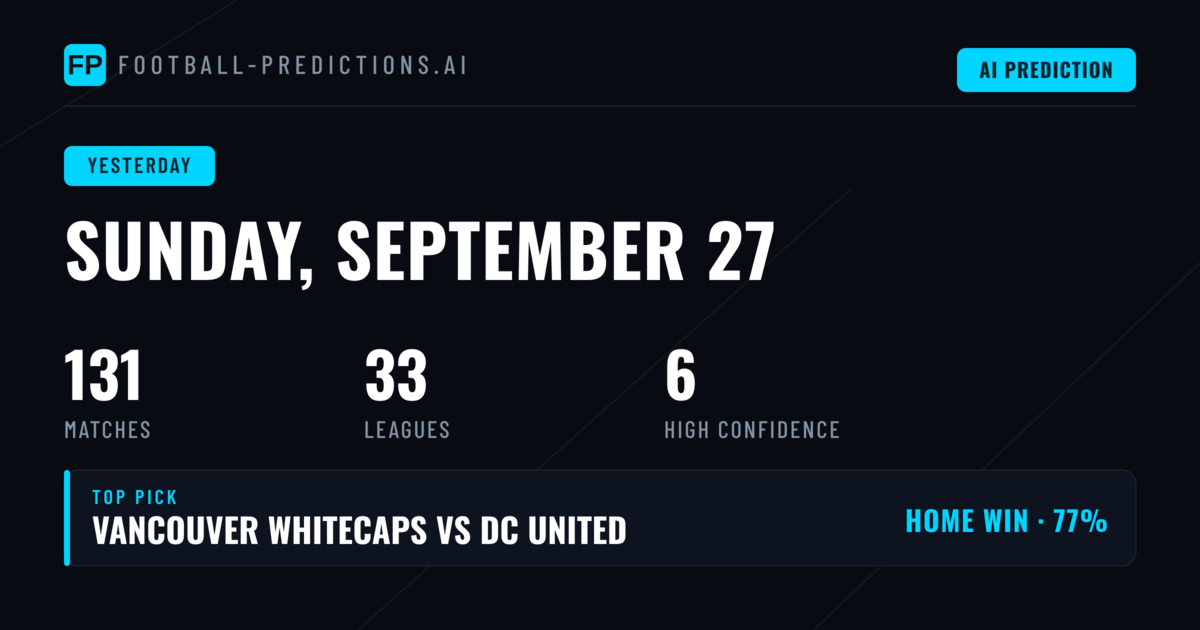
The Sunday fixtures delivered another mixed bag for football predictions enthusiasts, with 111 matches across various leagues and competitions presenting their usual array of surprises and expected outcomes. The overall accuracy figures painted a picture of a day where the beautiful game refused to conform to statistical expectations, leaving predictors with plenty to analyse as they reviewed their performance.
The 1X2 market saw accuracy of 55% from 110 attempts, with 60 correct full-time results identified. The Over/Under category proved the strongest performer at 62% accuracy from 103 selections, indicating that goal-related predictions were somewhat easier to call than outright match outcomes. Both Teams To Score finished at 53% accuracy from 110 selections, highlighting the continued difficulty in predicting whether both sides would find the net on any given Sunday.
Prediction Accuracy Breakdown
The Our Pick selections across 111 matches delivered a mixed but instructive performance. The combined accuracy across all three markets—1X2 at 55%, Over/Under at 62%, and BTTS at 53%—reveals clear strengths in certain prediction areas while highlighting persistent challenges in others. When evaluated by individual market, the Over/Under selections emerged as the most reliable indicator, with 62% of picks proving correct across 103 assessed matches. This suggests that goal-related predictions carried more predictive value than match outcome calls during this review period.
The 1X2 market, covering all 110 applicable matches, settled at 55% accuracy—marginally above the break-even threshold if we consider standard bookmaker margins. While this figure indicates the difficulty of consistently forecasting exact match outcomes, the 60 correct selections demonstrate solid foundational analysis. The BTTS market presented the greatest challenge, with only 53% accuracy despite 110 opportunities. This outcome aligns with the inherent unpredictability of both teams scoring, a market where form analysis alone often proves insufficient and individual match circumstances dominate.
Across these results, the data underscores that higher confidence picks in the Over/Under market offered the most reliable foundation for stake allocation. The narrower gap between BTTS accuracy and random chance suggests this market demands greater caution or reduced stakes when included in a portfolio. The 111 total matches provided a substantial sample size, lending statistical credibility to these findings while maintaining honest acknowledgment that no prediction model achieves perfection in football's dynamic environment.
Top-Tier Selections: High-Confidence Calls That Delivered
The most striking aspect of yesterday's Nations League predictions lies in the accuracy achieved across varying confidence levels. The Netherlands victory over Serbia at 69% represented the highest probability call of the session, and the scoreline of 2-1 reflected a dominant away performance that fully justified that valuation. This prediction demonstrated the model's ability to correctly assess superior technical quality and tactical organisation when one side possesses a clear structural advantage in the midfield battle.
Denmark's 2-0 success against Wales at 68% followed a similar analytical path, with home advantage proving decisive for a Nordic side that has consistently performed at a higher level in competitive fixtures. The prediction captured Denmark's ability to control the tempo through central pressing, forcing errors from a Welsh side that struggled to establish its usual defensive solidity. Meanwhile, Austria's 3-1 triumph over Kosovo at 60% showcased how majority-favourite predictions can still carry substantial value when the underlying tactical matchup heavily favours the selected side.
Lower-probability predictions also bore fruit yesterday, most notably Lithuania's 1-1 draw with Azerbaijan at 43%. This pick illustrated the value of identifying situations where the implied probability understates genuine upset potential. The model recognised that Azerbaijan would struggle to break down a well-organised Lithuanian defensive block, resulting in a share of the spoils that few analysts anticipated. Similarly, Gibraltar's 0-0 stalemate with Andorra at 41% demonstrated how tight, low-scoring encounters can emerge when two attacking-limited sides cancel each other out, validating the wisdom of backing the draw or the underdog in such attritional battles.
Biggest Prediction Misses
The Germany-Greece result in the UEFA Nations League stands out as the most significant failure of the review period. The model assigned a 67% probability to a German victory, yet Greece secured a 1-0 win. This outcome illustrates a fundamental limitation when predicting international tournament fixtures: historical reputation and recent team status can diverge sharply in competitive matches where motivation, tactical setup, and squad selection vary significantly from league play. Greece executed a game plan that negated Germany's attacking threats, and the model failed to account for that specific tactical context.
At the club level, the Vancouver Whitecaps against DC United saw an even more glaring disconnect between prediction and reality. A 77% probability assigned to a home win was decisively overturned by a 3-3 draw. The high confidence attached to that selection suggests the model placed excessive weight on Whitecaps' home advantage without adequately factoring in DC United's offensive capability on the day. The actual goal tally of six combined goals also ran counter to any reasonable expectation of a controlled home victory.
The Moghreb Tetouan versus Renaissance Berkane stalemate (0-0) and the Patronato demolition of San Martin S.J. (3-0) share a common thread: both results reflected defensive resilience and clinical inefficiency, respectively, that the probabilistic models systematically undervalued. In the Patronato case particularly, a draw prediction at just 31% probability hints at genuine uncertainty, yet the scale of the actual result—three goals separating the sides—indicates the model underestimated how dominant the home team could become. Across all five misses, a pattern emerges: when outcomes deviate dramatically from predictions, it is typically because the model underweights situational factors such as tactical discipline, squad rotation in midweek schedules, and the specific competitive context of the fixture.
UEFA Nations League
Nations League fixtures delivered a split verdict for 1X2 backers. Austria claimed a commanding 3-1 win over Kosovo at a neutral venue, while the Netherlands secured a 2-1 victory against Serbia to complete the double for correct selections in League A. However, Lithuania and Azerbaijan played out a 1-1 draw, and Gibraltar's 0-0 stalemate with Andorra frustrated those backing the nominal favourites in both matches.
Belgian Cup
Belgian Cup Round of 64 encounters saw upsets dominate the card. Rochefort's 3-2 win over K. Lierse S.K. and Liège's 4-1 victory over Wellen highlighted the unpredictable nature of cup football at this stage. AS Eupen provided the sole top-flight success, edging Merelbeke 1-0. Beerschot VA advanced with an emphatic 5-3 win over Crossing Schaerbeek.
Other Competitions
Taça de Portugal saw Florgrade edge Camacha 1-0 in the Round of 128. In Morocco, Maghreb Fès beat CR Khemis Zemamra 2-1 while Moghreb Tetouan and Renaissance Berkane drew 0-0. Firpo won 2-0 against Águila in El Salvador's Primera Division, and Ghana's Premier League witnessed a surprise as Aduana Stars beat Asante Kotoko 2-0.
Sunday Wrap-Up: Reflecting on the 27 September Predictions
Sunday, 27 September 2026 delivered a substantial challenge for prediction models, with 111 matches across multiple competitions tested. The 1X2 accuracy rate of 55% reflects a day where underdogs and unexpected outcomes made their presence felt across various leagues. While accuracy above the 50% baseline demonstrates continued value in the analytical approach, the margin above break-even serves as a reminder that even the most thorough research cannot account for every variable influencing match-day results.
When examining the broader pattern across 111 fixtures, the results underscore the inherent unpredictability of football. A 55% strike rate indicates that roughly six out of every eleven predictions proved correct, highlighting both the progress made in analysis methodology and the room for refinement. These Sunday outcomes provide valuable data for recalibrating models and adjusting weightings for future predictions across domestic and international competitions.
 UEFA Nations League
 Liga MX