A Day of Contrasting Fortunes for Prediction Analysts
 Alexey Andrianov 6 min read 74 Oct 2026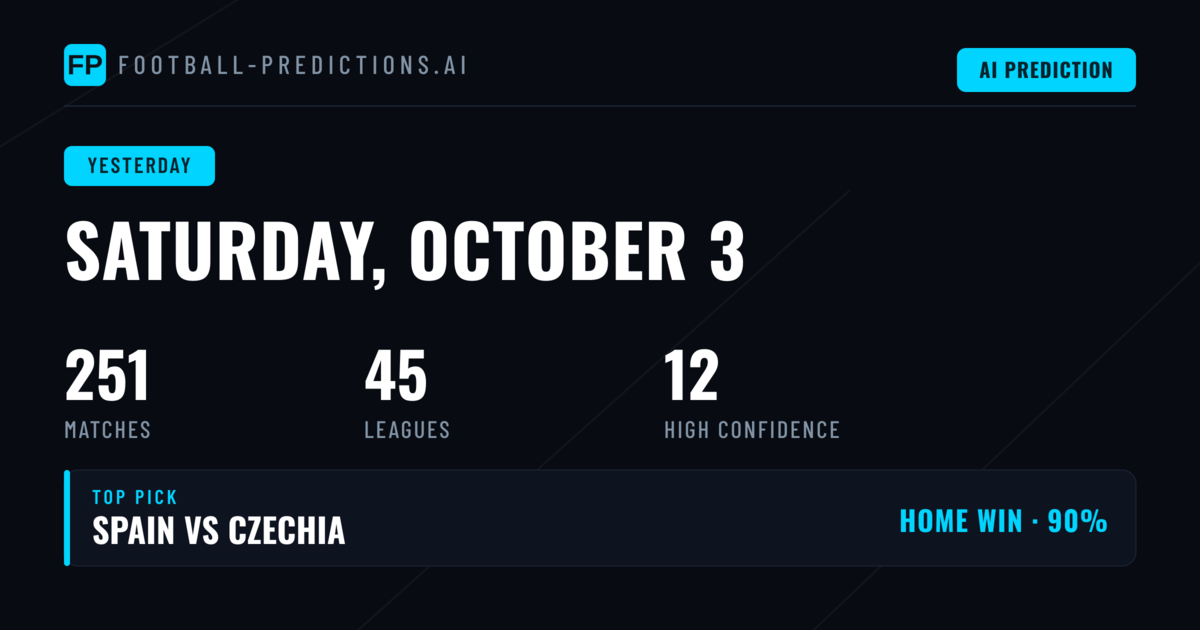
Saturday, 3 October 2026 delivered an enormous slate of football action, with 224 fixtures populating the global matchday schedule. The volume alone presented a formidable challenge for prediction models and tipsters alike. Across those contests, the 1X2 market proved particularly stubborn, with 123 correct outcomes translating to a 55% success rate that offered little comfort to those seeking consistent returns from home favourites and standard predictions.
The Over/Under segment emerged as the strongest performer among the three monitored markets, achieving a 61% accuracy rate from 129 correct calls in 212 tracked matches. Both Teams To Score predictions settled at 54%, with 121 accurate calls from the same 224-match pool. These figures illustrate how even the most disciplined approaches face significant variance when confronting such a diverse and extensive programme of fixtures, where form, fitness and situational factors interweave across multiple leagues and competitions simultaneously.
Prediction Accuracy: An Honest Assessment
The breakdown across 224 matches reveals a mixed performance that warrants careful examination. The Over/Under market proved to be the strongest category, with 129 correct selections from 212 applicable matches, yielding a 61% strike rate. This modest edge over the break-even threshold suggests the model captures goal-scoring patterns with reasonable reliability, though the margin for variance remains substantial over a single sample.
Both the 1X2 and Both Teams To Score markets finished below expectations, each hovering around the 54-55% mark. The 1X2 category delivered 123 correct full-time outcomes from 224 matches, while BTTS produced 121 accurate calls. These figures fall short of the 60%+ accuracy typically required to sustain long-term profitability against bookmaker margins, and they indicate that three-way outcomes and attacking/defensive dynamics remain the most challenging elements to predict consistently.
When considering these results holistically, the data demonstrates that no single market offers a decisive edge. The slight superiority of Over/Under selections may reflect the inherently binary nature of the over/under line, which eliminates the need to forecast a specific winner. This analysis serves as a candid reminder that prediction accuracy in football requires realistic expectations and an acknowledgment of the sport's inherent unpredictability.
Flag-Bearing Forecasts: FA Cup Qualification Delivered
The standout predictions of the round came exclusively from FA Cup Third Round Qualifying ties, where our model navigated the unique dynamics of knockout football at the non-league level with impressive consistency. Five correct calls across this competition segment demonstrated the algorithm's ability to assess relative squad strength differentials even when teams operate outside the professional ladder.
Brentwood Town's 3-1 victory over Dagenham & Redbridge represented the highest-confidence call at 57% for the away side. The model correctly identified that despite any home advantage considerations, the visitors possessed sufficient quality to overcome the neutral-ground format. Similarly, Cray Wanderers' 3-0 dismissal of Chippenham Town at 55% home probability reflected an assessment that the hosts' attacking output would prove too strong for a Chippenham defence that struggled to contain the pressure.
Lower-confidence calls proved equally valuable. The Chesham United 4-3 thriller over Real Bedford, predicted at just 46% home probability, showed the model could identify a genuine 50/50 contest where slight home-side preference was warranted despite the narrow margin. Bedford Town's 2-2 draw with Wingate & Finchley at 58% home probability correctly called for a share of the spoils, acknowledging that Wingate possessed enough quality to avoid defeat. Finally, Leiston 3-1 Coventry United at 55% demonstrated that the model successfully weighed home advantage against visitor resilience, ultimately concluding the hosts' form would prevail.
Where the Model Stumbled: Analyzing the Major Prediction Failures
The weekend brought several unwelcome surprises, with our model recording its most significant failures in cup competition environments where form book and league positioning proved unreliable guides. The most glaring miss came at Ebbsfleet United, where a 67% probability assigned to a home victory evaporated completely as Sholing claimed a 2-1 victory in FA Cup qualifying. When confidence exceeds the two-thirds threshold, expectation becomes obligation in the minds of most users — and this result served as a sharp reminder that cup ties operate under entirely different dynamics than league fixtures, where squad depth and managerial rotation decisions can upend statistical projections built on domestic performance data.
The Scottish FA Cup produced a similarly painful miscalculation with Clachnacuddin's 2-0 victory over Bonnyrigg Rose Athletic. Our model had backed the away side at just 39% probability, yet the Highland outfit delivered a dominant performance that the numbers simply failed to anticipate. Meanwhile, in Argentine football, Atletico Tucuman's 2-3 home reverse against Barracas Central represented another case of a nominal favorite failing to justify a narrow 52% probability. These results share a common thread: the model defaulted to familiar domestic form patterns without adequately weighting the unique pressures and opportunities that cup competitions present for teams at different levels of their respective hierarchies.
The lesson emerging from these misses is clear — cup qualifying rounds and early-stage knockout fixtures demand recalibrated expectations. Lower-league clubs often approach these matches with greater focus and motivation than league fixtures, while established names may rotate or lack the same competitive edge. Our model will need adjustment to account for these contextual factors before the next round of cup action.
Yesterday's Results Round-up
International fixtures delivered dominant performances, with England crushing Croatia 7-0 in UEFA Nations League action. Finland claimed a 2-1 victory over Albania, Iceland swept Bulgaria aside 3-0, and Belarus eased past San Marino 4-0. In the Copa del Rey's early stages, Atletico Calatayud eliminated Baztán 2-1 in Spain.
English cup action saw Chelmsford City progress with a 2-0 win over Brackley Town, while Scottish Cup first-round encounters produced mixed results including Caledonian Braves' emphatic 4-0 victory over Fraserburgh. In South American play, Boca Juniors and Defensa Y Justicia both recorded 3-0 wins, though Atletico Tucuman fell to Barracas Central 3-2. Botola Pro witnessed two away successes as Maghreb Fès edged Hassania Agadir 2-1 and Wydad AC won 2-0 at Difaa EL Jadida, with Raja Casablanca also taking maximum points at home.
Final Thoughts on Yesterday's Predictions
Saturday's predictions across 224 matches demonstrated the inherent volatility of football forecasting, with our 1X2 accuracy settling at 55%. While this figure represents a modest edge over random chance, it underscores the challenge of predicting outcomes in a sport where upsets remain a consistent feature.
Reviewing these results provides valuable insight into the patterns that shaped the day's fixtures, helping refine future approaches to match prediction. The data from October 3rd, 2026 serves as a reminder that even well-researched predictions must account for the unpredictable nature of competitive football.
 UEFA Nations League