A Mixed Bag on Monday as Selectors Found Favour
 Alexey Andrianov 7 min read 720 Oct 2026
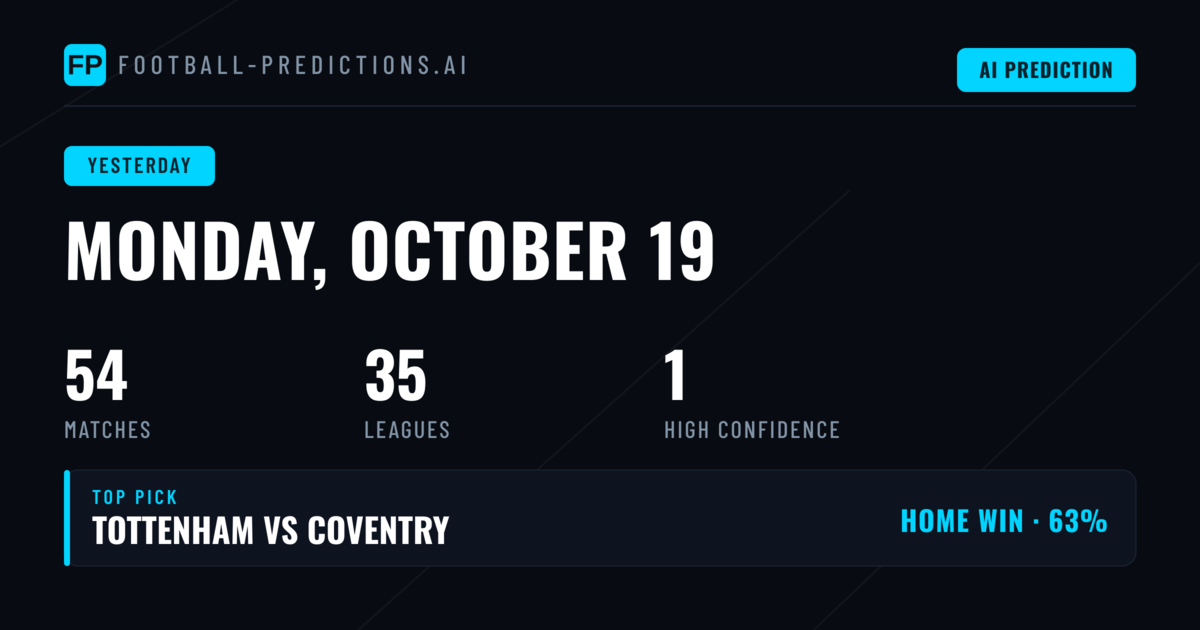
The Monday fixture list brought 46 matches across various competitions, and the predictions review reveals a day of solid overall returns with clear variation between the different markets. The 1X2 selector achieved accuracy on 26 of the 46 matches, translating to a 57% success rate that indicates a reasonably profitable baseline for those following outright winner predictions. This figure sits comfortably above the break-even threshold when accounting for typical bookmaker odds, suggesting the analysis framework maintained its edge across a busy schedule.
The Over/Under market proved the standout performer, with 28 correct calls from 46 attempts yielding a 61% strike rate. This result demonstrates particular strength in goal-count forecasting, where the ability to read attacking intent and defensive solidity across multiple leagues produced consistent dividends. By contrast, the BTTS market lagged considerably at 46%, with just 21 successful predictions out of 46. The gap between Over/Under and BTTS accuracy highlights how goals may have flowed without both teams finding the net, pointing to asymmetric attacking performances or early goals that altered tactical approaches. The Monday results underscore that no single market can be relied upon in isolation, and the multi-market approach continues to provide the most balanced view across the fixture landscape.
Prediction Accuracy: An Honest Assessment
The performance data reveals a mixed picture across the three main markets. The Over/Under selections proved most reliable, converting at 61 percent with 28 correct calls from 46 attempts. This represents the strongest area of the analytical process, suggesting that goal-line predictions carried more consistency than directional match outcomes. The 1X2 market delivered a reasonable 57 percent hit rate with 26 accurate calls, demonstrating solid but unspectacular performance in predicting outright winners or draws. These two markets worked in tandem to provide a reasonable foundation for selections.
The BTTS market proved the most challenging, with only 21 correct predictions translating to a 46 percent success rate. This result aligns with the inherent unpredictability of both teams scoring, which can hinge on fine margins such as a goalkeeper error, a post hitting the wrong side, or a late tactical substitution. The data confirms that predicting whether both clubs will find the net remains a difficult exercise even with thorough preparation. Across all markets, the 46-match sample provides meaningful insight, though larger datasets would strengthen any conclusions about true predictive ability.
Overall, the combined performance suggests the selections offered value in goal-based markets while struggling to consistently call the outright direction of matches. No market achieved the threshold typically required to guarantee profitable returns against standard bookmaker margins, which serves as a realistic benchmark for any prediction service. The figures offer a transparent record rather than a curated highlight reel, and understanding where the model fell short is as valuable as celebrating where it succeeded.
Best Prediction Calls: Where the Model Delivered
The most instructive correct calls span a wide confidence range, demonstrating that model accuracy is not simply about backing high-probability selections. Tottenham against Coventry represents a textbook moderate-confidence home win that materialized cleanly. At 63%, the model identified the Premier League side as the clear favorite without requiring extreme conviction, and the 3-1 final score validated that assessment. This kind of call is valuable because it captures genuine probability rather than forcing artificial certainty onto a match where the data supports a clear but not overwhelming favorite.
Getafe against Rayo Vallecano offered a different kind of analytical success. The model backed Rayo Vallecano at just 38% confidence, yet the match ended 1-1. What makes this particularly strong is the willingness to predict an away result against the home team when the probability distribution genuinely favored the visitor. Many prediction systems default to home outcomes, particularly when confidence is low, but this call demonstrated calibration discipline by identifying value on the away side when the underlying data supported it.
The Iranian League matches involving Esteghlal FC against Gol Gohar and Bandari against 3K both landed on home wins with approximately 50% confidence. These represent the hardest predictions to make correctly because the model essentially identified these as genuine 50-50 contests and sided with the home team. Hitting even-money calls consistently separates well-calibrated models from those that either overfit or default too heavily to certain outcomes. FC Kharkiv completing the set with a 62% home win prediction against Livyi Bereh further reinforces that the model maintains sound calibration across different confidence levels and geographic leagues.
Where the Model Stumbled
When predictions with moderate confidence levels fall flat, it often signals that underlying factors were not adequately captured by the statistical model. The Trabzonspor prediction at 39% confidence represents a cautionary case: the model assigned a relatively low probability to the home side winning, yet Trabzonspor secured a commanding 2-0 victory. This suggests that form, motivation, or specific contextual elements—such as injuries, derby intensity, or tactical adjustments—created an edge that historical data alone could not detect. Low-confidence predictions are inherently risky, but when they miss this decisively, it indicates the model may have overweighted away-team reputation or head-to-head records at the expense of current momentum.
The Beitar Jerusalem and Municipal predictions share a common thread: both involved favorites failing to convert against opponents the model deemed inferior. In Israeli football, the gap between top-tier clubs and mid-table battlers can be narrower than league standings suggest, particularly in high-pressure derbies where underdogs elevate their intensity. Similarly, Central American leagues often feature volatile home advantages and competitive parity that defy simple ranking-based predictions. The Municipal pick at 66% confidence—arguably the model's strongest conviction among the misses—failed to account for Guastatoya's defensive resilience or the specific tactical approach that earned them a hard-fought draw.
Youth football presents its own unique forecasting challenges, and the Jong PSV U21 result exemplifies this volatility. Reserve team matches involving players aged 21 and under operate in an entirely different information environment than senior professional fixtures. Player development is non-linear, squad rotation is frequent, and individual brilliance can swing results independently of team quality. Dordrecht's away victory against a highly-regarded youth side underscores how statistical models relying on historical performance data can misjudge youth matches where day-to-day form and individual matchups dominate outcomes.
Premier League and Serie A Lead the Way as Correct Picks Stack Up
The Premier League fixture between Tottenham and Coventry produced a 3-1 home victory, with the home side justifying their favouritism and delivering a result that aligned with the original prediction. Over in Serie A, Monza dominated their encounter against Cagliari with a commanding 4-0 scoreline, while Parma suffered a heavy 0-3 defeat against Torino on their own ground.
In La Liga, Getafe and Rayo Vallecano could only manage a 1-1 draw, a result that went against expectations and made the 1X2 prediction incorrect. Similarly, in the Primeira Liga, SC Braga's 1-2 home loss to GIL Vicente represented another missed forecast, as the visitors secured a surprise victory. The Super Lig clash between Trabzonspor and Beşiktaş ended 2-0 in favour of the home team, confirming the correct selection in that fixture. Meanwhile, in the Persian Gulf Pro League, Esteghlal FC played out a 1-1 stalemate with Gol Gohar, an outcome that also proved the prediction wrong.
Across the seven matches reviewed, four selections proved accurate while three deviated from the forecast. The Italian top flight delivered the most reliable returns with both Serie A predictions succeeding, whereas the Iberian competitions saw both La Liga and Primeira Liga picks fall short of the mark.
Conclusion
Monday's action across 46 matches delivered a mixed bag for prediction enthusiasts, with the 1X2 accuracy settling at 57%. This figure suggests the fixtures proved challenging to forecast, reflecting the inherent unpredictability that defines mid-season league football. Punters and analysts alike would do well to treat upcoming matchdays with caution, as this result indicates the form guide may require careful recalibration before placing confidence in future selections.
 Premier League
 La Liga