





Camp Nou Awaits: Barcelona's Perfect Start Meets Real Madrid's Push for Glory in Season's First Clásico
The atmosphere at Camp Nou on an October evening carries a weight that few stadiums in world football can replicate. When the floodlights illuminate the hallowed turf and the azulgrana faithful pack into the 99,000-seat colosseum, the venue itself becomes a weapon—a fortress where history has been made and broken in equal measure. For the first Clásico of the 2026 calendar, Barcelona return home not merely as contenders but as the undisputed leaders of La Liga, riding a wave of imperious form that has left the Spanish footballing landscape in awe. Real Madrid, the reigning Champions League holders, arrive as the hunters rather than the hunted, three points behind in third place but possessing the pedigree and experience that comes with European football's most prestigious trophy lifted just months ago.
Sunday's encounter represents far more than three points in a league standings. It is the measurement point where Hansi Flick's revolutionary attacking philosophy meets Carlo Ancelotti's tactical nous, where Barcelona's free-scoring machine collides with a Real Madrid side that has shown defensive vulnerability despite their domestic resilience. The 20:00 local kickoff provides prime-time theatre for millions worldwide, with American audiences able to catch the action on Fubo, ESPN, and NBC networks—a testament to the global reach of this fixture that transcends sport and enters the realm of cultural phenomenon.
Unstoppable at Home, Relentless Across All Fronts: Barcelona's Extraordinary Opening
Ten matches into the La Liga campaign, Barcelona have achieved something that even the most optimistic Camp Nou season-ticket holder would have struggled to predict at the campaign's outset. Ten wins from ten matches, a flawless record that has propelled the Catalan giants to 27 points and an unassailable position at La Liga's summit. The statistics underpinning this run border on the absurd: an average of 4.3 goals scored per game illustrates an attacking unit operating with surgical precision and devastating effect. When Flick arrived at Barcelona, few anticipated such a transformation so soon, yet the evidence on the pitch speaks for itself.
The defensive numbers, while impressive in their own right, reveal the fascinating tension within Barcelona's approach. Conceding an average of 1.1 goals per match suggests a backline that has tightened considerably, yet the 30% clean sheet percentage indicates that maintaining a zero at the back remains an aspiration rather than an expectation. This is a team that has embraced risk, understanding that total domination requires accepting the occasional vulnerability. The 70% both-teams-to-score percentage confirms that Barcelona's matches have become appointment viewing for neutral spectators—entertaining, unpredictable, and perpetually balanced on a knife's edge until the final whistle confirms their latest triumph.
The motivation driving this Barcelona side cannot be overstated. Occupying first place in La Liga with a six-point buffer over their eternal rivals sends a psychological message that extends far beyond the mathematical implications of the points gap. Champions League qualification is, of course, secured—mathematically assured from this position—but the true ambition burning within these players reaches toward something greater. The desire to reclaim domestic supremacy after seasons ofReal Madrid dominance has manifested in performances that combine youthful exuberance with tactical discipline, creating a blend that opponents have found impossible to contain consistently.
However, approaching this particular fixture, clouds have gathered over Flick's preparations. Eric García suffered a muscle thigh injury against Betis, casting serious doubt over his availability for the Clásico. Gerard Martín finished that same match with physical problems and will require evaluation before any participation can be confirmed. Most concerning perhaps is Jules Koundé, who ended the Betis encounter with physical problems and will undergo medical tests on Sunday—the eve of this monumental clash. The fitness situation across the squad represents Flick's most significant challenge in the buildup to the match, forcing difficult decisions about defensive partnerships and tactical flexibility.
The Merengues' Mission: Closing the Gap in La Liga's Title Race
Real Madrid's position in third place, four points behind Barcelona, tells only part of the story of their 2026-27 La Liga campaign. Two defeats in ten matches—unusual territory for a side accustomed to domestic dominance—obscure the underlying quality within Ancelotti's squad. The eight victories accumulated represent a strong foundation, though the margin for error has shrunk considerably compared to previous seasons where Madrid could absorb setbacks without genuine alarm. With 21 points from nine games, the mathematics of their title challenge remain viable, but the performance trajectory suggests improvements are necessary if they are to overhaul their Catalan rivals.
The attacking output of 2.7 goals per game places Real Madrid among La Liga's productive sides, yet the comparison with Barcelona's 4.3 average reveals a chasm that Ancelotti will seek to narrow on Sunday. Jude Bellingham, with his single goal and no assists across the matches tracked, has shouldered significant creative responsibilities despite modest personal returns. The England international's influence extends far beyond statistics, providing tactical flexibility and defensive contribution that statistics cannot capture. His ability to arrive in dangerous positions at crucial moments could prove the difference in a fixture where clinical efficiency will be rewarded.
Defensively, Real Madrid's numbers suggest vulnerability that Barcelona will look to exploit ruthlessly. The 1.2 goals conceded per game represents solid rather than spectacular protection for their goalkeeper, while the concerning 20% clean sheet percentage indicates struggles to organize defensive shape consistently. In a Clásico context, these defensive frailties assume heightened significance—the attacking talent within Barcelona's ranks requires no invitation to capitalize on uncertainty at the back. Ancelotti must devise a strategy that provides defensive security without sacrificing the creative output necessary to breach Barcelona's rearguard.
Tactical Battlefield: Contrasting Philosophies Under the Floodlights
The tactical confrontation awaiting us at Camp Nou represents a fascinating study in competing footballing philosophies. Flick has implemented a high-pressing, possession-dominant approach that has transformed Barcelona into a team capable of overwhelming opponents through relentless intensity. The pressing triggers from the front, coordinated movement across the attacking unit, and swift transitions have created a machine that generates chances at an extraordinary rate. When Barcelona win the ball back, the transition from defense to attack happens with terrifying speed—defenders find themselves exposed before they can organize, and the numerical advantages created in wide areas have produced numerous goalscoring opportunities.
Ancelotti, facing this challenge, must balance multiple competing demands. His side cannot simply defend and hope for counter-attack opportunities—Barcelona's control of possession means Real Madrid would cede territory and initiative, inviting pressure that could prove unsustainable over ninety minutes. Instead, a more proactive approach may be necessary, with careful attention to defensive shape when Barcelona build attacks while maintaining numerical superiority in midfield to disrupt the home side's rhythm. The away side's 2.7 goals per game suggests they possess the quality to threaten, even against Barcelona's improved defense.
The injured players' unavailability could force tactical adaptations that alter the match's complexion. Barcelona's defensive options may be compromised, potentially creating spaces that Real Madrid's attackers can exploit. Alternatively, Flick might opt for a more conservative approach, prioritizing defensive solidity over attacking ambition—a significant departure from recent patterns but one that the circumstances might necessitate. The fluidity of Barcelona's system under Flick, however, makes rigid tactical differentiation difficult; the players are drilled to press and attack regardless of opponent, meaning any defensive adjustment would represent a philosophical shift rather than a mere tactical tweak.
Individual Brilliance: The Players Who Could Decide the Clásico
When examining Barcelona's key performers heading into this encounter, the data reveals an interesting distribution of offensive responsibility. Raphinha has emerged as the creative fulcrum, contributing two goals and an assist across the tracked matches—the only player in the squad combining goal-scoring prowess with playmaking ability. His movement off the ball creates spaces for teammates, while his capacity to finish chances makes him a constant threat in the final third. Fermín, with two goals and no assists, represents the predatory instincts within Barcelona's forward line—the player positioned to convert half-chances into goalscoring opportunities.
Kylian Adeyemi's single goal demonstrates his potential impact despite limited minutes, suggesting a player capable of decisive interventions when called upon from the bench or starting XI. His pace and direct running could prove particularly valuable against a Real Madrid defense that has shown susceptibility to quick transitions and vertical passes in behind the defensive line. The German international's involvement, whether from the start or as an impact substitute, represents one of Flick's most potent tactical weapons.
For Real Madrid, Jude Bellingham's importance transcends his modest goal return. The England international's tactical intelligence, positioning between the lines, and ability to influence proceedings across multiple phases of play make him indispensable to Ancelotti's plans. His duel with Barcelona's midfield controlling figures could determine which side establishes territorial dominance, making his performance perhaps the single most significant factor in the away side's prospects. Supporting cast members must elevate their games to complement Bellingham's industry, creating the numerical advantages in attack that Barcelona's defense has occasionally failed to neutralize.
The Weight of History: Clásico Patterns and Psychological Dynamics
The head-to-head record between these clubs across recent encounters makes for compelling reading. In the last twenty meetings, both Barcelona and Real Madrid have claimed nine victories, with two matches ending in draws—perfect parity that reflects the intense competitiveness of this fixture regardless of domestic form or European standing. The average goals per match of 3.2 confirms that Clásicos rarely disappoint those seeking entertainment, with both sides contributing to goal-laden spectacles more often than not.
Recent encounters provide additional insight into potential patterns. Barcelona's 2-0 victory in May 2026 demonstrated their capacity to defeat Real Madrid while controlling proceedings defensively—a template they might seek to replicate if defensive concerns prompt a more measured approach. The 4-0 Camp Nou humiliation in October 2024 remains fresh in the memory, a reminder that when Barcelona click at full capacity, even the finest defensive organizations can be dismantled with alarming ease. Real Madrid's 2-1 victory in October 2025 and the extraordinary 4-3 Barcelona win in May 2025 illustrate the fixture's unpredictability, where tactical plans often dissolve in the intensity of competitive action.
The 55% both-teams-to-score percentage across these meetings suggests that while goals are plentiful, shutouts occur with sufficient frequency to warrant consideration. Against Barcelona's current form, Real Madrid scoring represents a reasonable expectation, but whether the visitors can keep their opponents silent remains the more pertinent tactical question. The psychological weight of the Clásico transcends league standings—players who have performed inconsistently in domestic competition often discover elevated performance levels when the white of Real Madrid or the blaugrana of Barcelona awaits them.
Betting Analysis: Finding Value in the Camp Nou Clash
The bookmaker odds for this encounter reflect the market's assessment of Barcelona's superiority based on current form and home advantage. Bet365 prices the home side at 1.53, with the draw available at 5.5 and Real Madrid at 4.33. Converting these prices to implied probabilities reveals fascinating insights about market expectations: Barcelona at 61% probability, the draw at approximately 18.7%, and Real Madrid at just over 20%. These figures align closely with our predictive model's assessment, suggesting the odds accurately price the known information without significant market inefficiency.
The 1X2 market offers limited value given the alignment between odds and probability. Barcelona at 1.53 represents fair pricing rather than an opportunity, though home favorites with strong form records have historically performed well in this fixture. The double chance market provides alternative perspectives: 1X at 1.18 offers minimal value given Barcelona's dominance, while X2 at 2.5 presents marginally more attractive odds for those seeking to back the away side without committing to an outright victory. The 12 option, essentially a "no draw" bet at 1.17, reflects the low probability assigned to stalemate scenarios.
Asian Handicap markets introduce more nuanced opportunities. Barcelona -1.25 at 2.1 requires the home side to win by two goals or more for full returns, with half-stake returned if Barcelona win by exactly one. The implied probability of around 48% suggests this line may underestimate Barcelona's attacking capabilities, though Real Madrid's quality means covering -1.25 remains far from guaranteed. Barcelona -1 at 1.81 provides an alternative requiring only a two-goal margin for victory, offering more conservative exposure while maintaining reasonable odds.
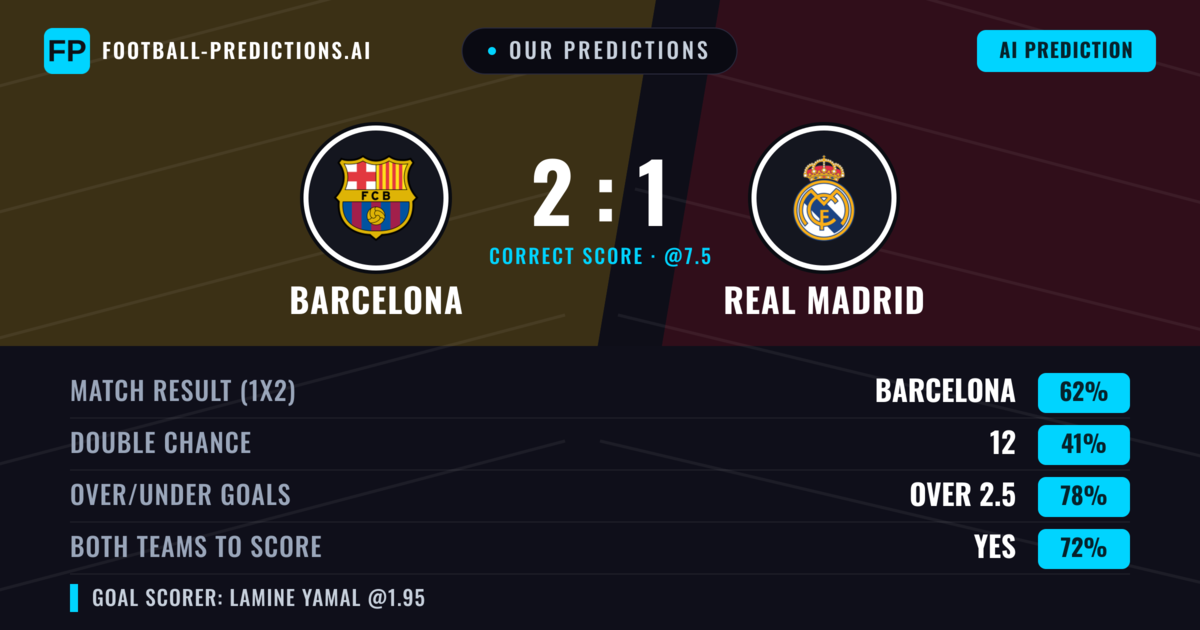
The over 2.5 goals market presents our highest confidence prediction at 78%, with both teams averaging over three goals combined per game across their respective campaigns. The 3.2 historical average in Clásicos supports this assessment, as does the 70% both-teams-to-score percentage for both sides this season. Barcelona's attacking output of 4.3 goals per game virtually guarantees goalmouth action, while Real Madrid's 2.7 average suggests they will contribute meaningfully to any goal glut.
Both teams to score carries 72% confidence, with the statistical evidence compelling. Barcelona's defensive vulnerability (30% clean sheets) meets Real Madrid's attacking quality (2.7 goals per game) in conditions where the away side should find the net at least once. Conversely, Real Madrid's defensive struggles (20% clean sheets) against Barcelona's relentless attack suggests the home side's goals are virtually assured. The combination of high probability and reasonable odds makes BTTS Yes an attractive selection for this fixture.
Correct score predictions based on available odds suggest Barcelona 2-1 at 7.5 as the market's preferred outcome, though 3-1 at 8.0 represents excellent value given the home side's scoring average. The over 3.5 goals market, while not explicitly quoted, would logically follow from our over 2.5 recommendation and offers superior returns for those confident in a goal-heavy encounter.
Our predictions carry the following confidence levels: Barcelona victory at 62%, over 2.5 goals at 78%, both teams to score at 72%, and the double chance 12 at 41%. The combination of BTTS Yes with over 2.5 creates a compound opportunity with approximately 55% implied probability, offering superior returns compared to single-market betting while maintaining high statistical foundation.
Value identification focuses on markets where the discrepancy between true probability and implied probability creates favorable conditions. Barcelona -1 at 1.81 may represent value given their home scoring average and Real Madrid's defensive limitations, though the single-goal margin scenario introduces variance risk. The draw at 5.5 carries implied probability of 18.7%—lower than our model suggests might occur in a fixture of this competitive intensity, though Barcelona's form provides limited justification for backing stalemate scenarios.
For readers in this market, kickoff is 20:00 (GMT, London time) on Sunday, October 25, 2026. The match will be broadcast on Fubo, ESPN, and NBC, ensuring comprehensive coverage across major platforms. Bet365 offers Barcelona at 1.53, a draw at 5.5, and Real Madrid at 4.33 for the 1X2 market.
Conclusion: The Verdict Approaches
As the Catalan autumn sun sets over the rooftops of Camp Nou, the final preparations will be underway in both dressing rooms. Barcelona, with their perfect record and four-point advantage, possess the psychological edge that accompanies invincibility—but Clásicos have historically defied form guides and league positions. The fitness concerns surrounding Eric García, Gerard Martín, and Jules Koundé introduce uncertainty that Flick must navigate, potentially altering the defensive solidity that has underpinned recent successes.
Real Madrid arrive as underdogs, but Champions League holders rarely shrink from challenges. Ancelotti's tactical acumen, the quality within his squad, and the occasion's significance could elevate performance levels beyond what domestic form suggests. The 3.2-goal historical average in this fixture guarantees entertainment regardless of tactical outcomes, though the specific question of which side claims the three points remains genuinely contested.
Barcelona's superior form, home advantage, and attacking firepower suggest they enter as deserved favorites, but the margin separating these clubs has narrowed in recent Clásicos. A closely contested encounter with Barcelona prevailing seems the most probable outcome, though the possibility of an away victory or high-scoring draw cannot be dismissed given the attacking quality on display. The over 2.5 and BTTS Yes markets offer the most statistically sound opportunities, while those seeking higher returns might consider Barcelona -1 given their home scoring prowess against a defense struggling to maintain clean sheets.
The stage is set. The players will enter to thunderous applause. The ball will be kicked, and for ninety minutes plus stoppage time, the footballing world will hold its breath as two of sport's greatest institutions collide once more.