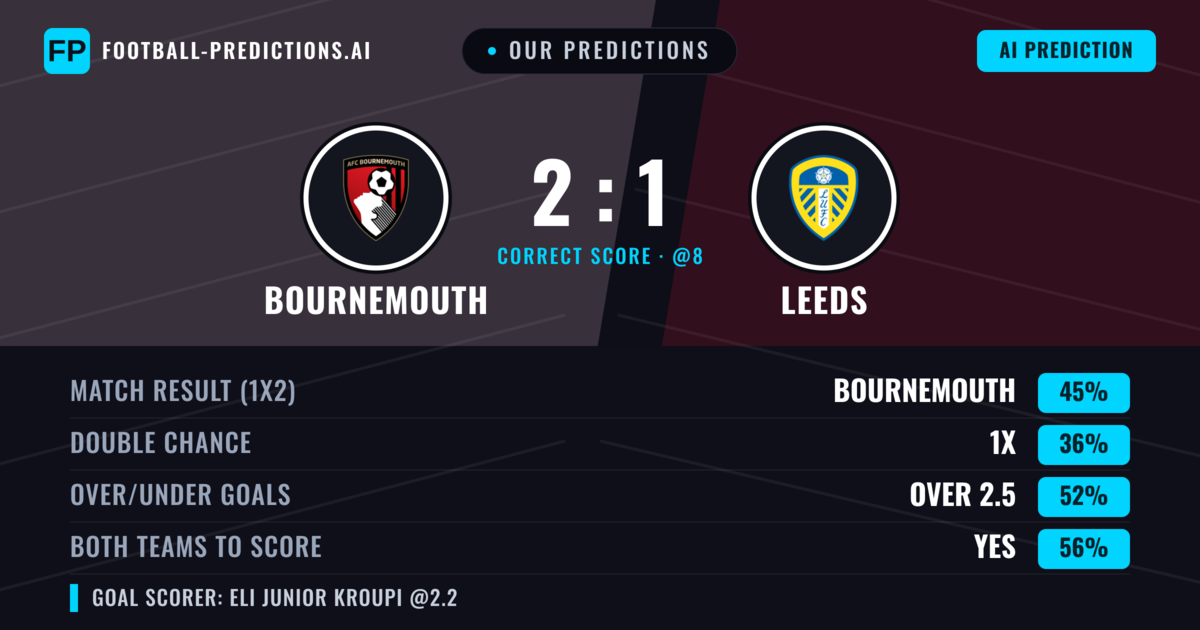







Bournemouth vs Leeds: Home Momentum Meets Defensive Steel at Vitality
The first decisive question at Vitality Stadium is not whether Bournemouth can continue their productive run, but whether Leeds can turn defensive resistance into the attacking momentum their league position suggests they need. Bournemouth arrive with the livelier recent record and the greater scoring average, while Leeds have established themselves as the harder team to beat and the more convincing defensive unit. The managers therefore face a classic tension: one side must preserve its attacking identity, while the other must decide how much risk to accept in pursuit of a breakthrough.
This is the ninth round of the Premier League season, and the standings add a useful secondary layer to that contest. Bournemouth are 13th in Premier League with nine points from eight matches, whereas Leeds sit seventh with 11 points from the same number of games. A home victory would allow Bournemouth to climb toward the middle of the table, while Leeds have their own reason to protect their position by continuing the run of draws that has kept them difficult to beat. The tension comes from the possibility that both teams may find their safest route to a point without taking the additional risk required to win it.
For supporters searching for a bournemouth prediction today, the evidence points toward an open enough contest to produce goals, although the market’s strong support for Bournemouth may make the home win harder to find at a useful price. The local schedule is clear: kickoff comes at 15:00 GMT on Saturday, October 31, 2026, with the match available to local readers on NBC. The central question is whether Bournemouth’s superior attacking trajectory can overwhelm Leeds’ defensive resistance, or whether the visitors can turn a controlled match into a tightly managed one.
The Premise: Two Very Different Routes to Control
Bournemouth’s numbers describe a side that has generally been more productive in front of goal. Across the supplied ten-match sample, they won five, drew three and lost twice, with an average of 1.9 goals scored and 1.2 conceded. Their headline five-match form is listed as WWWWL, while the verified situational feed gives a slightly different recent sequence of WWLLD. That difference appears to reflect the cut-off point used for the latest form update, but the wider sample still supports the central conclusion: Bournemouth have generated more wins and a substantially higher scoring rate than Leeds.
Leeds, by contrast, have produced fewer victories but fewer defeats. Their ten-match record is three wins, five draws and two losses, and the exact five-match form is DDLDW. Their average of one goal scored per game is modest compared with Bournemouth’s 1.9, but they have conceded only 0.9 per match. Both teams have a 50% BTTS rate and 40% clean-sheet rate in the supplied data, yet the underlying pattern differs: Bournemouth’s attacking output creates more separation, whereas Leeds’ profile is built around narrowing the gap through defensive control.
That makes the tactical battle more nuanced than a straightforward contest between the stronger attack and the stronger defense. Bournemouth must prevent Leeds from turning every transition into a controlled, low-event opportunity. Leeds, meanwhile, cannot simply retreat into their defensive strengths if they want to justify their seventh-place position and the market’s expectation that they can compete at this venue. The visitors need enough attacking purpose to unsettle the home side without exposing themselves to the high-volume scoring pattern that has defined Bournemouth’s better performances.
The standings underline the differing pressures. Bournemouth, 13th in Premier League, have more room to climb but cannot afford another run of defeats if they are to turn their recent attacking numbers into meaningful progress. Leeds, seventh in Premier League, have gained one point more and already possess the stronger league position. Their advantage lies in stability: two fewer losses than Bournemouth across the ten-match sample. If that stability survives the journey to Vitality, Leeds can remain dangerous even without producing the more adventurous football their home opponents are likely to favor.
Recent Momentum: The Home Team Carries the Greater Threat
Bournemouth’s attacking record is the loudest signal in the data. Their 1.9 goals per game is nearly double Leeds’ one goal per game, and their five victories in the ten-match sample demonstrate that the production is not entirely dependent on one fortunate result. The conceded average of 1.2 also shows weaknesses, but the gap between scoring and conceding is sufficiently pronounced to suggest that Bournemouth have been able to impose themselves more often than Leeds.
Leeds’ attacking figures require a more compact approach. Scoring once per game can be enough when the team concedes as little as 0.9 per match, particularly if draws are considered acceptable outcomes. That is precisely what their record suggests: five draws from ten matches. Leeds have repeatedly found ways to remain competitive, and a club with their current defensive profile can travel without needing to dominate possession or create a high number of chances. Their task is to make the match uncomfortable for Bournemouth, particularly in the periods when the home side’s attacking rhythm is building.
The head-to-head record supports the argument that neither side has held a decisive historical advantage. Leeds won four of the last eight meetings, Bournemouth won two and the remaining two were draws, yet the average total of 4.13 goals suggests volatility. Eighty-eight percent of those encounters also produced both teams to score. The recent meetings listed in the data reinforce that pattern: Bournemouth drew 2-2 with Leeds in April 2026, Leeds drew 2-2 with Bournemouth in September 2025, Bournemouth won 4-1 in April 2023 and Leeds won 4-3 in November 2022.
Those scores should not be treated as a prediction for this fixture, particularly because the squads and match conditions may have changed. They do, however, establish that this pairing can produce attacking football even when one side has a more cautious profile. Leeds should not assume that a 0.9 goals-per-match defensive average guarantees a low-scoring afternoon. Bournemouth’s capacity to score at nearly twice Leeds’ rate creates the possibility that one transition changes the emotional temperature of the entire match.
For this reason, the most plausible match script is one in which the first breakthrough matters disproportionately. If Bournemouth score first, the home side can ask Leeds to expose themselves in search of an equalizer. If Leeds score first, their defensive numbers become more useful because the home team must now generate controlled risk rather than continue playing with the freedom of a team that does not yet need to chase the game. The first goal is therefore not merely a scoring event; it changes the tactical geometry.
Tactical Geometry Without Presumption
No formations are supplied in the current data, and the season-statistics fields contain no usable team totals, so it would be irresponsible to present a formation chart with invented positional labels. Instead, the tactical discussion must focus on the demands each side is likely to place on the other. Bournemouth appear best equipped to attack through pace, width and repeated entries into scoring positions, while Leeds appear best equipped to protect the central areas and force the home team into less efficient work.
Bournemouth’s front-foot approach is supported by the scale of their scoring average. The side has won more often than Leeds and is almost twice as productive in attack, suggesting that the home team is likely to value territorial momentum rather than a purely conservative allocation of effort. The danger for Bournemouth is that attacking volume does not always produce proportionate scoring if the team becomes too stretched. If Leeds can disrupt the first pass, compress the space in front of goal and make Bournemouth repeat the same wide action without finding a central route, the home team could spend long spells creating pressure without a clear return.
Leeds can therefore pursue a compact defensive structure without abandoning the possibility of counterattacking. Their defensive advantage is clear in the supplied numbers, and a compact shape would increase the importance of any successful transition. Yet the visitors need to judge the match’s state accurately. Sitting behind the ball for long spells may frustrate Bournemouth and preserve a draw, but it can also allow the home side to settle into rhythm and generate the pressure that eventually produces a breakthrough.
The away side should therefore be selective rather than passive. Leeds can protect their defensive strength while making enough forward movements to discourage Bournemouth from committing every defender to the attack. Their midfield and defensive lines would need to remain coordinated, because Bournemouth’s higher scoring rate suggests that isolated forward actions could be punished quickly. Conversely, Leeds cannot commit too many bodies forward, as that would reduce the protection behind the ball and invite the home side to exploit the spaces created by the first runner.
Bournemouth’s challenge is to retain width without allowing the game to become sterile. They need two ways to score: service from wide areas and combinations that pull Leeds’ compact shape out of position. The 4-1 and 4-3 results from the head-to-head sample show the range that can emerge when this fixture opens, although the current data provides no basis for expecting a repeat of either margin. More important is the broader indication that both defenses can be exposed when the game’s rhythm becomes too fluid.
The Individuals Who Could Decide the Contest
The verified player data is deliberately narrow, listing only one recognized scorer for each club. Bournemouth have M. Tavernier as their listed top scorer with one goal and no assists, while Leeds have A. Stach in the same statistical position with one goal and no assists. No further names, positions or performance figures have been supplied, so the responsible approach is to discuss the influence these players could have without inventing attributes that are not recorded.
- M. Tavernier could matter most when Bournemouth need to turn sustained home pressure into a breakthrough. His one listed goal confirms scoring contribution, while the absence of listed assists suggests his value in this preview should be framed around direct involvement rather than unsupported claims about creative volume. Bournemouth may benefit if the visiting structure forces play toward areas where he can influence the finish.
- A. Stach is Leeds’ only listed top scorer, with one goal and no assists. As the visitors seek greater attacking authority, his ability to provide a direct scoring route becomes important, particularly in transition or set-piece situations if the game becomes closely balanced. His importance may extend beyond his goal tally because a credible outlet allows Leeds to play with more control.
The tactical roles of every other player remain unknown in the supplied material, so it would be misleading to nominate defenders, goalkeepers or creative midfielders as specific influences. That uncertainty increases the value of team-level evidence. Bournemouth’s 1.9 goals scored per game and Leeds’ 0.9 conceded per game are more dependable guides to the match’s likely direction than unsupported individual assumptions.
There is also a collective dimension to each listed scorer’s role. Bournemouth need more than one route to goal if Leeds’ defensive numbers are to have their intended effect, while Leeds need their leading scorer to stretch the home side without surrendering their own defensive structure. The most credible individual matchups are therefore likely to be functional: a Bournemouth scorer operating against the pressure created by Leeds’ compactness, and a Leeds scorer making the home team account for movement away from the ball.
What the Numbers Say About the Margin
The supplied market expects Bournemouth to win, but the margin of that expectation is not especially dramatic. Bookmaker 1X2 prices of 2.15 for Bournemouth, 3.3 for the draw and 3.3 for Leeds correspond to the stated normalized implied probabilities of 43.4%, 28.3% and 28.3%. The local Bet365 reference is 2.15 for Bournemouth, 3.4 for the draw and 3.4 for Leeds, which describes the home side as the favorite while leaving both three-way alternatives with meaningful support.
A 43.4% home probability is high enough to signal confidence, but it is also high enough to make the 2.15 price vulnerable if Bournemouth’s attacking superiority fades. The raw break-even rate attached to a