





Brentford vs Nottingham Forest: Home Resolve Meets Relegation Pressure
Brentford arrive at this Premier League meeting with the better numbers, the stronger home position and the more persuasive profile. They sit sixth with 11 points from eight games, compared with Nottingham Forest in 18th place on six points from the same number of matches. Yet the tension lies in the contrast between those table positions and the pressure surrounding them: Brentford can play with the confidence of a side protecting a strong start, while Forest need this match to alter the shape of their season. The last 20 head-to-head meetings also provide a useful warning, because Brentford lead 10-7 overall but have lost each of the two most recent listed encounters. Saturday’s 15:00 kickoff at Brentford Community Stadium therefore brings together two different forms of urgency, and the local audience will be watching whether Forest’s greater need translates into the performance their position requires.
For local readers, the fixture begins at 15:00 GMT on Saturday, October 31, 2026, with coverage available on NBC and TNT. This is Regular Season Round 9, not a knockout contest, so there is no aggregate framework and no away-goals equation to manage. Every attacking decision, every defensive risk and every point of contact in the middle third will instead be judged against the live Premier League table. Brentford’s objective is to preserve momentum and turn home advantage into further separation; Forest’s objective is to escape the relegation zone with a result that changes the mood around their campaign.
The Uneven Kind of Pressure
Brentford’s league position is the most reassuring feature of their recent work. They are 6th in Premier League with 11 points from eight played, having recorded two wins, five draws and one defeat. Their form string is DLDWD, which tells a story of a team that has found ways to recover and repeatedly prevent damaging runs from becoming damaging defeats. Seven draws are included in the wider form data, alongside two wins and one loss, while the supplied averages show Brentford scoring 1.7 goals per game and conceding 1.2. Their attack has therefore offered a firmer platform than their defensive record alone might suggest, and the 54% defense comparison also points to a side whose overall structure has held together better than Forest’s.
Nottingham Forest’s numbers are considerably less comfortable. They are 18th in Premier League with six points from eight played, and their form sequence is DLLLW. The wider figures list one win, four draws and five defeats, with 0.9 goals scored per game and 1.4 conceded. The contrast with Brentford is particularly clear in attack: the home side’s 1.7 scoring average is almost twice Forest’s 0.9, while the defensive gap is narrower but still meaningful at 1.2 compared with 1.4. Forest also have a 60% rate for both teams to score and only a 10% clean-sheet rate, giving them little evidence of the defensive control needed to reverse their position through one afternoon alone.
The motivation is not evenly distributed. The verified match context identifies Forest as a team fighting relegation and expects greater urgency from them, while Brentford have no specific table incentive beyond their strong standing. That does not mean the hosts are passive. A sixth-place position can be protected, consolidated or surrendered, and Brentford’s heavy collection of draws suggests they will be aware that another point without a win may preserve little momentum. Forest must pursue victory, but urgency cannot compensate for every weakness: the away side must still protect the spaces in which Brentford’s stronger attack has operated, control the central areas and avoid spending all their energy chasing an opening goal that does not arrive.
Rest should not materially alter the tactical picture. Brentford have had six days of rest and Nottingham Forest eight days, with each side having played one game in the previous ten days. There is no significant advantage for either team, and neither can reasonably claim freshness as a major source of superiority. More relevant is how each side converts recovery time into structure, movement and match-specific preparation rather than simply energy in the final third.
How Brentford Can Turn Control Into Points
No verified formation was supplied for either club, so it would be misleading to present a precise tactical shape as established fact. Brentford’s approach can instead be understood through the roles their available data supports. Their scoring average of 1.7 suggests a side willing to create a respectable number of chances, while seven draws indicate that converting pressure into decisive numbers has not always been straightforward. Against Forest, the hosts can be patient without becoming passive, using the forward line to stretch the visitors and then attacking the space created by Forest’s urgency.
The central tactical question is whether Brentford can make their attacking work coherent around the forward unit and the midfield connections behind it. M. Kayode, K. Lewis-Potter and V. Janelt are the only named Brentford players in the supplied key-player data, and each has one goal and no assists. Those figures do not justify projecting them as dominant contributors, but they do provide useful context: Brentford’s scoring is collective rather than dependent on one prolific figure, and the listed scorers offer direct attacking options without guaranteeing an imbalance.
Kayode’s role can be framed as a source of forward pressure, while Lewis-Potter offers another route into the attacking third and Janelt provides a further goal threat from deeper or more advanced midfield positioning. The exact tactical duties are not provided, so the safest conclusion is that Brentford need coordinated movement, not isolated individual bursts. Forest’s defensive unit has conceded 1.4 per game in the supplied averages and has recorded a clean sheet in only 10% of matches; those numbers make controlled repetition especially useful. A move that produces one chance may not be enough, while repeated rotations through the same advanced areas can force Forest to defend deeper and create the transitional openings Brentford wants.
Defensively, Brentford can exploit Forest’s modest attacking output by protecting the counterattacking lanes rather than chasing possession statistics. Their 80% BTTS rate indicates that matches have often contained goals from both sides, including in games where Brentford have still collected useful results. A clean sheet would be valuable against a relegation-pressed visitor, but it should emerge from disciplined positioning rather than excessive conservatism. If Brentford become too cautious, they may allow Forest to build the urgency that the away side craves; if they remain aggressive without defensive balance, they risk repeating the pattern of drawing matches without fully converting their territorial advantage.
Forest Need More Than Scrappy Resistance
Nottingham Forest’s task is unusually delicate because their league position demands ambition while their scoring output offers limited scope for passive football. The forward line has averaged 0.9 goals per game in the supplied data, compared with Brentford’s 1.7. Forest’s 60% BTTS rate demonstrates that they have still been involved in competitive attacking exchanges, but their 10% clean-sheet rate means the opposition has repeatedly retained a significant route to goal. To change that pattern at Brentford, Forest need a coordinated approach rather than a collection of isolated forward actions.
Because no individual player information is available for Nottingham Forest, it would be irresponsible to attach this match to unnamed stars or speculate about individuals whose status cannot be verified. Their decisive roles must therefore be described collectively. The forward line must improve the quality and timing of service, the midfield must reduce the amount of territory Brentford can claim, and the defensive unit must handle the pressure that accompanies Forest leaving larger spaces between their lines. Those are concrete tactical functions, even without attaching names to them.
Forest’s midfield control is likely to be central to their chances of unsettling the hosts. If they can move possession through Brentford’s first line without repeatedly losing it, they can slow the game and make the hosts’ urgency visible. If Brentford can disrupt that first pass and direct play toward the flanks, Forest’s defenders will face repeated pressure. The away side’s 1.4 conceded average suggests that preventing a stream of chances will be difficult; the more realistic target may be to reduce the quality of those chances while creating enough at the opposite end.
Set pieces and second balls also deserve emphasis, although their precise historical frequency is not included in the supplied information. Forest cannot rely on one perfect moment if Brentford can defend them effectively, and the hosts cannot assume their defensive unit will comfortably contain repeated deliveries. In a match where Forest need to climb from 18th, every secondary action matters: clearances that begin a counterattack, duels that stop a cross, and recoveries that prevent Brentford from resetting around the penalty area. Those details can compensate for a lack of established clean-sheet form, while an inability to perform them will expose Forest to the pressure created by Brentford’s greater attacking output.
The Head-to-Head Picture: A Warning Inside the Advantage
The broader history favors Brentford, but the most recent chapter belongs to Forest. Across the last 20 meetings, Brentford have won 10, three have been drawn and Nottingham Forest have won seven. The average total is 2.9 goals, while BTTS has occurred in 60% of those meetings. That is a history generally supportive of scoring interest, although it does not by itself determine the probability of the same pattern continuing, particularly with both clubs in different form and position situations from some of those earlier encounters.
The five most recent listed results provide a sharper warning. Nottingham Forest won 2-0 at Brentford on January 25, 2026 and 3-1 at Brentford on August 17, 2025. Brentford responded with a 2-0 win at Forest on May 1, 2025, before the sequence also included a 2-0 home defeat against Forest on December 21, 2024 and a 3-2 Brentford victory on January 20, 2024. The pattern is mixed rather than one-way, but Forest have taken the most recent two and have twice won at this venue by keeping Brentford scoreless.
That history should temper any assumption that home advantage is decisive. Brentford’s current table position and attacking numbers remain superior, but the recent H2H results show that Forest can make this ground uncomfortable. The psychological edge is less lopsided than the overall 10-7 split suggests. For Brentford, the objective is to prove that the current season’s stronger position has changed the underlying balance; for Forest, those two recent wins provide evidence that repeating the pattern is possible, not a guarantee that it will happen again.
Market Prices and the Search for Value
The main bookmaker 1X2 prices offered for this match are Brentford at 2.05, the draw at 3.50 and Nottingham Forest at 3.40. Those prices produce stated implied probabilities of 45.7%, 26.8% and 27.5%, respectively, with the margin accounting for the total exceeding 100%. Bet365’s local 1X2 prices are slightly different: Brentford at 2.00, the draw at 3.50 and Nottingham Forest at 3.60. The draw is unchanged, while the home side is marginally shorter and Forest marginally longer, making Bet365’s away price the better of the quoted alternatives for a Forest result even if the relative difference is small.
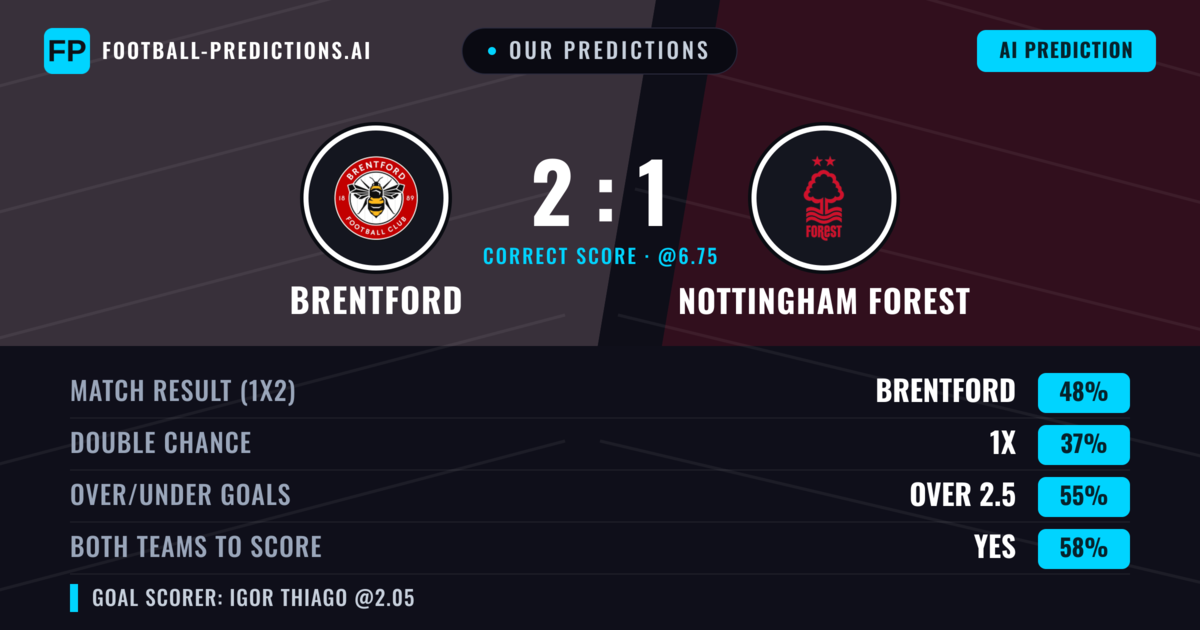
The supplied price set favors Brentford without making them an overwhelming favorite. A 2.05 home price translates to a raw 48.8% requirement before accounting for bookmaker margin, while Bet365’s 2.00 home quote requires 50%. Against that, the comparative model assigns Brentford 57% overall and Nottingham Forest 42%, with the home side leading the form, attack and defense categories. The personal forecast therefore places the home win at 48% confidence, which creates only a narrow edge against the 2.05 quote and no convincing edge at the shorter Bet365 price of 2.00. Brentford should be treated as the favored outcome, but not as an automatic bet at every available price.
The double-chance prices are 1X at 1.30, 12 at 1.30 and X2 at 1.75. The forecast for 1X carries 37% confidence, which is not a strong enough endorsement to label the 1.30 price as value. At that quote, the break-even requirement is approximately 76.9% before margin, making it a highly compressed expression of preference rather than a profitable-looking proposition based only on the supplied model confidence. The 1X market is better understood as a risk-management option than as the sharpest bet available.
Asian handicap prices are listed as Brentford -1.25 at 3.14, Nottingham Forest -1.25 at 1.33, Brentford -1 at 2.86 and Nottingham Forest -1 at 1.44. These are short and heavily margined selections, particularly the two 1.33 and 1.44 prices, and the available form does not support treating either side as a strong one-goal favorite. Brentford’s attacking advantage is clear, but seven draws in the wider sample and Forest’s recent two wins over Brentford make a large home margin difficult to justify. No aggressive handicap selection is therefore warranted from the evidence supplied.
The correct-score list is unusually concentrated on 1-1, with that score quoted at 6.00, 6.37, 6.50 and 7.00 in the supplied entries, alongside 2-1 at 6.75. The repetition of 1-1 reflects the structure of the provided market rather than a set of distinct correct-score predictions. It also connects neatly with both teams’ BTTS rates of 80% and 60%, but those rates do not make a correct-score wager objectively valuable. A 1-1 selection requires considerably more than the broad likelihood of both teams scoring, and the list alone is not enough to overcome the uncertainty attached to an exact result.
No bookmaker price for Over 2.5 or BTTS was included in the supplied odds,