



Chile Rotation Risk Complicates Lineup Planning for Canada Friendly
Canada and Chile prepare to face each other in a Friendly International on Saturday evening, with both sides entering the match following extended breaks from competitive action. The encounter presents an opportunity for both managers to assess their squads in a match environment, though the build-up has been shaped by notably different circumstances for each nation.
Chile face the challenge of a quick turnaround, with another fixture scheduled just three days after this meeting. That compressed timeline is expected to influence selection decisions significantly, potentially prompting changes to the starting XI that would not appear in a high-stakes competitive encounter. Canada, by contrast, operate without such immediate scheduling pressures heading into this friendly.
For viewers in the United Kingdom, kickoff is set for midnight on Sunday, with the match available to watch on ESPN. Both teams will be looking to use this friendly as preparation for future competitive challenges ahead.
Rest Advantage and Rotation Could Determine Canada vs Chile Outcome
Saturday's friendly between Canada and Chile at midnight BST represents an intriguing tactical puzzle, with both teams entering the match in vastly different competitive situations. Chile's extended 109-day rest period since their last fixture offers a considerable preparation advantage over Canada's 84 days, though this gap may prove less decisive given the nature of international friendlies. The longer interval could allow Chile's coaching staff to implement more detailed tactical systems, but it also raises questions about match sharpness and rhythm against a side that may have been more recently active in competitive action. Canada's shorter rest window, while theoretically less ideal for physical preparation, might paradoxically benefit them in terms of maintaining competitive edge and game tempo.
The most significant tactical factor entering this encounter is Chile's immediate fixture congestion, with another match scheduled just three days after this friendly. This compressed schedule creates substantial rotation risk for the visitors, likely forcing manager Ricardo Gareca to preserve key starters for the more immediately consequential fixture. This presents a tactical catch-22 for Chile: the extended rest advantages their preparations, but the quick turnaround may force them to field a changed lineup that cannot fully exploit those benefits. Canada, facing no such constraints on their immediate fixture list, can approach this match with their strongest available lineup and use it as a meaningful competitive exercise ahead of their own upcoming commitments. The Canadians will likely target the spaces vacated by Chile's potential changes and look to impose their tempo early, recognizing that visitor fatigue and unfamiliarity between rotated units could create exploitable defensive transitions.
From a stylistic perspective, both nations traditionally favor possession-based approaches with emphasis on technical quality in central areas, though the absence of confirmed formation data means tactical specifics remain speculative. Chile, historically organized around a compact 4-3-3 structure with aggressive full-back integration, will need to balance their creative ambitions against the reality of potentially fielding an experimental XI. Canada, meanwhile, can be expected to press proactively and look for direct routes to goal, particularly if Chile's defensive shape lacks the cohesion that comes from regular playing partnerships. The match's outcome may ultimately hinge on which team better adapts to in-game disruptions: Chile's rotation strategy or Canada's opportunistic pressing. Viewers can catch the match on ESPN as both sides look to build momentum through this final September international window.
Recent History Between Canada and Chile Yields a Tight Contest
The sole competitive meeting between Canada and Chile produced a cagey affair that ended without a goal. When the two sides faced each other on June 30, 2024, neither team managed to breach the opposition's defense, resulting in a goalless draw. This single encounter provides the entirety of the head-to-head record between these nations in recent times, meaning neither side holds a psychological edge heading into future meetings.
The 0-0 stalemate translates to a defensive battle in every measurable metric. With an average of zero goals per match across their history together, betting markets would logically flag the potential for another low-scoring affair should they meet again. Similarly, the Both Teams To Score statistic stands at zero percent, confirming that goals have been a rare commodity whenever these two nations have crossed paths.
Given the extremely limited sample size of just one meeting, drawing firm conclusions proves challenging. However, the pattern is clear: matches between Canada and Chile tend to be tight, disciplined contests where breaking the deadlock presents the primary challenge. For punters assessing future fixtures, the historical evidence points toward defensive organization trumping attacking intent when these teams meet.
Canada Aim to Build Consistency While Chile Look to End Winless Sequence
Canada head into this Friendly International encounter carrying notably stronger recent momentum, with their LWLWD sequence over their last five matches placing them ahead on the comparison charts across both form and attacking output. Their emphatic 6-0 victory over Qatar showcased their ceiling when operating with freedom against lesser-ranked opposition, while a hard-fought 1-0 away win against South Africa demonstrated resilience in tighter contest. However, that Morocco result—a 0-3 home defeat—exposed vulnerability against structured, physically dominant opponents, suggesting inconsistencies that Chile might look to exploit. With a 50% clean sheet rate and an average of 1.5 goals scored per match across their last ten outings, Canada present a balanced but occasionally fragile profile that has struggled to maintain concentration in high-stakes moments.
Chile arrive in contrasting circumstances, with their WLDD record indicating a side struggling to convert performances into positive results. Their standout recent result came in a 2-1 away victory against Congo DR, where they demonstrated the attacking fluidity capable of breaking down organised defences. Yet that success sits alongside a 1-2 defeat to Portugal and back-to-back draws against Canada and the USA, with the 0-0 stalemate against these very opponents a particularly frustrating outcome having dominated large stretches of that contest. Their defensive record remains a concern, with clean sheets recorded in just 25% of their recent matches and an average of one goal conceded per game exposing a back line that has not fully adapted to new tactical demands.
The statistical comparison reveals a significant gap in current momentum, with Canada's 75% form rating dwarfing Chile's 25%, while their 67% attacking advantage underlines a more consistent threat creation despite their heavier recent defeat. Defensively both sides sit level at 50%, though Canada's superior clean sheet percentage and lower goals conceded average suggest they have found greater stability at the back. Notably, Chile's BTTS rate of 75% highlights their tendency to be involved in open contests where both sides find the net, a pattern that could prove significant given Canada's own willingness to contribute offensively even when results disappoint.
Canada's Home Advantage and Defensive Setup Create Value in Saturday's Friendly
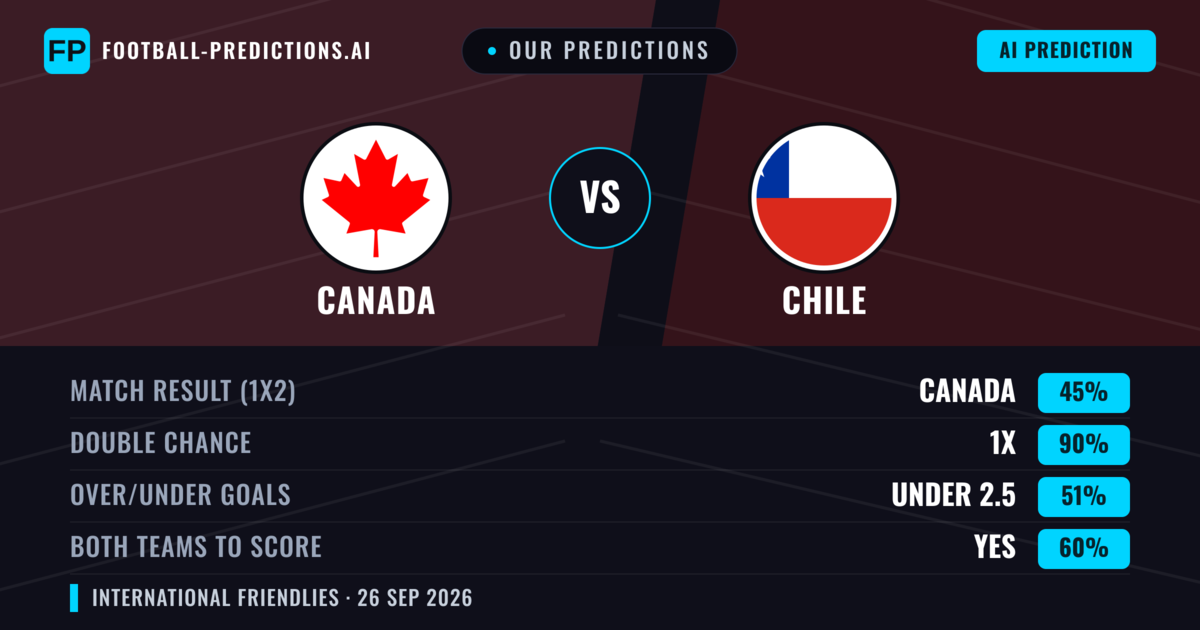
The model gives Canada a 45% chance of victory against Chile in this friendly encounter, with an identical 45% probability assigned to a draw outcome. This narrow margin reflects the competitive balance expected between two sides of similar caliber, though Canada's home environment tips the scales marginally in their favor. The friendly context carries significance as both nations use these matches to blood new talent and refine tactical approaches ahead of competitive fixtures, meaning performance levels can fluctuate more than in high-stakes competitive games.
The prediction of under 2.5 total goals at 51% confidence aligns with what typically transpires in friendly internationals where caution prevails and neither side exposes themselves unnecessarily. Coaches prioritize organizational discipline and defensive shape over expansive attacking play when results carry minimal consequence. Chile, in particular, may approach this encounter with a measured strategy, avoiding unnecessary risks that could result in injuries to key players ahead of their own competitive commitments. The 60% confidence on both teams to score reflects the expectation that both sides will find the net at least once, creating an interesting tension with the under 2.5 goal prediction.
Where the genuine value appears lies in the double chance market favoring Canada or a draw, with this selection carrying the highest confidence level at 90%. Given the probabilistic balance between a home win and draw, covering both outcomes provides substantial protection against the unpredictability inherent in international friendlies. The minimal gap between Canada's victory and a stalemate suggests that even if Chile manages an upset, the match is far more likely to end in a draw than in a comprehensive away victory. Punters should note that no bookmaker odds are currently published for this fixture, making it essential to monitor the market when lines become available.
The model presents a coherent betting thesis centered on Canada's competitive resilience on home soil combined with the conservative nature typical of friendly internationals. The convergence of high confidence on the double chance with moderate confidence on under 2.5 goals suggests a tight, well-contested match where scoring opportunities remain limited despite both teams eventually finding the target. Chile's 10% implied probability of an away victory reflects the challenging nature of securing three points in foreign conditions against a motivated Canadian side building confidence ahead of future competitive campaigns.
Our Verdict: Canada to Extend Their Unbeaten Run Against Chile
After thorough analysis of both squads, the betting data points toward a tightly contested encounter at the Friendly International stage. Canada holds the narrow edge in our match result projections, though the 45% confidence rating reflects the genuine competitiveness of this fixture. The Double Chance selection of 1X at 90% confidence provides the most security, suggesting that Canada are unlikely to leave this match empty-handed. With both teams expected to find the net at 60% confidence, the BTTS: yes angle offers solid value despite the anticipated low-scoring nature of the contest with under 2.5 goals at 51% confidence.
The combination of a Canada win or draw with both teams scoring presents an attractive betting angle for this Friendly International fixture. Backers should exercise proper stake management given the moderate confidence levels across individual selections, but the overall pattern favors the home side maintaining their unbeaten trajectory. Tune in at 23:00 on Saturday for what promises to be an intriguing international clash.