


Chesham United Host Real Bedford in Pivotal FA Cup Third Round Qualifying Showdown
There's something uniquely compelling about FA Cup qualifying rounds that separates them from the regular league grind. When Chesham United welcome Real Bedford to their home ground on Saturday afternoon, the 15:00 BST kickoff carries the weight of an entire season's aspirations compressed into ninety minutes—perhaps more if the lottery of extra time and penalties intervenes. Unlike league fixtures where points accumulate gradually, knockout football demands immediate perfection or facing elimination. Both clubs will approach this third round qualifying encounter knowing that victory propels them another step toward potential glory against bigger names, while defeat means a rapid return to more mundane competitive concerns.
The neutral observer might glance at the form guide and see two clubs in varying degrees of early-season turbulence. Chesham United arrive with a solitary defeat ringing alarm bells, conceding four goals in that opening encounter—an ominous defensive signal that opponents will have noted. Real Bedford, meanwhile, have shown more resilience in their two matches, collecting a draw alongside their defeat and demonstrating a defensive solidity that the Bedfordshire side will look to build upon. The contrasting statistical profiles suggest a fascinating tactical chess match where both managers must balance the necessity of attacking intent against the vulnerability that aggressive approaches might expose.
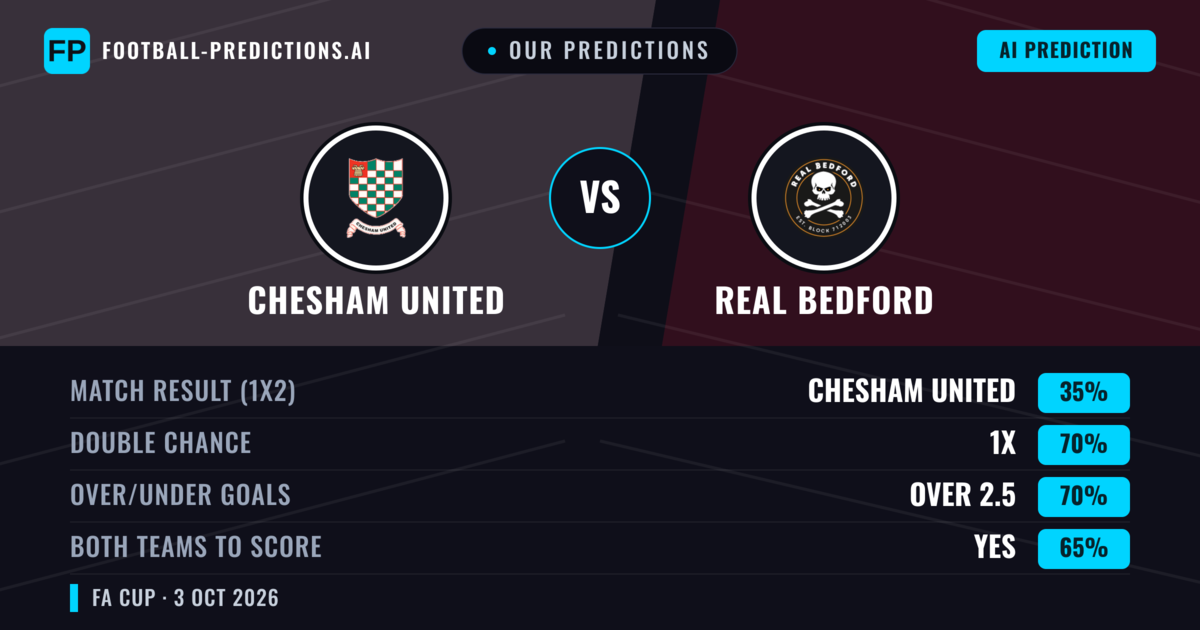
The model probabilities paint this as a genuinely competitive fixture, with home advantage marginally offsetting Real Bedford's superior underlying numbers. That 35% win probability for Chesham United—identical to the draw probability—tells us everything about the uncertainty surrounding this encounter. Neither side enters as clear favourite, which should translate into a tight, nervy affair where small moments of quality or errors could prove decisive. For bettors and neutrals alike, this uncertainty makes the match all the more intriguing, with theFA Cup's magic often manifesting most powerfully in these unexpected mismatches and closely-fought battles between clubs at different levels of the footballing pyramid.
The Current State of Play: Interpreting Early Season Form
Assessing form from the opening exchanges of any season requires considerable caution, and that principle applies double when examining just one or two matches. Chesham United's single competitive outing resulted in a heavy defeat, but the manner and context of that loss matter enormously. Four goals conceded suggests defensive frailties that the management team will have spent the intervening period attempting to address, but it would be premature to conclude that this represents their true defensive capability. Early-season fixtures often throw up anomalous results as players shake off rust and teams experiment with tactical approaches that may not yet be fully ingrained.
What proves more instructive is the 100% Both Teams To Score percentage from that solitary encounter. Whether through defensive lapses, attacking ambition, or a combination of both, Chesham United's opening fixture produced goals at both ends. For Real Bedford, the picture differs markedly—their two matches show a more conservative profile with only one of those games producing goals for both sides. This statistical divergence hints at different philosophical approaches that should fascinatingly collide on Saturday. The Bedford side have demonstrated greater defensive organisation while maintaining only modest attacking output, suggesting a pragmatic mindset that values clean sheets and structural solidity over free-scoring entertainment.
The goal statistics paint contrasting portraits of each side's early-season reality. Chesham United's average of four goals conceded per match demands immediate attention from their coaching staff, yet their single goal scored indicates the attack is not entirely toothless. Real Bedford's figures—half a goal scored and one conceded per match on average—suggest a side still finding their feet, perhaps prioritising defensive solidity while the forward players gel and develop understanding. The difference of nearly a full expected goal between attack and defence for Chesham United (1 scored, 4 conceded) contrasts sharply with Real Bedford's more balanced -0.5 differential (0.5 scored, 1 conceded), suggesting the visitors enter as the more composed unit.
Form Rankings and What They Tell Us
The AI analysis percentages offer fascinating insight into how these two sides stack up across different dimensions. Real Bedford's 67% form rating dominance over Chesham United's 33% represents the widest gap between the two clubs across any metric, suggesting that the visitors arrive in marginally better overall condition. However, this advantage narrows considerably when examining other factors—the attack metric actually favours Chesham United at 54% against Real Bedford's 46%, indicating that despite their defensive struggles, the home side may possess more cutting edge when pushing forward. This creates a compelling tactical tension: Chesham United can hurt teams going forward but have shown vulnerability at the back.
The defensive metric registers perfect parity at 50/50, which initially seems at odds with the raw statistics showing Chesham United conceding considerably more. This apparent contradiction likely reflects the algorithm's weighting of expected performance versus actual results, suggesting that the underlying defensive numbers may be more flattering than the four-goal defeat implies. Alternatively, Real Bedford's single goal conceded per match may not fully capture moments of genuine pressure they've faced that didn't result in goals. Either interpretation reinforces the message that this match features two incomplete teams still discovering their identities.
The overall 49% versus 50% split—essentially a coin flip—confirms what the model probabilities suggested: this fixture could genuinely go either way. Neither side enters with meaningful advantage, and the home venue may prove the deciding factor. The 15:00 BST kickoff on Saturday gives both teams the full week to prepare, with no rest differential to report—Chesham United and Real Bedford have enjoyed equivalent recovery time since their most recent fixtures. This parity in preparation time removes one variable that might otherwise influence the match, leaving tactics, mentality, and individual quality as the primary differentiating factors.
Tactical Preview: Formation Philosophies and Strategic Approaches
Without access to specific formation data or playing philosophy information for either club, tactical analysis must focus on what the available evidence suggests each side might prioritise. Chesham United's goal-scoring profile—modest output but clear ability to find the net—combined with defensive vulnerability points toward a side that may need to embrace their attacking instincts to progress. The mathematical reality facing the home manager is stark: if they cannot keep clean sheets, they must outscore opponents. This doesn't necessarily mean abandoning defensive structure entirely, but it does suggest calculated risk-taking in forward areas.
Real Bedford's profile suggests a more measured approach. With better defensive statistics and modest but existent attacking threat, the visitors may be content to allow Chesham United to dominate possession while seeking opportunities on the counter-attack. This pragmatic philosophy has proven effective at this level of the pyramid, where many opponents will commit numbers forward against perceived smaller clubs, creating exactly the spaces that disciplined visiting sides can exploit. The question for Real Bedford becomes whether they can convert these promising positions into goals, given their average of just half a goal per match.
The FA Cup context adds additional tactical considerations that differ from league football. There is no second leg to rescue a poor first-leg performance—everything must be decided within ninety minutes (plus any additional periods). This reality often makes teams more cautious early in matches as they assess the opposition, potentially leading to cagey opening periods before bolder approaches emerge. Alternatively, both managers might decide that seizing early initiative and establishing leads represents the optimal strategy, accepting greater risk in exchange for psychological advantage and the security of a cushion. The absence of clear form leaders adds to this tactical uncertainty, as neither side possesses the confidence that typically enables expansive, fearless football.
Knockout Football Psychology and Cup Fixture Dynamics
Third round qualifying represents a significant milestone in any non-league club's FA Cup journey. Those who advance through this round move within touching distance of the first round proper, where professional clubs from higher divisions enter the competition. The financial implications of progressing—such as prize money and potential television revenue—make this more than mere sporting pride at stake. For clubs like Chesham United and Real Bedford, each qualifying round victory can represent transformative revenue that influences budgets, facilities, and ultimately competitive prospects for the entire season.
Psychologically, knockout football imposes unique pressures that differ fundamentally from league matches. In league competition, a poor result can be contextualised within a broader campaign—three points dropped here doesn't eliminate title hopes, while a heavy defeat doesn't necessarily preclude future success. The binary nature of cup football removes this cushioning effect. Every match becomes potentially season-defining, and the margin between triumph and disaster shrinks to the width of a post or the timing of a referee's whistle. Players who thrive under this pressure can elevate their performance levels beyond what league fixtures demand, while those who struggle with the occasion may find their usual abilities compromised.
The scheduling adds another layer of complexity. With both clubs having played recently but no significant rest differential to report, fatigue shouldn't prove a major factor—barring extra time, of course. However, the psychological intensity of knockout preparation can prove equally draining as physical exertion. Managers must balance maintaining training intensity against risking player burnout or, worse, injury at such a critical juncture. The 15:00 Saturday kickoff provides traditional timing that both sets of players will find familiar, though the heightened stakes may introduce nerves and tension that don't normally accompany early-season league fixtures.
Head-to-Head History and Pattern Analysis
The absence of comprehensive historical data between these two clubs means any analysis must acknowledge the inherent unpredictability that accompanies limited previous encounters. FA Cup meetings between clubs at similar levels often produce unexpected results, with familiar opponents able to study each other's patterns and tendencies providing significant advantage over these comparative strangers. Each manager will have compiled dossiers on the other's preferred approaches, but the limitations of available video and statistical data at this level mean some elements of surprise remain inevitable regardless of preparation quality.
What we can observe from the form data suggests certain patterns that should manifest regardless of specific tactical arrangements. Chesham United's defensive issues mean they will likely struggle to keep clean sheets, while their attacking capability suggests they will contribute to high-scoring encounters. Real Bedford's more conservative profile indicates a team that won't self-destruct but may lack the creativity or ruthlessness to dominate proceedings. These baseline tendencies should produce a match where goals feel likely at both ends, creating the kind of entertaining, end-to-end contest that FA Cup qualifying rounds frequently deliver.
The absence of meaningful head-to-head history also means recent meetings against common opponents cannot provide useful comparative insight. Without knowing how both clubs performed against similar-quality opposition in recent seasons, we cannot extrapolate expected performance from contextual evidence. This forces reliance on the current season data alone, which—with its limited sample sizes—must be treated with appropriate caution. The most honest assessment acknowledges genuine uncertainty while highlighting the factors most likely to influence proceedings based on available evidence.
Value Identification and Comprehensive Betting Analysis
The absence of published bookmaker odds creates both challenge and opportunity for analytical purposes. Without industry-standard odds to reference, we must rely on model probabilities while acknowledging that the market's collective wisdom—which incorporates information, intuition, and sometimes bias from thousands of participants—typically proves more accurate than any single analytical model. However, when bookmaker odds remain unavailable, the model probabilities become the best available guide, and understanding their confidence levels helps calibrate expectations appropriately.
The prediction model favours a Chesham United victory at 35% confidence, with identical probability assigned to the draw scenario and a 30% chance of Real Bedford winning. These remarkably similar probabilities—essentially three equally likely outcomes—confirm the genuine uncertainty surrounding this fixture. The 35% home win probability translates to odds that would be considered underpriced in most betting contexts, as the vig built into bookmaker odds typically means even probability outcomes are offered at implied probabilities slightly below true value. However, without concrete odds to compare, identifying specific value requires accepting the model's assessment as a starting point rather than definitive truth.
More confidence attaches to the over 2.5 goals prediction at 70%, which represents substantial conviction that this match will produce at least three goals. Given Chesham United's four-goal concession in their only fixture and Real Bedford's defensive solidity combined with modest attacking output, this prediction might initially seem surprising. However, the logic becomes clearer when considering that one team's defensive weakness combined with the other's attacking limitations creates a scenario where the stronger attacking side (Chesham United based on the 54% attack rating) faces a defence that has proven vulnerable despite average concession statistics suggesting otherwise. The combination of home attacking intent meeting defensive uncertainty should produce the goals total this prediction anticipates.
The both teams to score prediction at 65% confidence aligns logically with the over 2.5 goals forecast. If three or more goals occur, the likelihood of both sides contributing at least one increases substantially—statistically, most high-scoring matches feature contributions from both teams rather than one side scoring all goals. Chesham United's demonstrated ability to find the net combined with their defensive vulnerability suggests they will score regardless of match outcome, while Real Bedford's single goal average demonstrates they possess enough attacking capability to threaten on their day. The 50% BTTS rate from Real Bedford's two matches and Chesham United's 100% rate from their single fixture create a combined average that supports this positive BTTS prediction.
The double chance prediction of 1X (Chesham United win or draw) at 70% confidence reflects the model's assessment that while Real Bedford enter as slight overall favourites based on form percentages, the home venue and equivalent preparation time create meaningful probability of the home side avoiding defeat. The identical probability percentages for home win and draw (35% each) mean combining them produces a 70% chance of avoiding away victory—considerably higher than either individual outcome. For betting purposes, this represents the highest-confidence single wager available from the prediction data, suggesting that risk-averse bettors might prioritise this market over trying to predict exact outcomes in such an uncertain fixture.
Considering the various confidence levels, the recommended betting approach should prioritise the higher-conviction predictions while maintaining appropriate stakes that acknowledge the genuine uncertainty present. The over 2.5 goals market at 70% confidence offers the most statistically-backed opportunity, though BTTS at 65% and double chance 1X at 70% provide alternative angles depending on preferred risk profiles. The match result prediction at just 35% confidence suggests backing any single outcome carries substantial risk relative to compound markets, making the draw-or-win option more attractive for those seeking mathematically-sound positions.
The Verdict: What to Expect from Saturday's FA Cup Encounter
All available evidence points toward a closely contested match that could genuinely be decided by small margins—a refereeing decision, an individual error, or a moment of quality under pressure. Real Bedford enter with marginally better form credentials and defensive statistics, suggesting they represent the more complete package at this early stage of the season. However, Chesham United's attacking potential and home advantage—combined with the home side's superior attack rating despite their defensive concerns—indicate they cannot be discounted and indeed enter with meaningful chance of prevailing.
The most likely outcome based on the available data appears to be a draw after ninety minutes, with the match potentially requiring extra time or penalties to separate these evenly-matched opponents. However, this assessment carries significant uncertainty, and the 35% confidence attached to each individual outcome confirms that any result would surprise only marginally. The over 2.5 goals prediction offers the most actionable insight with reasonable confidence, suggesting that regardless of which team advances, spectators should expect an entertaining encounter featuring multiple goals.
For Chesham United to progress, they must dramatically improve their defensive organisation while maintaining the attacking threat that their attack rating suggests they possess. The home crowd could prove crucial in inspiring the defensive improvement that their season requires, transforming nervous uncertainty into focused determination. For Real Bedford, maintaining their disciplined approach while incrementally improving their attacking output represents the pathway to victory. They need not transform their philosophy overnight but rather refine the execution of their existing game plan.
The FA Cup's capacity to create memorable moments ensures that regardless of our predictions and analysis, Saturday's encounter will unfold according to its own internal logic. Players will respond to match events in ways no preview can fully anticipate, and the unique pressure of knockout football will reveal character and quality in equal measure. Whether Chesham United's home advantage and attacking intent overcome Real Bedford's defensive solidity, or whether the visitors' measured approach frustrates and punishes the home side's ambitions, this third-round qualifying tie promises to deliver the drama and uncertainty that makes the world's oldest football competition so enduringly compelling.