


Chesterfield vs Yeovil Town: 1/128-finals stakes at SMH Group Stadium
With no league table positions supplied, the FA Cup provides the clearest framework for this 1/128-finals meeting: Chesterfield will host Yeovil Town at SMH Group Stadium, with a win carrying the tie into the next round. For Chesterfield, victory at home would reward the hosts with progress in front of their own supporters, while Yeovil Town will aim to travel south and overturn the home advantage. A draw would leave the outcome unresolved and ensure that neither side secures a straightforward passage.
The scheduling details point to a closely prepared contest rather than one side arriving with a major freshness advantage. Chesterfield have had eight days’ rest and have played one game in the last ten days, compared with seven days’ rest and one match for Yeovil Town in the same period. That small difference is unlikely to define the tie on its own, but it does suggest both camps have had time to work on their approach before the 15:00 GMT kickoff on Saturday, November 7, 2026.
This is an FA Cup 1/128-finals matchup, and the setting creates an opportunity for both teams to build momentum through a direct, low-margin contest. Chesterfield’s home crowd and familiarity with SMH Group Stadium may prove important, while Yeovil Town’s objective will be to make the visit as difficult as possible. The key question is whether the hosts can convert home advantage into the result required for progress or whether the visitors can produce the performance needed to extend their cup run. With no significant rest gap, the balance may come down to which side handles the pressure of the occasion more effectively.
Key Players, Probable Lineups and Team News
Chesterfield’s principal attacking reference point is L. Bonis, who leads the club’s scoring charts with one goal and no assists. His contribution has so far been modest, but he offers the clearest route to a Chesterfield breakthrough because he is the only listed player with a confirmed goal. Yeovil Town must therefore account for him without becoming distracted by the possibility of a one-goal contribution. For Chesterfield, the priority would be to create more opportunities for L. Bonis and turn his presence into a greater volume of scoring chances.
The available information does not include named starting lineups, positional breakdowns, injury updates, suspensions, or other confirmed team news for either Chesterfield or Yeovil Town. As a result, it would be misleading to identify specific players in a probable XI or infer that any absence will shape either side’s selection. The lineup analysis must remain provisional: Chesterfield can be expected to build around the attacking threat represented by L. Bonis, while Yeovil Town will require a balanced approach that combines defensive security with enough attacking quality to punish the hosts if opportunities arise. Neither club has supplied enough verified information here to support stronger claims about formations or individual match fitness.
No attributable quotes have been provided from either Chesterfield or Yeovil Town, so no player or coaching comments should be presented as part of the match preview. The useful pre-match questions are consequently tactical rather than quotation-based: Chesterfield need to improve the service reaching L. Bonis, and Yeovil Town need to prevent that supply line from developing. Chesterfield’s one-goal leading scorer suggests that attacking production is the principal area requiring improvement, whereas Yeovil Town’s challenge is to establish which combination offers the best balance of control and defensive protection. Until official lineups are released, the safest assessment is that L. Bonis is Chesterfield’s only confirmed key player in the available squad information, with selection and availability details for both teams still unresolved.
The tactical question: can Chesterfield turn defensive solidity into attacking momentum against Yeovil Town?
Chesterfield and Yeovil Town will meet in the 1/128-finals at SMH Group Stadium on Saturday, November 7, 2026, with kickoff at 15:00 GMT for local readers. The central tactical issue is whether Chesterfield can balance the need for goals with the control required to protect their defensive position. Their record of 0 goals scored and 0 clean sheets kept suggests that their attacking output has been the sharper problem: without a reliable scoring source, the team must create chances through movement, combinations and set-piece pressure rather than relying on individual superiority.
Yeovil Town arrive with three goals scored and three conceded, offering a slightly more productive but equally exposed attacking picture. With no clean sheet recorded, their defensive line has not yet produced a match in which the opposition was held scoreless. Their likely tactical priority will be to improve rest defense without abandoning forward momentum, especially when Chesterfield attempt to build from the back. Yeovil’s best route may involve quick transitions and direct attacks, looking to exploit the space behind Chesterfield’s advancing structure while also increasing the volume of chances they create.
Neither side has been given a confirmed formation in the available information, so the key battle could be one of shape rather than a fixed tactical matchup. Chesterfield may seek greater control of possession and a more aggressive presence in the final third, while Yeovil can benefit from adopting a compact defensive posture and then accelerating when possession changes hands. The rest picture is close, with Chesterfield having eight days’ rest and Yeovil seven, so no significant advantage exists from fatigue. In a tight cup tie, Chesterfield’s need for goals could push them forward, whereas Yeovil’s more productive scoring record gives them a credible route to threatening the hosts at both ends of the field.
Chesterfield’s recent head-to-head record against Yeovil Town
Chesterfield hold the stronger historical advantage in this matchup, with six wins from the last 13 meetings against Yeovil Town. The record also contains four draws and three Yeovil victories, while the average of 2.92 goals per game indicates that these meetings have frequently featured meaningful scoring. Both teams have found the net in 62% of the head-to-head contests, suggesting that the BTTS market has historically carried a credible basis despite the mixed results.
The five listed recent meetings strongly favour Chesterfield. They recorded three wins and two draws without conceding a victory, taking the most recent encounter at 1-1 before drawing 2-2 in their previous meeting. Chesterfield then won 1-0, 2-0 and 3-0 across three earlier fixtures. That sequence demonstrates how decisively they have been able to tighten their defensive record and turn home meetings into controlled performances.
Across those five results, Chesterfield scored nine goals and conceded only three. Yeovil scored twice in the 2-2 draw and once in the 1-1 draw, but were held scoreless in each of the three Chesterfield victories. The pattern points to Chesterfield’s recent record resting on a combination of defensive solidity and scoring consistency, while Yeovil’s strongest outcomes have come when they have matched their opponents rather than established control.
Chesterfield and Yeovil Town form guide and scoring trends
Chesterfield enter this 1/128-finals match with a mixed recent sequence of LWDLD, while Yeovil Town arrive with the stronger LWLWD record. The ten-match figures show Yeovil producing the more consistent attacking output, averaging 2.9 goals scored and conceding only 1.2 per game. Chesterfield have averaged 2.1 goals but also concede 1.7, suggesting that their scoring potential has often come with greater defensive exposure. The form comparison favours Yeovil strongly, with the away side also rated better on attack, while Chesterfield hold the stronger defensive comparison metric.
Chesterfield’s latest results include a 1-4 away defeat to Newport County, followed by a convincing 5-1 win against Crewe. Their other recent matches produced a 1-1 draw with Colchester, a 0-1 away defeat to Port Vale and a 2-2 draw at Crawley Town. The 5-1 victory over Crewe demonstrates their ability to create chances and produce a high-scoring performance, but the 1-4 loss at Newport County and the narrow 0-1 reverse at Port Vale show that defensive control remains inconsistent. Their 80% BTTS record and 10% clean-sheet rate point to a pattern of open games, with Chesterfield frequently involved in both scoring and conceding.
Yeovil Town’s form has been more productive overall. Their recent run includes a 0-2 away defeat to FC Halifax Town, a 2-1 win at AFC Hornchurch, a 1-2 loss to Altrincham, a 5-2 victory over Leatherhead and a 3-3 away draw with the same opponent. The two matches against Leatherhead were especially revealing: Yeovil won 5-2 at home before drawing 3-3 away, showing a willingness to score freely without shutting opponents out. Their six wins in ten, 2.9 goals scored per match and 60% BTTS rate indicate a regular source of goals, although the 30% clean-sheet record shows that Yeovil cannot be relied upon to contain every opponent.
For this match, Yeovil’s stronger scoring average and recent two-match return of eight goals against Leatherhead provide the clearest attacking advantage. Chesterfield can respond through the attacking momentum shown in their 5-1 win over Crewe, while their 2-2 draw with Crawley Town confirms that they can generate goals away from home. However, Yeovil’s lower goals-conceded average and more consistent ten-match record suggest they carry the better balance between attack and defence. Chesterfield’s 80% BTTS rate also indicates that an exchange of goals is plausible if both sides continue to concede at their recent rates, but Yeovil appear better placed to combine attacking productivity with a slightly more controlled defensive structure.
Chesterfield, Yeovil and the value case for the FA Cup 1/128-finals
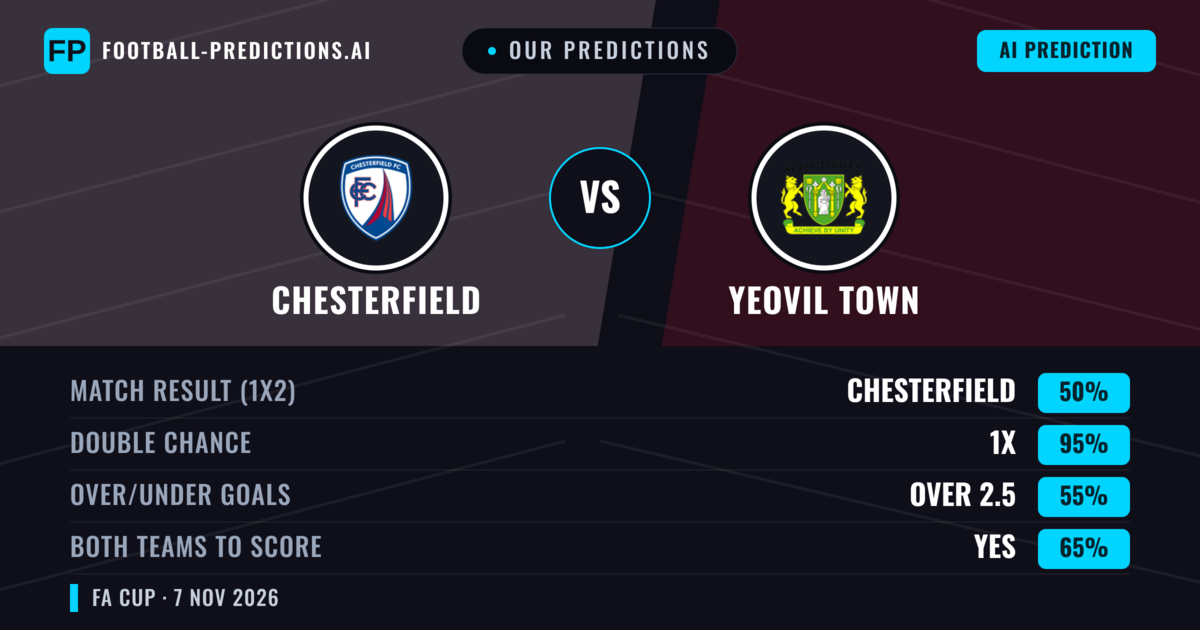
Chesterfield will host Yeovil Town in the FA Cup 1/128-finals at SMH Group Stadium on Saturday, November 7, 2026, with kick-off scheduled for 15:00. No bookmaker odds are published yet, so there is no market price from which to calculate an implied probability or identify a conventional value bet. The model instead assigns a 50% probability to a Chesterfield victory, 50% to a draw and 0% to a Yeovil win. That distribution makes the contest highly uncertain between the hosts and their visitors, despite placing the away side outside the model’s winning outcomes.
The primary selection is Match Result: 1, at a confidence level of 50%. Chesterfield’s home venue provides the central reason for favoring the hosts, and the model gives them a joint 50% chance of winning. However, the equal weighting for home and draw outcomes prevents this from being anything more than a cautious preference. A cup tie can remain level before a late decisive moment, and without published odds or further team-specific information, there is no defensible basis for assigning Chesterfield a stronger probability than the figure supplied. The selection should therefore be treated as a directional pick rather than a high-conviction forecast.
The goals-based outlook points to Total Goals: Over 2.5, with 55% confidence. This is a moderate projection and suggests that the model sees a reasonable route toward three or more goals, but it does not guarantee that the required scoring threshold will be reached. The absence of a firm draw or away-win probability gives the match more scope for an open result, particularly if Chesterfield’s home advantage encourages the hosts to push forward. Even so, the 55% confidence rating indicates that fewer than three goals remains a meaningful possibility.
Both teams scoring is supported by BTTS: Yes, at 65% confidence, making this the strongest of the four stated selections. The forecast indicates that the model anticipates each side contributing to the scoring, which fits a match in which neither Chesterfield nor Yeovil is given a clear winning probability. The more cautious market selection is Double Chance: 1X, at 95% confidence, reflecting the combination of Chesterfield winning or the match ending in a draw. For value-seeking punters, the key is to wait for actual prices before committing, because no best available odds or bookmaker-specific offers have yet been published and no decimal coefficient can responsibly be quoted.
Final Verdict: Chesterfield Favourable for a Home Result
Chesterfield versus Yeovil Town in the FA Cup 1/128-finals at SMH Group Stadium presents a fixture where the hosts offer the strongest platform for a positive result. Our match-result pick is Chesterfield to win, with 50% confidence, while the 1X Double Chance carries a substantial 95% confidence rating. That combination reflects the value of protecting the home side rather than requiring an outright victory.
The goal-based outlook is also encouraging: Over 2.5 goals receives 55% confidence, and BTTS Yes leads the recommendations at 65%. An open contest therefore appears preferable to the cautious 1X selection, as both teams scoring and a total of at least three goals could offer a sharper route into the match markets. Overall, Chesterfield win remains the central prediction, with goals and BTTS providing the supporting angles.