



China and New Zealand Return to Action in International Friendly
As the international calendar brings another window of competitive action, China and New Zealand prepare to meet in what promises to be an intriguing friendly encounter. Kickoff is scheduled for 12:35 BST on Sunday, September 27, 2026, giving fans across the region an afternoon slot to follow proceedings. Unlike the high-stakes qualifiers and tournament matches that often dominate the international schedule, this fixture offers both sides an opportunity to blood new tactical approaches and assess squad depth away from the pressure of points on the line.
For New Zealand, the timing of this match carries particular strategic significance. With another fixture scheduled just three days later, there exists a temptation to rotate the squad and preserve key personnel for subsequent challenges. This balancing act between gaining meaningful minutes and managing physical resources could shape how both managers approach selection and in-game substitutions. China, meanwhile, will be eager to establish momentum and test their preparations against a physically contrasting opponent that operates with different tactical principles.
International friendlies rarely carry the same analytical weight as competitive matches when assessing long-term trajectories, but they remain valuable crucibles for experimentation and development. The outcome here will not alter any league standings or qualification paths, yet both nations will view the result as a barometer for where their programs currently stand. How each side adapts to the other's style of play and manages the squad rotation implications could provide early indicators of their respective ambitions heading into the next phase of the international calendar.
Where the Clashes Between China and New Zealand Could Be Won and Lost
Sunday's Friendly International at 12:35 BST presents two nations at contrasting stages of their build-up cycles. China arrive with 110 days of rest behind them, having remained inactive since their last competitive fixture, while New Zealand have managed 92 days between games. That eight-day differential in preparation time could prove significant when it comes to tactical sharpness and set-piece readiness, areas where well-rested sides typically hold an edge over opponents who have been ticking over with fewer training days together.
China's recent output of two goals scored and two conceded across their recent matches suggests a side that struggles to dominate proceedings, though their defensive record has not been helped by the absence of clean sheets. They will likely look to establish a compact defensive shape and hit New Zealand on the transition, particularly given the visitors' quick turnaround ahead of another fixture in just three days. New Zealand, for their part, have failed to score in their recent games while keeping no clean sheets, indicating vulnerabilities at both ends of the pitch that their coaching staff will need to address. The rotation risk facing the New Zealand squad adds an extra layer of uncertainty, as key players may be rested, which could either freshen up their approach or reduce their collective cohesion on the day.
The tactical battle in this Friendly International is likely to hinge on which team can impose their style first. China's extended rest period should theoretically benefit their physical conditioning, but the lack of match rhythm can sometimes breed tentativeness in decision-making. New Zealand, despite their busier schedule and upcoming fixture, may prove dangerous if they can absorb early pressure and exploit spaces behind China's defensive line. Watch for the timing windows where both sides look to capitalise, as the first twenty minutes could set the tone for the entire contest given both teams' propensity for conceding rather than controlling matches.
New Zealand Holds the Edge in Recent Encounters
The head-to-head record between these two sides reveals a tightly contested recent history. Across their last two meetings, each team has managed to avoid defeat once, with one victory apiece and a share of the spoils in the other fixture. New Zealand secured a 2-1 victory in their most recent encounter, while their preceding meeting ended in a goalless draw. This pattern suggests that while New Zealand may hold a slight psychological edge from their latest result, China has proven capable of frustrating their opponents and earning at least a point from these matchups.
Goal-scoring patterns in this fixture have been relatively modest. The two matches combined produced an average of 1.5 goals per game, indicating that neither side has demonstrated a consistent ability to dominate offensively when facing the other. Additionally, both teams found the net in just one of the two meetings, resulting in a 50% BTTS rate. The prevalence of low-scoring outcomes and the frequency of clean sheets suggest that this fixture tends to be decided by narrow margins.
For bettors considering the historical trends, the data points toward another potentially tight contest. Neither team has shown a clear ability to assert dominance over the other, and the goal statistics indicate that another low-scoring encounter remains plausible. The even nature of the recent head-to-head record means that form in this particular fixture could play a significant role in determining the outcome, with neither side able to claim a psychological advantage based on past results alone.
Contrasting Momentum Sets the Stage for China-New Zealand Clash
The gulf in current momentum between these two sides could hardly be more stark. China arrive at this Friendly International fixture in reasonably solid shape, their recent trajectory punctuated by a hard-fought 0-0 draw against Thailand and an impressive 2-1 away victory over Singapore. Those results sit alongside a disappointing 1-2 defeat away to New Zealand earlier in their respective campaigns, though Branko Bianlic's men have otherwise demonstrated resilience, notably securing a 2-2 stalemate on the road against Uzbekistan and a commanding 2-0 home win over Palestine. With three wins from their last eight matches and just one defeat in that sample, China project an air of relative stability that contrasts sharply with their opponents' predicament.
New Zealand, by stark contrast, find themselves in freefall. The Football Ferns have claimed just one win from their last eight fixtures and enter this encounter on the back of five consecutive defeats. Their recent itinerary makes grim reading: a 1-5 thrashing at the hands of Belgium, a 1-3 loss to Egypt, a narrow 0-1 defeat away to England, and a humiliating 0-4 reverse against Haiti. The sole bright spot came via a 2-2 draw on the road against Iran, but that result feels like an anomaly rather than a turning point. Simply put, Michael Mayock's side arrive in poor shape, and the psychological weight of mounting defeats may prove difficult to shake heading into this fixture.
The statistical divide reinforces what the eye test suggests. China average 1.25 goals scored per match with a mean of just 0.75 conceded, translating to an impressive 50% clean sheet rate across their recent games. Their backline has proven considerably more reliable than New Zealand's, who ship an alarming 2.13 goals per fixture on average and have kept clean sheets in only 13% of their appearances. Both teams share an identical 50% BTTS figure, suggesting the possibility of goals at either end, but China's superior defensive structure — reflected in their 63% defensive rating compared to New Zealand's 38% — gives them a clear edge in the reliability department.
From a betting perspective, China's superior attacking metrics (reflected in their 100% attack rating versus New Zealand's 0%) underscore their likely dominance in the final third. The visitors' defensive vulnerabilities, compounded by their wretched recent form, make it difficult to envision them containing China's forward forays. While BTTS at 50% suggests neither defence is entirely airtight, the value proposition clearly lies with backing China to capitalise on New Zealand's disarray. The weight of evidence points toward a game where China's organisational solidity and goal threat overwhelm a New Zealand side still searching for answers after a string of heavy defeats.
China's Defensive Solidity Offers the Best Path to Profit in Tight Encounter
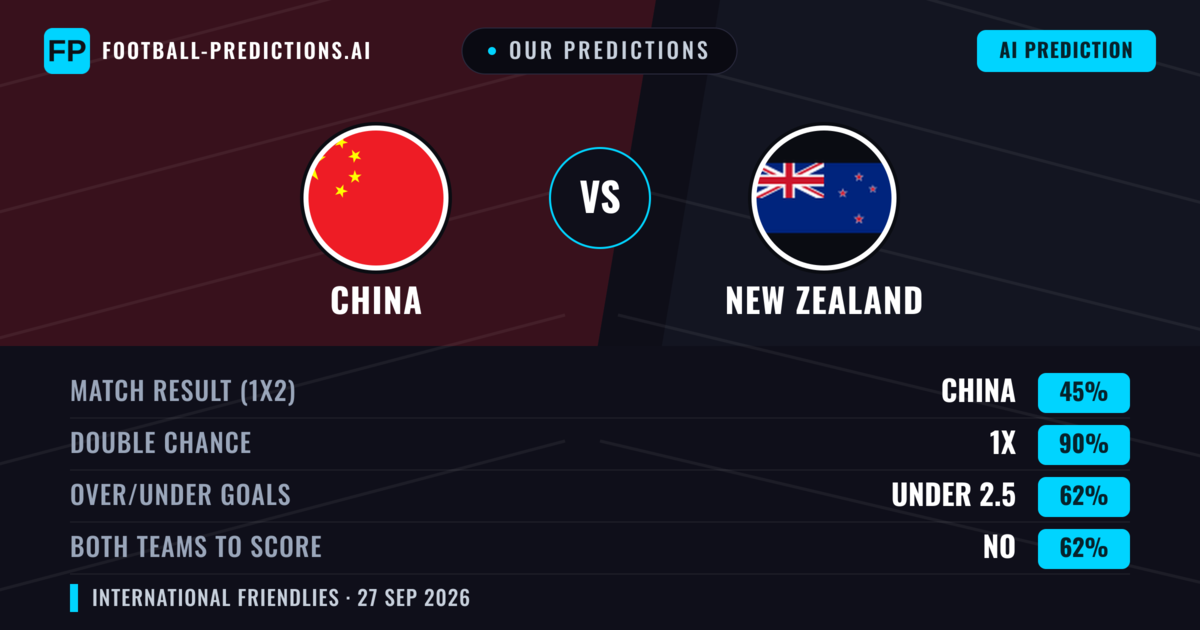
Sunday's friendly in the International Friendlies sees China playing at home against New Zealand, and the model gives the hosts a slight edge with a 45% win probability. What stands out immediately is how marginal this advantage is — the draw sits at an identical 45%, creating one of the closest calls imaginable. For bettors, this tight margin actually creates an opportunity: the Double Chance 1X prediction carries 90% confidence, making it by far the strongest signal in the data. Backing China to avoid defeat at that confidence level represents the most statistically sound approach available for this fixture.
The goal-scoring projections point toward a low-scoring affair. The under 2.5 total goals prediction holds 62% confidence, and this reflects the tactical approach both nations typically employ in friendly internationals. China has built a reputation for compact defensive structures when playing at home, while New Zealand often struggles to break down well-organized opponents on the road. The model anticipates a chess match rather than an open attacking spectacle, with both goalkeepers likely to remain relatively untroubled throughout the ninety minutes.
Supporting the under 2.5 projection is the strong BTTS No prediction, also sitting at 62% confidence. Neither side appears likely to find the net with any regularity, and this assessment aligns with historical patterns in Sino-Oceanic matchups. The absence of established goal-scoring threats in the New Zealand squad away from home compounds this expectation. China, for their part, have shown plenty of defensive discipline in recent home fixtures but have sometimes lacked the creative quality to unlock stubborn defenses — a factor that further supports the expectation of goals remaining scarce.
Given the absence of published bookmaker odds for this fixture, punters should monitor the markets closely once lines become available. The Double Chance 1X remains the standout selection at 90% confidence, offering protection against the very real possibility of a share of the spoils. Those seeking higher odds may find value in the under 2.5 goals market, though the lower confidence attached to that prediction warrants appropriate stake management. The fundamental picture is clear: this is a match where caution pays, and backing against goals and against a New Zealand victory represents the most rational approach to extracting value from the available data.
Our Verdict: China Look Solid for Home Victory or Draw
Taking all factors into account, China hold a clear advantage heading into this Friendly International fixture against New Zealand. The strongest signal comes from the Double Chance market, where 1X carries an impressive 90% confidence rating. Combined with the under 2.5 goals projection at 62% certainty and BTTS no also sitting at 62%, the data paints a picture of a tight, low-scoring contest where New Zealand may struggle to find the net.
While the straight win for China sits at 45% confidence — modest but still the most likely outcome — the safer approach aligns with backing the home side through the Double Chance market. A narrow Chinese victory or a hard-fought draw appears to be the most probable scenario, with both teams unlikely to produce an entertaining goalfest given the defensive signals in the data. Punters seeking value should consider the under 2.5 goals market alongside China's Double Chance as a composed, data-backed combination for this encounter.