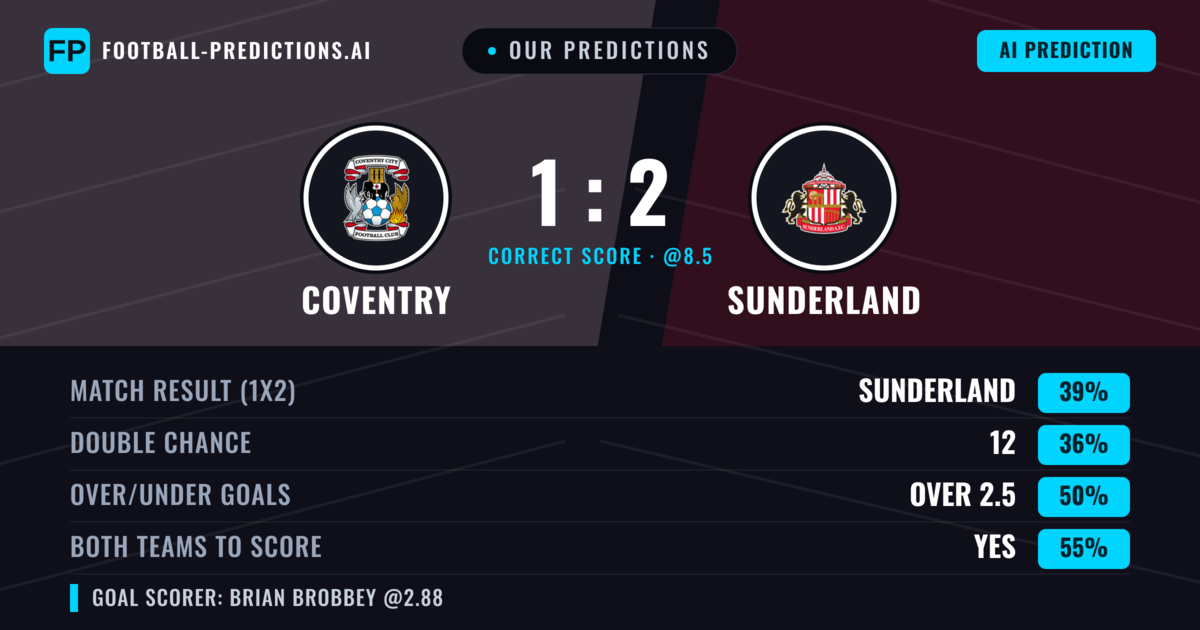







Coventry vs Sunderland: Relegation Pressure Shapes a High-Stakes Tactical Contest
Coventry and Sunderland meet at the Coventry Building Society Arena with two of the Premier League’s most urgent jobs waiting to be done. The central tactical question is straightforward: can Coventry turn the greater weight of home expectation into control, or can Sunderland impose enough structure and resilience to escape with a result that eases the pressure surrounding their recent performances? Neither side has supplied enough verified information about a fixed formation for this preview to pretend that positional certainty exists, so the emphasis must fall on roles, balance and the way each team manages the spaces between their units.
That lack of clarity does not make the match any less consequential. Coventry are 19th in Premier League with six points from eight games, while Sunderland sit 20th with five points from the same number of matches. The gap between the clubs is only one point, but the games behind them are likely to become increasingly important as the season develops. A home victory could lift Coventry away from immediate danger, whereas Sunderland could move level with their hosts or move beyond them by collecting their first points of the season in regulation.
The match takes place on Saturday, October 31, 2026, with kickoff at 15:00 GMT. Local readers can watch the game on Fubo and NBC. The surrounding numbers point toward a closely balanced contest rather than a conventional mismatch, although Coventry’s head-to-head record gives them an important historical edge and Sunderland’s market price suggests the visitors are not being treated as clear underdogs.
The Stakes at the Bottom of the Premier League Table
This is the ninth match of the Premier League regular season, but the competitive urgency is already substantial. Coventry’s six-point return has produced two wins and six defeats in eight games. That is not a record that suggests they have been comprehensively outplayed in every contest, but it does show how few points they have managed to retain from promising moments. Their home crowd and home venue therefore matter: this is a fixture in which marginal improvements in control, concentration and risk management could produce an disproportionate lift.
Sunderland’s five-point return offers a similar narrative of underperformance relative to ambition. They have one win, two draws and five losses, meaning several matches have delivered a point but not the follow-up result required to build momentum. In a relegation contest, draws can occasionally feel like half-gains, particularly for the side trying to climb away from the bottom, but a team with five points from eight games cannot afford too many sterile performances. Sunderland need progress that can be converted into full points, especially if they are to overturn Coventry’s historical advantage in this fixture.
Rest should not materially alter the balance. Coventry have had seven days and one game in the last ten days, while Sunderland have had six days and two games in the same period. The difference is negligible, and neither side can claim that fatigue has been suddenly removed by the schedule. More significant will be how each manager approaches the opening phase: Coventry will want the home crowd to create an urgent tempo, while Sunderland may prefer to deny them that momentum and make the game increasingly difficult as it enters its final stages.
There is also a useful contrast between the standings and the betting market. Coventry are one place above Sunderland, yet the main 1X2 prices make Sunderland the slight favourite. That is not an unreasonable reflection of their draw record and the greater number of matches they have managed to keep competitive, even though their goal-scoring figures have been modest. The market is effectively asking whether Sunderland can draw level in the table, while Coventry need to convert home advantage into the points that would establish a firmer platform.
Recent Momentum: Contrasting Routes Through the Last Five
Coventry’s supplied form string is LLWWL. The sequence contains two wins in a central stretch, but the most recent result is a defeat and the first two listed matches also ended without a Coventry victory. The longer sample of ten matches records four wins, no draws and six losses, with an average of 1.3 goals scored and 1.6 conceded per game. Coventry have therefore generally produced respectable attacking numbers without translating them into enough points.
The lack of draws is an important part of their profile. Zero wins in ten would be alarming, but four victories show that Coventry can convert games into outcomes. The issue is consistency: when they do not secure maximum points, they do not appear to have accumulated the draws that might have eased their position. That can influence tactical risk. A team chasing a result late in a match may accept greater exposure than it would in a one-point game, while opponents can play with less anxiety if defeat still leaves them ahead.
Coventry’s clean-sheet rate of 20% and BTTS rate of 30% are relatively modest. The latter means both teams scored in only three of their last ten matches, which suggests that zero-zero and one-goal scorelines have been more common than the higher-scoring outcomes sometimes associated with teams fighting relegation. The away attack may therefore gain value by controlling possession and reducing the number of transitions, rather than assuming that every low-lying fixture must become an end-to-end contest.
Sunderland’s listed form string is DDLWL. Their broader ten-match record of three wins, three draws and four losses is more resilient than Coventry’s, and it is one reason the away side carries a slight price favourite status. They average 0.9 goals scored and 1.4 conceded, so their attacking output is lower, but they also concede fewer goals and draw more frequently than Coventry.
The contrast between those two averages is important. Coventry create more goals but also allow more, while Sunderland score less and concede less. The first match against Coventry’s back line could therefore be determined by whether Sunderland’s forwards can find enough space to produce at least one decisive goal. For Coventry, the attacking task is clearer in numerical terms: they need to turn territorial or creative advantages into the higher scoring contribution that separates their average from Sunderland’s.
Sunderland’s BTTS rate of 40% is higher than Coventry’s 30%, while their clean-sheet rate is also better at 30% compared with 20%. Those figures point to an away team that is more capable of protecting a narrow advantage, especially when its defensive unit and midfield have managed to reduce open-play chances. A 0-1 result would fit their broader statistical profile, although it would also leave Coventry frustrated after failing to turn their attacking edge into a goal.
How the Tactical Battle Could Shape the Game
With no verified formation listed for either club, the safest tactical analysis focuses on the jobs required from each unit. Coventry’s first objective should be to establish a stable platform in midfield. Their superior goals-per-game average suggests they have found ways to generate attacking production, but zero draws in ten means they have not necessarily controlled enough of the overall match to protect leads. A cautious build-up could reduce the number of high-risk turnovers without abandoning the attacking ambition.
The home side must also decide when to apply pressure. A high starting tempo could expose Sunderland during the period when the visitors are still settling into their defensive responsibilities. Yet the same aggressive approach could become costly if Coventry’s forwards remain disconnected from midfield. The most productive version of their attack would likely involve quicker support play and an effort to attack through central areas rather than forcing crosses into a settled defensive block.
Coventry’s defensive unit faces a Sunderland side averaging 0.9 goals per game, which is not a severe scoring rate. That offers the home team some room to manage the game rather than defend continuously. The danger is that Coventry’s own 1.6 goals conceded per game shows how quickly games can become difficult when their structure is interrupted. Rather than chasing an unrealistic clean sheet, they may benefit from concentrating on preventing Sunderland’s most productive attacking transitions.
Sunderland, by contrast, can use Coventry’s home urgency as an opportunity. Their higher clean-sheet figure and better goals-conceded average suggest that an organised defensive approach is realistic. The visitors need to make Coventry work for each forward entry, absorb the early pressure and then create controlled counterattacking moments when the home side has moved numbers forward. This is especially relevant because Coventry’s defensive concession rate is higher than Sunderland’s.
The visitors’ midfield must also avoid becoming too passive. Drawing three times in ten shows Sunderland can compete without necessarily taking the game to the opponent, but two of the listed five-match form sequence also ended in defeat. A purely defensive blueprint could protect a point while allowing Coventry to regain confidence. Sunderland therefore need enough controlled possession to ensure Coventry cannot camp in front of them.
Set pieces and second balls may become important because the season averages do not point to either side being consistently prolific. Coventry’s forward line has a collective edge in output, but without verified individual statistics, it would be unsafe to identify a specific scorer. Sunderland’s approach can instead be judged in collective terms: can their delivery, movement and finishing produce the single goal their averages suggest they may need? The away team does not have to dominate possession to remain competitive, but every successful transition should carry greater tactical purpose.
Game-state management could ultimately decide the fixture. If Coventry score first, Sunderland must open up and thereby increase the possibility that the hosts produce a second goal. If Sunderland lead, Coventry’s attacking urgency may generate pressure, but it also gives the visitors counterattacking space. The first goal therefore may be worth more than the raw pre-match percentages imply, not because goals always deserve an automatic tactical premium, but because both teams are likely to alter their risk profile once the scoreboard changes.
Individual Influence Without Invented Lineups
Coventry have no individual player data available, so it would be irresponsible to name likely starters or attach statistics to members of their squad. Their key contributors must instead be assessed by role. The central attacking unit will be responsible for converting the home side’s superior goals-per-game average into an early lead, while their midfield must supply enough quality to keep possession from becoming a sequence of direct, predictable attacks. At the back, the most important collective task is to reduce transition chances against a Sunderland side that has conceded fewer goals than Coventry.
Sunderland have one verified name in the supplied key-player data: N. Angulo, who has scored one goal and recorded no assists. Those figures make Angulo the only individual whose contribution can be referenced with confidence, but they also show how much of Sunderland’s output is collective rather than concentrated around one prolific scorer. Angulo’s importance may therefore extend beyond his goal total through his involvement in Sunderland’s attacking structure, although no specific position or tactical responsibility has been provided.
The wider Sunderland attacking group has to create more than isolated individual moments. A single scorer can alter the balance of a match, but Coventry cannot be allowed to focus exclusively on stopping one route to goal. Sunderland’s chance creation will depend on how effectively the visitors combine their forward line with midfield support and how they turn possession into entries that test Coventry’s defensive unit.
Historical Pattern: Coventry’s Head-to-Head Edge Faces a More Complicated Recent Picture
Across the last 11 meetings, Coventry have won five, drawn five and lost once. That is a commanding historical advantage, particularly when compared with Sunderland’s single victory. The overall pattern supports the home side more strongly than the current standings do. Coventry have not been routinely dismissed in this fixture, and Sunderland’s recent head-to-head win should be placed in the context of a series in which they have otherwise struggled to dominate.
The average of 2.91 goals per meeting is relevant to the current tactical discussion. It suggests these fixtures have historically tended to produce more goals than the recent average-match totals of both clubs, while the BTTS rate of 64% indicates that both teams scoring has been common. The listed recent meetings support that scoring pattern: 1-2, 3-0, 2-2, 3-0 and 0-0 produced a mixture of comfortable margins, draws and a stalemate.
The most recent meeting ended with Sunderland winning 2-1 away, but the sequence immediately before it included a 3-0 Coventry victory and a 2-2 draw. Coventry also won 3-0 in the other listed meeting at Sunderland’s ground, while the remaining 0-0 result further demonstrates that these teams have not always combined to produce a goal. Historical superiority does not automatically translate into current superiority, especially given the uncertainty over personnel and formation, but it does mean Coventry should not be treated as easy underdogs.
That historical strength also sharpens the value question. The 1X2 market makes Sunderland only a narrow favourite despite Coventry’s five wins and five draws in the previous 11 meetings. A market price can incorporate current context that a long-term head-to-head sample cannot, so the discrepancy is not automatically a mispricing. It is, however, a reason to examine whether Coventry’s home advantage and historical matchup record are being underweighted.
Betting Analysis: Where the Price Offers a Defensible Edge
The main 1X2 market lists Coventry at 2.8, the draw at 3.3 and Sunderland at 2.45. The supplied implied probabilities are 33.4% for Coventry, 28.4% for a draw and 38.2% for Sunderland. Working directly from the listed prices produces raw probabilities of approximately 35.7%, 30.3% and 40.8%, respectively, before allowing for the bookmaker’s margin. The practical conclusion is that Sunderland are a slight favourite, but the market does not view them as overwhelming favourites.
For local price comparison, Bet365 lists Coventry at 2.7, the draw at 3.3 and Sunderland at 2.5. Those prices translate to raw implied probabilities of roughly 37.0%, 30.3% and 40.0%, producing an overround of about 7.3%. Coventry’s slightly shorter Bet365 home