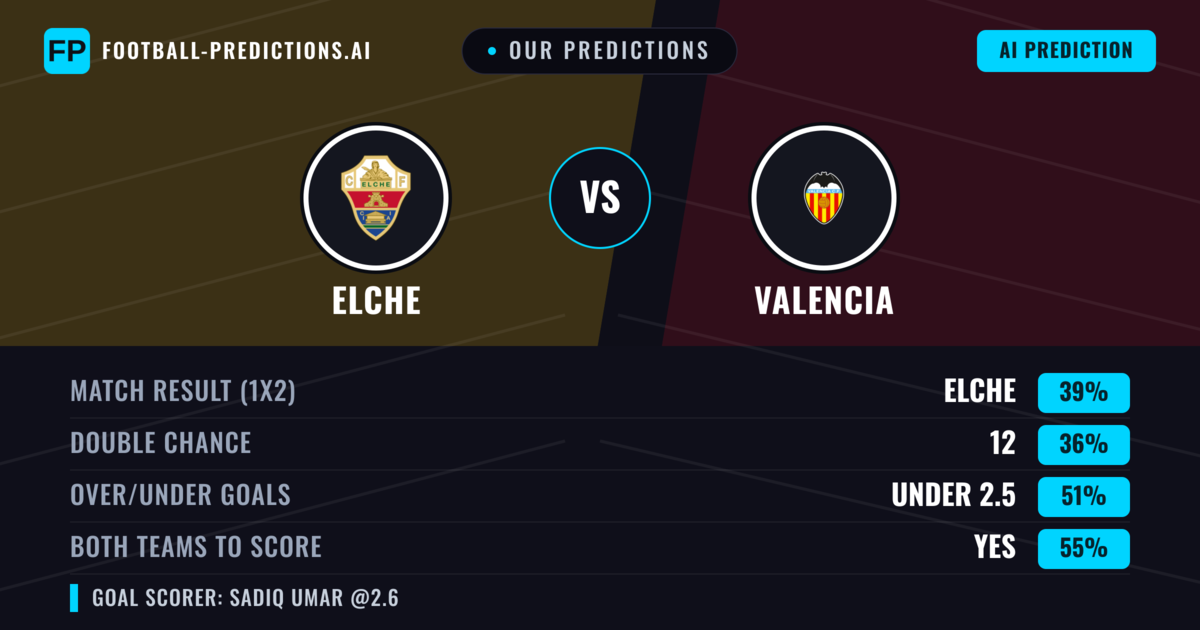







Elche vs Valencia: Survival Pressure Meets a Home-Form Advantage
Four points separate 15th-placed Elche from 19th-placed Valencia after both sides have played ten La Liga matches, yet the pressure surrounding this fixture is not evenly distributed. Elche have collected 10 points and arrive with a WDDWL form sequence, while Valencia have six points and a LDDLW sequence that leaves them fighting relegation. The numbers make the home side the stronger performer on the table, but Valencia’s greater need for points could sharpen their approach at Estadio Manuel Martínez Valero. With kickoff at 17:30 (GMT, London time) on Sunday, November 1, 2026, this is a meeting between a side looking to consolidate its position and another under immediate pressure to arrest a difficult start to the season.
Why Four Points Can Feel Like a Bigger Gap
Elche’s 10 points represent two wins and four draws from ten games, whereas Valencia’s six points come from one win and three defeats in the same number of matches. That gives Elche a four-point advantage, although the standings also reveal how narrow the productive margin remains for both clubs. Neither side has won frequently enough to pull away from the pressure around them, and Valencia’s position makes every home match against a team with marginally better momentum a potential opportunity to change the direction of their La Liga campaign.
The comparison model also provides a slight edge to Valencia overall, with 54% against Elche’s 45%, despite the table and recent-form evidence pointing toward Elche. This creates an important analytical tension. Elche have the better league position, the stronger last-five sequence and the higher scoring rate, while Valencia receive the larger motivation weighting because their relegation position is considerably more precarious. The model is therefore not predicting a straightforward home win; instead, it suggests that Elche have the stronger baseline performance while Valencia have the stronger reason to compete aggressively.
- Elche: 15th in La Liga, 10 points, 10 games played, W2 D4 L4.
- Valencia: 19th in La Liga, 6 points, 10 games played, W1 D3 L6.
- League gap: Elche lead Valencia by four points.
- Table incentive: Valencia are explicitly identified as fighting relegation, while no additional special incentive is flagged for Elche.
Elche’s Recent Momentum Has Been More Dependable
Elche’s WDDWL sequence provides the clearest statistical reason for cautious confidence in the home side. Only two of their last five matches produced a defeat, and the team’s broader averages show 1.4 goals scored and 1.7 conceded per match. Those numbers do not describe an immaculate attack, but they do indicate that Elche have consistently generated enough output to remain competitive. Their four draws also point to a team that has often found a way to protect a game when fully converting every chance or avoiding defensive errors has been difficult.
The attacking average of 1.4 goals per match is twice Valencia’s 0.7, while Elche’s 60% both-teams-to-score rate is 20 percentage points above Valencia’s 40%. That combination suggests two different ways in which Elche’s matches have developed. They have generally been more productive than Valencia, but their games have also more often featured goals from both sides, indicating that their defensive structure has not consistently delivered a clean sheet. Elche’s clean-sheet rate of 30% is identical to Valencia’s, so the distinction is not simply that Elche defend better; they have also been more willing or more capable of attacking.
Valencia’s LDDLW sequence tells a more concerning story. The three draws inside their last five show that they have been capable of resisting defeat, but only one victory confirms that turning defensive resistance into a winning result remains an unreliable process. Their 0.7 goals per match is the weakest scoring figure in the direct comparison, and it limits the value of their urgent motivation. A team chasing points cannot rely solely on defensive effort if it produces too few chances, especially against an opponent whose recent matches have yielded 1.4 goals per game on average.
Both teams have conceded 1.7 goals per match, making the difference in scoring efficiency especially relevant. Their defensive outputs are level on the supplied averages, but Elche create twice as many goals. In practical terms, Valencia may have to take greater tactical risks to generate an attacking advantage, while Elche can be more selective. That does not automatically translate into a home victory, but it strengthens the possibility that Elche remain competitive for long periods even if Valencia push forward late.
The Attacking Balance Behind Elche’s Advantage
Elche’s only named attacking contributor in the available player data is Marc Aguado, who has recorded one goal and no assists. That is not enough evidence to portray him as the team’s central attacking figure or to make a player-specific prediction, but it does provide one concrete point of reference. Elche’s scoring output is therefore collective rather than dependent on a documented leading scorer. Their 1.4-goal average has been generated across the team, and their likely chance-creation burden will fall on the forward line and the midfield supply behind it.
No individual player data is supplied for Valencia, so it would be inappropriate to attach a name to their forward line, midfield or defensive unit. Instead, the tactical focus should be on collective roles. Valencia’s front line must find ways to move beyond the 0.7 goals-per-match baseline, whether that means creating more central opportunities, pressing higher after losing possession or improving the service from midfield. Their defensive unit has kept the same 1.7-goals-conceded average as Elche, so the challenge is not simply to preserve that level but to provide the attacking unit with a platform from which the greater urgency of their league position can produce a result.
The 60% BTTS rate for Elche is important because it suggests that clean sheets have not been their defining defensive feature. Their matches have often been open enough for both scoring sequences to emerge, while Valencia’s 40% BTTS rate points to a more cautious or less productive pattern. A reasonable tactical interpretation is that Elche’s attacking approach has generated more exchanges, whereas Valencia’s lower output may reflect a greater emphasis on limiting damage. Both descriptions remain general because no confirmed formations are provided, and they should be treated as tactical expectations rather than reported set-ups.
A Tactical Contest Without Confirmed Formations
The season-statistics section contains zeroes for goals scored, goals conceded and clean sheets, while also leaving the formations blank. Those entries conflict with the more coherent form averages and therefore cannot be used as reliable tactical evidence. No formation should be assigned to either side, and any tactical preview must remain structural rather than positional. What can be assessed is how their available averages and standings imply that each team is likely to manage the game.
Elche can begin with a more balanced objective: protect their home position, remain difficult to beat and use their superior scoring rate to create enough pressure to make Valencia chase. Since Elche have produced four draws in ten matches, maintaining that pattern would be understandable if the game remains finely balanced. Yet the home crowd and the four-point table advantage may allow them to be more assertive than in previous matches, particularly if Valencia’s urgency exposes space in transition.
Valencia, by contrast, have little scope for passive management. Sitting 19th in La Liga with only six points means their tactical choices are likely to be shaped by the need for at least one positive outcome rather than by a comfortable margin for experimentation. Javier Aguirre is confirmed as Valencia’s manager, according to Mundo Deportivo, but no further tactical details about his preferred formation or approach are provided. The safe conclusion is that Valencia will seek greater urgency without knowing precisely how that urgency will be structured on the pitch.
The central tactical question is whether Valencia can increase their attacking output without worsening the defensive numbers that already match Elche’s 1.7 goals conceded per match. If they push too aggressively and lose the ball in dangerous areas, Elche’s higher scoring rate becomes more relevant. If Valencia remain too cautious, they risk repeating the pattern reflected in their 0.7-goal average and failing to turn the match into a meaningful result. Elche’s best route to victory is likely to make Valencia carry more of the game while remaining efficient enough to punish their defensive unit.
Head-to-Head History Adds Context, Not Certainty
Valencia have won seven of the last 12 meetings, Elche have won three and the remaining two ended in draws. That historical edge belongs to the visiting side, but the most recent meeting in the supplied list points in Elche’s direction: Elche won 1-0 at home on April 11, 2026. Their previous encounter on January 10, 2026 finished 1-1, making it the only draw among the five most recent listed meetings and reinforcing how closely this fixture has recently been contested.
The older meetings in the sample also contain higher-scoring and lower-scoring examples. Valencia won 2-0 away on April 23, 2023, while the October 15, 2022 meeting ended 2-2. Valencia also won 1-0 away on March 19, 2022. Across all 12 meetings, the average has been 2.58 goals and BTTS has occurred in 58%. These figures suggest a history in which goals are often relevant, but they do not override the immediate evidence: Elche have the better current scoring average, Valencia have the worse attacking output, and the most recent listed meeting was settled by only one goal.
History also reinforces the value of caution around the away side. Valencia’s seven wins in 12 establish that they have repeatedly found ways to beat Elche, yet the current table and form do not support treating them as a strong away team. The historical pattern is best treated as background context rather than a decisive forecasting input. Elche’s most recent home success, Valencia’s recent away victory and the intermediate 1-1 all point to a fixture that can remain tight even if the standings create an imbalance in motivation.
Team News: A Limitation for Valencia’s Midfield
Goal.com reports that Valencia’s David Otorbi suffered a hamstring injury and was carried off during the match against Villarreal. The information confirms the injury but does not explicitly establish his availability for Elche, so it would be inaccurate to claim that he is definitely absent or definitely unavailable. What can be said is that Valencia’s midfield options have been affected by a reported hamstring problem, creating potential uncertainty around selection and balance in the central areas.
That issue may be particularly relevant because Valencia need to improve their 0.7 goals-per-match output. If Otorbi’s absence or limited fitness restricts the midfield, Valencia may find it harder to supply their forward line or sustain pressure when Elche regain possession. Yet the evidence does not permit a stronger conclusion, and no other injury, suspension or fitness issue should be inferred. Elche have no verified player-specific update in the supplied material.
Both sides have also had eight days’ rest and played one match in the last ten days, meaning there is no meaningful rest disadvantage attached to either team. The practical difference is psychological and positional rather than physical. Elche can prepare around improving their position, while Valencia must create urgency while avoiding the kind of disorganisation that can expose them to Elche’s more productive attack.
The Betting Picture: Small Edges, No Blind Chases
The supplied 1X2 market lists Elche at 2.4, the draw at 3.25 and Valencia at 2.8, corresponding to implied probabilities of 38.5%, 28.5% and 33%. Bet365’s local