



Lugano Seek Control as Kauno Žalgiris Face a UEFA Conference League Turning Point
The stakes at AIL Arena are straightforward in shape but demanding in substance: FC Lugano host Kauno Žalgiris in the UEFA Conference League league stage with momentum, structure and a large first-place price advantage pointing in their favour. Lugano arrive having won five consecutive matches, sit 2nd in the UEFA Conference League with six points from two games and have scored six goals while conceding only once. Kauno Žalgiris, by contrast, have lost five of their last ten matches, sit 36th with no points and enter the match on the back of an L-W-L-L sequence in their latest five-game run.
This is a cup competition rather than a domestic fixture, and the league stage still carries substantial importance because every point can shape the route toward qualification. Lugano do not need to treat the match as though their advantage guarantees a place beyond this round; they need to convert control into a productive performance. Kauno Žalgiris have considerably more immediate corrective work to do, yet a disciplined away performance could slow the home side and create a match in which one moment decides the outcome.
The available evidence strongly favours Lugano. Their home price of 1.17 reflects that imbalance, while Kauno Žalgiris are priced at 15 by Bet365 for a local kickoff at 20:00 on Thursday 5 November 2026. Yet the strongest judgement is not merely that Lugano should win. It is that the gap in current form, scoring efficiency and tactical coherence should be visible enough to influence more than the 1X2 market.
The Value of a Third League-Stage Game
Neither club can afford to treat the UEFA Conference League league stage as a soft run of fixtures. Lugano’s perfect two-game start has given them the platform to build momentum, but Kauno Žalgiris’ opening two defeats mean that pressure is already accumulating around their campaign. The table positions supplied for this match—2nd and 36th in the UEFA Conference League—show the competitive distance between the sides, although the standings alone do not describe the full risk.
Lugano’s task is to preserve their strong start without becoming complacent. Kauno Žalgiris cannot demand an unrealistic comeback from the opening of the match, but they can look for signs of hesitation in the home team and make the first hour difficult. Every UEFA Conference League match also carries the wider emotional weight of continental competition: progress can change the shape of a season, while a poor run can turn one defeat into a damaging sequence before qualification has been settled.
That makes this more than an exercise in protecting a strong record. Lugano should seek a performance that demonstrates their attacking superiority and allows them to manage their workload, while Kauno Žalgiris need evidence that they can compete in a structured match against a leading side. The competition setting raises the stakes without changing the basic analytical picture: Lugano are better placed to control the game, and Kauno’s most credible route to frustrating them is through organisation rather than an open exchange.
Recent Momentum: Form That Points in Opposite Directions
Lugano’s form is the foundation of the home case. The exact run is W-W-W-W-W across the last five listed matches, and the wider sample is equally imposing: nine wins, one draw and no defeats from 10 matches. Their goals-scored average is 3.1, their goals-conceded average is 1.1, both teams have scored in 70% of those matches and they have kept three clean sheets.
Those numbers describe more than an unbeaten record. Lugano have combined the ability to score with a defensive solidity that makes it difficult for opponents to remain in the match. A rate of 3.1 goals per match points to sustained attacking pressure, while conceding 1.1 suggests that their control is not entirely dependent on outscoring chaotic exchanges. The UEFA Conference League figures reinforce that picture: six goals scored, one conceded and one clean sheet in two matches.
Kauno Žalgiris arrive with a very different profile. Their last-five form string is L-L-W-L-L, although the wider ten-match record is less severe than that sequence alone: three wins, two draws and five defeats. They have scored at an average of 0.8 and conceded 2.1, with both teams scoring in 40% of matches and three clean sheets recorded. Their UEFA Conference League numbers are four goals scored and three conceded across two games, but neither victory nor a point has followed.
The important distinction is between the severity of the sample and the direction of the current run. Kauno have demonstrated that they can win and that they can score, but the latest sequence ends with four defeats in five. Lugano, by contrast, have not merely stayed competitive; they have won every listed match in their recent run. For a cup match at this stage, that difference can influence confidence, pressing intensity and the willingness to continue pushing after the opening goal.
Tactical Preview: Two Structures With Different Routes to Control
Lugano are expected to operate in a 3-4-2-1, according to the supplied season information. That structure naturally supports a strong central attacking presence, two advanced midfield positions and width from the wing-backs. Kauno Žalgiris are listed in a 4-1-4-1, which gives them a clear defensive base, a protected midfield pivot and a lone forward reference point.
The tactical question is whether Lugano can use their front three and advanced midfield support to pull Kauno’s defensive unit out of position. In the 4-1-4-1, the most important collective battle should occur between Kauno’s midfield line and the space behind it. Lugano’s two advanced central players can create vertical passing options, while the wide outlets stretch the back line and potentially isolate its defenders. The objective would not simply be to send crosses into the box; a productive home side would make Kauno defend in several directions at once.
Kauno’s approach should be compact and selective. With a defensive line of four, a holding midfielder and four attacking midfielders, the visitors can attempt to reduce the central space available to Lugano and force play toward the flanks. The risk is that sustained pressure eventually stretches that structure. If the home side moves the ball quickly between the centre and the wings, Kauno may have to choose between protecting the middle and helping at the sides.
Because no player-level information has been supplied, individual names should not be attached to particular roles. The decisive participants will instead be defined by function: Lugano’s central forward and attacking midfield pair, the wing-backs responsible for delivering width, the central midfield unit that supplies the second wave, and the defensive line in front of the home goalkeeper. For Kauno, the key roles are the defensive unit, the midfield screen, the four attacking midfielders and the forward line. Their quality in those collective functions will determine whether the away side can make the match competitive.
Rotation is the principal complication in Lugano’s preparation. The verified schedule information shows that the club has had four days’ rest and has played one game in the last ten days, while Kauno have had 14 days’ rest and have not played in that period. Lugano also play again in three days in another competition, so there is a clear rotation risk. The home side may use this game to preserve energy for that forthcoming fixture, potentially withdrawing attacking or creative players during the latter stages if the match is already secure.
That does not necessarily weaken the home win case, because the baseline gap is substantial. It does, however, make the timing of the strongest performance important. Lugano should seek to establish control and a lead before their workload becomes harder to manage. Kauno, conversely, may be able to sustain greater pressure late in the match than a team managing a congested schedule would normally accept.
Where the Match Will Be Won
Lugano’s 3-4-2-1 should create a three-versus-three problem around Kauno’s back three. If the home team can establish possession in the attacking third, the away side may become trapped between defending the centre and protecting the wings. The forward line’s ability to occupy central defenders will matter, but so will the timing of runs from the advanced midfield pair.
Kauno cannot rely on defending passively. A 4-1-4-1 that simply drops behind the ball risks allowing Lugano to dictate every phase. The visitors need their midfield to carry the ball out with controlled passes, enabling the front line to move toward Lugano’s defensive unit. Even modest spells of possession would reduce the home side’s scoring rhythm and make it harder for them to build a large lead.
The duel between the teams’ midfield structures is therefore crucial. Lugano want to progress the ball into dangerous areas before Kauno can recover their shape. Kauno want to disrupt those first forward passes and move play away from the defensive third. Whichever side wins that phase should dictate the broader terms of the match.
Set pieces may also matter, although the supplied information does not provide specific set-piece numbers. Rather than inventing a statistical advantage, the prudent conclusion is that dead-ball situations deserve attention because they can interrupt momentum and reward the team that organises its defensive unit more effectively. Lugano’s home setting and attacking numbers suggest they are capable of creating pressure, while Kauno’s three clean sheets from ten matches show that a low event count remains possible when their defensive shape holds.
Head-to-Head: No Reliable Pattern to Claim
No head-to-head history has been provided for this fixture, and it would be inappropriate to manufacture a supposed precedent or claim that either club has repeatedly beaten the other. The absence of that information limits one traditional avenue of analysis, particularly because past meetings would normally help establish familiarity, emotional context and recurring tactical outcomes.
The available current data offers a clearer route. Lugano are unbeaten in the UEFA Conference League, while Kauno have lost both of their matches there. Lugano have also produced a five-match winning sequence, compared with a latest run of L-L-W-L-L for Kauno. In a contest where historical patterns are unavailable, the strongest measurable evidence is the contrast between the two teams’ present trajectories.
That does not make the match automatic. A cup competition can expose differences in risk appetite, and an away team with nothing to lose in the standings may play more freely than its results suggest. But when the available evidence points in the same direction from form, goals, defensive record and market price, there is no need to manufacture a head-to-head narrative to support it.
One Market View: Odds, Implied Probabilities and the Sharpest Angles
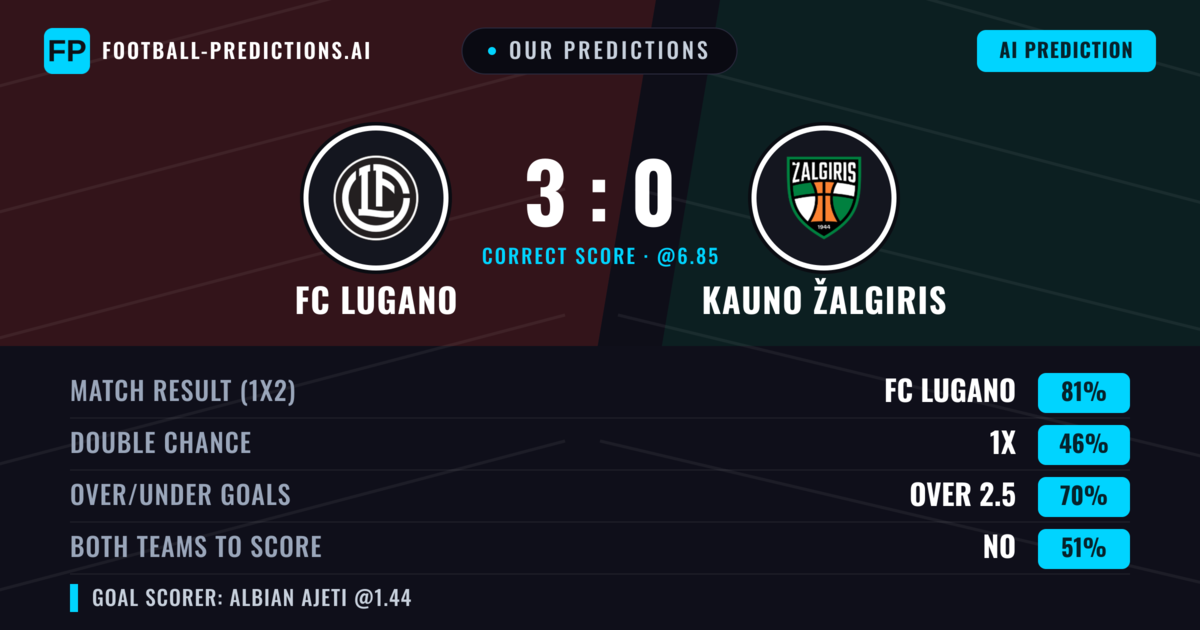
The supplied 1X2 prices are 1.17 for Lugano, 7 for the draw and 13 for Kauno Žalgiris, while the local Bet365 reference lists 1.17, 7 and 15 respectively. The 1.17 home price produces a raw implied probability of approximately 85.5%. The draw at 7.00 implies 14.3%, while 13.00 for the away side implies 7.7%. Taken together, those raw figures exceed 100% because the bookmaker margin is built into the prices. The supplied normalized probabilities are 79.5% for the home side, 13.3% for the draw and 7.2% for Kauno Žalgiris, which is the more appropriate guide when comparing the full market.
Even the conservative reading of those normalized figures leaves Lugano with a commanding favourite status. The market agrees with the form analysis: a home victory is the central expectation, and the short price itself communicates how much separation the bookmaker sees. This is also why the home win should not be confused with automatically attractive value. At 1.17, the return is limited, and the price leaves little room for an unexpected dip in Lugano’s performance.
The strongest recommended result prediction is FC Lugano to win, with 81% confidence. That confidence is slightly above the normalized market probability and rests on the combination of five consecutive wins, nine wins in ten overall, a 3.1 scoring average and Kauno’s four defeats in their latest five matches. The number is also marginally below Lugano’s raw 85.5% implied probability, which prevents the analysis from becoming more confident than the price itself. This is a sound directional selection, but the compact price reflects that it is the most likely result rather than necessarily the largest value.
For the total-goals market, the data supports over 2.5 goals, with 70% confidence. Lugano’s 3.1 goals-scored average naturally supports a high-total interpretation, and their 3-4-2-1 gives them several ways to attack. Kauno’s 2.1 goals-conceded average against a team of Lugano’s attacking quality also points in that direction, although the absence of a supplied actual over/under price prevents a genuine price-value calculation. The selection should therefore be treated as a data-led market view rather than a quoted wager at an assumed price.
No bookmaker price for over/under or for both teams to score was included in the supplied odds, so it would be inaccurate to claim that either outcome is underpriced at a specific figure. The forecast for the goals market is both teams to score: no, with 51% confidence. The modest confidence level reflects a genuine tension: Lugano’s attacking output and Kauno’s 40% both-teams-to-score rate create risk, but Lugano’s 30% clean-sheet rate, their one goal conceded in two UEFA Conference League matches and Kauno’s 0.8 goals-scored average support the possibility that the visitors do not convert enough chances to make the sides’ scoring rates overlap.
The supplied double-chance price is 1.03 for 1X and 4.8 for X2, with 1.08 for 12. The corresponding market view is double chance 1X, with 46% confidence. At 1.03, this protects against a draw but offers virtually no margin, and the confidence figure is correspondingly lower than for the Lugano win. Its appeal is as insurance rather than as a primary value proposition: it becomes relevant if the forecast is right about Lugano avoiding defeat but wrong about the timing of the result.
Asian handicap provides the most interesting alternative route to support the home side. Lugano -1 is priced at 1.21, with Kauno +1 at 3.98, while the -1.25 line is available at 1.38 and Kauno +1.25 at 2.99. The -1.25 price requires a two-goal home victory for the full stake to win, whereas -1 offers a better balance between the strong home expectation and the possibility of a one-goal margin. Given Lugano’s three-goal scoring average and Kauno’s two-goal conceded average, the handicap can be more attractive than simply backing the 1.17 home win because it offers a stronger return while still being anchored in the same clear hierarchy.
The handicap does carry risk. Lugano’s verified schedule includes another match in three days, and rotation could reduce the intensity or continuity of their starting lineup. If the home side manages the tie efficiently, a one-goal margin could become insufficient at -1.25. The best way to interpret the prices is that 1.17 identifies the most likely winner, 1.21 on Lugano -1 expresses confidence in a controlled margin, and 1.38 on -1.25 asks for a more emphatic performance than the basic home-favourite market demands.
For readers seeking UEFA Conference League prediction and UEFA Conference League betting tips, the hierarchy should therefore be clear: Lugano’s 1X2 price is directionally secure but low-yield; Lugano -1 is the more expressive handicap alternative; over 2.5 has the strongest statistical support among the goal markets; and a no-both-teams-to-score view is plausible but not forceful enough to rank above the other conclusions. The absence of supplied prices for total goals and both teams to score also means those selections should be checked against the live market before any wagering decision is made.
Final Assessment
Lugano have the form, tactical fit and statistical profile to control this UEFA Conference League match. Their unbeaten run, 3-4-2-1 structure and capacity to create roughly three goals per match contrast sharply with Kauno Žalgiris’ L-L-W-L-L sequence, 4-1-4-1 setup and limited 0.8 goals-per-match output. The home side should be able to dictate territory and generate the clearer chances, provided they begin with urgency rather than allowing fixture management to slow their opening.
Kauno Žalgiris’ best route is not an all-or-nothing pursuit of the away win. Compact defending, rapid counterattacks and a refusal to allow Lugano’s advanced midfielders to turn freely can keep the contest within reach. The 14-day rest advantage may help them play with freshness late, while Lugano’s forthcoming match creates the possibility of controlled rotation. Those factors are significant enough to caution against treating a one-goal home victory as impossible.
Even so, the evidence points most firmly towards a Lugano win at AIL Arena. The expected match narrative is a home team applying the pressure, an away side trying to remain compact and transition