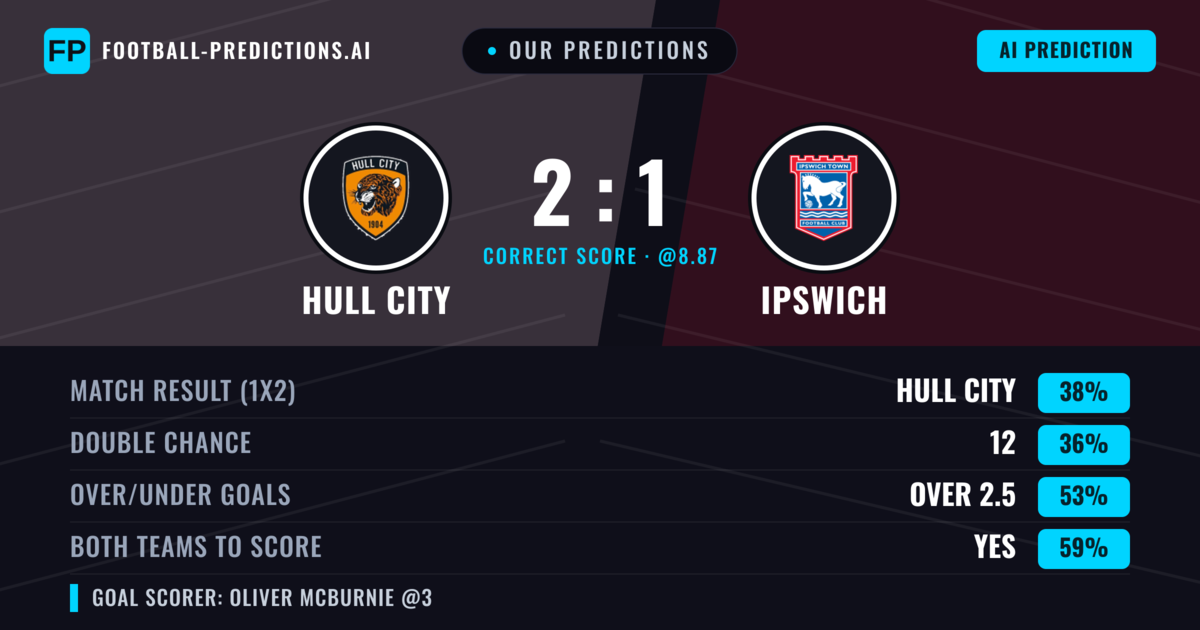







Hull City vs Ipswich: The MKM Stadium Test for a Tight Premier League Contest
S. Ajayi and J. Clarke are the names most likely to decide this contest, although the wider evidence suggests neither match will be settled by one isolated moment. Hull City’s leading scorer has one goal and no assists in the supplied season data, while Ipswich’s J. Clarke carries the same modest attacking return. Their value therefore lies less in established output and more in the space each may receive. With Hull set up in a 5-4-1 and Ipswich holding a 54% edge in the comparative attacking rating, the decisive question is whether Ipswich can turn territorial pressure into enough chances to breach a home side whose defensive comparison is considerably stronger.
The stakes are straightforward but meaningful in a Premier League contest where both clubs occupy the lower reaches of the top ten. Hull City are 10th in Premier League with 10 points from eight games, while Ipswich are 12th in Premier League with 10 points from the same number of matches. Neither position carries a specific qualification incentive, but the equal point totals mean a result here could reshape the short-term order around them. Hull’s compactness may be more effective against a direct opponent, whereas Ipswich’s greater attacking potential gives them a route to moving level and, with it, overtaking Hull.
This is a regular-season fixture in Round 9, scheduled for Saturday, October 31, 2026, at MKM Stadium. Local readers can watch the match on NBC, with kickoff at 15:00 GMT, London time. The setting gives Hull a clear familiarity advantage, although that should not be confused with evidence of superiority from the recent head-to-head record. Indeed, Ipswich have won each of the two most recent listed meetings and took three points from five of the latest five encounters. The market has consequently priced the teams almost symmetrically, presenting a genuine contest rather than a conventional home-favourite scenario.
Hull’s Route to Control the Tempo
Hull City’s listed five-match form is DLDLD, indicating that the sequence contains no victory despite two draws. The accompanying form summary is broader, covering 10 matches in which Hull recorded four wins, four draws and two defeats. This creates a minor but important data inconsistency, since the aggregate figures do not align perfectly with the five-letter sequence. The safest conclusion is that Hull’s recent results have been difficult to turn into wins, but that the wider performance sample has still been relatively stable. Their goals-scored average stands at 1.2, while the conceded average is 0.8.
That defensive record is Hull’s clearest advantage in the percentage comparison. The supplied ratings give Hull 65% in defense compared with only 35% for Ipswich, producing an overall rating of 44% against Ipswich’s 56%. A separate season-statistics line records Hull with two goals scored, no goals conceded and one clean sheet, while the form summary tells a less conclusive story. Those figures evidently draw from different reporting windows, so they should not be combined into a single definitive performance rate. Even with that caveat, every available source portrays Hull as less porous than Ipswich.
The 5-4-1 formation gives Hull a clear structural advantage in the phase before possession becomes vertical. Five defenders can protect central space, while the midfield’s four-player shape offers a route to overload Ipswich’s central channels and begin attacks through numerical superiority. The natural risk is that this arrangement leaves the lone forward isolated. S. Ajayi and N. Mendy have each scored once and supplied no assists, so Hull’s current attacking output is not yet strong enough to assume that the formation alone will create sustained scoring opportunities.
Hull therefore need to use their defensive stability as the platform for selective control rather than retreat into passivity. A low event of goals is plausible from the underlying attacking numbers, particularly against a team whose current season-statistics line also records zero goals scored and zero conceded despite an earlier form summary showing a 1.7 goals-scored average. If Hull can keep Ipswich’s wide attacking transitions controlled and prevent the visitors from establishing territory in the final third, the home side can force a low-risk game in which one transition or set-piece delivery becomes decisive.
Ipswich Need Greater Efficiency, Not Mere Aggression
Ipswich’s listed form string is DLWLW, which contains two wins, one draw and two defeats in the specified five-match run. The broader form data also covers 10 matches and records four wins, two draws and four losses. Ipswich have therefore shown greater variance than Hull: their defeats are more frequent, but their attacking ceiling is also higher. The team has scored at an average of 1.7 goals and conceded at 1.8, while their listed Premier League position is 12th with 10 points from eight games.
The most striking percentage in Ipswich’s profile is the BTTS rate of 70%. Only 10% of their matches are listed as clean sheets, sharply contrasting with Hull’s 50%. This suggests that Ipswich’s games more frequently develop into exchanges involving at least one goal from each side, although the absence of actual match-by-match scoring in the form data means the underlying games behind those percentages remain unidentified. Ipswich’s attacking comparison is 54% against Hull’s 46%, while the defensive figures fall the opposite way at 35% compared with 65%.
That profile points to a productive but vulnerable Ipswich side. Emersonn and J. Clarke are the only players explicitly identified in the attacking data, with one goal and no assists each. Neither carries enough scoring volume to suggest a settled focal point, so Ipswich’s chance creation must be assessed at a collective level. Their higher goals-scored average indicates greater attacking output than Hull’s, but their higher conceded rate shows that they have also allowed opponents more opportunities to score.
The visitors need balance. If Ipswich commit too many bodies forward, they risk exposing the spaces required for Hull to operate in the 5-4-1 and leaving their own defensive structure vulnerable. If they become overly cautious, they may surrender the territorial initiative and reduce a game in which their attacking edge is most valuable to a stalemate. The most rational approach is to press selectively, retain enough cover for counterattacks and look to create numerical advantages in areas where Hull’s back line can be drawn out of position.
Reading the Tactical Chess Match
Hull’s 5-4-1 places them in a position where a single clean phase can transform the match. The five defenders can form a secure base around the penalty area, and the four midfielders can operate as a screen between that defensive unit and the lone forward. Ipswich have no formation specified in the supplied data, so it would be speculative to assign them a precise structure. What can be established is that their collective ratings favour attack by nine percentage points while their clean-sheet rate is only 10%, suggesting that preventing Hull from countering is a more credible route to success than simply outscoring them.
The tactical battle may therefore hinge on transition discipline. Hull’s 1.2 goals-scored average is sufficient if they create one high-quality opening, particularly against a side with a 1.8 goals-conceded average. Ipswich, conversely, have scored at 1.7 per game in their broader form sample and may be more capable of sustaining pressure. The visitors should avoid treating every regain as permission to commit the full team forward; a measured first attack could pull Hull’s midfield block outward before Ipswich exploit the resulting channels.
Set pieces deserve attention as well, though the data does not provide a dedicated set-piece statistic. With Hull operating from a five-defender base and their listed scorers carrying no assists, one delivery could carry greater weight than a sustained possession sequence. Ipswich need to make the most of dead-ball situations, while Hull’s compact structure should allow them to contest second balls and prevent clean contact toward goal.
Game-state scenarios should further shape the contest. If Hull score first, their defensive numbers encourage them to protect the lead and make Ipswich generate in a controlled way. If Ipswich lead, Hull’s scoring limitations could become increasingly visible as they need to stretch the five-defender shape. A goalless first half would increase the importance of a substitute or tactical adjustment, but neither club’s named options beyond the four listed players are available in the research, so the focus must remain on systems rather than imagined bench impact.
The Players Who Could Alter the Balance
Only two Hull City players are provided in the key-player data, so it would be inappropriate to manufacture a wider list of names or attach unsupported positions to them. S. Ajayi and N. Mendy have each registered one goal and zero assists. That output leaves both without a proven record of sustained Premier League contribution, but it also means Hull’s scoring does not depend on one player dominating the statistics. Their value in this fixture can come from movement, link play and occupying Ipswich’s attention even without a large individual goal total.
Ajayi’s most important influence may be what his movement does to Ipswich’s defensive decisions. With Hull in a 5-4-1, the forward can occupy a defender and create space for midfield runners to collect forward passes. Mendy’s task would then be to provide either an additional central outlet or support in combinations close to the box. Neither role is supported by a documented assists figure, so their impact should be judged by whether Hull can progress beyond uncontested midfield territory, not by assuming a supply line that the data does not confirm.
Emersonn presents Ipswich with a comparable attacking reference point: one goal and no assists. As with Hull’s forwards, his primary potential is tactical rather than statistical. He can stretch the home shape, draw attention to defensive movements and offer a target for transitions. J. Clarke likewise has one goal and no assists, meaning Ipswich must create better quality around their attacking personnel rather than relying on either player to produce decisive output independently.
The wider question is whether Ipswich’s collective 1.7 goals-scored average reflects a more distributed attacking threat than Hull’s 1.2. If so, Clarke and Emersonn can operate as links in a system producing repeated entries rather than isolated finishes. Hull’s advantage remains their stronger defensive percentage and greater frequency of clean sheets, so the most plausible form of an Ipswich advantage is greater attacking volume rather than overwhelming control of the match.
Head-to-Head Record: Historical Edge for Hull, Recent Edge for Ipswich
Across the last 17 meetings, Hull City have won 10, Ipswich have won four and three matches have ended in draws. That overall distribution gives Hull a substantial historical advantage, with 10 victories compared with Ipswich’s four. The average total of 2.71 goals per meeting also points to a history that has often been more productive than a standard low-scoring contest, while the BTTS rate of 35% indicates that many of those goals arrived one-sidedly.
The recent pattern, however, favours Ipswich. They won 1-0 at home on March 3, 2026 and then defeated Hull 2-1 at MKM Stadium on November 25, 2025. Before those two consecutive home victories for Ipswich, the teams shared 3-3 at Hull in April 2024. Ipswich also won 3-0 in October 2023 and 1-0 at Hull in February 2021. Across the five listed recent meetings, Ipswich have won three, Hull one and one match has ended in a draw.
Those recent scorelines contain several low-margin results, including three 1-0 outcomes and one 2-1 contest. That supports the idea that Ipswich have recently found ways to edge close matches rather than consistently dominate them. The 3-3 is the exception, and it is also the only listed recent meeting in which both teams scored. With this matchup projected to be finely balanced, the head-to-head record prevents either a simplistic home or away conclusion: Hull own the long-term advantage, while Ipswich own the more recent psychological and competitive edge.
One Integrated Betting and Probability Analysis
The initial 1X2 market prices Hull City at 2.62, the draw at 3.3 and Ipswich at 2.62. Those figures produce raw implied probabilities of approximately 38.2%, 30.3% and 38.2%, but the total exceeds 100% because of the bookmaker margin. Normalised in line with the supplied distribution, the market gives Hull 35.8%, the draw 28.4% and Ipswich