





Ipswich vs Bournemouth: Can the Home Side Punish the Premier League Leaders’ Run?
M. Tavernier may be the name attached to Bournemouth’s latest surge, but the true difference-maker at Portman Road could be the balance his team manages around him. The midfielder is the only Bournemouth player listed among the club’s leading scorers, with one goal and no assists in the supplied player data, and that modest return tells its own story: Bournemouth’s recent momentum has been collective rather than dependent on one prolific individual. Ipswich, meanwhile, need the kind of decisive contribution that Emersonn and J. Clarke have begun to provide. The striker and his attacking teammate have each recorded one goal, offering enough evidence of threat at Portman Road but not enough to suggest that Ipswich can simply trade chances with a side the market has priced as the clear favorite.
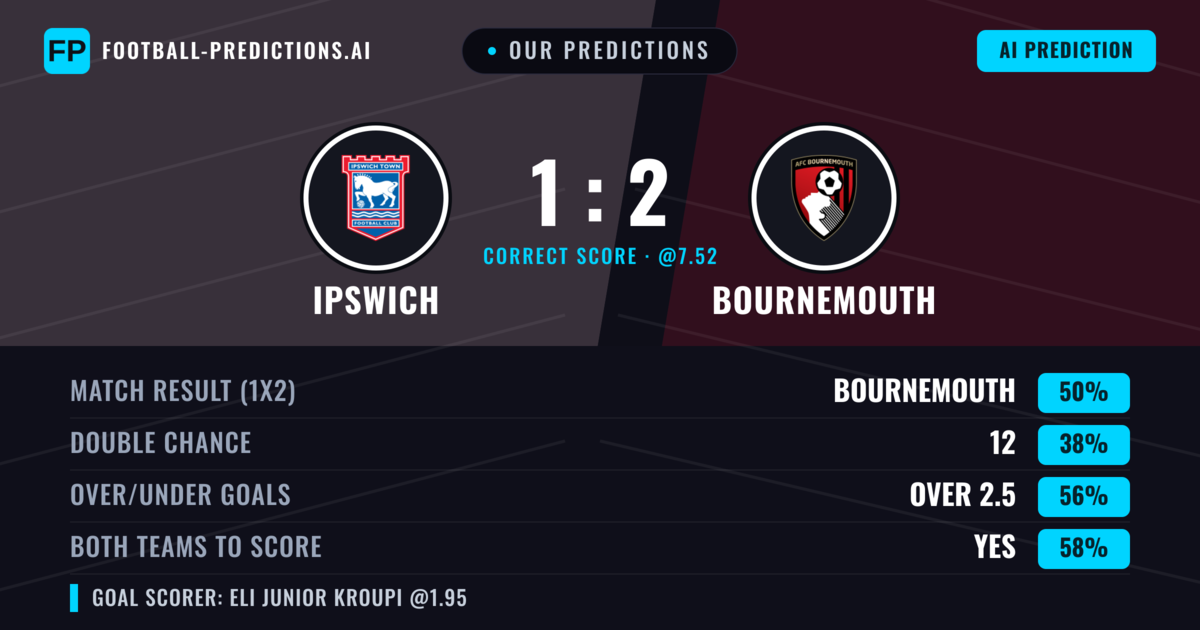
That tension sits beneath this Premier League meeting. Bournemouth arrive with the stronger headline form and an 8th-place position in Premier League, while Ipswich are 14th in Premier League and still searching for a run that pulls them away from the lower reaches of the table. The visitors’ 1.91 price on Bet365 tells local readers that the away side is expected to win, yet there is no home advantage in the supplied 1X2 market that is strong enough to make the match feel one-sided. Ipswich can attack the space behind a favored opponent, and the H2H record supports caution: across six previous meetings, four were drawn, with neither club having established clear supremacy.
For readers searching for an ipswich vs derby prediction or a bournemouth prediction today, this is not a derby fixture, but it still carries the tension of a match in which momentum and positional ambition are moving in different directions. Bournemouth’s five consecutive wins in the form string supplied for this preview suggest acceleration. Ipswich’s DDLWL is less convincing, particularly after a home defeat in that sequence. Yet Portman Road can change the nature of a contest, and the H2H numbers show a meeting in which goals have consistently been more likely than a cautious one-goal resolution.
A Regular-Season Test with Uneven Stakes
This is a Regular Season - 10 Premier League contest, scheduled for Sunday, November 8, 2026, with kickoff at 14:00 GMT in the local market. It is neither a two-legged tie nor a final, so there is no aggregate arithmetic or away-goals objective to shape the approach. The league context remains meaningful, however, because the standings snapshot places Bournemouth in 8th in Premier League with 12 points from nine games and Ipswich in 14th in Premier League with 11 points from nine. The gap is only one point, even if the betting market sees a substantial difference in underlying match quality.
Both sides have had eight days’ rest and each played one match in the last ten days. There is therefore no significant rest advantage to exploit, and neither team can reasonably attribute a tactical edge to freshness. Motivation is also presented without a specific table objective beyond the positions themselves. For Ipswich, the immediate demand is to turn home fixtures into points and improve a 14th-place standing. For Bournemouth, the challenge is to convert the momentum suggested by the headline form into another result that strengthens an already respectable 8th-place position in Premier League.
The timing matters for the audience as much as the football. The match is a Sunday afternoon affair, giving local readers a conventional weekend slot rather than a midweek or evening contest. It will be broadcast on NBC, while Bet365’s local price reference lists Ipswich at 3.8, the draw at 3.75 and Bournemouth at 1.91. Those prices are only a market snapshot, but they frame the central question clearly: can Bournemouth continue their run away from Portman Road, or can Ipswich make the favorite uncomfortable?
Two Very Different Momentum Signals
Ipswich’s form string is DDLWL, and it captures a team that has been unable to sustain momentum for long. The supplied form sample records four wins, two draws and four losses over 10 appearances, with an average of 1.7 goals scored and 1.8 conceded per match. Those scoring and concession figures give the home side a sense of balance, but not control. A 1.8-goal concession average leaves little room for a passive approach against an opponent averaging two goals per match, and the 70% BTTS rate for Ipswich indicates that games involving them have regularly featured goals from both sides.
The percentage figures also reveal where Ipswich’s problem can become most visible. Their clean-sheet rate is only 10%, while Bournemouth’s is listed at 50%. Combined with the visitors’ scoring average of two goals per game, that suggests a recurring risk for Ipswich: once the home team is under pressure, there may be little defensive resistance to a second blow. The standings snapshot, which shows three wins, two draws and four losses from nine Premier League matches, is broadly consistent with that sense of inconsistency, even though the broader 10-match form sample and table sample are not identical datasets.
Bournemouth’s supplied headline form is WWWWW, an extraordinary run of five wins that naturally explains why the away side is priced as a strong favorite. The associated figures strengthen that case, with six wins, two draws and two losses in 10 appearances, two goals scored per match and only 1.1 conceded. A 40% BTTS rate and a 50% clean-sheet rate give the visitors two distinct ways to win: they can control matches by preventing goals, or they can move ahead and let the game open.
There is, however, an important data inconsistency within the supplied material. The main form panel lists Bournemouth as WWWWW, while the later verified situation feed gives the club’s recent run as WWWLL. Both cannot describe the same uninterrupted five-match sequence, so the safest analytical conclusion is not to treat either string as unquestionable proof of dominance. The aggregate averages and the 8th-place position in Premier League still make Bournemouth the stronger-looking side, but their form should be interpreted as a strong recent run with a source discrepancy rather than as an unqualified five-match winning streak.
There is also a corresponding numerical issue elsewhere in the data. The season-statistics fields for both clubs list zero goals scored, zero conceded and zero clean sheets, while the form panel and standings provide clearly non-zero scoring information. Those zero entries should be treated as incomplete placeholders rather than literal evidence that either team has not scored. Betting decisions therefore need to rest on the usable form averages, standings snapshot and H2H sample, not on the contradictory zero fields.
How the Tactical Battle May Be Decided
No confirmed formation is provided for either club, so it would be misleading to force artificial labels such as a 4-3-3 or 3-4-3 onto the teams. The tactical preview must instead focus on the demands each side is likely to face. Bournemouth’s 1.1-goal concession average and 50% clean-sheet rate indicate a structure capable of denying space and protecting a lead, while their two-goal scoring average suggests they can also impose pressure at the opposite end. Ipswich, with their 1.7 scoring average and 1.8 concession average, need a more balanced performance: enough attacking support to make the home crowd relevant, but sufficient control to prevent Bournemouth from turning every transition into a dangerous moment.
The first tactical battle will probably occur between Ipswich’s attempts to progress and Bournemouth’s capacity to stop them. If Bournemouth can keep possession without risking excessive transition space, they can reduce the influence of Emersonn and J. Clarke and make the visitors’ 1.91 price look increasingly justified. If Ipswich instead push more players forward, the home side may create territorial momentum, but they would also expose the defensive areas behind them that have contributed to their 1.8 goals conceded per match.
That is why the first goal could carry special weight. Bournemouth’s BTTS rate of 40% is lower than Ipswich’s 70%, and the visitors’ clean-sheet percentage is exactly twice the home side’s 10%. A Bournemouth goal would not merely change the scoreline; it could also narrow Ipswich’s path back into the match by encouraging the visitors to protect a lead. An Ipswich goal would produce the opposite effect, forcing Bournemouth to solve a problem they have so often solved through control rather than exchange.
Set pieces, second balls and territorial discipline may become especially important as the match grows. The H2H sample contains four draws from six and an average of three goals per meeting, yet the recent listed scorelines include both 1-2 results and three 2-2 draws. That pattern suggests that previous meetings often remained fluid without becoming runaway affairs. If this match follows a similar route, neither side’s technical superiority may be enough to separate the teams cleanly.
The Names Attached to Each Side’s Success
Only four players are listed as leading scorers in the supplied current-season data, so the player analysis must remain narrow and honest. Ipswich have Emersonn with one goal and no assists, and J. Clarke with one goal and no assists. These are modest totals, but their joint contribution can still shape Portman Road. If either player receives the ball in the kind of central or advanced area from which Ipswich’s 1.7 goals-per-game average is generated, the home side may create the transitions that the H2H pattern suggests are possible.
Emersonn’s importance may extend beyond the recorded goal because the 53% attack comparison gives Ipswich a narrow technical edge in the model’s assessment. That does not mean the home side will create more chances; it means Ipswich do not look entirely outclassed in attack. The same caution applies to J. Clarke. One goal without an assist is a limited contribution, but it confirms that the Ipswich attack has at least one source of production beyond the midfield and defensive units.
For Bournemouth, M. Tavernier is the listed leading scorer with one goal and no assists. His scoring return does not match the club’s collective form, which makes him more a symbol of how the team has generated its momentum than a standalone finisher. The visitors’ six wins in the supplied form sample, two-goal scoring average and 50% clean-sheet rate imply a broader source of quality. Tavernier’s role in this preview is therefore to represent the final action that could unlock a side already performing strongly in collective terms.
Alex Tóth is identified in the verified team news as a Bournemouth midfielder who underwent hamstring surgery and is not expected back until after the new year. His absence removes one of the visitors’ named midfield options, although the supplied information does not quantify how his absence changes the team’s shape or performance. Bournemouth will still possess enough momentum to be favored, but the 1.1-goal concession average cannot simply be assumed to remain untouched.
Juanlu Sánchez is also confirmed to be absent for a prolonged period after twisting his ankle, according to Hayters. His absence further reduces Bournemouth’s available personnel, making it important not to treat the five-win form string as evidence of a fully settled selection. Reports also suggest that Junior Kroupi has been linked with Arsenal boss Mikel Arteta ahead of the January window, per Sky Sports, but transfer interest says nothing about his readiness for this match and should not be treated as match-related team news.
On the Ipswich side, Kings of Anglia reports that on-loan full-back Somto Boniface has returned from injury and played 78 minutes for Leyton Orient. That is evidence of a return to playing work rather than confirmation that he is fully ready for this Premier League fixture. If he is available, his ability to support Ipswich defensively could be valuable against a side averaging two goals per match, but no stronger selection claim should be made without further team information.
History Points Toward Goals and Resistance
The six-match H2H record is strikingly balanced: Ipswich have one win, Bournemouth have one win and four matches ended in draws. Across those meetings, the average total