


Lask Linz vs Slovan Bratislava: UCL Tactical Showdown
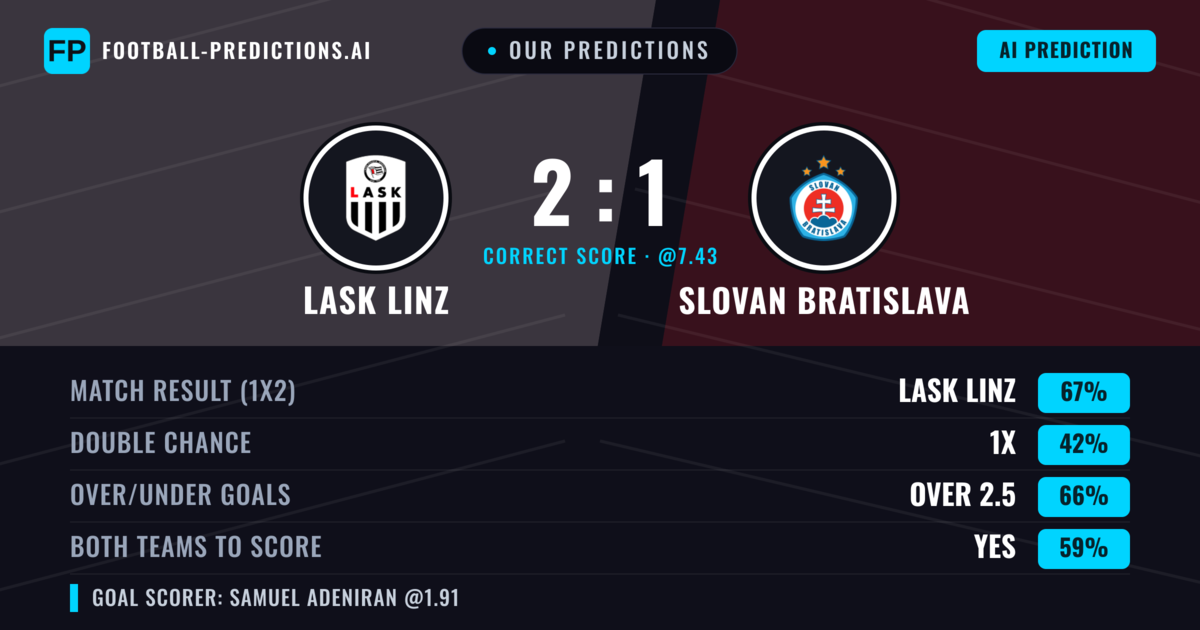
The first thing to understand about this UEFA Champions League group-stage match is that it will be decided by small tactical adjustments rather than overwhelming superiority. Lask Linz have something to protect and a table position to improve, while Slovan Bratislava need to show that their better attacking profile can translate into meaningful results. Without confirmed formations, the most sensible way to frame the contest is around the likely principles: Lask Linz should seek control through compactness and quick forward progression, whereas Slovan Bratislava need greater efficiency in the final third and a more disciplined structure when Lask possession turns into counterattacks.
That tension is central to this UEFA Champions League prediction. The supplied odds make Lask Linz clear favorites, yet the team-comparison figures give Slovan Bratislava an edge in form and attack. In other words, the price suggests a straightforward home success, while the underlying indicators suggest that Slovan could be dangerous enough to make the margin uncomfortable. The match begins at 20:00 local time on Tuesday, November 3, 2026, at the Raiffeisen Arena in Linz, with both clubs having had three days of rest and two games in their last ten days.
This is the group-stage phase of a major European cup competition, so the pressure should be sharper than in a routine league fixture. Every point carries weight, every missed chance can alter the competitive picture and every misplaced pass risks exposing a team to the counterattack. Lask Linz sit 24th in UEFA Champions League with three points from three matches, while Slovan Bratislava are 36th with no points after three defeats. The difference in motivation is therefore clear: the home side have a playoff race to pursue, whereas no specific table incentive has been identified for Slovan.
Why the Tactical Duel Will Define This Champions League Meeting
Lask Linz have to balance two requirements. Their primary objective must be to win in front of their own supporters, but they also need to avoid a match that becomes stretched or chaotic. Slovan Bratislava, by contrast, need an away performance that restores belief and potentially changes the expectations surrounding their campaign. The Slovak side cannot simply defend for long periods and hope that the game reaches them through set pieces; the better attacking comparison in the data suggests they should seek more purposeful possession.
The key battle may be in the space between Lask Linz’s midfield and Slovan Bratislava’s forward line. If Lask can advance directly and quickly, they can make use of the home crowd before Slovan establish any rhythm. If Slovan can draw Lask out and then move the ball beyond the first pressure, the visitors could expose the spaces that tend to appear behind teams pushing forward. These are tactical possibilities rather than claims about confirmed formations, since the provided season data does not identify either side’s setup.
There is also a question of emotional control. Lask Linz are in a race, and Slovan Bratislava are searching for their first point in UEFA Champions League. The former may accept a controlled, pragmatic contest; the latter may have little to lose by being more ambitious. That does not automatically make Slovan the better side, but it raises the possibility that the visitors can make this closer than the headline home price suggests.
- Lask Linz: Compact defending, quick progression and controlled pressing in the opposition half.
- Slovan Bratislava: More deliberate build-up, sharper combinations around the box and greater urgency in recovering possession.
- Decisive detail: Whether Slovan can retain enough structure to attack without becoming vulnerable in transition.
Current State of Play: Form Favors Slovan, Motivation Favors Lask
The broader ten-match sample favors Slovan Bratislava. Lask Linz have played ten matches, won four, drawn once and lost five, with a goals-scored average of 2.3 and a goals-conceded average of 2.1. Slovan Bratislava have also played ten, but their record is four wins, three draws and three defeats, while averaging 1.6 goals scored and 2.1 conceded. That makes Slovan the more stable side in the supplied sample, particularly in terms of avoiding defeat.
The five-match form labels require some care. The primary match data lists Lask Linz as WLWWL and Slovan Bratislava as WWDLW. A separate situational note records the more recent sequences as WLLWL for Lask and LLLWD for Slovan. Rather than trying to reconcile those labels by inventing results, the safest conclusion is that neither side should be presented as being in an uninterrupted run. The ten-match totals are more dependable for assessing overall quality, while the Champions League standings provide the clearest competitive context.
Slovan’s advantage is reflected in the team comparison, which gives them 79% for form and 62% for attack, compared with Lask’s respective figures of 21% and 38%. The defensive percentages are evenly split at 50% each, suggesting that neither team has a decisive structural edge at the back. In practical terms, Slovan appear more likely to create something worthwhile, while Lask’s greater scoring average may be tied to a more aggressive or higher-risk approach.
Home advantage and the standings alter the interpretation. Lask are not merely playing for pride: they are 24th in UEFA Champions League with three points from three games, and the verified motivation assessment identifies a playoff race. Slovan are 36th with zero points from three games and have lost all three. The away team therefore enters without the same established position to defend, whereas Lask have a reason to push for the three points.
The attacking trends also point toward goals. Lask’s 70% BTTS rate is stronger than Slovan’s 60%, but their clean-sheet rates are only 10% and 20%, respectively. When those indicators are placed beside the scoring and conceding averages, the match profile suggests a contest with more chances than a typical cautious European meeting. The attacking advantage belongs to Slovan, but the greater attacking frequency belongs to Lask.
Lask Linz’s Route to a Breakthrough
Lask Linz should use the setting at the Raiffeisen Arena to establish a clear hierarchy in the match. Their most effective route is likely to be through quick ball circulation after winning possession, especially before Slovan can organize their defensive shape. Slovan’s 79% form rating and 62% attack rating suggest that playing long and surrendering possession would be disproportionately helpful to the visitors.
The home team’s 2.3 goals-per-match average indicates an attacking side capable of producing multiple chances, but their five defeats in ten show that this attacking potential can be undermined by defensive vulnerability. Lask cannot simply send every player forward and rely on a large lead. Their better approach would be to increase pressure in controlled phases: winning the ball near the opposition half, creating numerical superiority around the penalty area and forcing Slovan to defend repeatedly.
There is also psychological value in Lask scoring first. Slovan’s zero-point position means they cannot afford to become emotionally subdued by an early concession, while Lask have a table objective that rewards early progress. A home lead would not only alter the scoreboard; it would force Slovan to expose more space in search of an equalizer and give Lask opportunities to attack the spaces Slovan leave behind.
The risk is that impatience undermines that structure. Lask’s home favorite status may encourage them to seek a decisive result rather than a controlled one. Against a side with the stronger overall form and attacking comparison, stretching the game could be dangerous. The smartest version of Lask’s approach is not maximal aggression but selective acceleration: press when the conditions are favorable, retain the defensive shape and make each forward action look purposeful.
Slovan Bratislava Need Their Better Form to Become Champions League Points
Slovan Bratislava face a more straightforward objective in terms of behavior: they need to improve their Champions League standing from 36th, with no points from three matches. The tactical challenge is to do that without abandoning the aspects that have produced four wins and three draws in the ten-match sample. A defensive retreat would not fully utilize the 62% attacking advantage assigned to them, nor would it solve the issue of converting pressure into goals.
Slovan need particularly strong decision-making in the final third. Their listed leading scorer, Cristian Jesús Martínez, has one goal and one assist, while A. Šporar and R. Čerepkai each have one goal. These are modest totals, but they identify three players capable of producing decisive contributions. Martínez offers the clearest combination of finishing and creative involvement, while Šporar and Čerepkai can be important outlets as Lask push forward.
Against Lask’s likely forward pressure, Slovan should aim to make their first pass beyond the initial pressure rather than circulate unnecessarily. The visitors’ attacking edge may be most valuable on the counter, particularly if Lask’s full-backs or central midfielders advance in numbers. Slovan need enough bodies around Martínez, Šporar and Čerepkai to make the first forward pass meaningful, rather than isolating one target against a recovering defense.
At the same time, Slovan’s defensive organization will be tested. Lask have a higher scoring average than Slovan and a 70% BTTS rate over the supplied ten-match sample. If the visitors surrender central territory, they may reduce their own attacking output simply because they spend most of the match without the ball. Their ideal result is not passive resistance but controlled pressure, drawing Lask toward them before moving the ball into dangerous areas.
Players Who Could Decide the Evening
The available player data is concentrated in three names for each club, giving the contest several clear focal points without inventing roles that have not been supplied.
- S. Adeniran: Lask Linz’s leading scorer with two goals. He is the home side’s most proven listed attacking contributor and could be central to Lask converting territorial and numerical advantages into goals.
- M. Usor: One goal and one assist. That combination makes Usor the most visibly creative contributor in Lask’s player group, particularly valuable in a match where controlled buildup may be more important than long spells of possession.
- R. Ljubičić: One goal. Ljubičić provides another listed scoring threat and could give Lask a way to vary the attack rather than relying exclusively on Adeniran.
- Cristian Jesús Martínez: One goal and one assist for Slovan Bratislava. His involvement across scoring and creation makes him the visitors’ most versatile attacking reference point.
- A. Šporar: One goal. Šporar is one of three listed Slovan scorers and can help the visitors turn a limited number of chances into a meaningful return.
- R. Čerepkai: One goal. Čerepkai offers another attacking outlet against a Lask side whose conceding average of 2.1 raises questions about how well it will contain repeated forward runs.
It is worth resisting the temptation to attach positions, appearances or detailed statistics that have not been provided. What can be said confidently is that Lask possess three listed scorers with two goals between the leading pair, while Slovan’s three leading names share four goal contributions in total. That supports the data-driven conclusion that both attacks have output, but that efficiency will matter if neither side creates many chances.
No Head-to-Head Pattern Can Be Claimed
No head-to-head archive, previous meeting record or historical venue pattern has been supplied for this fixture. It would therefore be irresponsible to invent a precedent or claim that one club has traditionally dominated the other. The better analysis is matchup-specific: Slovan