





Lazio vs Cagliari: The Olimpico Test for a Rising Championship Contender
There is a sense of urgency surrounding this Serie A meeting at the Stadio Olimpico, even though Cagliari arrive with no specific table incentive attached to their name. Lazio, by contrast, sit 2th in Serie A with 25 points from nine games, and every home match now carries the weight of a club attempting to turn an exceptional run into sustained momentum. Their five-match form is listed as WWWWW, while the wider figures supplied for their ten matches show eight wins, one draw and one defeat. This is a side that has made the title and Champions League picture the central part of its season, and Cagliari will have to be considerably more disciplined than their recent results suggest if they are to leave Rome without conceding control of the contest.
Cagliari’s position is 11th in Serie A, with 13 points from nine games, and their most recent five-match sequence reads LLLDW. That run, combined with an average of only 0.9 goals scored per match across the supplied ten-match sample, creates a difficult proposition against a Lazio side averaging 2.2 goals. The visitors are not without hope: their historical meetings with Lazio have been remarkably unfavorable, but they have also produced enough draws and narrow losses to show that careful organization can keep a match within reach. Sunday’s meeting at 14:00 GMT will therefore be less about an evenly matched technical contest and more about whether Cagliari can slow the tempo, protect their defensive structure and make Lazio’s attacking efficiency work harder than it has recently.
Why This Round Matters Beyond the Immediate Result
This is Regular Season Round 10, and the differing motivations are strikingly clear. Lazio have far more riding on the result than Cagliari: they are in the title and Champions League race, while no specific table objective has been flagged for the visitors. That does not guarantee three points, but it does give the home side the stronger psychological setting. Five wins in the supplied last-five form sequence suggest not merely statistical momentum but a collective belief that matches can be controlled through consistent performance.
Cagliari, meanwhile, must treat the occasion carefully. Their record of four wins, one draw and four defeats in nine league games leaves them without the cushion of a particularly secure position, even if no formal target is specified. A draw could be regarded as a useful outcome, yet the stronger sporting ambition is to build momentum after a sequence containing three defeats. There is another important consideration: both teams have had five days of rest and have played two games in the last ten days, so neither can attribute any edge to physical preparation. The match will be decided more by tactical clarity and emotional concentration than by recovery.
The timing also gives Lazio’s home support a chance to shape the atmosphere. The Stadio Olimpico is not simply a location on the fixture list; it is the stage on which Lazio’s title ambitions can be made tangible. Cagliari will need to make sure that the scale of the occasion does not pull their game away from the fundamentals. One misplaced pass, one delayed decision or one concession from the attacking third can transform a carefully balanced contest into a home team’s comfortable evening.
Momentum Has Built Lazio’s Identity
The most striking feature of Lazio’s recent profile is the contrast between what they produce and what they prevent. Their supplied ten-match figures show eight wins, one draw and one defeat, with an average of 2.2 goals scored and 0.9 conceded per match. A clean-sheet rate of 40% indicates that defensive control is already a meaningful part of their performances, while a 50% both-teams-to-score rate suggests their attacking output has not always arrived through high-scoring exchanges. In practical terms, Lazio have looked capable of taking games through either sustained pressure or a lead that makes them difficult to dislodge.
Form can be misleading when it is detached from the quality of opposition and the underlying numbers, but the data here points in the same direction. Lazio are listed as WWWWW in their last five matches, and their unbeaten league record of eight wins and one draw provides further support for the idea that this is not merely a short-lived surge. The oddity in the supplied form sample is that it lists ten matches while the standings contain nine league games, so the figures should be treated as separate datasets rather than forced into a single timeline. Even with that distinction, the conclusion remains the same: Lazio have been the stronger and more productive team.
That said, a five-match winning sequence can make a team vulnerable to the expectation that momentum will continue uninterrupted. Lazio must resist becoming overly reliant on the same attacking pattern. Their 1X2 price of 1.44 tells the market that victory is highly probable, but the more difficult challenge is deciding how aggressively to pursue a second or third goal once the game begins to open. A narrow home win remains plausible, particularly against opponents averaging 0.9 goals scored, but the home side’s superior attacking output gives them the capacity to create separation if Cagliari’s defensive unit begins to tire.
Cagliari Need a Different Kind of Performance
Cagliari’s immediate challenge is evident in their numbers. They have won four of nine league matches but have also lost four, and their five-match form sequence of LLLDW offers little evidence of sustained momentum. Their attack has averaged 0.9 goals per match across the supplied ten-match sample, while the defensive side has conceded 1.5 per match. The difference of half a goal between those two averages defines their problem: even when their defensive work holds together, the attacking output may not be sufficient to turn a controlled match into a victory.
The visitors’ 40% both-teams-to-score rate and 30% clean-sheet rate point to a modest attacking profile rather than a consistently aggressive one. Their likely route to a competitive result is therefore not to assume that they can outscore Lazio in an open exchange. Instead, they must compress the space available to the home forwards, make every clearance count and then seek moments of transition. A clean sheet would be a significant achievement against a side averaging 2.2 goals, but it would only guarantee one point. To win, Cagliari would also need to improve on their own scoring average.
That does not make a positive result unrealistic. The head-to-head record contains a 0-0 draw and several one-goal margins, proving that Cagliari have previously found ways to prevent Lazio from running away with the game. Their task is to repeat that defensive discipline while adding enough threat at the opposite end. If they become passive for long periods, Lazio’s pressure may become difficult to withstand. If they push too many bodies forward, they could expose themselves to the home side’s stronger attacking numbers.
The Tactical Battle Without a Prescribed Formation
No formations are supplied for either club, so it would be misleading to present a rigid shape as established fact. The tactical preview must instead be derived from the available performance profile. Lazio’s 2.2 goals per match indicates an attack capable of sustaining pressure, but their 0.9 goals conceded suggests they do not need to follow an uncontrolled attacking script. Their most likely objective is to establish control, prevent Cagliari from building attacks and then increase the pressure as the visitors’ defensive unit tires.
Cagliari’s expected approach should be more compact. With an attacking average below one goal per game, they cannot afford to spend excessive energy on speculative forward play. Their midfield and defensive unit need to obstruct Lazio’s route to goal, close passing lanes and force the home side to work from less favorable positions. When possession is secured, the priority should be to make the transition purposeful rather than merely to clear the ball. Cagliari do not need possession for long periods; they need enough controlled attacks to prevent Lazio from settling into a low-risk rhythm.
Game management will be crucial. Lazio’s coaching task is to avoid the trap of treating a 1-0 advantage as sufficient, while Cagliari must resist becoming so defensive that they surrender territory without resistance. The home side’s attacking numbers justify a proactive approach, but their clean-sheet rate indicates they can also value control. Cagliari’s recent sequence demands patience rather than desperation. A frantic final 20 minutes would be unsurprising, but it must not become the product of a plan that surrendered the first hour.
The Individual Detail That Could Shape the Night
The available player data is limited, so the most responsible approach is not to manufacture a list of names or invent tactical responsibilities. For Lazio, the only named scorer in the supplied key-player section is D. Frattesi, with one goal and no assists. That is a modest statistical contribution, but its importance should be interpreted carefully: the data identifies him as a scoring option rather than establishing him as the club’s central creative figure or most indispensable player.
Lazio’s wider attacking strength comes from the collective output reflected in the 2.2-goal average. Their forwards and attacking midfielders will be collectively responsible for sustaining pressure, combining in advanced areas and punishing transitions. Without more detailed individual information, it would be unfair to identify one unlisted player as the likely creator, finisher or penalty-box presence. The tactical question is instead whether Lazio can move the ball into productive zones quickly enough before Cagliari’s compact shape settles.
For Cagliari, no individual player data is available beyond the supplied injury information, so there is no defensible basis for naming key performers or assigning precise roles. The decisive unit is more naturally described in functional terms: the forward line must create enough scoring opportunities to complement a disciplined defensive effort, while the midfield must protect the space in front of the back line. Cagliari’s ability to frustrate Lazio will depend less on one isolated star than on whether those collective functions operate in unison.
The Availability Questions Around Both Squads
The injury lists add uncertainty to the tactical picture, although the two teams arrive on equal rest. Lazio are missing A. Furlanetto with a knee injury, A. Gudmundsson with a shoulder injury, A. Marusic with a muscle injury and N. Rovella with a calf injury. These absences could affect selection, balance and rotation, although the supplied data does not specify each player’s position or the extent to which their absence changes the side’s structure.
Cagliari’s concerns are M. Felici with a knee injury, R. Idrissi with a knee injury and H. Winks with a back injury. As with Lazio, the data does not permit precise conclusions about tactical replacements or the number of goals conceded or prevented by any absence. Their shared five-day rest means neither club can rely on extra recovery time to compensate for unavailable personnel.
The important point is that neither roster is presented as being fully intact. Coaches may therefore face forced choices in squad selection, particularly if the four Lazio absences affect different parts of the team. For Cagliari, preserving the cohesion of their defensive approach could be just as important as the availability of any individual. With Lazio’s attacking average standing at 2.2 goals per match, the visitors cannot afford to be disrupted repeatedly in defensive positions.
A Head-to-Head Record That Weighs Heavily on Lazio
History offers Lazio an enormous advantage. Across the last 20 meetings, Lazio won 16, four were drawn and Cagliari did not record a victory. The average total is 2.9 goals, and both teams scored in 60% of those meetings. This is a record that establishes psychological and structural superiority without proving that the pattern must continue in every fixture.
The most recent examples show different versions of the same imbalance. A 0-0 draw at Cagliari was followed by a 2-0 Lazio victory, then a 2-1 away win for Lazio. Earlier meetings included 2-1 and 3-1 Lazio victories. The away draw demonstrates that Cagliari can deny the home side a breakthrough; the other results show that when the visitors concede first, Lazio have repeatedly been capable of controlling the remaining contest.
The 60% both-teams-to-score rate also deserves attention. It indicates that Cagliari have previously found the net more often than a low-scoring away record might suggest, but it also means Lazio have not always kept them scoreless. For this match, that history supports a cautious approach: Cagliari should not assume that protecting the score at 0-0 guarantees a point, while Lazio should understand that clean-sheet frequency has varied against this opponent even if their more recent result was a 2-0 win.
Reading the Market Without Chasing an Obvious Favorite
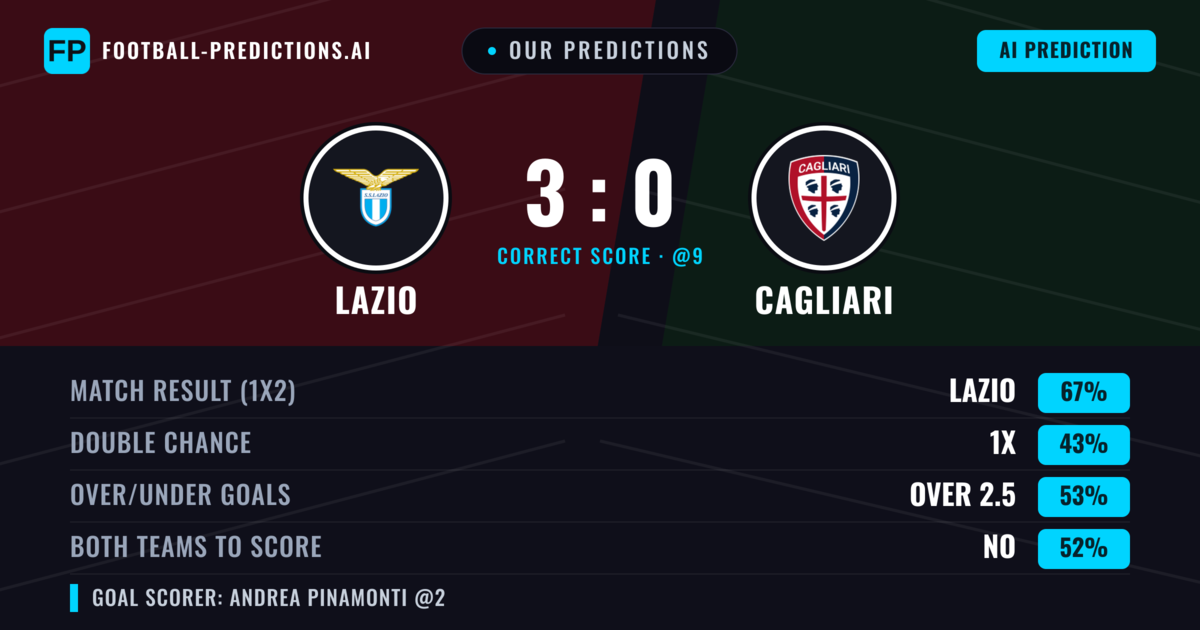
The main 1X2 market lists Lazio at 1.44, the draw at 4.2 and Cagliari at 6.5. Those prices imply raw probabilities of approximately 69.4%, 23.8% and 15.4%, but because the total exceeds 100%, the normalized market view is closer to 63.9% for Lazio, 21.9% for a draw and 14.2% for Cagliari. Bet365 separately prices the match at Lazio 1.42 / Draw 4.75 / Cagliari 7 for local readers. That is a factual price reference rather than an instruction, and it reinforces how strongly the market expects the home side to win.
That support has a limit. At 1.42–1.44, a Lazio victory demands a high strike rate, and the combination of Lazio’s 1.44 quoted price with Cagliari’s low 0.9 scoring average leaves little visible margin for a value home-win bet. The draw at 4.75 on the Bet365 scale is longer than the broader-market 4.2 quote, while Cagliari’s 7 is only marginally shorter than the listed 6.5. Neither away-win price appears especially attractive when judged solely by the stated team numbers: the visitors have lost four of nine league games and average only 0.9 goals scored.
The double-chance prices are 1X at 1.1, 12 at