






Maritimo vs Santa Clara: Fourth-Place Ambition Meets a Funchal Survival Test
Santa Clara arrive in Funchal with the ambition of a promotion chase in full flow, while Maritimo face a different kind of pressure: improving their position in the Primeira Liga without allowing another productive stretch to fade. The round 10 meeting on Sunday, November 1, 2026, kicks off at 18:00 local time, which is 18:00 GMT in London, and the contrast in momentum is stark. Santa Clara are fourth in Primeira Liga with 18 points from eight matches, whereas Maritimo are 14th with eight points from nine. It is a regular-season fixture, but it carries very unequal motivational weight. The away side are chasing promotion and potential Europa League qualification, while the hosts are seeking the points and confidence that can lift them away from the lower reaches of the table.
The numbers support that motivational imbalance. Maritimo’s recent form sequence is LLDLL, and their wider ten-match sample contains three wins, two draws and five defeats. Santa Clara’s sequence is WDWWD, with six wins, three draws and only one defeat in ten matches. The difference is not merely cosmetic: Maritimo have scored 1.1 goals per match and conceded 2.0, while Santa Clara average 1.4 scored and only 0.5 conceded. For anyone searching for a football prediction before this weekend’s Primeira Liga action, the match data points toward a disciplined away team that is considerably harder to score against and more accustomed to producing positive results.
That conclusion does not make the match straightforward. Maritimo are still capable of improving, the historical head-to-head record offers encouragement, and the bookmaker market has priced the away side as the narrow favourite rather than an overwhelming one. The best approach is therefore not to treat Santa Clara as a safe lock. Instead, the evidence points toward a cautious away performance, a low-event contest, and a selection built around Santa Clara avoiding defeat while the goals market remains conservative. This preview examines the form, tactical questions and historical patterns before arriving at one considered set of soccer predictions for Maritimo versus Santa Clara.
The Stakes: Santa Clara’s Season Suddenly Has a Clear Destination
Santa Clara’s league position gives their objective a distinct shape. Fourth in Primeira Liga with 18 points after eight games is a strong platform, particularly when accompanied by a WDWWD form sequence and a defensive record of just 0.5 goals conceded per match. The verified motivation data identifies the club as chasing promotion, with Europa League qualification also in view. They do not need to treat every match as an emergency, but they do need to preserve the momentum that has carried them into the top four. A win in Funchal would confirm that their strong start is translating into results away from home; a draw would still be useful, depending on how the rest of the fixture list develops.
Maritimo’s position demands improvement but does not carry the same urgency. They sit 14th in Primeira Liga with eight points from nine matches, and no more specific table objective is flagged beyond the basic need to make progress. Their recent LLDLL sequence, including three defeats in the last five, has put pressure on the mood and competitive rhythm of the team. The goal is not simply to contain Santa Clara for an hour and hope for a lucky moment. A useful result for Maritimo would combine defensive resistance with greater attacking efficiency, particularly because Santa Clara’s 60% clean-sheet rate shows that conceding a large share of the goals they concede is not inevitable.
There is another scheduling detail worth placing in context. Maritimo have had nine days’ rest and have played once in the last ten days, while Santa Clara have had 22 days’ rest without playing in that period. The assessment concludes that there is no significant rest disadvantage, and that is the right interpretation: Santa Clara’s longer break should not be turned into a weakness, nor should Maritimo’s more recent competitive rhythm be overstated. Both sides are sufficiently prepared, so the differences in form and motivation are more meaningful than the difference in rest.
For the broader community following soccer and football predictions, this is a useful reminder that table position and motivation often deserve more attention than reputation alone. Santa Clara have earned their fourth-place position through results and defensive control. Maritimo need to improve their own results, but the available evidence suggests they will face a well-motivated and balanced opponent rather than one already in freefall.
Recent Momentum: The Form Curves Separate Sharply
Maritimo’s five-match form tells a difficult story. The sequence LLDLL is made up of only one victory, two draws and three defeats, and it explains why the hosts have remained 14th in Primeira Liga despite having played one more match than Santa Clara. Their ten-match totals reinforce the message: three wins and two draws are not enough in a league where every dropped point compounds, while five defeats have left the team searching for a more consistent base. Their averages of 1.1 goals scored and 2.0 conceded also reveal where the imbalance lies.
Maritimo are not completely sterile in attack, because 1.1 goals per match represents a reasonable rate of production, but the issue is the gap between their attacking output and what they concede. The difference is 0.9 goals per match. In practical terms, the hosts need to improve the defensive side of their performances at the same time as making sure they do not become overly cautious. If they concede first, Santa Clara’s strong defensive record and fourth-place momentum make it easier for the away side to control the game. The best route to a positive result for Maritimo is therefore to remain level through the middle phase and avoid giving the match the open, transition-heavy pattern that has hurt them over the wider sample.
The listed attacking names provide some individual interest. Maurice Osei Boakye, M. Diouri and Raphael Guzzo have each recorded one goal and no assists in the supplied player data. The figures are modest, but they should not be dismissed. A goal split across three contributors suggests that Maritimo’s scoring has not depended entirely on one player, and it also means that one moment of quality could alter a low-scoring match. What the data cannot prove is the full attacking structure around them, so no formation should be imposed on the hosts without evidence.
Santa Clara’s WDWWD form offers a very different profile. Six wins in ten matches is the foundation of their fourth-place position, while three draws and only one defeat show that they have rarely been destabilised for long. Their scoring average of 1.4 goals per match is not spectacular, but it is supported by an exceptional 0.5 goals conceded per match. The low defensive figure also explains their 60% clean-sheet rate and why their BTTS rate is only 30%. Santa Clara can win without necessarily producing an attacking spectacle, which will be central to the tactical expectations in this match.
Gonçalo Paciência is the only Santa Clara player listed in the key-player data, with three goals and no assists. His total gives the away side a modest focal point in attack, but it is important not to inflate his role beyond the available evidence. Santa Clara’s strength comes from the collective shape of their results: four of their five most recent matches ended in a win, and their overall defensive numbers are stronger than their attacking ones. Their task in Funchal may therefore be less about overwhelming Maritimo and more about preserving their defensive standards while being patient enough to take an opportunity when one appears.
Tactical Outlook: Control the Space, Not Merely the Scoreboard
No reliable formation information is provided for either club, so the tactical discussion must remain in terms of functions rather than invented setups. Santa Clara’s likely approach should be built around control: compact the spaces that allow Maritimo to attack, remain difficult to break down and avoid treating every clearance or possession loss as the trigger for an uncontrolled game. Their 0.5 goals conceded per match suggests that risk control is already part of their results profile. Against a home side with a 2.0-goal concession average, the away team has every incentive to reproduce that structure.
That does not mean Santa Clara should sit passively. The danger of excessive conservatism is that it gives Maritimo the ball and enough time to build attacks without having to survive repeated transitions. A more effective away approach would be to make deliberate progress when possible, protect the ball in the middle and push Maritimo into difficult territory. The objective should be to lower the number of high-quality chances conceded while retaining enough attacking threat to make the home side respect the scoreboard.
Maritimo’s likely need is to improve their defensive platform first, not to force an attacking blueprint that the data does not support. Against Santa Clara, the hosts should be patient in possession, avoid losing the ball in dangerous areas and prioritise a compact distance between their defensive and attacking lines. Because the away side’s clean-sheet rate is 60%, repeatedly crossing into the same channels may produce little return. Maritimo instead need variation, quick movement around the edge of the defensive block and enough quality to make the single decisive pass count.
The three named Maritimo attackers should not all be expected to solve the match alone. Their one goal each indicates distributed involvement, while the absence of listed assists says nothing reliable about chance creation beyond that. Santa Clara can expect sustained pressure at some point, and Maritimo’s best response will be coordinated defensive work followed by a purposeful transition rather than a continuous series of hopeful crosses.
The match script therefore has two credible versions. If Santa Clara control the first phase and prevent Maritimo from turning possession into clear chances, the away side’s superior form and defensive record will become increasingly influential. If Maritimo survive the opening spell and create the first meaningful opening, the psychological balance shifts because the hosts will have demonstrated that their more cautious objective is achievable. This is why the away win is credible without being a certainty and why the double chance remains more dependable than a straight result prediction.
Head-to-Head Memory: Encouragement for Maritimo, Context for Santa Clara
The last 12 meetings are almost perfectly balanced. Maritimo have five wins, Santa Clara have four, and three matches ended in a draw. Across those encounters, the average total is 2.58 goals and BTTS has occurred in 58%. The competitive balance is clear, and there is no historical pattern that automatically favours either side. Santa Clara’s superior current form should carry greater weight, but Maritimo can point to enough previous success to avoid treating this as an unfamiliar assignment.
The most recent listed meeting ended 0-0. That result fits the broader low-risk profile that tends to define the safer side of this matchup, particularly when the stronger contemporary team is also the more defensively secure one. Maritimo then won 3-1 in February 2023, before Santa Clara answered with a 2-1 home win in September 2022. A 2-2 draw completed the listed sequence in April 2022. These results show both clubs can score, but they also demonstrate that neither historical record nor the most recent meeting guarantees a high-scoring contest.
There is an important caution here. The head-to-head sample predates the current season and should be treated as background rather than predictive proof. Current form, current defensive rates and the motivational context are more relevant. Santa Clara are producing 1.4 goals per match while conceding only 0.5, whereas Maritimo’s averages point to more volatile matches involving 2.0 conceded goals per match. The most relevant historical signal is therefore not the old win-loss distribution but the fact that the latest meeting was goalless, a reminder that this fixture can remain compressed even when the standings are far apart.
One Betting Market, One Read: Where the Value Sits
The supplied 1X2 market lists Maritimo at 3.14, the draw at 3.19 and Santa Clara at 2.50. The corresponding implied probabilities are 30.9% for the home side, 30.4% for a draw and 38.8% for the away side, adding to 100.1% and indicating an effectively balanced book with only a very small bookmaker margin. Santa Clara are favourites, but not overwhelming favourites. A price of 2.50 means a winning stake returns 2.50 units including the stake, and the odds do not suggest the away side is protected from a draw or a home result.
The Asian handicap prices are listed as Maritimo +0 at 2.18 and Santa Clara +0 at 1.75. Since both selections are level-handicap outcomes, their raw implied probabilities are approximately 45.9% and 57.1%, respectively. The combined figure is about 103%, reflecting the margin. Santa Clara +0 at 1.75 is broadly aligned with the same away-favourite direction as the 1X2 market, although its shorter price reduces the value available if the away side merely avoids defeat rather than wins. It is the more conservative route to an away selection, not necessarily the more rewarding one.
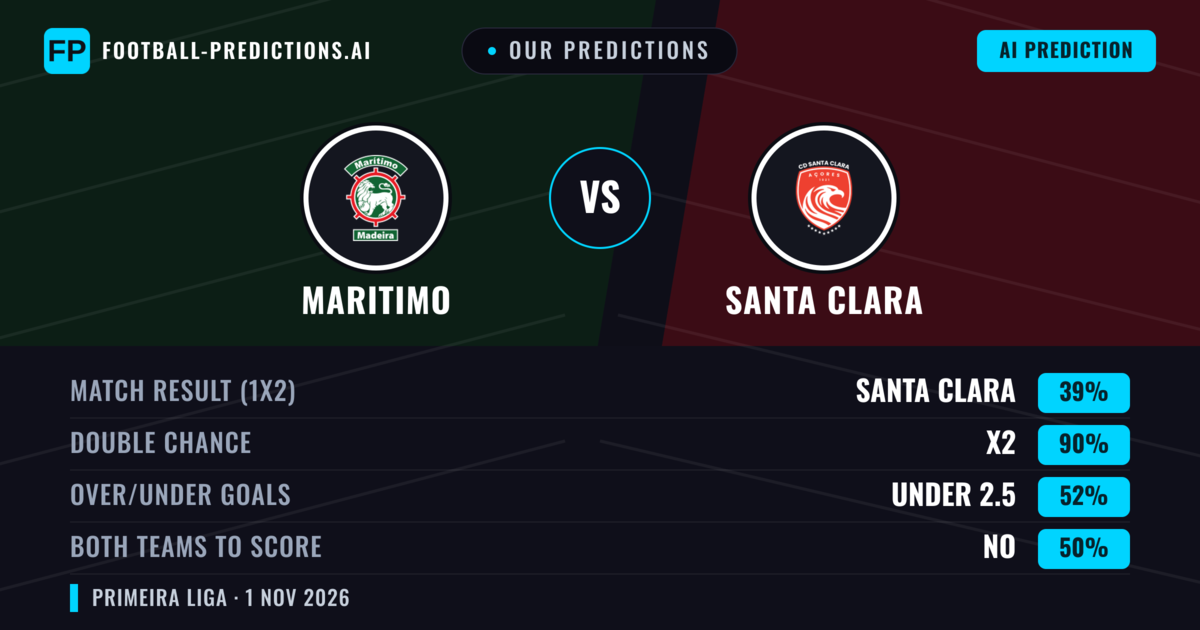
The strongest data-supported selection is Santa Clara or draw, or X2, at 90% confidence. It should not be confused with a 90% statistical probability of Santa Clara winning; the figure is the stated confidence level for the double chance. The recommendation is supported by Santa Clara’s WDWWD form, six wins in ten, 18 points from eight matches, 0.5 goals conceded per match, 60% clean sheets and the explicit promotion motivation. X2 also offers a logical buffer against the uncertainty surrounding a straight away win at 2.50. It does not require Santa Clara to dominate, which aligns well with their profile of controlling games and protecting defensive leads.
The result prediction is Santa Clara win, with 39% confidence. This is a directional forecast rather than a claim that the market’s 38.8% implied probability is certainly wrong. Santa Clara have the stronger form, stronger defensive numbers and greater motivational urgency, all of which justify making them the preferred side. Nevertheless, Maritimo’s five wins in the last 12 meetings, the balanced historical margin and the absence of confirmed formation information prevent the away win from being presented as a high-conviction certainty.
For the goals market, the prediction is under 2.5 goals, with 52% confidence. No actual bookmaker price for over/under 2.5 is supplied in the available data, so no price or implied probability can be responsibly calculated or fabricated. The analytical case nevertheless has several components: the latest listed head-to-head meeting finished 0-0, Santa Clara’s 0.5-goal concession rate is the best of the two teams, and their 60% clean-sheet rate shows that scoreless or one-goal matches are a realistic part of their profile. The latest five-match form of both clubs also contains enough draws and defeats to keep the game from becoming a free-scoring contest.
The BTTS prediction is no, with 50% confidence, and again the supplied information contains no bookmaker price for that market. The support comes from Santa Clara’s BTTS rate of 30% and clean-sheet rate of 60%, alongside Maritimo’s BTTS rate of 70%. These rates point in opposite directions, which is precisely why the prediction remains at a moderate rather than emphatic confidence level. Santa Clara’s defensive profile is the stronger influence, but Maritimo have produced more open games, so this cannot be treated as a lock.
Value identification should be made with the available prices rather than imaginary ones. At 2.50, the away win offers only a modest market edge if the analyst believes Santa Clara’s true win probability is appreciably above 38.8%; the 39% directional confidence indicates only limited separation. The 1.75 Santa Clara +0 quote is useful for protection but leaves less margin than the 2.50 outright price. The best balance therefore comes from X2, while the outright away win is the preferred result forecast. Where no price is provided, as with under 2.5 and BTTS no, the selections should be treated as analytical forecasts rather than claims of verified market value.
Final Assessment: An Away Side That Can Keep the Game Tight
Santa Clara’s case rests on more than their place in the table. They are 4th in Primeira Liga, unbeaten in seven of their eight matches according to the standing record, and supported by six wins and three draws in their ten-match sample. Their 0.5 goals conceded per match is the standout figure, the kind of number that can define a side in a match where the away team does not need to dominate. Maritimo’s LLDLL sequence and 2.0 goals conceded per match contrast sharply with that record.
The hosts still have a credible route to frustrate the favourite. Their historical head-to-head record is strong, the most recent meeting ended 0-0, and the market has priced Santa Clara at only 2.50 rather than treating them as an overwhelming selection. Maritimo can make this match difficult by protecting the central spaces, avoiding repeated defensive scrambles and using the quality of Maurice Osei Boakye, M. Diouri and Raphael Guzzo when openings appear.
For Santa Clara, Gonçalo Paciência provides the listed attacking reference point, but the larger message is collective: control the game’s emotional temperature, concede as little as possible and apply pressure when Maritimo’s defensive concentration fades. With promotion and Europa League qualification providing a sharper motivational edge, the away side has more riding on the result and the stronger recent profile.
The resulting football forecast for today is Santa Clara to win, with under 2.5 goals, BTTS no and X2 as the preferred betting positions. This is not a prediction of an away-team rout. It is a forecast of a close, controlled match in which Santa Clara’s defensive strength and fourth-place momentum outweigh Maritimo’s urgency and historical resistance.
For readers looking