



Mauritius and Djibouti Meet in Friendly International Action
Mauritius and Djibouti face each other in a Friendly International fixture on Wednesday, September 30, with kickoff scheduled for 13:00 BST. Both nations enter this encounter having been absent from competitive action, creating an intriguing scenario where preparation becomes a significant factor in determining which side can adapt more effectively to the demands of international football.
The extended break from competitive fixtures provides both teams with an opportunity to assess their squads and implement tactical approaches that could shape their future campaigns. With neither side having played in the previous ten days, the match offers a valuable platform for players to regain match sharpness while coaches evaluate their options in a competitive environment.
Djibouti Brings Winning Momentum Into Mauritius Reunion
Djibouti arrives at this Friendly International fixture carrying significant momentum after securing back-to-back victories against the same Mauritius side. The away 3-1 triumph followed by the home 3-1 win demonstrates a team that has found its attacking rhythm, averaging three goals per match across these encounters. While the clean sheet percentage remains at zero percent for both teams, Djibouti has shown the ability to convert their chances at a clinical rate, suggesting they will look to impose their offensive quality once more when the sides meet.
Mauritius faces this return fixture from a position of difficulty, having failed to collect points in either of their previous encounters with Djibouti this season. The 3-1 defeats, both home and away, exposed defensive vulnerabilities that continue to persist—the team concedes an average of three goals per match, a statistic that will concern any analyst reviewing their prospects. However, the fact that they have found the net in both matches against Djibouti, scoring once on each occasion, indicates some attacking capability exists, even if the defensive structure has yet to prove adequate against a team that has demonstrated clear superiority in recent head-to-head meetings.
The scoring patterns reveal a concerning trend for Mauritius when examining their overall campaign statistics. With a goals-scored average of just one per game and a goals-conceded average of three, the gap between attack and defence presents a fundamental imbalance that must be addressed. Djibouti, by contrast, boasts a healthy +2 goal difference across their two matches, highlighting the one-goal cushion they maintain between scoring and conceding. This defensive solidity, relative to their opponents, has underpinned their winning run and provided the platform for their attacking players to operate with freedom.
Both teams enter this Friendly International having seen the ball hit the back of the net in every match they have played this season, with BTTS percentages standing at one hundred percent for each side. This shared characteristic suggests that while neither defence has managed to keep a clean sheet, both attacks carry enough threat to potentially exploit the opposition. For Mauritius, the challenge lies in translating their occasional attacking moments into a more sustained performance that can trouble a Djibouti side that has already demonstrated its capability to score freely against them in recent weeks.
Contrasting Tactical Identities Set Stage for Balanced Encounter
As Mauritius and Djibouti prepare to face each other in this Friendly International fixture on Wednesday afternoon, the tactical battle promises to offer fascinating subplots despite both nations operating from limited preparation resources. With neither side having featured in competitive action within the past ten days, both will approach the 13:00 BST kickoff with freshness on their side, though the lack of recent match rhythm could initially manifest in cautious, error-strewn opening periods. The absence of competitive pressure typical in friendly encounters often encourages managers to experiment with formations and personnel, meaning both outfits may prioritize structural solidity over expansive attacking intent in the early exchanges before perhaps opening up as the match progresses.
International teams from smaller footballing nations frequently adopt pragmatic defensive shapes, prioritizing compactness and defensive solidity to negate opponent advantages. The challenge for both Mauritius and Djibouti will be translating defensive discipline into meaningful attacking contributions, particularly given the limited opportunities for cohesive training sessions ahead of this fixture. Set-piece situations could emerge as a decisive tactical battleground, where well-drilled routines might unlock stubborn defenses more effectively than open play approaches. The physical contest in midfield areas will likely prove crucial in determining which side can establish tempo control and limit the other's attacking ambitions.
The friendly nature of this encounter provides both sets of players with invaluable exposure to international competition, making individual battles across the pitch particularly compelling to observe. How each team balances defensive responsibility with attacking ambition will likely define the tactical narrative, with the opening thirty minutes serving as an important barometer for the match's likely trajectory. Fans tuning in at the 13:00 BST start time should anticipate a contest where tactical discipline initially takes precedence, though the absence of competitive stakes could gradually encourage more expansive football as both teams search for breakthrough moments.
Djibouti's Clear Upper Hand in Recent Encounters With Mauritius
The head-to-head record between these two nations makes for uncomfortable reading for Mauritius supporters. Across their two most recent meetings, Djibouti have secured victory on both occasions, leaving Mauritius without a single win or even a draw to their name in this rivalry. The away side prevailed in both fixtures, with Djibouti claiming comfortable wins regardless of whether the matches took place on Mauritian soil or their own territory.
Both encounters followed an identical scoreline, ending 3-1 in Djibouti's favor. The aggregate across these two meetings reads 6-2 in Djibouti's favor, averaging exactly four goals per match. Notably, both teams found the back of the net in every single encounter, resulting in a perfect 100% BTTS rate across this fixture history. This consistency in goal distribution suggests that when these sides meet, attacking play tends to prevail over defensive caution.
For those considering betting angles, the historical data presents some clear patterns. The average of four goals per match indicates that Over 2.5 Goals has been a reliable market in this fixture, while the 100% BTTS record highlights the likelihood of both sides contributing to the scoring. However, the overwhelming dominance of Djibouti in this matchup, winning both previous meetings by identical margins, suggests one side enters this contest with significant psychological and historical confidence.
Mauritius vs Djibouti: Betting Analysis and Our Best Selections
The upcoming friendly between Mauritius and Djibouti presents an intriguing betting puzzle as both sides prepare for this international fixture. The 1X2 market currently prices Mauritius as the clear favourites, with home odds of 1.95 implying an approximate 47.3% probability of a home victory. The draw and away outcomes are priced identically at 3.5, translating to 26.4% implied probability each. This pricing structure suggests bookmakers view Mauritius as the stronger outfit but acknowledge meaningful uncertainty, particularly given the limited scoring expectations for this encounter.
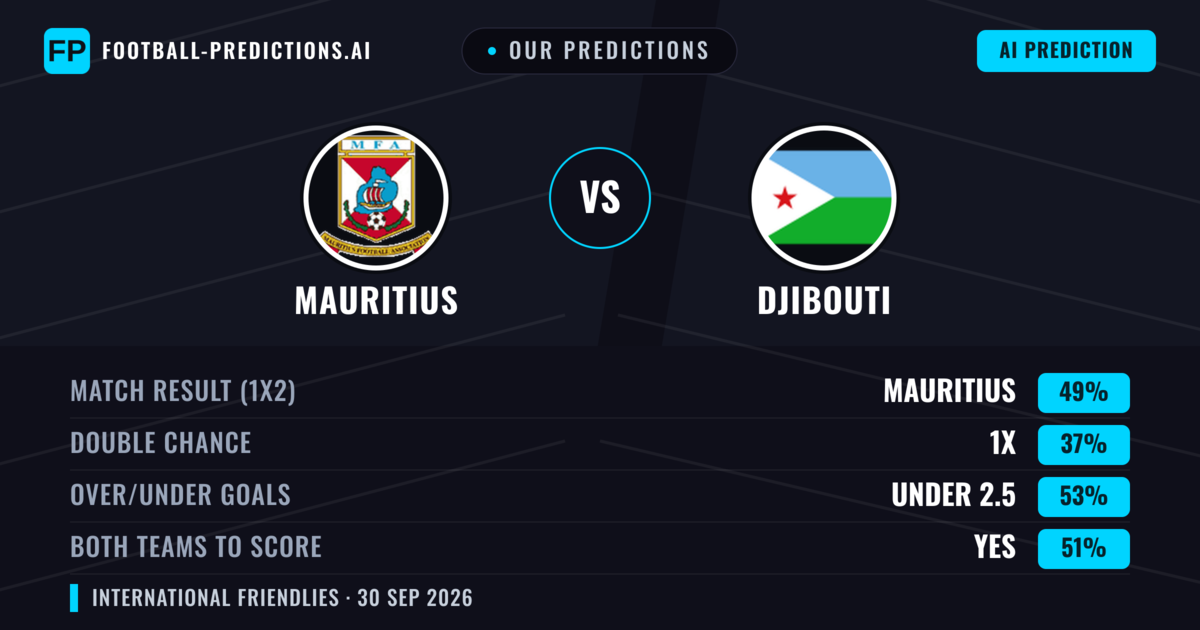
Our predictive model assigns a 49% confidence rating to a Mauritius victory, aligning closely with the bookmaker assessment. At the best available price of 2.07 with 1xBet, backing the hosts offers genuine value compared to the standard market line. The tight odds reflect what promises to be a competitive contest between two nations that historically struggle for consistency at this level. For punters seeking reduced risk, the 1X double chance selection carries 37% confidence and provides a sensible alternative if concerns about an outright home win persist.
The goal-scoring market reveals perhaps the most compelling tension in this matchup. Our model indicates 53% confidence in under 2.5 goals, which reflects the general pattern of low-scoring encounters in international friendlies between teams of comparable ability. However, the BTTS market tells a contrasting story, with yes registering 51% confidence. This apparent contradiction exists because both outcomes remain genuinely plausible within a low-scoring framework, yet neither team inspires sufficient attacking confidence to dominate proceedings.
For our primary recommendation, we favour backing Mauritius to win at the enhanced price of 2.07 available at 1xBet. The secondary angle of under 2.5 goals offers complementary value given the defensive orientation these matches typically produce. Punters should note that all confidence ratings sit in the moderate range, underscoring the inherent difficulty in predicting friendly matches between nations with limited competitive exposure. The best draw price of 3.72 with 1xBet and best away odds of 3.8 with Betfair remain available for those seeking higher-risk alternatives to our main selections.
The Verdict: Mauritius the Safer Selection
The statistical picture points toward a narrow Mauritius victory in what shapes as a tightly contested Friendly International encounter. While the confidence levels remain modest across all markets, the recommended play centres on a home win with under 2.5 total goals — a combination that reflects both teams' tendency toward defensive solidity in friendly fixtures. The slight preference for BTTS-yes adds an alternative dimension for those seeking slightly higher returns, though the core prediction maintains that scoring opportunities will be limited on the night. Backers should approach with measured stakes given the inherent unpredictability of international friendlies, where squad rotation and experimental approaches frequently influence outcomes.