

Olympiakos Piraeus vs PAOK: The Championship Picture Hangs on a Piraeus Night
Two points separate the first three places in Super League 1, and on Sunday evening at Georgios Karaiskakis Stadium, second-placed Olympiakos Piraeus will attempt to preserve that advantage against a PAOK side determined to erase it. The fixture belongs to the tenth round of the Super League 1 regular season and carries the particular pressure of a direct confrontation between clubs with identical objectives: keeping pace at the summit and refusing to cede ground to a direct rival. Olympiakos arrive with the stronger numbers, the stronger recent run and the expectation of home support, but PAOK have enough attacking quality to make this more than a straightforward exercise in control.
For Olympiakos, the priority is to turn home advantage into a measurable points advantage over third place. Imanol Alguacil’s side have won all five of their most recent matches, while verified reporting also identifies an eight-game winning streak entering this contest. The long unbeaten run has established a clear identity: difficult to beat, increasingly difficult to attack and particularly difficult to dislodge in Super League 1. PAOK arrive on a more volatile run, represented by WLWLW, with a 2-1 victory over Asteras Tripolis in their previous match. The contrast is clear even if the destination remains uncertain. Olympiakos look like the team with momentum and balance; PAOK look like the side more likely to make the evening complicated.
There is also a tactical tension beneath the table pressure. Olympiakos have conceded only 0.5 goals per game in the supplied form sample, with clean sheets in 60% of those matches, while PAOK’s average concession stands at 1.5. Yet PAOK have averaged two goals per game and produced an 80% BTTS rate in their last five, compared with 30% for Olympiakos. One side appears built to control proceedings and deny space; the other appears equipped to make games open and difficult. That tension should shape the market interpretation, particularly around whether the home team can win without exposing itself to a counterattacking response.
The Stakes at Karaiskakis
Olympiakos are 2nd in Super League 1 with 22 points from nine games, while PAOK are 3rd in Super League 1 with 18 from the same number of matches. Neither club can treat this as an ornamental meeting between prominent teams. Both remain firmly in the championship race, and the standings explain why even a narrow result could alter the shape of the top of the table. A home victory would allow Olympiakos to preserve their two-point cushion, while a PAOK win would put the visiting side level with their hosts on 22 points.
The importance of the draw should not be overlooked merely because it splits the points. A point for PAOK keeps them within touching distance of second place, while a point for Olympiakos still reinforces the sense that the champions have established a benchmark the chasing group cannot yet match. It is precisely this balance of ambition and risk that makes the match compelling: Olympiakos must seek the victory their home position and current run suggest, whereas PAOK can be dangerous if they play for disruption rather than simply matching their opponent.
There is also psychological value in taking points from a direct rival. The supplied head-to-head record is closely divided, with nine Olympiakos victories, five draws and six PAOK victories from the last 20 meetings. Olympiakos lead, but not by enough to treat this fixture as a formality. The recent meetings include a 1-1 draw in May 2026, a 3-1 PAOK win three days earlier, a 0-0 draw in March and a 2-1 PAOK victory in October 2025. Across the full 20-match sample, the average has been three goals and BTTS has landed 80% of the time.
Those numbers reveal why caution is necessary despite the home price. Olympiakos’ defensive profile points toward control, but the historical pattern suggests that PAOK have repeatedly found a way to score in this matchup. The best home side is not necessarily the best bet at a short price; the distinction between “most likely to win” and “best value on the market” will be central to the betting assessment.
Recent Momentum: Olympiakos Bring Control
The form data presents Olympiakos with a substantial edge. Their exact recent sequence is WWWWW, five victories from five, and the broader form figures show eight wins, one draw and one loss in 10 matches. Their attack has produced 1.7 goals per game, while their defensive record of 0.5 goals conceded per game is the foundation of their run. Clean sheets in 60% of matches further underline how frequently opponents have been left without a meaningful scoring return.
That combination is especially valuable in a league contest where the standings are compressed. Olympiakos do not need to be prolific to remain in front; their capacity to restrict the opposition means a modest attacking output can still produce three points. A one-goal victory would therefore carry substantial weight in the title race, while a clean sheet would reinforce the impression that Alguacil’s side can win through control rather than exchange.
The eight-game winning streak also creates a psychological advantage. PAOK know that overturning the home team’s momentum is not simply a matter of scoring once. They must sustain pressure, avoid allowing Olympiakos to regain control after losing the ball and prevent the hosts from finding the decisive second or third goal. That is a demanding assignment against a team averaging only 0.5 goals conceded.
At the same time, Olympiakos should not treat this as a game that must be won through sheer force. Their attack is efficient rather than prolific at 1.7 goals per game, and the low BTTS rate of 30% shows that many of their recent victories have been built around keeping the opposition scoreless. The smart path to victory is therefore likely to involve control first, with attacking ambition increasing if PAOK fail to create a threatening response.
PAOK’s Volatile but Dangerous Profile
PAOK’s recent sequence of WLWLW tells a different story. They have won six of 10 matches, lost four and drawn none, producing six points fewer than Olympiakos despite having played the same number of games in the standings. Their 2.0 goals per game is marginally higher than Olympiakos’ 1.7, but their 1.5 goals conceded per game is considerably worse. Clean sheets have arrived in only 20% of matches, compared with 60% for their hosts.
The defensive concern is reinforced by verified team news. Jonjoe Kenny was sent off in PAOK’s previous match in this competition and is likely to be suspended for the visit to Piraeus. The absence of a defender weakens the back line and adds weight to the possibility of Olympiakos finding a way through. It also increases PAOK’s need to keep the match tight, because a stretched defensive unit facing a side with strong clean-sheet tendencies can deteriorate once the first goal changes the shape of the contest.
PAOK did, however, defeat Asteras Tripolis 2-1 in their previous match, as confirmed by the supplied team news. Their attacking output in this latest result demonstrates that they remain capable of scoring, even if consistency is the missing element in their recent profile. Their eight named scorers also provide evidence that goals can arrive from several directions rather than being dependent on one isolated source.
PAOK’s 80% BTTS rate in the last five matches is striking. It suggests that when their defensive structure is under pressure, their offensive quality often keeps them competitive. Against Olympiakos, that would make outright defeat a less straightforward outcome than the home odds might imply. The visitors do not need to dominate the game; they need to remain dangerous enough to keep Olympiakos from settling into a comfortable shutout and then exploit the uncertainty that can emerge late.
How the Tactical Contest May Develop
Olympiakos have a clearly identified 4-2-3-1 formation, giving them a defined structural base. The two midfield positions can provide defensive security, while the three-player line behind the striker can offer creative freedom and options in possession. Against PAOK, the key question is whether that shape is used to dictate territory or merely to protect the home team against transitions. Given the defensive sample and Olympiakos’ control of recent results, the balance is more likely to tilt toward control.
PAOK do not have a confirmed formation in the supplied data, so it would be inappropriate to assign one. Their tactical discussion should instead centre on the demands of the match. They need enough defensive cover to compensate for the likely absence of Jonjoe Kenny, without removing the forward threat that has driven their 2.0-goal average. A cautious approach may be necessary against the ball, but excessive retreat would invite Olympiakos to dictate and potentially score the second goal that changes the game.
The percentages supplied by the comparison model reinforce the imbalance. Olympiakos receive 57% in the form category against PAOK’s 43%, while defence is heavily weighted towards the hosts at 89% to 11%. Attack is rated evenly at 50% for each side, which makes sense in light of the respective scoring averages. Overall, Olympiakos hold a narrow 52% to 47% advantage rather than overwhelming superiority.
That 52-47 split is important context for the handicap market. A strong favourite can still be a poor value proposition when the price implies nearly the same thing. Olympiakos’ defensive strength creates a credible route to a one-goal home victory, while PAOK’s scoring rate and head-to-head record make a wider home win less certain. The tactical battle may ultimately be about margins: whether Olympiakos can win by one, or whether PAOK can stretch the match into the kind of high-scoring contest their recent BTTS numbers encourage.
The Players Who Could Decide the Evening
Olympiakos’ listed attacking figures show Jota Silva as the central attacking reference, with five goals and one assist. His five goals represent the largest individual contribution among the three Olympiakos players provided, and his presence gives the hosts a clear source of goals without requiring an expansive attacking output. M. Saliakas has one goal and one assist, offering another listed scoring contribution, while Chiquinho’s one goal gives the home side a further name in its attacking group.
The names should be considered in context rather than treated as a complete squad list. Only these three Olympiakos players have been supplied with specific statistics, so no wider conclusions can responsibly be drawn about other individuals. Within that limitation, Jota Silva is the player most closely associated with the home side’s ability to turn territorial or possession advantages into goals. Saliakas and Chiquinho are important because they demonstrate that the scoring contribution is not presented as coming from one source alone.
For PAOK, C. Ndiaye and D. Pelkas have each scored three goals, while A. Živković has two goals and four assists. Živković’s four assists stand out as the highest creative tally in the supplied player data, making the visitors’ attacking potential more varied than a simple goals-only comparison suggests. Ndiaye and Pelkas offer direct scoring power, while Živković supplies the link between possession and chances. Their exact tactical roles are not specified, so the emphasis should remain on the documented production rather than invented positions.
PAOK’s possible defensive suspension adds a second layer to the individual matchup. Kenny’s likely absence is not merely a naming issue; it changes the visitors’ capacity to remain compact. If Olympiakos can exploit the space created by a weakened back line, Jota Silva and the listed attacking support may benefit. Conversely, if Kenny’s absence forces PAOK to surrender possession or sit deeper, Živković, Ndiaye and Pelkas may receive fewer opportunities to build an attacking response.
What the Last 20 Meetings Reveal
Olympiakos have nine wins in the last 20 meetings, PAOK have six and five have been drawn. The overall balance favours the hosts, but PAOK have certainly avoided being overawed in this fixture. Their most recent victory was emphatic by the margin of two goals, winning 3-1 in May 2026. Before that, the teams shared a 1-1 draw, while the March meeting produced no goals in a 0-0 contest.
The sequence demonstrates the range of possible scripts. Olympiakos can certainly win the match; PAOK can certainly win it; and both defences have also demonstrated the ability to prevent the other from scoring. The 2-1 PAOK win in October 2025 and the 4-2 Olympiakos victory in May 2025 show that this fixture can also open decisively when one side’s attacking quality takes control.
The 80% BTTS rate across the 20 meetings is the most commercially significant historical pattern. It is noticeably higher than Olympiakos’ recent BTTS rate of 30%, but the combined data suggests that the historical matchup is more likely to produce goals than the hosts’ most recent form alone would suggest. The 3-goal average reinforces the same message, with most meetings producing at least two goals and a meaningful number exceeding 2.5.
No historical result, however, should override current-season context. PAOK are without their defensive reinforcement, Olympiakos are in exceptional form, and the standings place the hosts in the stronger position. The head-to-head record is best used as a warning against treating Olympiakos’ win as automatic, not as evidence that they are guaranteed to cover a substantial handicap.
The Singular Betting Assessment
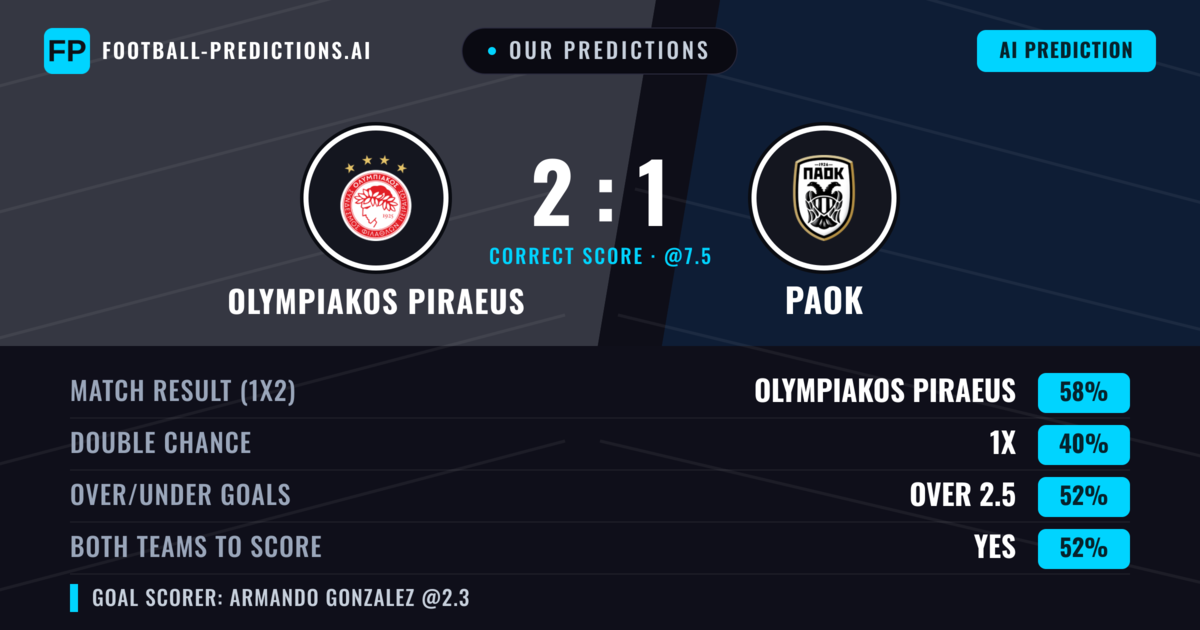
The available 1X2 market has Olympiakos Piraeus at 1.62, the draw at 3.7 and PAOK at 5.0. Those prices translate to implied probabilities of 56.8%, 24.9% and 18.4%, respectively, with the one-percentage-point excess caused by rounding and the bookmaker’s margin. Bet365’s local reference is slightly different at 1.65 for Olympiakos, 3.7 for the draw and 5.0 for PAOK, confirming that the market still regards the home side as the clear but not overwhelming favourite.
At 1.62, Olympiakos require more than a simple probability advantage to represent good value. Their 52-47 overall model comparison supports the favourite, and the combination of an eight-game winning run, 60% clean sheets and PAOK’s likely defensive absence strengthens that case. The recommended result prediction is therefore Olympiakos Piraeus to win, at 58% confidence. That is a meaningful selection, but not one that guarantees value at every possible price; the 1.62 quote is the relevant entry point rather than the absolute result.
The Double Chance prices are 1.15 for 1X, 1.25 for 12 and 2.2 for X2. The 1X option at 1.15 is the conservative expression of the home-favourite thesis and also protects against PAOK securing a draw. Its corresponding prediction is 1X, with