





Paris Saint-Germain vs Estac Troyes: Champions’ Pace Meets Relegation-Battle Urgency
The central tactical question at Parc des Princes is whether Paris Saint-Germain can turn superior momentum into controlled pressure without becoming careless, while Estac Troyes attempt to construct one of those rare counterattacking nights that can unsettle a dominant side. The market’s expectation is clear: Paris Saint-Germain are overwhelming favorites, but the best way to understand this fixture is through the contrasting pressure attached to each team. PSG are chasing the top of Ligue 1; Troyes are fighting to escape the relegation zone. One side needs to protect and extend a commanding position, while the other needs a result that changes the mood around its season.
That contrast should influence every duel, turnover and transition. Paris Saint-Germain have the stronger scoring profile and the more productive form, giving them both permission and responsibility to attack. Troyes, by contrast, cannot rely on a long spell of possession or an even exchange of chances if they are to take something from the match. Their most credible route is to reduce the space in front of them, protect the central areas and make Paris Saint-Germain work for every progression. The home team’s superiority is substantial, but the sheer number of available attacking routes can make favorites vulnerable when their opponents accept that most of the field will belong to them.
For readers following ligue 1 predictions today, this is a fixture with an exceptionally clear favorite but more than one meaningful betting angle. The central 1X2 price is short, the handicap market suggests a two-goal expectation, and the correct-score prices are concentrated around a clean PSG win. Yet the underlying data also supports an over 2.5 total, largely because Paris Saint-Germain’s attacking output is substantially stronger than Troyes’ defensive record. The disagreement between those two possibilities is where the most interesting analysis lies.
The Stakes at Opposite Ends of the Table
Paris Saint-Germain sit 1th in Ligue 1 with 20 points from nine games, with the supplied table information recording six wins, two draws and one defeat. Their recent form string is WWWWW, and the broader form data shows 10 wins from 10, no draws and no defeats. That is a remarkable level of consistency, accompanied by an average of 3.6 goals scored and 0.9 conceded per match. Paris have also produced both teams to score in 70% of their matches and kept clean sheets in 30%.
Estac Troyes occupy 16th in Ligue 1 with eight points from nine games, with two wins, two draws and five defeats recorded in the supplied standings. Their form string is WDLLL, and the wider figures show two wins, two draws and six defeats across 10 matches. Their attacking average is only 0.7 goals per match, compared with 1.7 conceded. Both teams to score has occurred in 30% of their matches, while clean sheets have also been recorded in 30%.
The gap therefore extends beyond league position. Paris Saint-Germain have won every match represented in their form sample, while Troyes have collected only two wins in their last-five run. PSG’s numerical superiority in attack is especially pronounced, and the home team’s defensive average, although not the strongest part of their profile, remains considerably better than the defensive numbers of their visitors. Troyes must also respect the possibility that PSG’s high scoring rate is partly connected to opponents having to chase the game after conceding first.
Motivation is similarly polarized. Paris Saint-Germain’s title and Champions League league-stage ambitions make every point important, while Troyes are engaged in a direct relegation battle, with the supplied situation identifying the Relegation Playoffs as part of the wider context. This is not a fixture in which either side can comfortably treat the schedule as a platform for rotation. PSG’s concentration should be high; Troyes’ urgency should be visible in their pressing and defensive work.
Rest should not materially alter the matchup. PSG have had four days’ rest and played twice in the last ten days, whereas Troyes have had seven days and played once. The difference is not significant, and Troyes’ extra recovery time does not offset the quality and momentum gap in the supplied form data.
Paris Saint-Germain: Turning Control into Goals
No formation is provided for either club, so it would be unsafe to assign a specific shape. The same limitation applies to the season-statistics section, where no meaningful goals, concessions or clean-sheet totals have been supplied for this match. The tactical analysis must consequently be built around verifiable principles: Paris Saint-Germain’s 3.6-goal average, their 0.9-goal concession rate, their exceptional form and their need to continue their title pursuit.
Paris’s most likely approach is one of territorial ambition. With Troyes struggling to produce 0.7 goals per match and conceding 1.7, the home side can expect the majority of possession and the clearest chances. The relevant issue is not simply how long PSG keep the ball, but how quickly they turn territory into high-value entries. Against a team forced to defend for long periods, Paris can create numerical pressure in advanced areas, move the defensive block laterally and attack spaces around it rather than forcing the ball through a crowded center.
The danger for Paris lies in a related weakness: their opponents have scored against them often enough for both teams to score to be a 70% occurrence. A clean sheet should not be treated as automatic simply because Troyes have a modest attacking average. PSG’s defensive line can be stretched by quick transitions, particularly if the home side commits many bodies forward and leaves too much distance between its defensive and attacking phases. Troyes do not need a high-volume attack; a few direct transitions could be enough to disrupt the rhythm that makes the home side so effective.
The only named Paris Saint-Germain player in the supplied current-season data is Ferran Torres, with two goals and no assists. That contribution provides a useful attacking reference without allowing broader conclusions about the entire squad. Torres’ role in the final third will be important if Paris break Troyes’ compact shape, but the home team’s scoring average indicates that collective attacking production extends well beyond one listed forward. The practical question is whether Torres and the surrounding attacking unit combine efficiently enough to turn PSG’s territorial control into at least three goals.
For PSG, the ideal performance would combine an early breakthrough with continued pressure after the scoring phase changes the game. If they lead without conceding, Troyes must become more adventurous in search of an equalizer, creating the counterattacking spaces that can extend a comfortable home victory into a larger one. If the match remains goalless for long, Paris may need greater urgency around the box and more direct use of wide areas. Either way, their 3.6 goals per match makes 2-0 and 3-0 the natural score shapes around which the listed correct-score market is built.
Estac Troyes: Survival Requires Restraint and Risk
Troyes do not have individual player data in the supplied material, so it would be inappropriate to identify or profile any of their players by name. Their influence must instead be discussed through collective roles: the forward line’s ability to retain the ball, the midfield’s capacity to disrupt passing lanes, and the defensive unit’s resistance to repeated pressure. With no formation supplied, the tactical description has to remain role-based rather than assigning an unsupported 4-3-3, 3-5-2 or another shape.
The most important collective objective is balance. Troyes need to frustrate Paris Saint-Germain, but they also need a credible route to score. Sitting behind the ball without a counterattacking plan would reduce their chance of gaining a point; yet pushing too many players forward would leave their defensive unit exposed against PSG’s superior attack. The middle path would involve making the first forward pass decisive, protecting possession when regain it and sending runners into space before Paris can reorganize.
Their attacking average of 0.7 goals per match makes it unlikely that Troyes can sustain pressure for long spells. Their better route may be to remain compact, force Paris to attack from outside the preferred scoring zones and then target the channels exposed by forward commitment. They can also exploit the fact that PSG have conceded at a rate high enough to produce both teams to score in seven out of ten matches. In other words, Troyes do not need to match Paris’s attacking volume, but they should avoid going missing completely.
The defensive side must be especially alert to the danger of a two-goal deficit. Once Troyes concede, their incentive changes. If they continue to sit deep, PSG’s volume of pressure will only increase; if they push out, the space behind them becomes more dangerous. Troyes therefore need their first goal to preserve the possibility of staying in the match, even if that requires accepting spells without the ball. Set pieces may also help them create a target, although no set-piece statistics are supplied and no specific advantage should be claimed.
Paris Saint-Germain’s head-to-head record makes the visitors’ task daunting, but Troyes can still approach this with a clear survival-focused logic. Avoid conceding early, deny easy central access and make every transition count. If they can remain within one goal into the later stages, the emotional and tactical pressure on PSG can rise. If they fall behind twice, Paris’s attacking quality is likely to make the remaining period increasingly difficult.
Weight of History: A Record of Parisian Control
The last ten meetings strongly favor Paris Saint-Germain: nine PSG victories, one draw and no wins for Estac Troyes. The average total across those encounters is 4.1 goals, while both teams have scored in 50%. That is a substantial body of evidence against a comeback scenario and also a reminder that the historical meetings have often contained enough attacking action to produce competitive scorelines.
The five listed recent examples provide a useful range. PSG won 3-1 away in May 2023, 4-3 at home in October 2022 and 2-2 in May 2022. A 2-1 home victory followed in August 2021, while the March 2018 meeting ended in a 2-0 away win for Paris. Four of those five games contained three or more goals. The lone exception was the 2-0 result, which demonstrates that a clean-sheet home victory remains entirely credible.
History should not be overvalued, particularly because the most recent meeting is several years old and current squads may have changed. It is nevertheless a strong contextual signal. Troyes have repeatedly struggled to defeat PSG, and the away side has not won once in the supplied ten-match sample. The combination of historical dominance, current form and the market’s 83.4% implied home probability points in the same direction.
There is also a useful connection between the head-to-head pattern and the betting prices. A 4-3 result illustrates why a PSG win does not automatically mean a low total, while the 2-0 and 2-1 examples show that the visitors can be contained when the home team controls the game. The correct-score decision therefore depends on whether Troyes’ low attacking output or PSG’s tendency to concede is expected to have the greater influence.
One Market, Several Angles: Betting Analysis
The main 1X2 bookmaker price is Paris Saint-Germain 1.12, draw 9 and Estac Troyes 15. Those prices imply probabilities of approximately 83.4% for PSG, 10.4% for the draw and 6.2% for Troyes, after allowing for the bookmaker’s margin. For this market, the local Bet365 reference is PSG 1.12, draw 9 and Estac Troyes 19, with the longer away price reflecting a slightly more cautious assessment of the visitor’s chances. The short home price is directionally supported by the form, standings and head-to-head record, but it leaves little room for error in a value-driven approach.
The double chance prices are 1X at 1.03, 12 at 1.07 and X2 at 5.5. The 1X market protects against a draw, although at 1.03 the available return is extremely small. The 12 price is more useful in the sense that it combines the two outcomes heavily favored by the evidence—PSG winning and a draw—yet it also requires accepting the possibility of a home defeat. Since the data strongly discounts an Estac win, 12 at 1.07 represents the most sensible protected route if the aim is to back the favorite without using the standard win market.
On the handicap, PSG -1.5 is priced at 1.43, while PSG -1.75 is 1.53. The alternatives are Estac Troyes +1.75 at 2.51 and Estac Troyes +1.5 at 2.74. PSG -1.5 is strongly connected to the scoreline range: a two-goal margin is sufficient for the bet to win, while three-goal or larger margins would also cover the -1.5 line. The -1.75 price demands more, since a two-goal victory would produce a push, and only a margin of three or more would pay. PSG’s 3.6-goal average and Troyes’ 1.7-goal concession rate make that scenario credible, but the home price is short enough to reflect much of it.
The strongest handicap value is arguably Estac Troyes +1.5 at 2.74. The case rests on Troyes’ 0.7-goal attacking average and on PSG’s clean-sheet rate of 30%, which indicates that not every match has ended with the opposition held scoreless. A narrow PSG victory, even after a strong opening spell, would still cover this line. At the same time, the risk is clear: Troyes’ six defeats in their broader 10-match sample and the nine PSG wins in the last ten head-to-head meetings show how frequently the visitors can be overpowered.
The supplied odds do not include prices for the total-goals or both-teams-to-score markets, so no honest bookmaker price can be quoted for either. The available correct-score prices are 3-0 at 6.5, 2-0 at 7 and 3-0 at 7.14, with several entries clustered around the same three-goal home-win scenario. The duplicate 3-0 listings point to that scoreline being the market’s central proposition, while 2-0 at 7 reflects the possibility of a controlled home win against Troyes’ limited attack.
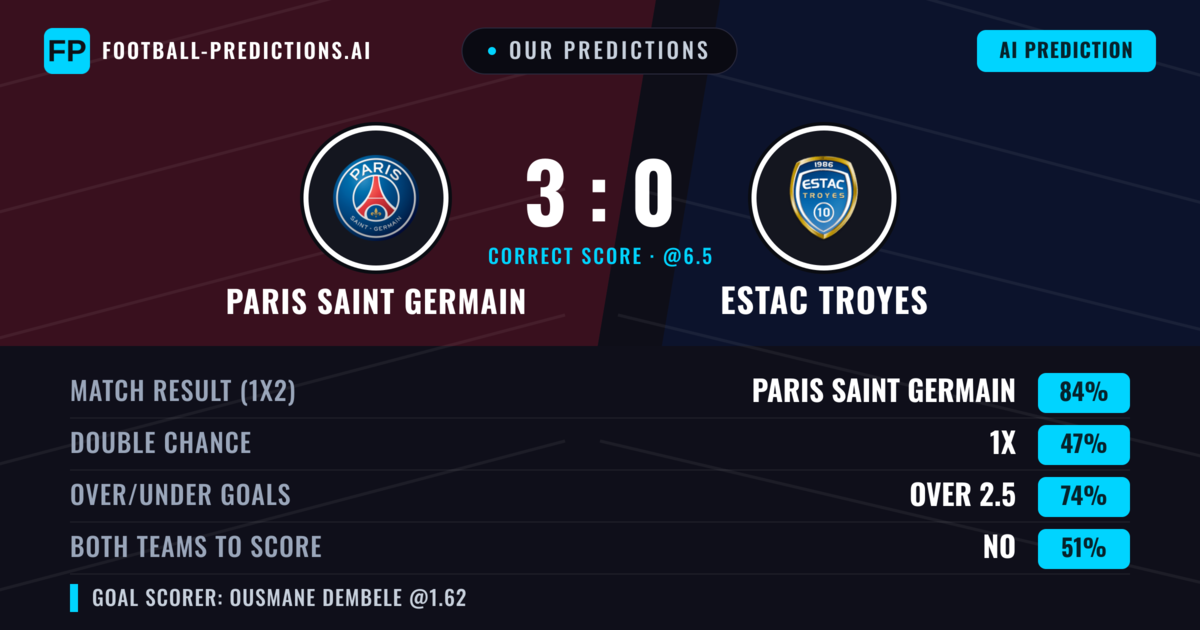
For a ligue 1 correct score prediction, Paris Saint-Germain 3-0 Estac Troyes is the most representative selection because it reflects PSG’s 3.6-goal average, Troyes’ 1.7-goal concession rate and the concentration of the listed correct-score market. It does carry exact-score risk by nature, so it should be treated as a considered forecast rather than the safest available wager. The safer tactical expression of the same idea is PSG -1.5 at 1.43, which is won by a two-goal margin or more.
The match result prediction is Paris Saint-Germain to win, with 84% confidence. That figure is consistent with the 83.4% implied probability in the main market and with the exceptional form comparison. The total-goals prediction is over 2.5, with 74% confidence: PSG’s scoring power provides the foundation, while Troyes’ concession rate makes a larger PSG total more plausible than a low-scoring home fixture. The both-teams-to-score prediction is no, with 51% confidence, reflecting Troyes’ 0.7-goal average and the possibility that the visitors remain subdued. That call is close, which appropriately reflects PSG’s 70% both-teams-to-score rate.
The double-chance selection is 1X, with 47% confidence. It is the most secure outcome in the data, but the 1.03 price offers almost no margin for error and is therefore difficult to classify as attractive value. Among the quoted markets, Troyes +1.5 at 2.74 carries the clearest contrarian value because it is less dependent on PSG winning by four or more than the market’s shortest prices. For readers seeking the principal ligue 1 score predictions, the hierarchy is a PSG win first, over 2.5 goals second and a clean sheet to Troyes as the narrowest of the three calls.
Schedule Note for Local Readers
For the local audience, the listed broadcast time is 19:45 GMT on Saturday, November 7, 2026, with the match available on Fubo. There is a verified scheduling update that readers should take into account: Foot Mercato reports that the PSG-versus-Troyes kickoff was moved to 21:05 from 20:45. Because that update differs from the 19:45 GMT listing, supporters should check the latest broadcast information before setting an alert or heading to the coverage.
The key matchup remains unchanged. Paris Saint-Germain have the form, production, table position and historical dominance to control a match in which Troyes are under substantial pressure. Yet the most useful analysis lies beyond the simple certainty of a home win. The question is how Paris manage their advantage: whether they turn Troyes’ low attacking output into a clean-sheet performance, whether they expose their own transition vulnerabilities, and whether the visitors can remain within a manageable margin long enough to make the handicap market contestable.
Paris should be favorites by every major indicator, but favorites must still manage the game. Troyes, meanwhile, must treat the first hour as a survival exercise, accept that spells without possession are inevitable and create danger on the transitions. If PSG’s attacking unit executes, a three-goal home victory is the cleanest expression of the evidence. If Troyes’ defensive unit and Paris’s occasional concessions disrupt that pattern, the handicap and the late stages of the match become far more