

Posta Rangers FC vs GOR Mahia: Home Resolve Meets FKF Premier League Momentum
At 13:15 GMT on Saturday, November 21, 2026, Posta Rangers FC welcome GOR Mahia to a venue not yet specified in the available match information. That detail matters, because home football begins before the teams reach the technical area: supporters create the backdrop, the hosts’ defensive unit gains familiarity with the surroundings, and visiting players must adapt to an environment they do not control. For Posta Rangers FC, home advantage therefore represents more than a place in the schedule; it is an opportunity to close the gap between a team sitting 14th in FKF Premier League and one occupying second place. GOR Mahia, meanwhile, arrive with the stronger recent profile, but their longer rest period also means there is no recent competitive match waiting to sharpen them for this contest.
This Regular Season round 8 meeting carries weight without the exaggerated atmosphere of a cup final. Points are the currency in FKF Premier League, and the standings reveal why neither side can treat the fixture casually. Posta Rangers FC have collected seven points from seven games, while GOR Mahia have earned 13 from six. The numbers suggest that a single result could alter the competitive picture around this match, particularly for the hosts, yet there is no specific table incentive or stated team news to justify inventing a narrative beyond the standings and form. The best analysis is therefore rooted in what can be measured: Posta Rangers FC need a sharper end product, GOR Mahia need greater consistency, and the historical matchup strongly favors the visitors.
That does not make the outcome inevitable. Head-to-head history is important, but it is only one input, particularly when the most recent meeting between these clubs finished 1-1. GOR Mahia have won 11 of the last 18 encounters, compared with three wins for Posta Rangers FC and four draws. The visitors’ historical edge is substantial, but the latest result in that sequence offers encouragement for the hosts. The central question is whether Posta Rangers FC can reproduce the resistance shown in that 1-1 draw, or whether GOR Mahia’s stronger scoring and defensive rates will reassert themselves.
Pressure and Points at the Heart of the FKF Premier League Contest
Posta Rangers FC’s league position creates urgency without necessarily creating panic. They are 14th in FKF Premier League with seven points from seven matches, a return of one point per game. GOR Mahia sit second with 13 points from six, averaging a little over two points per match. The contrast is clear, but the hosts have not been entirely disconnected from productive stretches. Their supplied form sequence is LWLDW, a mixture of setbacks and a final encouraging result, while the visitors’ form reads DLWWW. Both form patterns suggest that momentum can change quickly rather than remaining fixed for long.
The broad figures behind those sequences reinforce the gap in performance. Across ten matches, GOR Mahia have won five, drawn three and lost twice, scoring 1.3 goals per match and conceding 0.8. Their clean-sheet rate stands at 40%, and both teams to score has been a successful outcome in 50% of those matches. Posta Rangers FC, over the same ten-match sample, have won three, drawn two and lost five. They score 0.9 goals per game, concede 1.4, record a 30% clean-sheet rate and have also seen both teams score in 50%. The headline conclusion is straightforward: GOR Mahia produce more and concede less.
Yet there is an important distinction between the ten-match form sample and the league standings. Posta Rangers FC’s listed table record is two wins, one draw and four defeats in seven FKF Premier League games, while GOR Mahia’s is four wins, one draw and one defeat in six. This means the broader form figures include matches outside the table sample or otherwise cover a different competitive scope; the data does not specify the competition for every match in those ten. It is safest, then, to use the averages as evidence of overall performance rather than treating them as exact FKF Premier League scoring records.
For Posta Rangers FC, the attacking margin is the most obvious target. Scoring 0.9 goals per match across the supplied sample is respectable for a team in the lower half of the table, but it is 0.4 below GOR Mahia’s rate. More importantly, the hosts’ 1.4 conceded average creates a 0.5-goal difference between their scoring and defensive output. GOR Mahia’s corresponding gap is smaller: 1.3 scored against 0.8 conceded. The visitors therefore possess both a stronger attack and a more controlled defensive profile, which explains why the overall comparison places them at 90% and Posta Rangers FC at 10%.
How the Hosts Might Make Home Advantage Matter
No formation data is available for either side, so any tactical discussion must remain at the level of roles and principles rather than pretending to know an exact setup. Posta Rangers FC’s most plausible route to a useful result begins with their defensive unit reducing the space available to GOR Mahia’s forward line. The hosts cannot match the visitors’ scoring output consistently, which means that every clear chance conceded raises the scale of the task in front of their own attacking group. Compactness, discipline and rapid transitions are more valuable to them than an expansive possession game.
The hosts’ midfield would also have an important structural responsibility. Rather than trying to outplay GOR Mahia in settled possession, the central players could protect the area in front of the defense, force play toward less productive channels and prepare quick releases for the forward line. With no individual player data supplied, it would be inappropriate to attach names or specific statistics to those roles. The relevant question is collective: can Posta Rangers FC’s midfield create enough forward momentum from second balls and turnovers to support a forward line averaging 0.9 goals per match?
Set pieces may also become a source of marginal advantage, although the available data contains no evidence about either side’s set-piece record. It is therefore not possible to claim that either team is particularly strong or weak in that area. Still, for a home side seeking to maximize home advantage, dead-ball situations offer a way to create pressure without requiring prolonged possession. The hosts must defend them effectively, of course, but a single well-executed set piece can also alter the emotional temperature of a match that may otherwise be controlled by GOR Mahia.
The attacking unit should focus on efficiency rather than volume. Posta Rangers FC do not need an extravagant number of attempts if they can raise the quality of the few chances they create. Their best tactical scenario is one in which the defense holds firm, the midfield closes down central progression and the forwards attack space at speed. Their harder scenario is a match in which GOR Mahia establish control, move beyond the first line of pressure and expose the hosts’ defensive weaknesses repeatedly. The supplied averages indicate that GOR Mahia’s attack is more likely to produce that kind of control, so Posta Rangers FC need to protect leads and manage transitions better than they have across their wider ten-match sample.
GOR Mahia’s Route to a Stronger Return
GOR Mahia’s tactical case is built on balance. Their forward line has averaged 1.3 goals per match, their defensive unit has allowed only 0.8 per game and they have kept clean sheets in 40% of their ten matches. That combination suggests a team that does not need to rely exclusively on high-volume scoring. Even when the attack is less productive, the defensive platform can reduce the chance of losing ground in the standings.
Against Posta Rangers FC, GOR Mahia can theoretically play with less urgency in possession because their opponents’ scoring rate of 0.9 offers a reasonable platform for counterattacking. That is a strategic interpretation rather than a claim about their actual formation. The forward line can press higher when circumstances allow, while the midfield works to prevent the hosts from launching unopposed counterattacks. The defenders, meanwhile, can protect the central zone and use their defensive record as justification for controlled risk.
That balance will be tested by the historical pattern of the rivalry. GOR Mahia have won 11 of the last 18 meetings, and several of the listed recent victories were decisive: 3-0 in October 2025, 2-1 in February 2025, 3-0 in October 2024 and 4-0 in March 2024. However, the most recent meeting, on March 5, 2026, ended 1-1. The visitors cannot simply assume that the same attacking superiority will continue, particularly against a home side that has now accumulated more league games than GOR Mahia without matching the visitors’ points total.
The longer rest period should be interpreted carefully. The verified information gives Posta Rangers FC six days of rest with one game in the previous ten days, compared with 13 days for GOR Mahia and no games in their previous ten. This is not a significant imbalance that demands either side to alter its approach, and it cannot be converted into a physical advantage without fitness data. It does, however, mean the visitors have had a longer uninterrupted preparation period rather than arriving directly from another competitive fixture.
Tactical Roles That Could Decide the Afternoon
Because no player data is available, the most responsible way to identify influential figures is by role rather than by name. For Posta Rangers FC, the central defender or defensive leader must organize the line, judge when to step forward and ensure that the team’s rest defense is not exposed. The central midfield pair or collective must screen that unit and prevent GOR Mahia from establishing possession in the most dangerous zones. At the front, the leading forwards need to occupy the visitors’ defenders without surrendering the counterattacking outlet.
GOR Mahia’s corresponding pressure points lie in the opposite direction. Their central midfielders must prevent Posta Rangers FC from using home momentum to create an early lead, while their fullbacks or wide defensive outlets must provide passing options when the hosts compress the center. Their forward line should remain patient rather than forcing low-quality entries, because one goal against a side conceding 1.4 per match could become the difference between a productive result and a frustrating one.
The battle between those roles may determine the shape of the match. If Posta Rangers FC protect the center and contest possession in compact areas, GOR Mahia may need to move the ball patiently from side to side before creating an opening. If the hosts push too many players forward, the visitors’ superior scoring rate becomes more dangerous. The goalkeepers and defensive units also deserve attention, particularly because clean sheets have been achieved in 40% of GOR Mahia’s matches compared with 30% for Posta Rangers FC.
Another important duel would be between Posta Rangers FC’s first line of pressure and GOR Mahia’s buildup. The visitors have scored in productive fashion across their ten-match sample, but no passing, shot or possession figures are supplied. It would therefore be unjustified to call them especially good or bad at build-up. The observable advantage is in final output: 1.3 goals per match. Any tactical analysis should therefore focus on whether they convert that possession into chances, not on unsupported assumptions about how the chances are created.
What the Head-to-Head Record Reveals—and What It Cannot
The last 18 meetings provide the clearest long-term signal in the dataset. GOR Mahia’s 11 wins are more than three times Posta Rangers FC’s three, while four matches ended level. The average total is 2.72 goals, and both teams scored in 50% of the encounters. That scoring level is higher than either club’s wider form average, indicating that this matchup has often produced more attacking output than a typical match involving the same teams.
There are two useful ways to interpret that pattern. First, GOR Mahia’s historical superiority is not built solely on low-scoring affairs; the visitors have repeatedly won with multiple goals. The 3-0 and 4-0 victories in the listed recent meetings show that their edge has included emphatic performances. Second, the 50% both-teams-to-score rate means that defensive solidity alone has not always characterized the rivalry. Posta Rangers FC have found ways to score against this opponent even when their overall attacking numbers are less impressive.
Against that, the latest 1-1 draw shows the value of recency. GOR Mahia cannot treat previous wins as evidence that the same result is automatically transferable, particularly with a home side whose immediate league position gives them motivation to improve. The visitors should still be favourites in the broad statistical sense, but the historical edge becomes more useful as a contextual factor than as a guarantee. It supports confidence in the visitors avoiding defeat without proving they will dominate every phase.
The Single Betting Assessment: Markets, Probabilities and the Strongest Calls
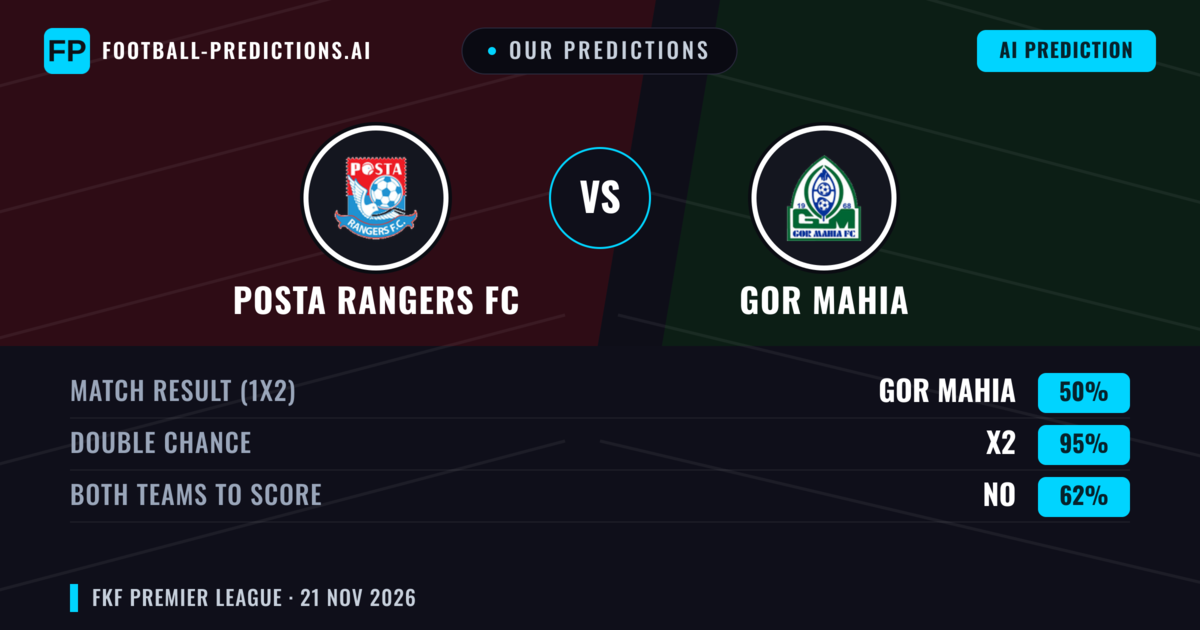
No bookmaker odds have been published for this fixture, so it is not possible to provide actual 1X2, Over/Under, both-teams-to-score, double-chance or Asian-handicap prices. For the same reason, no genuine implied probabilities can be calculated from bookmaker odds, and the value of a selection cannot be assessed against a quoted price. Inventing prices would create the appearance of precision without any underlying evidence. The available probability framework instead supplies a 0% home-win forecast, a 50% draw forecast and a 50% away-win forecast, while the established market selections are both teams to score: no at 62% confidence and double chance X2 at 95% confidence.
The logic behind the both-teams-to-score call lies in the balance between Posta Rangers FC’s scoring rate and GOR Mahia’s defensive record. The hosts have averaged 0.9 goals per match and produced enough output to make a clean sheet a credible possibility, while GOR Mahia have conceded only 0.8 per game across their ten-match sample and kept 40% of clean sheets. Although both teams scored in 50% of both clubs’ broader matches and in 50% of the head-to-head meetings, the combination of the hosts’ limited attacking output and the visitors’ defensive strength supports the higher-confidence “no” assessment. It is a directional football prediction rather than a claim that goals are impossible.
The strongest risk-protection selection is X2. GOR Mahia’s five wins, three draws and two defeats across ten matches compare favorably with Posta Rangers FC’s three wins, two draws and five losses. Their league positions—second with 13 points from six games and 14th with seven points from seven—show the same hierarchy. GOR Mahia also lead the historical series 11-3 across the last 18 meetings. Those factors explain the 95% confidence attached to the double-chance market: it covers a draw and an away victory, offering protection against the possibility that the hosts find one more level than their recent numbers indicate. With no quoted price, however, the selection should be treated as a strong analytical lean rather than a verified value bet.
For the match-result market, the supplied forecast is an away win at 50% confidence. GOR Mahia’s 1.3 goals per game, 0.8 goals conceded, 40% clean-sheet rate and five wins in ten all point their way, as does their dominant head-to-head record. The margin for confidence remains limited because the most recent meeting finished 1-1 and the model still gives the draw equal weight. This is why the away-win view is more aggressive than X2 and should not be confused with a high-confidence outright prediction. No total-goals price or forecast is supplied, so neither an Over/Under selection nor an Asian-handicap recommendation can be justified from the available information.
Value identification ultimately depends on price. The data supports a clear hierarchy of football prediction ideas—X2 as the safest outcome-oriented selection, both teams to score “no” as the more specific goals market call, and the away win as the boldest match-result forecast—but without bookmaker odds there is no way to determine whether any of them is underpriced. Anyone using these football predictions should wait for a confirmed price and assess whether the implied market probability leaves enough margin for the model’s stated confidence. This approach applies equally to today’s soccer predictions and to anyone searching for a football forecast for today.
Final Assessment: A Test of Margins and Composure
Posta Rangers FC have the harder route to satisfaction. A home crowd can create urgency, but the available numbers show a side scoring 0.9 goals per match, conceding 1.4 and sitting 14th in FKF Premier League. Their tactical task is to make the match compressed: deny GOR Mahia repeated entries, protect the leads created by the forward line and use home momentum to make every attacking transition count. If they can remain disciplined, the latest 1-1 head-to-head result proves that the gap can be contested.
GOR Mahia possess the stronger portfolio of indicators. They have won five of ten, average 1.3 goals scored and 0.8 conceded, sit second in FKF Premier League and have taken 11 wins from the previous 18 meetings against Posta Rangers FC. Their best approach is not reckless; it is controlled. The visitors should use their defensive unit to reduce the hosts’ momentum, allow their forward line to remain patient and then punish the spaces created by a home side that must attack.
The most convincing conclusion is therefore not that GOR Mahia must win by a particular margin. It is that they are better positioned to avoid defeat, with Posta Rangers FC facing the tougher task of protecting any advantage they manage to create. For readers looking at soccer prediction football, 2day football prediction, prediction in football today or predictions for today’s matches, the central issue remains whether the market price reflects GOR Mahia’s edge without underestimating the draw. Without published odds, the recommendation stays conditional on price: the analytical preference is X2, accompanied by both teams to score “no” as the more specific attacking call.