

Rennes vs Lille: The Ligue 1 Title Race Hangs on a Clash of Momentum
Roazhon Park will provide the setting for a Ligue 1 regular-season contest with genuine significance attached to it. Rennes are 3th in Ligue 1 with 16 points from nine matches, while Lille sit immediately above them in 2nd place with 18 points from the same number of games. Only two points separate the two sides, and that compactness is central to the attraction: this is not merely another meeting between two clubs seeking to build consistency, but a direct confrontation between two teams intent on remaining in the title and Champions League league-stage race.
Home advantage should matter here, although the margin for Lille is narrower than the standings alone might suggest. The market has Rennes as a slight favourite, while the comparison metrics give Lille the stronger overall profile: 58% to 41% in overall team comparison, 53% to 47% for form and 77% to 23% defensively. Rennes, however, carry a much stronger attacking rating of 63%, compared with Lille’s 38%, and their scoring average is also superior. The result is a match with two credible routes to victory: Rennes can overpower Lille through greater attacking production, while Lille can extend their defensive advantage and make the home side work for a breakthrough.
The interesting part of this meeting is not the apparent conflict between a stronger Rennes attack and a stronger Lille overall. It is the way each club’s available production relates to the expectations placed upon them. Rennes have scored 1.9 goals per game in the supplied form sample and conceded 1.8, giving them the more volatile profile. Lille’s corresponding figures are 1.2 scored and 1.4 conceded, suggesting a narrower, more controlled contest in which fewer chances may decide the result.
A Championship Race on Two Different Tracks
The standings make the stakes straightforward. Rennes are 3th in Ligue 1 and Lille are 2nd, with both clubs firmly inside the Champions League league-stage race according to the verified motivation data. Neither side can treat this as a fixture to be managed from first to last. Lille have two points more, but they also carry the stronger overall analytical rating and a markedly better defensive comparison. Rennes know that victory would move them past their visitors, whereas Lille have the option of protecting their position while still playing on the front foot.
There is also a useful contrast in the records. Rennes have five wins in their supplied ten-match form dataset, two draws and three defeats. Lille have four wins, two draws and four losses. Yet the standings list Lille with five wins and one defeat from nine matches, compared with Rennes’ five wins, one draw and three defeats. Those figures present Lille as the more successful side in the league table, while the broader form sample is closer and somewhat less convincing.
That distinction matters because the match data is not entirely aligned. The form section gives Rennes a last-five sequence of LWDLW and Lille WDLDL, while the verified situational snapshot lists the recent form as LWLWL for Rennes and WDDWL for Lille. Rather than pretending that these labels create a perfectly smooth trend, the honest reading is that both teams have experienced mixed periods. Lille’s league position indicates consistency; Rennes’ attack suggests greater potential but also greater exposure when their defensive structure is under pressure.
This makes the meeting a useful test of substance over presentation. Lille’s 18 points and 77% defensive comparison rating provide the more stable foundation. Rennes’ 63% attacking comparison rating and 1.9 goals per game supply the greater attacking threat. A single breakthrough could therefore matter disproportionately, particularly if Lille’s defensive platform is asked to absorb pressure it has not consistently faced in the supplied averages.
Recent Momentum: Stronger Numbers, Uneven Labels
Rennes’ 1.9 goals scored per game is the most persuasive attacking number in the preview. Across the form dataset, they have won five of ten and remain only two points behind Lille in the Ligue 1 standings despite having one more defeat on the table. Their 60% BTTS rate also points towards games in which both scoring areas tend to be involved, and their 30% clean-sheet rate suggests they have not always established control at the opposite end.
Lille’s attacking numbers are less emphatic. Their 1.2 goals per game is substantially below Rennes’ output, while their 1.4 conceded average shows they have generally kept a tighter line. The 40% clean-sheet rate is better than Rennes’, and the 50% BTTS rate is lower than the home side’s 60%. Taken together, those indicators describe a team more likely to control the shape of matches and reduce the frequency of open exchanges, even when its own attacking production is less consistent.
Neither side, however, should be treated as rigid. Rennes’ 1.8 goals conceded per game means their attacking strength has not translated into full defensive control. Lille’s four losses in the ten-match form dataset show that the disciplined defensive profile has not always produced enough output at the other end. The match therefore comes down to whether Lille can maintain their defensive standards while facing the most productive attack in this comparison, and whether Rennes can convert pressure into goals without allowing Lille’s counter-attacking threat to exploit the spaces that pressure creates.
Rest should not tilt the balance. Both clubs have had nine days of rest and have played one game in the last ten days. That means there is no scheduling imbalance to exploit and no clear fatigue-based reason to expect either side to fade late. It also makes tactical execution more important: fresh legs will not decide the match, but the ability to maintain a coherent structure under pressure almost certainly will.
How the Shape of the Game Could Develop
No formations are supplied for either team, so it would be irresponsible to assign a confirmed setup or invent a tactical inheritance that the data does not verify. The more revealing approach is to examine the roles the numbers demand. Rennes need not be passive simply because Lille have the stronger defensive rating. Their attacking comparison of 63% and scoring average of 1.9 indicate an edge in the ability to create and convert, and the sensible home objective is to use that superiority to establish a lead before Lille can settle into a more conservative contest.
What that means structurally depends on the personnel and decisions available on the day, none of which can be reconstructed from the provided material. Rennes can be expected to seek quicker movement between attacking phases, while Lille’s defensive numbers point towards priorities such as reducing central space, protecting the first line of pressure and making the home side attack from less favourable positions. These are tactical requirements rather than claims about a specific formation, and the contest should remain flexible rather than becoming a static battle between two set structures.
Lille’s challenge is to avoid becoming purely reactive. Their defence has the stronger rating, but their attack trails Rennes by a considerable margin in both the comparison percentages and the goals-per-game average. If Lille sit too deep for too long, Rennes may control territory and create the type of chances consistent with their 1.9-goal scoring rate. The visitors therefore need enough forward presence to make Rennes look over their shoulder, even when the home team has the ball.
Conversely, Rennes must respect the pace of a transition. A 60% BTTS rate in their form dataset means a high proportion of their matches have featured scoring on both sides, while Lille’s 50% figure gives them enough evidence to punish an attempted defensive clean sheet. The away side does not need to match Rennes’ scoring volume continuously; one well-taken counterattack can alter the entire risk calculation for the home team.
Game management could be decisive. If Rennes score first, Lille must become more adventurous, exposing the defensive strengths that have helped justify their stronger overall rating. If Lille score first, Rennes face a different kind of pressure because their 1.8 conceded average shows that they do not always manage games once opponents force them into repeated defensive actions. The first goal would therefore change not only the scoreline, but the range of outcomes each side can realistically pursue.
The Scorers Who Carry the Available Scoring Information
Only two Rennes players are identified in the supplied key-player data, so it would be misleading to add names or assign positions that have not been provided. S. Szymański and E. Lepaul are the two listed Rennes scorers, each with one goal and no assists. Their modest totals do not provide evidence of prolific form, but that makes Rennes’ collective 1.9 goals-per-game average all the more significant. The attacking strength is evidently distributed beyond the two players highlighted here.
Szymański’s one goal shows that he has already made a direct scoring contribution. In a match where Lille’s defensive rating is the strongest element of the visitors’ profile, even one confirmed forward contribution carries contextual value. It does not prove that he will be the decisive player, but it establishes him as someone capable of making the difference rather than being a purely peripheral attacking option.
E. Lepaul likewise has one goal and no assists. That combination suggests impact as a scorer in the narrow statistical sense, without evidence of creative production from the data supplied. Rennes may need more than isolated finishing if their total attack is to be fully effective, but Lepaul’s contribution gives the home side a named outlet when Lille compress the space in search of control.
Lille’s listed scorers are Tiago Santos and O. Giroud, again with one goal apiece and no assists. Neither should be presented as a proven match-winner based on the available numbers. Their value is positional and contextual: Lille need forward output to prevent Rennes from controlling the match at both ends, and these are the two players the supplied material identifies as having already registered goals for that objective.
Tiago Santos and Giroud should be viewed in the context of Lille’s team average rather than as isolated stars. Lille have scored 1.2 goals per game in the form dataset, meaning a modest return from either forward can represent a significant share of their attacking production. If one of them finds space against a Rennes defence that concedes 1.8 per game, Lille could gain more from the move than the raw one-goal totals initially suggest.
The lack of listed assists for all four players is also relevant. It indicates that neither side’s identified scorers have been recorded as creative distributors in the available data. That places greater collective emphasis on creating chances and finishing chances rather than elevating one named playmaker. It also reinforces the need for caution when reading the overall scoring rates: the numbers describe team output, but the player-level evidence is limited to four goals and no assists.
Twenty Meetings and a History of Competitive Balance
The last 20 meetings provide a useful counterweight to the current table gap. Rennes have won six, Lille eight and six have been drawn. Lille therefore hold the historical edge, but only by two victories across the full sample. The matches have also produced an average of 2.6 goals, while 65% featured both teams scoring. That is broadly compatible with the idea of an open but productive contest, although the current season averages are less explosive: Rennes’ 1.9 goals and Lille’s 1.4 together total 3.3 in terms of average scoring and conceding figures.
The recent head-to-head results are particularly varied. Rennes lost 1-2 at home to Lille on March 15, 2026, but won 2-0 away to Lille on January 3. Lille won 2-0 at Roazhon Park on February 16, 2025, before drawing 2-2 at home against Rennes on March 10, 2024. Lille also won 1-0 at home on November 24, 2024. The sequence contains wins, draws, clean sheets and two-goal margins, demonstrating how difficult it is to identify one stable pattern.
Two conclusions can still be drawn. First, Lille have repeatedly demonstrated that they can win away from home, which matters in a fixture where Rennes possess the stronger attacking rating and home advantage. Second, Rennes have also won at Lille recently, so the visitors cannot rely solely on historical superiority. The head-to-head record supports a close contest rather than a one-sided expectation.
The 65% BTTS historical rate is notable, but it should not be mistaken for a guarantee. Current form shows Rennes at 60% and Lille at 50%, placing both clubs below that long-term meeting average. History points towards goal involvement from both teams; the current numbers support the possibility but do not make it certain. This distinction is important when assessing whether the most attractive betting approach lies in a correct-score market, a goals total or a more conservative side selection.
The Betting Desk: Prices, Probabilities and the Sharpest Angles
Bet365 prices the 1X2 market at Rennes 2.05, draw 3.7 and Lille 3.3. Those prices translate into raw implied probabilities of approximately 48.8%, 27.0% and 30.3%, respectively. The sum is 106.1%, meaning the book contains roughly a 6.1% overround. After normalizing the three prices, Rennes remain the narrow favourite, with Lille second and the draw third. The original match-winner feed listed Rennes at 2, which implied 46.6%, a draw probability of 25.2% and Lille at 28.2%; the move to 2.05 for Rennes reduces the home side’s raw implied chance slightly.
The appropriate conclusion is that the market expects Rennes to win, but not with overwhelming confidence. Lille’s defensive comparison rating and second-place Ligue 1 position justify respect, and the head-to-head record shows they have won eight of the last 20 meetings. Rennes’ stronger attacking figures explain why they are favoured at Roazhon Park, but neither the standings nor the historical numbers justify treating the home side as an automatic selection.
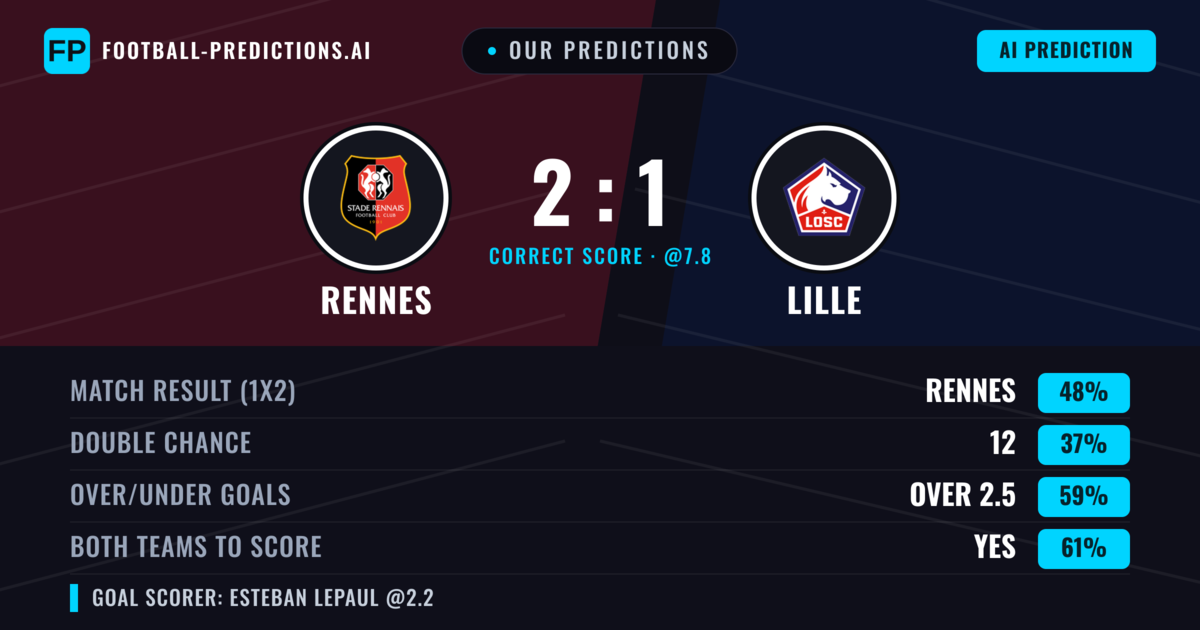
Our primary result prediction is a Rennes win, with 48% confidence. That sits close to the market’s normalised view rather than claiming an edge based on the supplied prices alone. The reason to lean toward Rennes is the combination of home advantage, the superior 63% attacking comparison and the higher 1.9 goals-per-game average. The reason not to assign greater confidence is Lille’s 77% defensive comparison, their 40% clean-sheet rate and their ability to win away matches in the head-to-head sample.
For the double-chance market, the supplied prices are Rennes or draw at 1