




Scotland Returns to World Cup Stage After 28 Years as Injury Clouds Gather Over Group C Opener
For the first time since 1998, Scotland prepares to step onto football's grandest stage, but the build-up to Friday's World Cup opener against Morocco at Gillette Stadium in Boston has been far from ideal for Steve Clarke's side. The Scottish national team cancelled its final warm-up match against Norway due to a growing injury crisis within the squad, according to reports from Morocco World News, leaving Clarke with limited options to fine-tune his preparations. Billy Gilmour, who sustained an injury during the recent friendly against Curaçao, has been ruled out of the tournament entirely, dealing a significant blow to Scotland's midfield plans.
Morocco arrives at the encounter facing its own selection headaches. The Atlas Lions, who reached the semi-finals in 2022, suffered fitness blows during their draw with Norway, with key players requiring medical attention. Head coach Walid Regragui expressed satisfaction with the team's performance despite the setbacks, but the timing of these injuries places Morocco in a precarious position ahead of what promises to be a fiercely contested Group C fixture. Both teams currently sit level on points in the group standings, with Brazil and Haiti also competing for advancement.
The venue adds another layer of intrigue to this encounter, as Gillette Stadium plays host to its first World Cup match since 1994. Scotland demonstrated their attacking capabilities during preparations, recording a commanding 4-0 victory over Bolivia in New Jersey, suggesting that despite their injury troubles, they possess enough quality to threaten Morocco's defense. The North African side, however, possesses the experience of deep tournament runs and will look to leverage that pedigree against a Scotland team still finding its feet on the biggest stage of all.
Scotland and Morocco Head Into Group C Opener in Contrasting Moods
Both teams enter this Group C encounter at Gillette Stadium still seeking their first points of the tournament, but the trajectory of their recent preparations tells strikingly different stories. Scotland arrive with a mixed recent record of two wins and two defeats from their last four matches, a sequence that highlights both their capability to dominate inferior opposition and their ongoing struggles against more established footballing nations. The 4-0 victory away to Bolivia demonstrated what Scotland can achieve when operating with freedom and precision, though that performance needs to be replicated against a far more challenging opponent on Friday.
Morocco, by contrast, head into this fixture on the back of an impressive unbeaten run spanning seven matches, collecting four wins and three draws during that sequence. Their recent results read like a demonstration of clinical efficiency, with comprehensive victories against Madagascar (4-0) and Burundi (5-0) showcasing their attacking potency, while a hard-fought 2-1 win against Paraguay provided evidence of their ability to dig out positive results against competitive opposition. The 1-1 draws against Norway and Ecuador suggest this Moroccan side remains difficult to break down, even against technically gifted opponents. Their scoring average of 2.14 goals per game across these fixtures stands notably higher than Scotland's 2.0, and their superior defensive record of 0.57 goals conceded per match compared to Scotland's 0.75 indicates greater structural solidity at the back.
The contrast in clean sheet percentages further illuminates this defensive divide. Morocco have kept clean sheets in 43% of their recent matches, while Scotland have managed only 25%, a statistic that correlates with Scotland's tendency to concede at least once in three out of every four games. Scotland's BTTS percentage of just 25% suggests their recent matches have tended to be either comfortable victories or defeats where they failed to score, rather than closely contested affairs. Morocco's BTTS figure of 57% indicates more competitive encounters where both sides have found the net, a pattern that reflects their position as a side capable of scoring regularly while occasionally being caught out defensively.
Scotland will take encouragement from their emphatic wins against Bolivia and Curaçao, performances that illustrated their attacking capabilities when executing their game plan effectively. However, back-to-back 1-0 defeats against Ivory Coast and Japan expose vulnerabilities that Morocco will look to exploit, particularly given the North African side's proven ability to break down organized defenses in their recent fixtures. The Scottish defense faces a significant test against a Morocco side averaging over two goals per match and showing no signs of slowing down. For Scotland to emerge with a positive result, they must recapture the cutting edge and defensive organization displayed against Bolivia while finding a way to contain an opponent whose form suggests they represent the strongest challenge Scotland have faced in their build-up to this World Cup campaign.
Contrasting Philosophies: Scotland's Directness Meets Morocco's Structured Control
Scotland approaches this World Cup opener with renewed confidence after a commanding 4-0 victory over Bolivia, a result that showcased the attacking potential Steve Clarke has cultivated during the build-up. The performance featured goals from Lawrence Shankland, Scott McTominay, and a double from Che Adams, with McTominay's strike coming from the edge of the area following a clever assist from Shankland, as reported by Oman Daily. Clarke appears to favour a structured 4-3-3 system that allows his side to transition quickly when winning possession, with Ben Doak's pace on the flank providing a genuine counterattacking outlet. The Scots' pre-tournament preparations have been disrupted by an injury crisis that forced the cancellation of a planned friendly against Norway, with John McGinn publicly defending the decision by stating that Scotland's job is to look after Scotland, according to The Guardian. The loss of Billy Gilmour, sustained during the Curaçao friendly, represents a significant setback for Clarke's midfield options.
Morocco, under Walid Regragui, enters this fixture carrying concerns about the fitness of key players following their draw with Norway. Abdelmalik Ezzalzouli and Nayef Aguerd both picked up injuries during that encounter, with Ezzalzouli forced off at half-time and Aguerd experiencing a shoulder problem early in the match, as detailed by Al Jazeera. Despite these setbacks, Regragui expressed satisfaction with the overall performance, noting that the team left a positive impression against a strong opponent, per the same source. Morocco likely deploys a compact 4-3-3 or 5-4-1 shape that prioritises defensive solidity while allowing creative midfielders to control tempo. The side possesses technical quality in deeper positions and looks to build methodically rather than absorb pressure passively.
The tactical mismatch here presents fascinating sub-plots. Scotland's willingness to commit players forward in wide areas creates space behind their full-backs that Morocco's counterattacking units can exploit if Aguerd recovers to anchor the defence. Conversely, Clarke's side will target Morocco's defensive transitions, particularly if the injuries to Ezzalzouli and Aguerd force changes to Regragui's preferred back four. Scotland demonstrated they can strike early, with Shankland scoring after five minutes against Bolivia, suggesting the opening stages could prove decisive in determining which tactical approach gains control first.
Scotland vs Morocco: Betting Analysis and Match Prediction
Both teams enter this Group C encounter at Gillette Stadium in Boston with identical records of zero points from zero matches, making this opening fixture crucial for establishing early momentum in a group that also features Brazil and Haiti. The bookmakers have priced Morocco as clear favourites, with odds of 2 (2.00 decimal) available at 1xBet for an away victory, translating to an implied win probability of 46.6%. Scotland, playing on home soil for this World Cup fixture, find themselves as underdogs despite the venue being a neutral American location, with odds of 4.22 at 1xBet representing a 23.3% implied probability of success. The draw is priced at 3.3 with Betfair, offering the third-best value among the three outcomes.
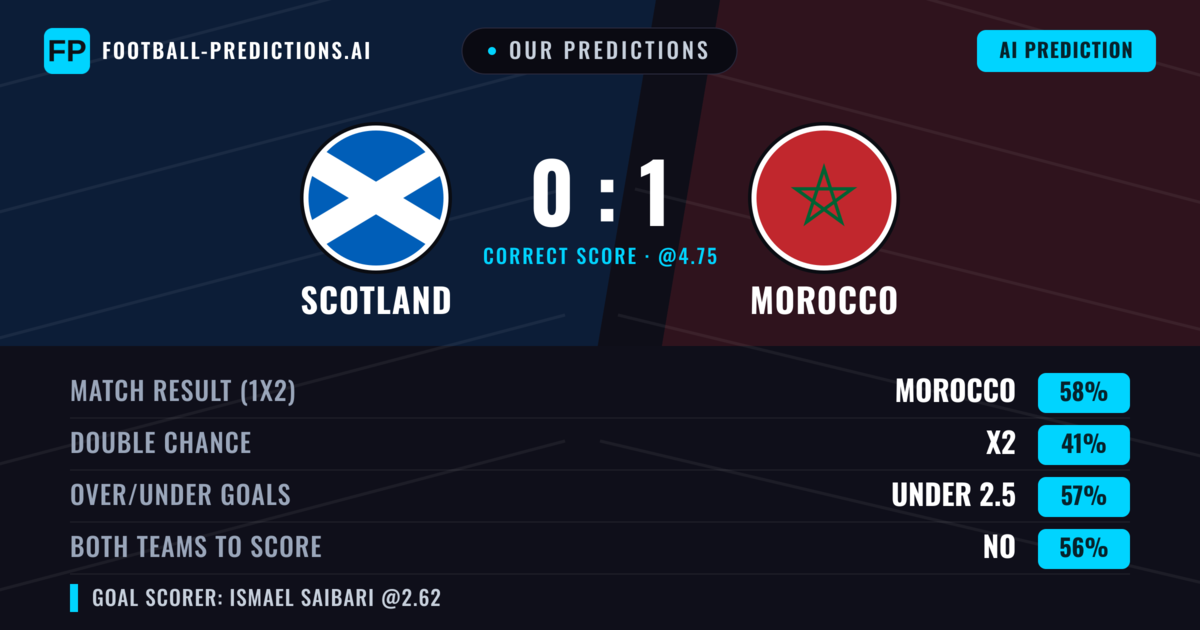
Our analysis indicates Morocco as the most likely winners with 49% confidence, aligning with the bookmaker sentiment that favours the African side. The prediction of under 2.5 total goals carries 58% confidence, suggesting a tightly contested affair where both defences are expected to hold firm. This aligns with the double chance prediction of X2 (Morocco win or draw) at 38% confidence, providing a safety net for punters who believe the outright away victory may prove too narrow a margin. The both teams to score prediction of "no" at 53% confidence reinforces the expectation of a low-scoring match where clean sheets are anticipated for at least one side.
For punters seeking value, the best available odds for a Morocco win are 2 at 1xBet, while those favouring the draw can secure 3.3 at Betfair. Scotland backers will find their best potential return at 4.22 with 1xBet, though the 23.3% implied probability indicates this remains the least likely outcome among the three options. The under 2.5 goals market appears well-supported by the data, with the highest confidence rating in our predictions, making it a strong candidate for accumulator builders seeking a reliable foundation bet.
From a strategic perspective, Morocco's tactical approach typically prioritises defensive solidity while exploiting counter-attacking opportunities, a style that naturally lends itself to low-scoring outcomes. Scotland, facing an early group stage must-win situation, may need to adopt a more aggressive posture that could expose defensive vulnerabilities. The combination of Morocco's disciplined defending and Scotland's potential necessity to push forward creates a scenario where the under 2.5 goals market (58% confidence) and both teams to score no (53% confidence) appear to be the most analytically sound selections for this fixture.
Supplementary Betting Angles for Scotland's Group C Opener
The Asian Handicap market presents the strongest conviction play of the night, with Morocco installed at -0.25 at odds of 1.26 backed by a 79% confidence rating. This slight favoritism reflects the narrow margin separating the sides in the handicap market. For those seeking longer odds on the correct score landscape, the 0:1 result emerges as the most probable outcome at 5.25, though it carries only 19% confidence — a reminder that while it represents the statistical most likely scenario, significant probability mass remains distributed across other score lines. These two markets complement each other well for stake management, with the Asian Handicap offering higher reliability and the correct score providing value for those with stronger risk tolerance.
The half-time result market shows draw odds of 1.94 with 45% confidence, indicating the bookmakers view an even first half as plausible but far from certain. This positions the draw as the modal half-time outcome without overwhelming probability. Looking at the technical and disciplinary markets, the corners line of under 9.5 corners at 1.57 with 59% confidence suggests a relatively contained territorial battle rather than an end-to-end affair. Similarly, the cards market leans toward over 3.5 cards at 1.58 with 58% confidence, indicating expectations of a physical contest where referee interventions factor into match dynamics. These supplementary markets offer alternative angles for bettors looking beyond standard match result markets and may present value when combined with the primary handicap selection.
Verdict: Morocco Set to Edge Scotland in Tight Group C Opener
When Scotland and Morocco face off at Gillette Stadium in Boston, the prediction model favors Morocco to secure a positive result. The 49% confidence rating on a Morocco win reflects their competitive edge, while the double chance market (Morocco win or draw) at 38% provides an alternative angle for cautious bettors. The strongest signal in the data is under 2.5 goals at 58% confidence, suggesting a tight, low-scoring affair. BTTS "no" at 53% aligns with this outlook, indicating defensive solidity from at least one side.
For those finalizing their betting strategy, backing Morocco on the double chance offers reasonable protection given the narrow margins involved. The under 2.5 goals market represents the most reliable play based on current data. Both teams enter this fixture with everything to prove in Group C, where Brazil looms as the heavy favorite. A positive start in Boston could prove decisive for either nation's hopes of advancing beyond the group stage.