



Craiova Seek Control Against Egnatia in Conference League Decider
The difference in this UEFA Conference League encounter may not be identifiable through one star name, because no individual player information has been supplied for either Universitatea Craiova or Egnatia Rrogozhinë. Instead, the potential match-winner could emerge from collective strengths: Craiova’s attacking structure, their defensive control and the ability of their three-at-the-back system to dictate possession. Egnatia, by contrast, may find their decisive advantage in the spaces created by their 3-5-2 shape, particularly if they can turn defensive resistance into quick transitions. This is a league-stage match in a cup competition, but the pressure is substantial because every point carries direct value in the pursuit of progression.
Universitatea Craiova host Egnatia Rrogozhinë at Stadionul Ion Oblemenco on Thursday, November 5, 2026, with kickoff at 20:00 local time and 18:00 GMT for London readers. The round is officially the third of the UEFA Conference League league stage, meaning this is not a one-off knockout game with a return fixture waiting. Nevertheless, it demands knockout-style urgency. A defeat could leave a team requiring a demanding recovery across its remaining matches, while a draw could be valuable without being decisive. The distinction matters for the likely tempo: Craiova will want to establish control rather than merely protect a point, while Egnatia have every incentive to remain competitive and avoid being overwhelmed.
A Cup-Stage Test With Direct Consequences
There is no need to dress this fixture up as a routine league contest. The UEFA Conference League is a cup competition, and although its league stage operates through a points format, the consequences remain tied to advancement. Universitatea Craiova sit 11th in UEFA Conference League with four points from two matches, having recorded one win and one draw. Egnatia are 20th in UEFA Conference League with two points, also from two matches, after drawing twice. Both teams are therefore unbeaten in the competition, but Craiova have already accumulated the stronger return.
Craiova’s position gives them a practical advantage without removing the need for further points. Their home venue and stronger recent numbers suggest this should be an opportunity to take command of their group. Egnatia, meanwhile, cannot treat a cautious scoreline as an automatic success. Two draws have given them two points, but the gap in performance indicators is considerable, and another passive performance could leave them increasingly dependent on events elsewhere.
The timing also introduces a subtle complication. Universitatea Craiova have had four days of rest and have played two games in the last ten days, while Egnatia have had 14 days of rest without playing a match in that period. The source data classifies this as no significant rest difference, although the workload pattern is still noticeable. More importantly, Craiova play again in three days in another competition, creating a genuine rotation risk. That possibility could affect selection and perhaps the intensity of their pressing, but Egnatia should not assume the hosts will be weakened. The home side still has the stronger form profile and the greater need to make this match count.
Craiova Bring Momentum and Defensive Control
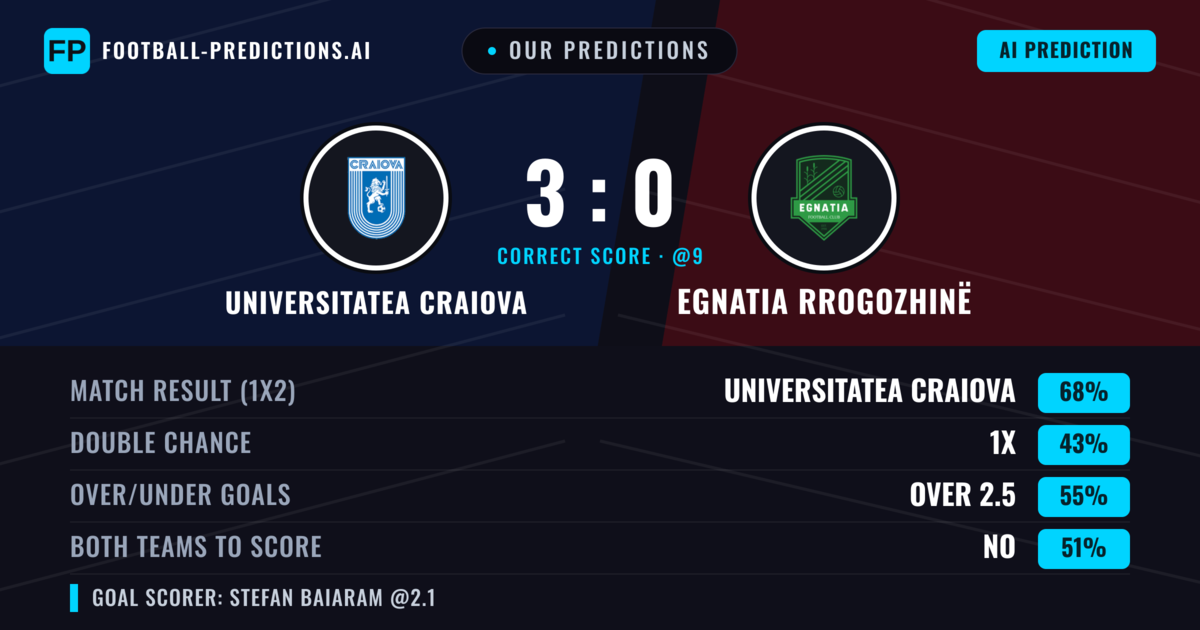
Universitatea Craiova’s form string is WDWWW, and the numbers behind it make a strong foundation for this analysis. Across the ten matches covered by the form sample, the home side have won eight, drawn two and lost none. Their average scoring output is 2.5 goals per match, while their defensive record is even more impressive, with only 0.4 goals conceded on average. A 60% clean-sheet rate reinforces the picture: Craiova have not merely accumulated positive results, they have frequently controlled matches with little opposition pressure.
Their UEFA Conference League figures also point in the same direction. The hosts have scored five goals and conceded only one in two matches, producing one clean sheet. There is no need to extrapolate too far from those numbers, but they support the broader conclusion that Craiova’s game is built on more than sporadic attacking success. The side combines a substantial goal return with a structure capable of protecting leads and limiting opponents’ chances.
That profile should influence the home approach. Craiova can afford to be patient without becoming passive because their form and defensive record provide a strong safety net. The risk is that excessive conservatism would waste the home advantage and the 2.5-goal average. A balanced performance would involve using the first forward line to establish a lead, then reducing the openness while keeping the defensive unit protected. Their objective should be a controlled home win rather than a frantic attempt to reach an arbitrary scoreline.
Craiova’s five wins in their last five also matter psychologically. Egnatia can identify positive features in their own performance, but they are entering a match against a side that has not lost within the supplied ten-match sample. The hosts’ challenge is not to prove that momentum guarantees success; it is to turn momentum into goals before Egnatia’s defensive resistance becomes more comfortable.
Egnatia’s Form Offers Hope, Not Certainty
Egnatia’s exact form string is DDDDWL, a pattern defined by resistance and near misses. In the ten matches represented by their form data, they have won three, drawn six and lost once. Their attacking average is 1.9 goals per match, which is respectable and only slightly below Craiova’s 2.5, but their 1.1 goals conceded per match indicates that they have not maintained the same defensive control. Their 70% both-teams-to-score rate also separates them sharply from the hosts, who sit at 40%.
That last comparison suggests two possible interpretations. Egnatia’s matches have often featured goals from both sides, possibly because they engage opponents in more open exchanges. Alternatively, their defensive unit has repeatedly been forced to protect a lead but has not always succeeded in doing so. Against Craiova, who average only 0.4 goals conceded, the second interpretation is especially dangerous: Egnatia cannot expect to concede and still rely on an eventful game to carry them through.
In UEFA Conference League, Egnatia have scored seven goals and conceded two across their two matches. The attacking return is better than Craiova’s five goals, but the contrast comes at a cost: Egnatia have not kept a clean sheet, whereas Craiova have. The visitors therefore need either an efficient attacking performance or a disciplined defensive showing, and ideally both. Their 30% clean-sheet rate in the wider form sample leaves little margin for a passive approach.
Three consecutive draws before the win and the lone defeat in the five-match sequence also underline the need for variety. Egnatia cannot keep offering the same narrow margins and hope that one breakthrough eventually changes the pattern. Against a home team with such strong results, the visitors might need to attack before the crowd has time to settle. If they sit too deep, they could spend the match absorbing pressure and eventually concede to a set-piece, a wide delivery or a moment of individual quality.
How the Two Formations Could Shape the Night
The most important tactical information concerns structure: Universitatea Craiova use a 3-4-3, while Egnatia Rrogozhinë operate in a 3-5-2. Both systems are built around three defenders, which should make the first phase of possession especially significant. The team that wins the ball in central areas can create immediate numerical advantages in front of or around the opposition back line.
Craiova’s 3-4-3 should allow them to press with one front forward and three midfielders, using the width of the wing-backs to stretch Egnatia’s 3-5-2. Egnatia’s wide midfielders are likely to have defensive responsibilities in that structure, meaning Craiova’s wide attackers may try to isolate them. If the hosts can move the ball across the front of the defensive line, Egnatia’s midfield may be forced either to retreat or expose channels around the wide players.
At the other end, Egnatia’s two forwards give them a direct route through Craiova’s build-up. A 3-5-2 is often effective in transition because the front pair can immediately contest a central defender and force passes toward the wide areas. Craiova’s three defenders will therefore need to manage the space in front of the centre-backs carefully. Conceding a central transition would be particularly damaging against a team with a 70% both-teams-to-score rate, even though Craiova’s own defensive record is much stronger.
The key tactical battle is likely to take place in the middle third. Craiova want their three midfielders to connect the back three with the front line, while Egnatia need their central midfield trio to control the same zone and launch the forwards. If Egnatia can disrupt Craiova’s passing rhythm, the hosts may struggle to generate the volume of chances required to turn their overall superiority into a decisive score. If Craiova’s midfield wins the duels, Egnatia’s back five could become progressively deeper and more passive.
The Difference Makers Are Collective, Not Individual
No individual player names or player statistics have been provided, so it would be inappropriate to manufacture a key-player shortlist. The relevant difference-makers must instead be identified by role. For Craiova, the first is the central forward, whose ability to occupy the centre-backs can create space for the attacking midfielders and wing-backs. The second is the leading midfielder, who will be responsible for connecting possession to penetration. The third is the leading defender in the 3-4-3, whose ball-carrying can help the hosts escape Egnatia’s first pressing line.
The fourth important role for Craiova is the defensive unit as a whole. Its 0.4 goals conceded per match is the foundation of the team’s form, and maintaining that level against Egnatia’s two-forward shape will matter. If Craiova’s defenders remain composed and avoid being drawn into isolated duels, the hosts should have the greater control. The same four roles can also be viewed collectively: the full-backs’ width, the front line’s movement and the midfield’s recovery work all influence whether the team’s strong form survives the transition phase.
Egnatia’s potential match-winners are similarly defined by position. The two forwards must provide a credible outlet and make the hosts’ centre-backs uncomfortable. The central midfielder, particularly in possession, can dictate whether Egnatia progress through pressure or retreat into a low block. The wing-backs or wide midfielders in the 3-5-2 must balance attacking width with recovery duties, because their defensive positioning will determine whether Craiova can attack through the flanks.
The most consequential role may be that of Egnatia’s defensive trio. They will face a home side averaging 2.