

USA Welcome Peru in International Friendly as Both Sides Eye Squad Rotation
When the final whistle sounds at the meeting between USA and Peru on Saturday evening, both managers will already have one eye on further fixtures just three days later. This timing creates a fascinating tactical puzzle for both sides as they balance maintaining match sharpness against the physical demands of a condensed schedule.
Both teams enter this Friendly International from periods of inactivity, with USA having had 82 days of rest compared to Peru's slightly longer 110-day break. The extended layoffs mean coaches on either side will likely view Saturday's encounter primarily as an opportunity to evaluate squad depth and build fitness rather than chase an outright result. Kickoff is scheduled for 21:30 BST, giving supporters in the UK a convenient evening slot to watch the action unfold.
The short turnaround ahead means rotation is almost certainly on the agenda. Both nations face another commitment in just three days, which typically signals that established starters may be preserved for later battles while newer faces get their chance to impress. For bettors, this creates an interesting dynamic where traditional form guides carry less weight and individual player motivation becomes harder to gauge. The friendly nature of the contest, combined with these logistical constraints, suggests a match that could defy conventional prediction.
Where the Match Could Be Won and Lost
Saturday's friendly at 21:30 BST presents an intriguing tactical puzzle for both sides, particularly given the rotation pressures facing each camp. With both USA and Peru scheduled to return to action in just three days, each manager faces a balancing act between blooding squad depth and maintaining competitive intensity. The extended rest periods — USA with 82 days compared to Peru's 110 — suggest both sets of players will approach this contest with fresher legs than might be typical, potentially allowing for a more expansive tactical canvas than a typical friendly.
Without confirmed formation details available for either side, the preview must focus on broader strategic tendencies. The absence of any goals data for either team this cycle means this friendly represents a genuine blank slate, where tactical experiments carry lower stakes but higher informational value for coaching staff. The mutual rotation risk creates a scenario where the match could unfold in distinct phases — perhaps more conservative early approaches as both teams assess their lineups, followed by more aggressive intent if substitutes are introduced with fresher legs in the second half.
The key tactical battleground likely centers on midfield control and transitional play. Both sides will be wary of exposing defensive units that may contain unfamiliar combinations, which could create a cagey opening period before either team commits to a clearer tactical identity. The friendly nature of the fixture paradoxically increases tactical unpredictability — without league points at stake, both managers have license to test alternative approaches, making this contest as much an information-gathering exercise as a competitive test. The team that adapts more effectively to in-game tactical shifts may hold the edge in what promises to be a measured but meaningful encounter.
Limited Head-to-Head Record Offers Few Clues for Tuesday's Clash
The historical record between these two nations presents a notably sparse dataset, with just one documented encounter providing the entirety of their competitive meetings. That single fixture, contested in October 2018, ended in a stalemate that offered no decisive advantage to either side. The scarcity of prior meetings means that patterns observed in this fixture carry significant weight despite the limited sample size, as managers and analysts have very little traditional head-to-head data to draw upon when preparing tactical approaches for this contest.
The sole meeting between these sides produced a goal-heavy affair, with both teams finding the net in a match that averaged two goals across the ninety minutes. The mutual goal-scoring outcome in that encounter gives bettors a marginal statistical signal to consider, though it must be weighed against the caveat of representing just one data point. Whether that result reflects a genuine tactical compatibility that favors attacking football from both sides or simply represents an isolated anomaly remains impossible to determine with confidence given the absence of additional fixtures to establish a meaningful trend line.
For punters assessing markets such as both teams to score or goal totals, the historical sample provides limited reassurance either way. The single data point confirms these teams are capable of combining for goals when they meet, with every meeting in the recorded history featuring scores at both ends. However, extrapolating from one match played several years ago introduces substantial uncertainty, particularly as player rosters and coaching staff have likely undergone considerable transformation on both sides since that October 2018 fixture. The head-to-head record ultimately serves more as an interesting footnote than a reliable predictor for Tuesday's outcome.
Current Shape and Results: Contrasting Trajectories Collide in Friendly Showdown
USA arrive at this encounter with a patchy recent record of three wins in their last five fixtures, alternating between impressive victories and concerning defeats. Their most recent result, a heavy 4-1 home win over Paraguay, showcased their attacking potential, though that followed a disappointing 2-3 defeat away to Türkiye. Prior to that, they secured a comfortable 2-0 home victory against Bosnia & Herzegovina and another 2-0 win over Australia, suggesting they can be dominant on their terms. However, their defensive record makes for troubling reading — conceding an average of 2.0 goals per game across their last ten matches and keeping clean sheets in only 20% of those fixtures. A 1-4 loss to Belgium highlighted the defensive frailties that persist within this side, though they have demonstrated the ability to recover and respond positively.
Peru enter this fixture with the slight edge in form percentage at 57% compared to USA's 43%, yet their recent trajectory tells a concerning story. A 2-2 draw against Honduras provided some respite, but they suffered defeats against Spain (3-1) and Mexico (1-0) on the road, with a loss to Senegal (2-0) also away from home. Their sole win came in a 2-1 victory away to Haiti, a result that feels increasingly isolated among mostly disappointing performances. The concern for Peru lies in their attacking output — they average just 1.0 goal per match, and in three of their last five games, they failed to find the net at all. Their inability to create consistent goalscoring opportunities, particularly in away fixtures, places significant pressure on their defensive unit.
The statistical comparison reveals contrasting profiles that inform our analysis. USA's attack registers at 55% compared to Peru's 45%, reflecting their superior scoring average of 1.9 goals per match versus Peru's 1.0. USA also leads in BTTS frequency at 70%, indicating that when they concede, they typically score too — though this also signals vulnerability. Peru's defensive strength sits at 58% versus USA's 42%, highlighting that despite their attacking struggles, they remain slightly more defensively organized, conceding an average of 1.43 goals compared to USA's 2.0. However, Peru's 14% clean sheet rate undermines this defensive advantage considerably.
When examining the patterns emerging from both camps, USA present as the side more likely to control proceedings and generate clear opportunities. Their four-goal outburst against Paraguay and consistent scoring across home fixtures suggest they approach this matchup with confidence in their attacking structures. Peru's road form — losing three consecutive away matches — does not inspire belief that they can withstand sustained pressure. The combination of USA's superior attacking metrics and home advantage points toward a fixture where the hosts should dominate possession and chances created. Peru may struggle to impose their game plan, and without a marked improvement in their away scoring record, finding goals could prove elusive.
Peru's Double Chance Presents the Most Reliable Value in Balanced International Friendly
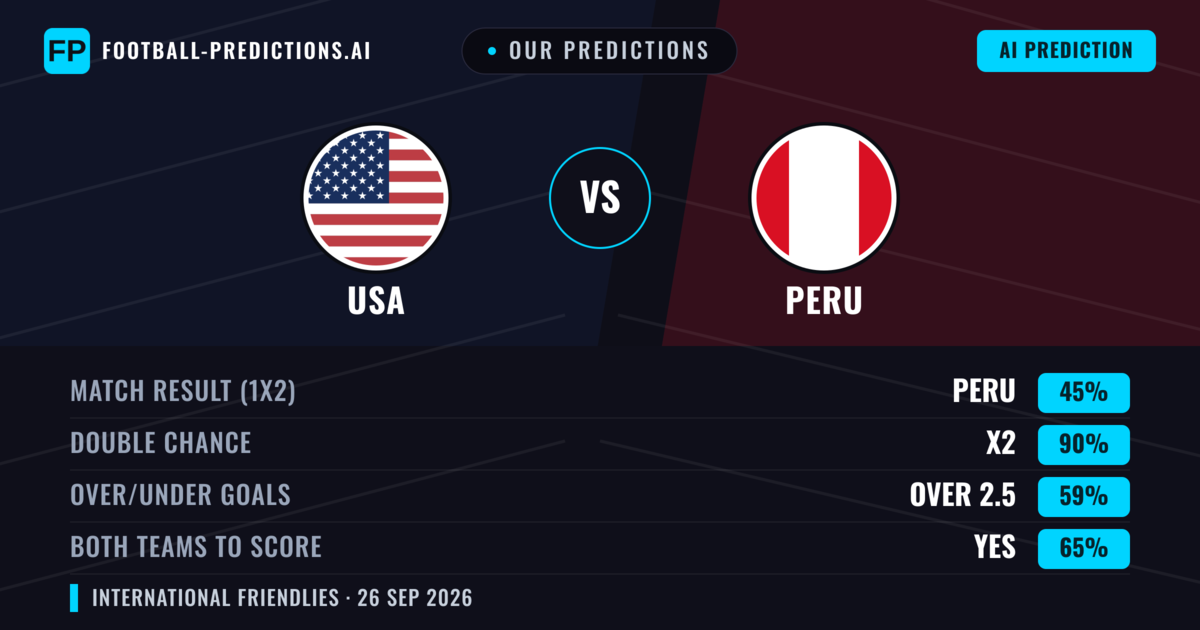
Saturday's international friendly between USA and Peru represents a fascinating tactical puzzle for punters seeking value. The model gives the hosts just a 10% chance of victory, while Peru and the draw share equal probability at 45% each. This stark assessment of USA's chances suggests the three-time CONCACAF Gold Cup winners face a significant challenge despite home soil advantage. For bettors, the immediate takeaway is clear: backing Peru or the draw through the double chance markets offers the most statistically grounded approach, with a 90% confidence rating that reflects the overwhelming probability of either outcome materializing.
The friendly context adds an important layer of complexity to this analysis. International friendlies rarely follow the same competitive intensity as qualifiers or tournament matches, which can lead to more open contests with fewer tactical constraints. The model recognizes this by assigning a 65% probability to both teams scoring and a 59% likelihood of over 2.5 goals. These figures suggest we should anticipate an attacking encounter where defensive organization takes a back seat. Peru, with their rich tradition of technical football and creative forwards, possess the quality to breach the American backline regardless of which combination manager Gregg Berhalter selects.
When examining the goal-related markets, the BTTS recommendation carries the second-highest confidence rating in our analysis. At 65%, the model indicates strong structural reasons to expect goals at both ends. The United States have shown vulnerability at the back in recent competitive fixtures, while Peru's attacking unit features players comfortable in tight spaces who can create chances against organized defenses. The over 2.5 goals market, while slightly less confident at 59%, remains a reasonable supplementary play given the anticipated openness of a friendly fixture where both managers will prioritize player evaluation over rigid defensive shape.
For punters approaching this market, the key insight centers on the asymmetry between USA's slim win probability and Peru's substantial chance of at least avoiding defeat. Without concrete bookmaker odds available, the model's assessment provides the framework for identifying where the genuine value sits. The double chance on Peru or draw represents the most defensible selection, combining both statistical probability and logical reasoning around the likely narrative of an international friendly where the visiting side possesses superior individual quality. Whether the match ends in a narrow Peruvian victory or an even contest that both teams accept, backing X2 covers the vast majority of realistic scenarios for this encounter.
Our Final Call: Peru to Edge Past USA in Attacking Friendly
Taking everything into account, Peru emerge as the preferred selection at 45% confidence, with the double chance backing them commanding a robust 90% conviction rate. The visitors avoiding defeat provides the most secure avenue, though the home side cannot be overlooked given their quality. Both teams finding the net at 65% confidence aligns with an attacking contest, while over 2.5 total goals at 59% suggests this Friendly International should deliver meaningful entertainment value for both neutrals and bettors alike.
For those seeking higher confidence plays, the double chance on Peru or the draw represents the most prudent approach, with BTTS yes offering solid backup given the complementary goal-scoring indicators. The market appears to price Peru with some value, presenting potential returns despite the moderate outright prediction confidence.