






Veres Rivne vs Kolos Kovalivka: Uzhhorod Test for the Premier League’s Closest Rivals
The tactical battle in this Premier League meeting will be defined less by individual personnel than by the balance between structure and risk. Veres Rivne, with the stronger overall comparison and a marginally better recent record, have an opportunity to impose control from Avanhard Stadium in Uzhhorod. Kolos Kovalivka, however, arrive with the more productive scoring average and a superior head-to-head record over the last 12 meetings. The visitors’ main threat should come through attacking ambition, while the hosts are likely to prioritize defensive security and the avoidance of unnecessary transitions. That tension creates an interesting setting for anyone following premier league predictions or searching for football prediction premier league analysis based on current numbers rather than reputation.
Kickoff is at 10:00 local time on Friday, October 23, 2026, which is 11:00 BST for readers in the London market. Both teams have had almost identical rest allowances: Veres have had seven days and Kolos six, with each playing one match in the previous ten days. There is therefore no meaningful recovery advantage for either manager. The available team-news data also flags no specific table incentive beyond the general objective of improving position, meaning the most important difference may come from how each side interprets a close, low-scoring contest. That interpretation will shape the first decisive passage of the match.
Why This Premier League Meeting Matters Beyond the Position
Veres Rivne are 9th in Premier League with nine points from nine matches, while Kolos Kovalivka are 10th with eight points from eight. Those are separated by only one point and one place, making this one of the Premier League’s most directly comparable fixtures on the table. The standings also illustrate how little breathing room either side has: Veres have won two and drawn three of their nine matches, whereas Kolos have two wins and two draws in eight. A result here could therefore alter the order immediately around both clubs without requiring either team to produce a dramatic attacking display.
The broader figures suggest two clubs with different profiles. Veres have scored at an average of 0.8 goals per match and conceded 1.4, while Kolos average 1.5 goals scored and 1.6 conceded. Kolos consequently carry more attacking output but also expose themselves to a greater number of goals. Veres’ stronger defensive comparison—57% against Kolos’ 43%—reinforces the idea that the hosts could be more effective at controlling space and protecting their defensive unit. Yet the margins are narrow enough that neither approach can be treated as automatically superior.
Friday’s schedule also adds a practical consideration: matches played under greater time pressure can become more fragmented, particularly if both managers prioritize composure. A fast start would allow the trailing side to expose more space in transition, while a cautious opening could lead to a long period of midfield calculation. Veres may want to make Avanhard Stadium count, but the scoreline available from their previous five-match form line is mixed enough to make aggressive risk-taking difficult to justify. Kolos, meanwhile, have an incentive to use their attacking edge without surrendering the defensive platform that has kept them within touching distance of Veres in the standings.
Recent Momentum: Reading the Available Form Carefully
The supplied five-match indicators show a slight edge to Veres. Their primary form string is LLWDW, indicating that the latest complete sequence contains two opening defeats followed by a win and a draw before another win. A separate team-news feed lists LLWDD, while sharing the same opening two losses. Because the available sources differ over the final character, it would be irresponsible to invent match-level results or claim a precise unbeaten run that cannot be verified from the data. The safe conclusion is that Veres began the recent window with two losses but ended it in a more resilient section, with at least one success and improved stability in the available form readings.
Kolos’ corresponding primary form string is LWWLL, while the team-news feed gives LWWLD. Both versions again share the initial loss before two wins, followed by a difficult run in which the final result differs between the supplied records. The common pattern is therefore a team that recovered strongly from an opening defeat but has not maintained that momentum at the latest end of the window. Their three wins from ten matches, despite an average of 1.5 goals scored, show that their attacking numbers have not translated into consistently productive league returns.
Across the last-five-match sample, Veres have won three, drawn three and lost four, with a 50% rate for both teams to score and a 30% clean-sheet rate. Kolos have won three, drawn two and lost five. Their both-teams-to-score rate is higher at 60%, although their clean-sheet rate is only 20%. This combination implies that Kolos games have more frequently featured goals from both sides, while Veres have delivered more frequent defensive blanks. The difference is not large enough to treat either pattern as deterministic, but it supports a tactical interpretation in which Veres’ defensive organization could create problems for a Kolos attack that has generally been productive.
Road to Avanhard Stadium: Two Routes to the Same Objective
Veres’ most likely route to success is based on positional discipline. The hosts have a better comparison in both form and defense, and their lower scoring average gives them more scope to progress without taking unnecessary chances in open play. By remaining compact around the central areas and reducing the space available for Kolos to move forward, Veres can reduce the visitors’ advantage in the most dangerous phase of the match. At Avanhard Stadium, that would turn every clear Kolos attack into a test of patience rather than a high-percentage chance.
The hosts still need a way to turn defensive strength into enough attacking output. Their 0.8-goal average is the weaker of the two teams’ production figures, and no individual player data is available to identify a reliable creative outlet. The relevant unit is therefore the forward line as a collective: its pressing, width, support runs and movement into scoring positions. Without player-level information, it would be inappropriate to attach the prediction to a named attacker. The tactical question is whether Veres’ front line can consistently occupy Kolos’ defensive unit well enough to prevent the visitors from settling into their preferred rhythm.
Kolos can approach the match with a different set of priorities. Their 1.5-goal average gives them a clearer attacking argument, particularly when playing away, because they do not need to monopolize possession to generate chances. The visitors can allow Veres to have the ball in areas that do not threaten the goal, then target transitions and the channels immediately behind the hosts’ defensive line. Their attacking advantage means the most dangerous move may be the first forward action that catches Veres out of shape rather than a prolonged possession sequence.
That approach must be balanced against Kolos’ 1.6-goal conceded average and the fact that their recent form has not remained consistently strong. A team scoring efficiently but conceding frequently is vulnerable if its attacking structure breaks down and leaves the defensive unit exposed. Kolos therefore need coordinated recovery as well as forward momentum. Their defensive unit must close the route back into midfield after an attack, while their forward line must preserve enough structure to initiate the next action. If Kolos become too direct, Veres can absorb the initial attack and exploit the space left behind.
The Tactical Question: Does Kolos’ Attack Disturb Veres’ Control?
The central matchup is not a conventional goalkeeper-versus-striker battle because no player-level information is supplied. It is instead a clash between Veres’ collective defensive structure and Kolos’ collective ability to create transitions. Veres can use their stronger defensive comparison to reduce the value of a loose ball or regain possession before Kolos can establish a second phase. Kolos, for their part, can turn every recovered ball into a forward action before Veres’ midfield and defensive lines recover their positions.
Veres should also be conscious of how their own attacks affect the tactical balance. If they retreat too deeply and surrender possession for long periods, Kolos can build an attacking rhythm and make the hosts react rather than dictate. A measured attempt to progress through midfield would keep the visitors under greater pressure, but the forward line must avoid remaining isolated when possession is lost. The ideal balance is aggressive enough to discourage Kolos from taking comfort in a long spell of control, yet structured enough to prevent the visitors from finding immediate forward passing options.
The tactical battle may become especially important late in the match. If one side protects a narrow margin and the other chases an equalizer, the chasing team must commit additional players forward, creating counterattacking space. That is where Kolos’ higher scoring average could become more relevant, but also where Veres’ defensive strength would be tested. Conversely, if Veres can maintain their compact shape and make Kolos’ attack look less fluid, the hosts could create the more dangerous transition despite having the lower scoring average.
Without a Player-Name Checklist: The Roles That Will Decide It
No individual player data is available for either club, so assigning influence to named individuals would create false precision. The most responsible way to analyze the decisive contributors is through their roles. For Veres, the defensive unit must manage the space in front of the goal, the central midfield group must delay Kolos’ first forward pass, and the forward line must give the hosts an outlet when possession is recovered. The full-backs or wide defensive options are also relevant because they help Veres control both sides and recycle possession without going long.
For Kolos, the primary attacking unit carries the responsibility of converting the visitors’ superior scoring average into a tangible advantage. The supporting midfielders must give the forwards enough options rather than allowing every attack to become a direct attempt through the middle. Kolos’ defensive unit also has an active role: a clean sheet would be especially significant in a match where the opponent has the stronger defensive comparison, while conceding the first goal would force the visitors to alter their preferred transition-based rhythm.
Goalkeeping deserves attention even without player data. Kolos have kept clean sheets in 20% of their last-five-match sample, compared with 30% for Veres. If the expected pattern is a relatively low number of goals, the standard of one important save or one well-timed intervention can prove decisive. The same is true of set-piece organization, an area that often decides matches between teams with modest scoring averages, although no set-piece figures are provided and no stronger claim should be made.
Previous Meetings: Kolos Carry the Historical Weight
The head-to-head record is the clearest counterweight to Veres’ stronger current comparisons. Across the last 12 meetings, Kolos Kovalivka have won eight, Veres have won two and the remaining two were draws. Kolos therefore won two-thirds of the available meetings, while Veres won only one match in six. The average total of 1.75 goals also supports the case for a controlled contest rather than a high-scoring spectacle.
The supplied recent meetings continue that pattern. Kolos won 1-0 at Veres on March 22, 2026, while the meeting on September 20, 2025 ended 0-0. Veres recorded a 2-1 home victory on March 2, 2025, but Kolos won 1-0 away on February 25, 2024. Only one of the five most recent listed meetings produced both teams to score, matching the broader head-to-head BTTS rate of just 25%. That pattern is particularly relevant against the current match data, where Veres have a 30% clean-sheet rate and Kolos’ recent BTTS frequency is 60%.
There is a tension between the historical and immediate evidence. Kolos’ 12-match head-to-head advantage is substantial, but Veres arrive with better defensive and overall comparisons, while Kolos’ recent form has been less consistent than at other stages of the same period. The prior meetings should therefore provide context, not dictate the result. Kolos can take confidence from knowing they have repeatedly solved Veres, yet the hosts can point to a stronger recent defensive profile and a narrower gap in the present Premier League standings.
Market Odds, Probabilities and the Search for Value
The supplied 1X2 market lists Veres at 3.2, the draw at 3.1 and Kolos at 2.1, wait—the main market prices are Veres 3.2, draw 3.1 and Kolos 2.2. Those prices imply raw probabilities of 28.7%, 29.6% and 41.7%, respectively, placing Kolos as the clear favorite but leaving a meaningful share of the market on a home result. Bet365’s local price reference is slightly different: Veres 3, draw 3.2 and Kolos 2.1. Those Bet365 prices correspond to raw implied chances of 33.3%, 31.25% and 47.6%, or approximately 29.7%, 27.8% and 42.4% after the bookmaker margin is normalized. The price movement therefore strengthens Kolos in relative terms, especially against a home win, without turning the away outcome into an overwhelming market expectation.
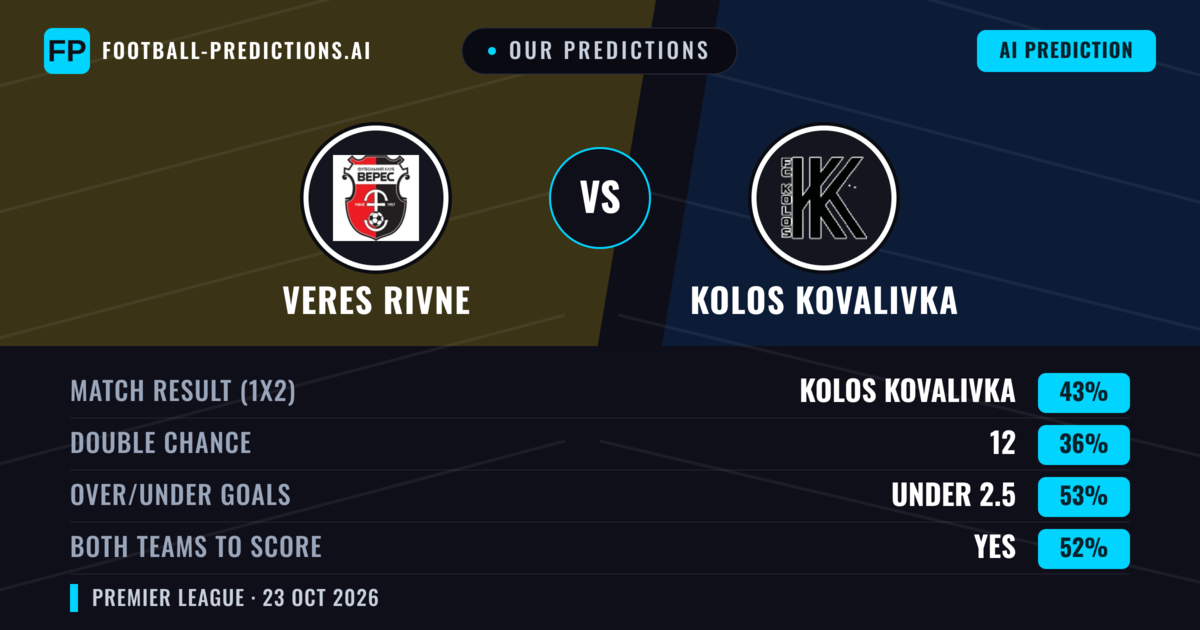
The central prediction is a Kolos Kovalivka win, offered at 43% confidence. This is slightly stronger than the normalized probability implied by the principal 1X2 prices and directionally supported by Kolos’ 1.5-goal scoring average, their eight wins in 12 previous meetings and their status as 2.2 favorites. It is not a large enough discrepancy to describe the 2.2 price as automatic value, particularly because the Bet365 price of 2.1 is shorter. The recommendation should therefore be understood as a considered away-lean rather than the claim that every available away price contains a large edge.
For the total-goals market, the data supports a prediction of under 2.5 goals at 53% confidence. That is reinforced by the 1.75-goal average across the previous 12 meetings, the 25%