



AEK Athens FC vs Real Madrid: A Champions League Group-Stage Test of Nerve
Real Madrid arrive at Allwyn Arena with the confidence of a team accustomed to demanding nights in European competition, but this UEFA Champions League group-stage meeting carries a particular kind of tension: the visitors are overwhelmingly favored, while AEK Athens FC have every reason to treat their home crowd as a source of resistance rather than merely an inconvenience. The date, Wednesday, November 4, 2026, brings another reminder of how unforgiving the Champions League can be. A favorable ranking, a dominant run of recent victories or a reputation for pedigree cannot remove the pressure from playing the first meaningful test in Athens.
For AEK, this is an opportunity to define what they can achieve against one of Europe’s most demanding opponents. Real Madrid, listed fourth in the UEFA Champions League with nine points from three matches, enter with momentum and a 1X2 price of 1.25 at Bet365. The home side, 29th in the UEFA Champions League with three points from three matches, are priced at 8 by the same bookmaker, with the draw at 7. Those numbers tell the broad story, but not the complete one. The market expects Madrid to win; the harder question is whether they will win convincingly enough to satisfy those expectations without allowing AEK’s attacking threat to produce a destabilizing goal.
That is where the interest lies. Madrid’s unbeaten five-match sequence of WWWWW, combined with a Champions League record of three wins from three, points toward control. Yet AEK’s own recent pattern of WLLWW contains enough resilience to suggest that this will not be a passive home performance. This is not a tie requiring aggregate management and there is no first-leg or second-leg dynamic to calculate. It is a UEFA Champions League group-stage match, but one that must still be treated with the urgency of cup football: every possession matters, every transition can alter the psychology of the evening, and an early concession could change the character of the contest entirely.
Why This Group-Stage Meeting Carries Cup Pressure
UEFA Champions League group stages can be deceptive. The presentation of a table can make a fixture appear routine, yet the wider significance of the competition means that points are part of a larger European campaign rather than an isolated statistical exercise. AEK are 29th in the UEFA Champions League with three points from three matches, while Madrid sit fourth with nine from three. Neither side has been flagged with a specific table incentive, which makes the competitive motivation more nuanced: Madrid can rely on established momentum, whereas AEK can find motivation in home pride and the prospect of unsettling a heavily favored opponent.
Real Madrid’s position also brings a certain expectation. The club is the current Champions League holder, having won the 2023/24 edition, and the provided reference identifies them as the reigning European club champion. That status cannot manufacture goals or guarantee a clean sheet, but it does shape the market’s pricing. Madrid are expected to take the initiative, set the tempo and eventually impose their quality on the game. Their price of 1.25 in Bet365’ 1X2 market implies roughly 80% before accounting for the bookmaker’s margin, confirming how heavily the expectation is weighted.
AEK, by contrast, can play with a clearer sense of freedom. The pressure belongs primarily to Madrid because the visitors’ result is considered the natural outcome. That does not mean AEK must sit deep and wait for the game to come to them, but it does encourage a selective approach: compactness first, resistance in midfield, and quick attacks whenever possession can be regained. The home team’s attacking figures support the idea that directness can be dangerous. Averaging 2.4 goals across their last ten listed matches, AEK have repeatedly demonstrated a capacity to score, even if their 50% clean-sheet rate also shows that defensive control has not been equally consistent.
The schedule adds one further detail. AEK have had 11 days of rest and have played no matches in the previous ten days, while Madrid have had 10 days of rest and played once in that period. There is no meaningful difference in recovery. However, Madrid face another competition in three days, creating rotation risk and potentially affecting how aggressively their starters begin. In a stadium in Athens, an early Madrid goal could settle the visitors; an early home goal would instead force Madrid to solve a match that suddenly looks less straightforward.
Madrid’s Momentum: Form Built for a Demanding Night
Real Madrid’s form is the clearest argument for the away price. The supplied five-match sequence is WWWWW, while the wider figures show eight wins, no draws and two losses from ten matches. Their goals scored average is 2.5 and their conceded average is 1.3. Those numbers do not describe an unbeaten record across the listed sample, but they do portray a side winning more often than not and producing enough output to make victories the prevailing pattern.
The contrast in clean sheets is important. Madrid have recorded clean sheets in only 10% of those matches, while their opponents have found the scores in 80% of them. AEK, by comparison, have kept a clean sheet in 50%. This is not a statistical argument for Madrid to attack more defensively; rather, it suggests that the visitors should not be treated as automatic underdogs to an AEK goal. Madrid’s defensive record creates an opening for the home forwards, but the frequency of BTTS outcomes in Madrid’s recent sample means that a scoreline such as 1-2 or 2-2 should not be viewed as remote.
The Champions League standings reinforce the same message. Madrid are fourth in the UEFA Champions League with a perfect nine-point return from three matches. AEK have three points from the same number of matches and sit 29th. These figures indicate that Madrid have been much more productive in the competition to date, although no specific scores or match-by-match details have been supplied. It would therefore be unsafe to invent the manner of those victories; the value lies in the combination of a winning sequence and a stronger points return, not in unsupported narratives about how each goal was scored.
One caveat is rotation. Madrid play again in three days in another competition, so the lineup may not represent their strongest possible version. In a match of this magnitude, even modest rotation tends to affect rhythm: defenders may be less coordinated, pressing patterns may change, and a star attacker may begin with less continuity. Yet rotation also creates an opportunity for the home crowd to test the visitors early. If AEK can survive Madrid’s first spell of control and exploit the spaces created by a less settled line, the market’s favorite can be forced to work harder than its price implies.
AEK’s Route to Resistance: Finding Value in the Home Environment
AEK’s five-match record of WLLWW tells a useful story without requiring invented match details. The sequence contains two defeats, but it ends with two wins. Over the broader ten-match sample listed, AEK have won six times, drawn twice and lost twice, with an average of 2.4 goals scored and 1.1 conceded. Their 50% BTTS rate indicates that half of their matches have featured scoring from both sides, while their 50% clean-sheet rate reflects a more balanced defensive profile than the market price alone conveys.
That 1.1 conceded average is particularly notable when placed beside Madrid’s 1.3. On the raw figures, AEK have actually conceded slightly fewer goals per match in the supplied sample. Madrid’s superior form and standing explain why they remain overwhelming favorites, but the underlying numbers also prevent this from becoming a one-sided forecast. The home side has enough defensive solidity to avoid treating every Madrid attack as inevitable, especially if they can remain compact around the central areas and contest Madrid’s attempts to progress.
The tactical priority for AEK should be to make Madrid’s width work against itself. Without confirmed formation information, it would be unsafe to claim that either side starts in a particular system, but the general shape of the contest can still be described. Madrid will need possession and territory because scoring away from home against a team with AEK’s scoring average is unlikely to come from isolated chances alone. AEK can accept a lower share of the ball if their defensive spacing remains disciplined and their counterattacks are launched quickly before Madrid can reset.
Set pieces and second balls will also carry weight. A Champions League group-stage match at Allwyn Arena is likely to be tense and compressed, particularly if Madrid establish their superiority early. AEK’s listed scorers have modest but meaningful totals: B. Varga has two goals, L. Jović one and R. Marin one. They have not been prolific by the standards suggested by AEK’s team scoring average, but the key-point requirement in this match is to turn even one dangerous transition or set-piece delivery into a goal. Against a favorite priced at 1.25, the home side does not need a large volume of chances; it needs quality and timing.
The Individuals Who Can Decide the Margin
Only a limited set of player information is provided, so the safest way to assess influence is through each listed player’s confirmed scoring contribution rather than invented roles, appearances or statistics. For AEK, the three names supplied offer a small but varied group of attacking options.
- B. Varga: With two goals, Varga is AEK’s leading listed scorer and the home side’s most direct source of a breakthrough. His importance may extend beyond the finish itself, particularly if he occupies positions that allow him to attack crosses or second balls.
- L. Jović: Jović has one goal and can represent the focal point around which AEK build an attacking move. His value will be tied to the quality of service from midfield and wide areas rather than to any unsupported statistical claim.
- R. Marin: Marin’s one goal gives him a confirmed scoring contribution. At this level, a forward with even one goal can carry threat if he is given the freedom to move between lines rather than remaining fixed in one area.
For Madrid, the listed scorers are Kylian Mbappé and F. Valverde, with one goal apiece. Their inclusion should not be interpreted as evidence that the rest of Madrid’s scoring threat is absent; the team has an average of 2.5 goals across the supplied ten-match sample. Rather, it identifies two players capable of turning that broader attacking production into decisive individual moments. Mbappé’s value is particularly relevant when Madrid need to stretch a compact home defense, while Valverde’s contribution can provide midfield authority and a connection between possession and the final third.
- Kylian Mbappé: Madrid’s listed leading scorer can be decisive when the game opens, particularly if AEK’s defensive attention is drawn toward Madrid’s wider or deeper attacking positions.
- F. Valverde: Valverde’s goal gives him a tangible attacking contribution, while his broader importance is likely to come through the quality and control of Madrid’s ball-carrying in midfield.
The tactical duel between these groups will be crucial. If Madrid can move the ball beyond AEK’s first line and create repeated access to the penalty area, their individual quality should eventually produce a result. If AEK can keep Madrid’s central attackers occupied without surrendering the ability to counter, Varga, Jović or Marin may force Madrid into the kind of pressure their group-stage position and price suggest they can avoid.
What Historical Evidence Does—and Does Not—Tell Us
No head-to-head record, historical scoreline or prior meeting between these clubs is supplied in the reference material. It would therefore be irresponsible to manufacture a pattern, quote an old result or claim that one team has traditionally frustrated the other. This match must be analyzed from the current evidence available: Champions League positions, recent form, scoring averages, clean-sheet rates, listed scorers and the present odds.
That absence of historical data does not make the preview less meaningful. It simply changes the analytical focus. There are no reliable previous encounters to support claims about Madrid’s record in Athens or AEK’s record against elite opposition. The current numerical picture points to Madrid as favorite and as the more consistent winning side, but it also shows that AEK are not without defensive resistance and that an AEK goal is a credible scenario.
The knockout or cup context adds another layer of interpretation. In a single elimination contest, one mistake can eliminate a team and one exceptional performance can overcome a major gap in form. Although this is a group-stage match rather than a two-legged tie, the Champions League setting still rewards teams prepared for abrupt changes in momentum. Madrid cannot treat a narrow lead as a guarantee of the result; AEK cannot treat a strong start as enough if their concentration fades after the interval.
The Numbers Behind the Betting Picture
The primary 1X2 market makes Madrid the overwhelming favorite. The listed odds are 8 for AEK Athens FC, 5.8 for the draw and 1.3 for Real Madrid, producing raw implied probabilities of 11.7%, 16.2% and 72.1%. Bet365’s local prices are slightly different—AEK at 8, the draw at 7 and Madrid at 1.25—making Madrid an even clearer favorite in the local 1X2 market. These are price references rather than instructions, and the margin built into the book makes a simple probability conversion an approximation rather than a precise forecast.
The strongest sporting argument still points toward Madrid. Their five-match WWWWW sequence, perfect Champions League return and 2.5-goal scoring average outweigh AEK’s more encouraging defensive averages. Yet the low away price leaves little room for error. A Madrid win by one goal delivers a winning side but misses the implied comfort of the 1.3 price; a draw or home victory would be a major upset. The value question is therefore not simply whether Madrid will win, but how they win and whether that margin can be combined with a market where a safer outcome is also available.
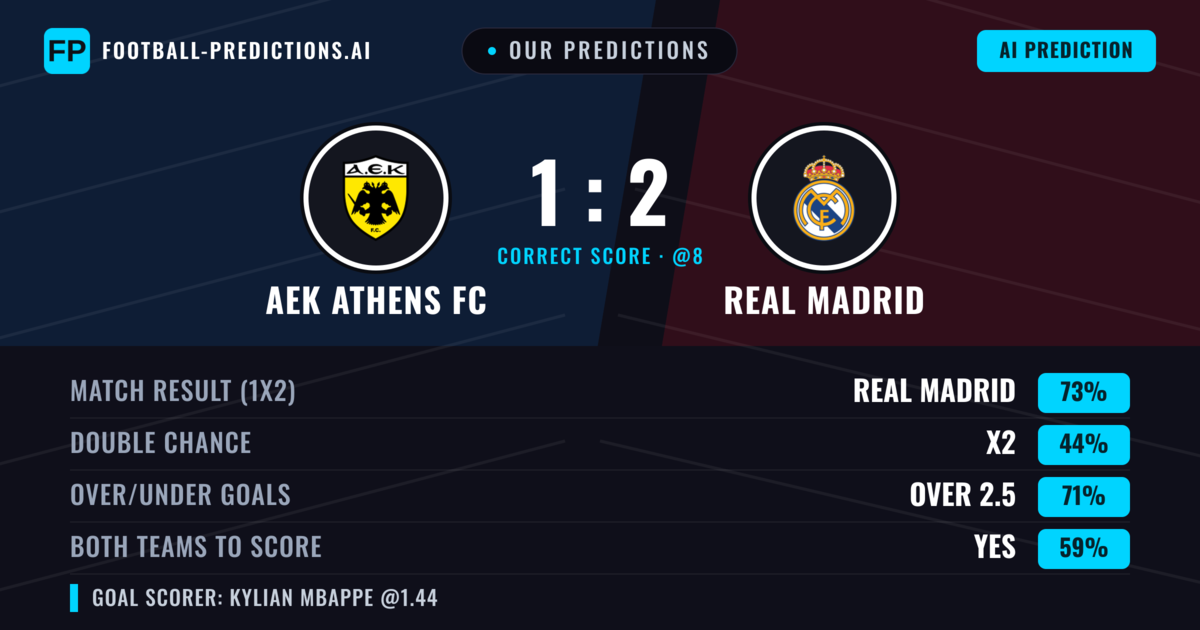
For Double Chance, the supplied prices are 3.4 for 1X, 1.12 for 12 and 1.08 for X2. X2 is the most naturally aligned selection with the 73% confidence in the predicted match result, because it protects the draw-or-Madrid outcome while avoiding the need for a clean-sheet assumption in a game where Madrid have recorded only 10% clean sheets. The 1.08 return is not generous in isolation, but it reflects a high-probability position and can be useful when paired with a more ambitious correct-score or goals market rather than consumed as the sole wager.
The Asian Handicap prices are AEK +2.75 at 1.33, Madrid -2.75 at 3.16, AEK +4 at 1.05 and Madrid -4 at 7.65. Madrid -2.75 is a demanding line given the available evidence. It requires a three-goal away victory, while AEK have conceded only 1.1 per match across the listed sample and Madrid’s own defensive record does not suggest a guaranteed margin of that scale. AEK +2.75 at 1.33 offers a more interesting cushion: it wins if Madrid fail to win by three goals, including any AEK victory or draw, and the data makes a one-goal Madrid win entirely credible.
The Top Correct Score market is heavily concentrated around a 1-2 result, with prices ranging from 8 to 8.5. That scoreline reflects the basic tension in the data: Madrid favored and more productive, but AEK capable of scoring and difficult to keep completely shut out. A correct-score wager remains the least stable part of any prediction because even a strong positional reading can be damaged by one deflection, one late goal or a goalkeeper intervention, so it should be treated as a high-variance option rather than the foundation of the analysis.
The goals market is where AEK’s attacking numbers become especially relevant. Their listed average is 2.4 goals scored, Madrid’s is 2.5 and AEK have conceded only 1.1 per match. Madrid, meanwhile, have produced BTTS in 80% of their listed matches, compared with 50% for AEK. Taken together, those figures support a projected match with at least three goals and a plausible goal for each side. The pick is over 2.5 goals with 71% confidence, while both teams to score is predicted with 59% confidence. No bookmaker price was supplied for either market, so it would be inappropriate to claim that either constitutes an independently verified value selection without seeing the available odds.
Overall, the recommended combination is Madrid to win, over 2.5 goals and BTTS, with AEK +2.75 providing a more conservative handicap route if the preference is to protect against the visitors’ winning narrowly rather than dominating. The away result carries 73% confidence. These selections are coherent with the same underlying scenario: Madrid’s superior winning profile and attacking production should deliver the result, while AEK’s scoring average and Madrid’s limited clean-sheet rate leave room for the home side to score as well.
Final Verdict
Real Madrid’s unbeaten recent sequence and their strong start in the UEFA Champions League make them the right forecast to win at Allwyn Arena, but the margin should not be exaggerated. Their 1.3 listed price is a statement of superiority rather than an invitation to expect another rout. AEK have averaged 2.4 goals, conceded only 1.1 and ended their listed five-match run with consecutive wins, giving them enough resistance to make this competitive.
The likely match shape is Madrid controlling possession and territory, AEK protecting themselves before attacking in transition, and the home crowd becoming more influential if Madrid’s early pressure fails to produce a goal. Kylian Mbappé and F. Valverde represent Madrid’s individual attacking quality, while B. Varga, L. Jović and R. Marin provide AEK with identifiable scoring threats. The best interpretation of the prediction of UEFA Champions League data is a productive, close-margin Madrid victory rather than a comfortable one. For readers searching for a real madrid prediction today or comparing broader UEFA Champions League