






Agropecuario vs Temperley: A Tale of Two Ambitions in Primera Nacional
As the Estadio Ofelia Rosenzuaig prepares to host what promises to be a fascinating tactical chess match, the Argentine Primera Nacional presents us with one of the season's most compelling narratives: a battle between desperate survival and soaring promotion ambitions. On Sunday, July 12, 2026, at 21:00 local time, Agropecuario will welcome Temperley in a Round 20 encounter that encapsulates everything that makes Argentina's second tier so intensely dramatic and unpredictable.
The hosts find themselves in familiar yet uncomfortable territory, occupying the 18th position with just 18 points from 19 matches. Their record of four wins, six draws, and nine defeats tells a story of a side perpetually swimming against the current, desperately trying to keep their heads above water in the relegation battle that consumes so much energy and focus in Argentine football's second division. Conversely, Temperley arrive as genuine promotion contenders, sitting in a formidable fourth place with 30 points, their record of seven wins and nine draws from 19 outings representing one of the most consistent campaigns in the division this season.
The tactical dimension of this contest becomes particularly fascinating when we consider the psychological frameworks both managers must navigate. For Agropecuario, the mathematics of survival are unforgiving: every point dropped represents ground surrendered to those below, and the recent form guide of LLLDD provides cold comfort, even if that sequence does contain two draws that offered brief respite from the losing habit that has plagued their season. The question of how to approach this match carries enormous weight—do they attack with the desperation that their position demands, or do they seek the kind of defensive solidity that has kept them competitive in several matches despite their lowly standing?
Temperley, meanwhile, enter this fixture on the crest of an impressive wave. Their recent form of WDWWW speaks to a side that has found its rhythm, developed a winning mentality, and understands precisely what is required to climb from the second tier into the light of promotion. The 4-3-3 formation that has become their tactical signature allows them to press aggressively while maintaining defensive discipline, and the 1.1 goals per game they average represents a respectable return that has been sufficient to accumulate their impressive points tally. Managerially, they have struck a balance between pragmatism and ambition that has served them well throughout the campaign.
Current State of Play: Reading the Form Guide
The form guides in Argentine football carry particular significance, given the grueling demands of the Primera Nacional schedule and the psychological toll that sustained pressure can exact on playing squads. When we examine the last ten matches for each side, the divergence becomes immediately apparent. Agropecuario's return of two wins, four draws, and four losses represents a points-per-game ratio that would condemn most teams to the lower reaches of the standings, and indeed that is precisely where they find themselves. Their average of 0.7 goals scored per match indicates a fundamental problem in the final third—a side struggling to convert possession and chances into the goals that would lift them toward safety.
The defensive metrics for Agropecuario are equally concerning but contain some flickering hope. An average of 1.1 goals conceded per match is not catastrophically poor, and their clean sheet percentage of 40% suggests that on their day, they can be difficult to break down. The issue lies in the consistency of these performances and the inability to translate defensive solidity into points. When we factor in their BTTS percentage of just 30%, a pattern emerges: matches involving Agropecuario tend to be low-scoring affairs where either they fail to score, or they concede while managing to find the net themselves.
Temperley's form guide tells a dramatically different story. Four wins and four draws from their last ten matches represents a points accumulation that has propelled them toward the promotion places. Their attacking output of 1.1 goals per game matches their defensive concession rate, creating a balanced profile that suggests they are neither overly reliant on attack nor vulnerable at the back. The BTTS percentage of 50% indicates that they are involved in matches where both outcomes remain possible, which aligns with their position as a side capable of grinding out results through various means rather than relying on a single tactical approach.
The rest situation adds another layer to our analysis. Both teams have had approximately a week since their last fixtures—Agropecuario with seven days and Temperley with eight—which means freshness should not be a determining factor. Neither side arrives with a significant physical advantage, and any fatigue-related considerations would likely affect both equally if the match develops into a physically demanding encounter. This equilibrium in preparation time perhaps favors the side with greater tactical flexibility, and on current evidence, that description fits Temperley more comfortably than their hosts.
The Tactical Battlefield: Formation and Philosophy
When considering how this match might unfold tactically, we must acknowledge that precise formation data remains unavailable in our records, which prevents us from making definitive statements about expected lineups. However, we can analyze the general tactical approach each side is likely to adopt based on their season statistics and the specific pressures they face.
Agropecuario, given their relegation predicament, will almost certainly prioritize defensive solidity while seeking to exploit any space left by an attacking Temperley side. Their low goals-scored average of 0.7 per match suggests a side that has struggled to create clear-cut chances, which means their forward play must be clinical and their set-piece execution precise. The question of whether they dare to press Temperley high up the pitch or drop into a defensive block represents the central tactical decision their manager faces. A high press could disrupt Temperley's build-up play but risks being bypassed by a side with the quality to play through such pressure. A deep block, meanwhile, offers greater defensive security but potentially cedes territory and allows Temperley to control the tempo of the match.
Temperley's approach will likely be characterized by controlled possession football, patient build-up play, and the exploitation of wide areas where their attacking players can isolate fullbacks and deliver quality crosses into the box. Their 1.1 goals per game represents adequate rather than exceptional firepower, which means they will need to maintain their defensive discipline while creating enough chances to break down what promises to be a motivated and organized Agropecuario defense. The psychological dimension cannot be underestimated here: Temperley are favorites, they know it, and they must resist the temptation to become passive against a side they are expected to defeat comfortably.
The match context amplifies these tactical considerations significantly. For Temperley, the away fixture represents an opportunity to consolidate their position in the promotion places and take another step toward what would be a transformative achievement for the club. Every point matters in the tight Primera Nacional race, and three points here would maintain the pressure on the teams above them. For Agropecuario, this match carries the weight of survival itself—they simply cannot afford to lose, and even a draw would represent a step forward from their recent sequence of results. This desperation could manifest as either aggressive urgency or nervous caution, and how they balance these impulses may well determine whether they emerge with anything from this contest.
Historical Patterns: Reading the Head-to-Head Record
The archive of encounters between these two clubs provides fascinating insight into what we might expect from Sunday's matchup. In eleven recorded meetings, Temperley have established a clear advantage with five victories, while Agropecuario have managed three wins, with three matches ending in draws. The goal average of 1.45 per match across these fixtures suggests that tight, low-scoring encounters have characterized this rivalry—a pattern that aligns with the broader statistical profile of Agropecuario's season and the modest but consistent attacking returns of Temperley.
Perhaps most striking is the BTTS figure of just 18% across these eleven meetings, indicating that in the vast majority of encounters between these sides, at least one team has failed to find the net. This historical data correlates strongly with the betting prediction of under 2.5 goals, and it suggests that patterns established over multiple seasons tend to persist in football, particularly when the underlying tactical and quality disparities remain relatively constant.
The most recent meetings paint a clear picture of Temperley's dominance in this fixture. The February 2026 encounter saw Temperley emerge victorious by a 1-0 margin at home, following a 0-0 draw in the corresponding fixture last August. Earlier meetings in 2023 saw Temperley record more emphatic victories, including a 3-1 away win and a 2-0 home success. This historical pattern cannot be dismissed as irrelevant—these results reflect genuine quality differences and tactical approaches that have consistently favored Temperley in this matchup.
For Agropecuario, the historical record offers little comfort. They have struggled to match Temperley's intensity and organization in these encounters, and their recent league form provides no reason to believe they have suddenly discovered the formula to upset their more successful opponents. However, football's capacity for surprises means that the 18% BTTS figure and the three historical Agropecuario wins remind us that these are professionals capable of rising to specific occasions when motivation and circumstances align.
The Statistical Landscape: What the Numbers Tell Us
When we synthesize all available data, the analytical indicators point consistently in one direction, though never with absolute certainty. The AI-generated comparison percentages—Agropecuario at 23% overall versus Temperley at 76%—reflect the aggregate assessment of form, attack capability, and defensive solidity. The attack comparison is particularly stark, with Temperley's 82% versus Agropecuario's 18% highlighting the significant disparity in attacking threat between the two sides.
Defensively, the gap narrows but does not close. Temperley's 56% versus Agropecuario's 44% suggests that while both sides have defensive vulnerabilities, Temperley have generally been more reliable at the back when it matters. Their clean sheet percentage of 30% versus Agropecuario's 40% might seem to contradict this assessment, but we must consider the context: a side that scores more frequently and controls more matches will face fewer opportunities for clean sheets, as opponents are forced to attack and create chances.
The form comparison of 21% versus 79% in Temperley's favor perhaps represents the most significant predictive factor. Recent momentum carries enormous weight in football analysis, and Temperley's four wins in their last five matches contrasts sharply with Agropecuario's failure to win in their last five. This psychological and statistical advantage cannot be dismissed, particularly when we consider that Temperley are playing with the confidence that comes from consistent results, while Agropecuario are searching for any sign of positivity to arrest their slide.
The Betting Dimension: Finding Value in the Markets
The absence of published bookmaker odds means we must work with model-generated probabilities rather than actual betting markets. The model suggests home win probability of just 10%, with both draw and away win assessed at 45% each. These probabilities create an interesting scenario where the bookmaker's margin would typically favor the outcome closest to the implied probability, yet the near-equal split between draw and away win reflects genuine uncertainty about how this match will resolve.
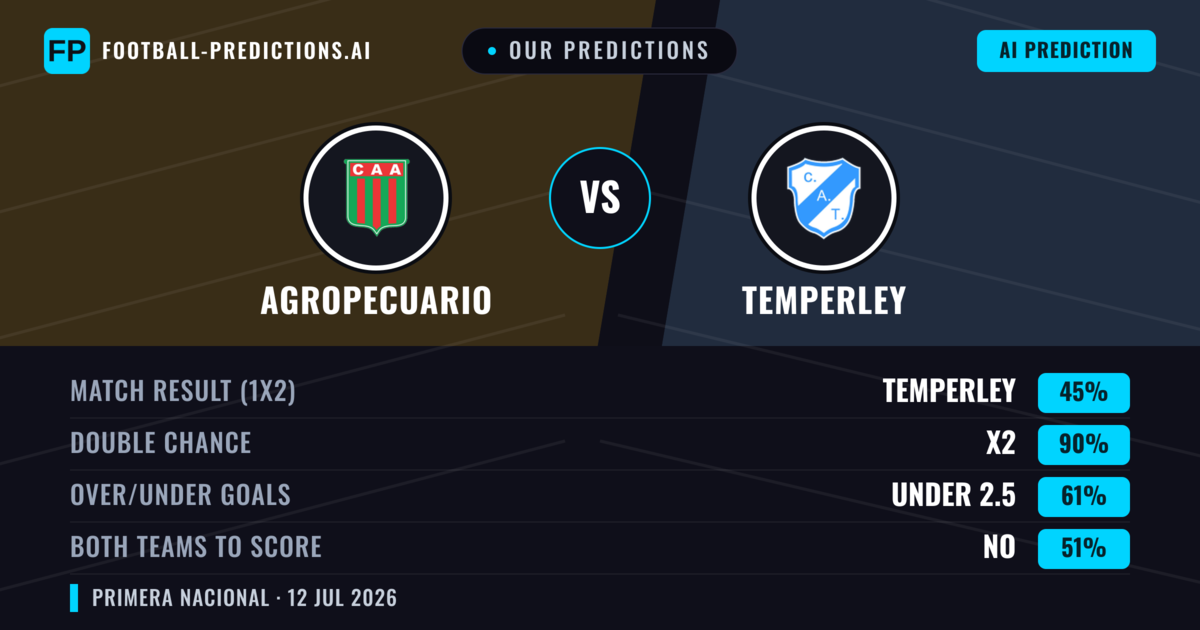
The prediction confidence levels provide our primary guidance for market analysis. The prediction of a Temperley win carries 45% confidence, which aligns with the model probability but remains below the threshold we might normally require for a strong recommendation. The under 2.5 goals prediction, however, offers considerably more confidence at 61%, and this represents the statistical sweet spot where the historical data (1.45 average goals across 11 meetings) combines with current form analysis to create a compelling case.
The BTTS prediction of "no" with 51% confidence represents a marginal recommendation that gains strength from the historical 18% BTTS rate in this fixture and the modest attacking outputs of both sides this season. Given that both teams' BTTS percentages (30% for Agropecuario, 50% for Temperley) suggest that their matches tend to feature at least one team failing to score, the historical pattern reinforces the prediction. However, at 51% confidence, this remains a bet that requires acceptance of significant variance.
The most confident prediction in our analysis is the Double Chance of X2, carrying 90% confidence. This recommendation essentially states that Temperley will either win or draw, and when we consider their form, quality advantage, and historical dominance in this fixture, this appears to be the selection most strongly supported by the evidence. The low reward potentially available from this bet reflects the market's likely assessment of Temperley as clear favorites, but for those seeking value, it represents the selection with the highest probability of success.
For those constructing multi-selection betting strategies, the combination of under 2.5 goals with the X2 double chance offers an attractive profile—the correlation between these two outcomes is logical (a Temperley win or draw with low scoring is consistent with both predictions), and it provides a framework for the match that aligns with historical patterns and current form analysis.
Strategic Implications: What Each Side Needs
The context of Primera Nacional's promotion and relegation structure lends this match additional significance beyond the three points at stake. For Temperley, currently occupying fourth place with 30 points from 19 matches, every victory represents progress toward an automatic promotion place that would see them join Argentina's top flight. The nine draws in their record indicates a side that has often been unable to convert promising positions into wins—a habit they will need to break if they are to maintain their push through the remaining fixtures of the season.
The promotion race in Primera Nacional is characteristically competitive, with several clubs separated by small margins throughout the campaign. Three points here would not only add to Temperley's tally but would also send a psychological message to their promotion rivals: this is a side capable of winning difficult away matches against motivated opponents fighting for survival. The capacity to perform under such pressure is often what separates promotion winners from runners-up in Argentine football's second tier.
For Agropecuario, the situation demands immediate and decisive response. Sitting 18th with 18 points, they are deeply immersed in the relegation battle that defines the lower reaches of Primera Nacional. Their record of four wins, six draws, and nine defeats represents a points-per-game ratio that simply cannot continue if they are to preserve their status in the division. The mathematics are unforgiving: with the season's midpoint approaching, they must begin accumulating points at a significantly higher rate than they have managed thus far.
The form guide of LLLDD suggests a side that has found draws but has lost the ability to win football matches. Whether this represents a confidence issue, a tactical problem, or simply the accumulation of difficult fixtures, the result is the same: they need wins, and they need them urgently. A positive result against Temperley—second-placed promotion contenders no less—would provide exactly the kind of statement victory that can transform a season's trajectory. The question is whether they have the quality and tactical coherence to achieve such a result.
Conclusion: Predicting the Unpredictable
As we approach this fascinating encounter between two clubs operating at entirely different frequencies of ambition and expectation, the analytical consensus points clearly toward a Temperley victory or at minimum a draw. Their superior form, quality advantage, and historical dominance in this fixture create a compelling case for their success. However, football's capacity for surprise means that Agropecuario's desperation cannot be dismissed, and in the pressure cooker environment of a relegation battle, unexpected performances occasionally emerge.
The most probable outcome appears to be a low-scoring Temperley victory or stalemate, with under 2.5 goals representing the selection most strongly supported by historical data and current form analysis. The X2 double chance offers the highest confidence prediction, reflecting Temperley's quality and the reasonable expectation that they will not lose this match. For those seeking value, the combination of these selections provides a coherent strategy aligned with the statistical and tactical evidence available.
Sunday's match at the Estadio Ofelia Rosenzuaig will reveal whether the numbers tell the complete story or whether Agropecuario can summon the performance their situation demands. What seems certain is that in Primera Nacional, where every point carries enormous weight and every match carries enormous pressure, the only prediction we can make with complete confidence is that the final outcome will require no small measure of quality, character, and perhaps fortune from whoever emerges victorious.