Top Yellow Cards Over/Under Picks for 21 Jun 2026
 Alexey Andrianov 5 min read 13521 Jun 2026 Updated 22 Jun 2026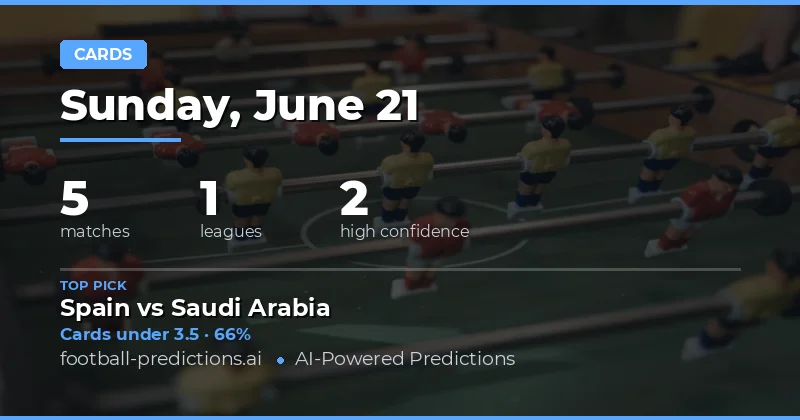
Back these two selections today based on current form, head-to-head data and booking trends.
- Spain vs Saudi Arabia: Back Under 3.5 cards at 1.37 with 66% confidence. Spain vs Saudi Arabia
- Tunisia vs Japan: Back Under 3.5 cards at 1.47 with 60% confidence. Tunisia vs Japan
Yellow Cards Over/Under: Matchday Analysis
The Yellow Cards Over/Under market remains one of the most popular alternative markets for bettors seeking value beyond traditional match result predictions. Understanding team discipline patterns, refereeing tendencies, and tactical approaches provides a statistical foundation for identifying potential opportunities in this market. With five matches scheduled for 21 June 2026, analyzing historical card data becomes essential for informed betting decisions.
Weather conditions, player form, and match importance all influence disciplinary incidents. Teams under pressure may commit more fouls, while high-stakes encounters often see increased physicality. Successful Over/Under predictions require examining head-to-head records, average cards per game for each side, and the specific officials appointed to each match. This comprehensive approach helps bettors move beyond intuition and toward data-driven selections that account for the unique circumstances surrounding each fixture.
Match-by-Match Analysis
Spain's fixture against Saudi Arabia generates the strongest conviction at 66% confidence for the under 3.5. The home odds of 1.05 against Saudi Arabia at 23 speak to a gulf in class that reshapes the entire match dynamic. When one team enters as overwhelming favourites, the opponent typically shifts toward a defensive posture, with tackles concentrated in a single unit rather than distributed across both sides. Spain's technical superiority should produce a match where fouling remains asymmetric, keeping the cumulative card count below the threshold despite the high-stakes environment.
Tunisia and Japan represents the under angle from a different perspective — the 60% confidence pick centres on Japan's tactical identity. Japan arrives as the away favourite at 1.31, and their playing philosophy emphasises ball retention over aggressive pressing. This approach naturally reduces engagement in aerial duels and physical confrontations that generate yellow cards. Tunisia, priced at 6.25 with draw odds of 4.2, faces a scenario where they must choose between pressing Japan's technical players or sitting deep and absorbing pressure. The latter strategy, almost certainly the chosen path, produces fewer cardable incidents from both sides.
Uruguay's match against Cape Verde Islands at 58% confidence offers the under 3.5 backed by South American tournament experience. The odds structure — Uruguay at 1.28, draw at 4.1, Cape Verde at 7.5 — suggests the Africans will deploy numbers behind the ball rather than risk an open contest. Uruguay's pedigree in managing such fixtures means they rarely need to resort to tactical fouling or aggressive challenges to secure results. Cape Verde, with minimal World Cup exposure, typically mirrors their opponents' intensity rather than escalating it, creating a low-card environment regardless of the scoreline.
Ecuador and Curaçao round out the strongest selections at 56% confidence, where the match odds of 1.07 for the home side mirror the Spain fixture's disparity. The under 3.5 carries particular appeal when the favourite plays at home, as Ecuador will control territory and tempo without requiring the desperate, card-generating challenges that accompany desperate defending. Belgium's meeting with Iran at 54% confidence provides the final selection, with Iran's reputation for disciplined defensive work against European sides creating conditions where the under 3.5 remains viable despite Belgium's clear favouritism at 1.27.
Midweek Fixture Congestion: A Critical Factor for Yellow Card Markets
When teams face a compressed schedule with multiple matches within a short timeframe, the Yellow Cards Over/Under market takes on added significance. Player fatigue becomes a pivotal variable, as tired legs lead to mistimed tackles, rushed challenges, and a higher likelihood of reactive officiating decisions. Managers rotating their squads introduce another layer of unpredictability — less-familiar partnerships in midfield or defense often result in positional errors that invite unnecessary fouls. The data consistently shows that fixture density correlates with elevated card counts, particularly in the 60th to 75th minute window when accumulated fatigue peaks.
Home teams generally face a psychological advantage that can suppress yellow card incidents, as they dictate the tempo and enjoy crowd influence that discourages overly physical play from visitors. Conversely, away sides with little possession may resort to tactical fouling to disrupt counter-attacks, inflating their personal foul tally. When assessing Over/Under lines for specific fixtures, analysts must weigh home advantage against the desperation of trailing teams willing to accumulate cards in pursuit of an equaliser. The defensive organisation of each side, measured through tackles attempted and interceptions made per match, provides valuable context for anticipating whether officiating leniency or strictness will prevail.
Referee profiles deserve prominent attention in any yellow card handicapping exercise. Some officials maintain consistent booking rates around 4.0 cards per match, while others average below 2.5, creating substantial line value for bettors who identify the right officiating assignments. Historical encounters between specific referee-cup tie combinations reveal persistent patterns worth exploiting. Additionally, rivalry matches and local derbies consistently produce elevated card counts regardless of tactical approaches, as emotional intensity overrides technical discipline. Smart handicappers cross-reference referee averages against team disciplinary records, particularly away form, to identify mismatches between the Over/Under line and genuine probability.
Final Verdict: Approach With Caution
The five fixtures analyzed present a mixed picture for Over and Under yellow card selections. While certain matchups show clear indicators toward higher disciplinary incidents, others remain too balanced to call with confidence. Season context, referee tendencies, and team motivation levels all play crucial roles in determining final outcomes.
For bettors, diversifying selections across multiple matches rather than concentrating stakes on a single fixture offers a more sustainable approach when uncertainty is present.
Discover comprehensive strategies, tips, and insights on cards betting in football. Learn about over/under booking points, referee impact, league tendencies, and more.
Read Full Guide