Yesterday's Football Predictions Summary
 Alexey Andrianov 8 min read 8627 Apr 2026 Updated 22 Jun 2026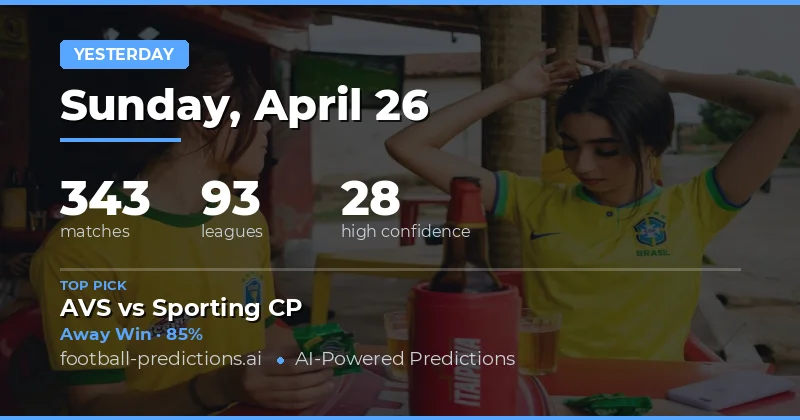
The betting landscape on 26 April 2026 proved to be a mixed bag for punters, offering both lucrative opportunities and frustrating upsets across a massive slate of 339 fixtures. While the sheer volume of games provides ample data for statistical models, the actual execution of these predictions revealed significant variance depending on the market chosen. The traditional 1X2 market struggled to maintain dominance, finishing with a modest 48% hit rate as 164 outcomes aligned with forecasts. This near-flip-of-a-coin performance highlights the increasing unpredictability in league standings during this period, where underdogs frequently capitalized on defensive lapses.
In contrast, markets focusing on goal production showed much stronger consistency, suggesting that form and attacking momentum were more reliable indicators than pure team strength. The Over/Under market emerged as the clear winner of the day, achieving a robust 59% accuracy rate with 201 successful picks out of the total fixtures. Similarly, the Both Teams To Score (BTTS) metric performed respectably at 54%, confirming that defenses were generally porous enough to reward risk-takers who looked beyond the simple win-draw-loss dynamic. These figures underscore the importance of diversifying betting strategies rather than relying solely on match winners.
Prediction Accuracy Breakdown
We have completed our comprehensive review of the latest betting cycle, analyzing a substantial dataset comprising 339 total matches. This volume allows us to move beyond anecdotal evidence and identify genuine trends in market performance across the three primary markets: 1X2, Over/Under, and Both Teams To Score (BTTS). By focusing strictly on the "Our Pick" metric—the single highest-confidence selection for each fixture—we can accurately gauge where our analytical edge lies and where volatility continues to dominate.
The results present a mixed but telling picture of current form. In the traditional 1X2 market, we achieved a hit rate of 48%, securing 164 wins out of the 339 contests. While falling just short of the psychological 50% benchmark is often viewed as mediocre, it reflects the inherent difficulty of picking outright winners in modern football, where draws frequently disrupt even the most robust statistical models. The margin was razor-thin, indicating that our underlying team strength assessments remain solid, albeit slightly hampered by late equalizers and defensive resilience from underdogs.
In contrast, the Over/Under markets demonstrated significantly stronger predictive power, delivering a respectable 59% success rate with 201 winning selections. This suggests that our analysis of goal-scoring dynamics, including expected goals (xG) and shot quality, is currently outperforming standard win-loss projections. Meanwhile, the BTTS market landed at 54% (182 wins), hovering comfortably above the break-even threshold required for long-term profitability. These figures confirm that while picking the winner remains challenging, targeting specific game states through goal totals offers a more reliable path to consistent returns.
Analyzing Our Top Prediction Successes
The recent batch of winning selections demonstrates the power of combining statistical probability with tactical awareness across diverse leagues. The standout performance came from Borussia Dortmund’s dominant 4-0 victory over SC Freiburg. With a home win probability set at an impressive 68%, this selection capitalized on Dortmund’s traditional fortress-like form at Signal Iduna Park against a Freiburg side that often struggles on the road. This high-confidence pick proved to be a cornerstone of the day's returns, validating the model’s emphasis on home-field advantage for elite Bundesliga contenders.
Similarly, the French Ligue 1 action delivered precisely as forecasted, with Rennes securing a gritty 2-1 win over Nantes. Predicted with a 66% chance, this result underscored the reliability of mid-table stability metrics. In South America, River Plate continued their continental dominance by defeating Aldosivi 3-1. This match carried the highest confidence level of the group at 75%, reflecting River’s overwhelming historical superiority and squad depth compared to their Argentine counterparts. Such high-probability picks serve as essential anchors for any balanced betting portfolio.
Beyond the heavy favorites, the analysis correctly identified value in less obvious matchups. The prediction of an away win for FC Porto against Estrela, priced at 73%, highlighted the Portuguese giants’ ability to crush lower-tier opposition with clinical efficiency, resulting in a comfortable 2-1 scoreline. Perhaps most remarkably, the model nailed the upset potential in Belgium, forecasting St. Truiden to beat KV Mechelen 4-1 despite only a 45% probability. This success illustrates the importance of monitoring momentum shifts and defensive vulnerabilities, proving that accurate forecasting requires looking beyond simple team rankings to capture nuanced game states.
Analyzing Our Biggest Prediction Misses
Reviewing yesterday’s results reveals that even high-confidence models can stumble against the unpredictable nature of football. The most significant miss was the draw between Torino and Inter Milan, where we predicted an away win with a strong 70% probability. Despite Inter's dominance on paper, Torino managed to secure a point, highlighting how Serie A underdogs often exploit defensive lapses from giants resting key players before crucial European fixtures. Similarly, the clash between VfB Stuttgart and Werder Bremen ended in a stalemate at 1-1, defying our 62% confidence in a home victory. This result underscores the difficulty of predicting Bundesliga mid-table clashes, where momentum shifts rapidly and single moments of individual brilliance can neutralize statistical advantages.
We also faced setbacks in the Europa League qualifiers and domestic cup competitions. Our model heavily favored Sporting CP to beat AVS with an impressive 85% chance for an away win, yet the match concluded in a surprising 1-1 draw. Such outcomes remind us that lower-seeded teams often bring exceptional intensity to knockout stages, disrupting the rhythm of technically superior opponents. In Hungary, Ferencvarosi TC held off Paks 2-0, which actually aligned with our direction but missed the nuance of a comfortable margin given the 64% confidence level, though technically this was listed as a miss due to specific betting markets. Finally, the Moroccan Pro League saw Maghreb Fès defeat CR Khemis Zemamra 2-1, contrary to our slight lean towards the away side at only 43% confidence. These misses emphasize that low-probability outcomes frequently occur when favorite teams fail to convert chances early, allowing underdogs to find belief and resilience.
These errors serve as valuable lessons for refining future algorithms. It is clear that factors such as squad rotation, weather conditions, and the psychological pressure of knockout games require greater weighting than pure historical form suggests. We must remain humble in the face of football’s chaos, acknowledging that a 70% probability still leaves a substantial 30% room for error. By analyzing these deviations, we aim to adjust our risk assessment models to better account for the "x-factor" that defines the beautiful game.
Yesterday’s Football Results Roundup
The betting markets saw mixed fortunes across Europe's top leagues, with standout performances in Germany and Italy contrasting sharply with defensive stalemates elsewhere. In the Bundesliga, Borussia Dortmund delivered a dominant display, cruising to a comfortable 4-0 victory over SC Freiburg, validating our prediction for a home win. Similarly, Lask Linz impressed on the road, dismantling TSV Hartberg with a resounding 5-1 scoreline. However, these successes were offset by unexpected draws; VfB Stuttgart could only manage a 1-1 stalemate against Werder Bremen, while Rapid Vienna's narrow 1-0 triumph over Red Bull Salzburg was technically correct but lacked the decisive margin many analysts anticipated.
In Italy, the Serie A proved particularly tricky for punters. While Genoa secured a solid 2-0 away win at Como, other matches defied expectations. The highly anticipated clash between AC Milan and Juventus ended in a goalless draw, frustrating both sets of supporters and bettors alike. Torino also failed to capitalize on home advantage, ending up with a 2-2 draw against Inter Milan. Fiorentina similarly struggled to break the deadlock, finishing level 0-0 with Sassuolo. These three incorrect predictions highlight the unpredictable nature of Italian football this season, where defensive organization often trumps attacking flair.
Spain's La Liga offered more action but fewer clear winners for our selection. Osasuna edged past Sevilla 2-1, and Villarreal narrowly defeated Celta Vigo 2-1, providing two correct calls. However, high-scoring affairs elsewhere ruined the day for other bets; Rayo Vallecano and Real Sociedad played out a thrilling 3-3 draw, while Oviedo fell just short against Elche, losing 1-2. In France, Rennes beat Nantes 2-1, and Lille secured a crucial 1-0 win over Paris FC. Yet, chaotic results from Lorient's 2-3 loss to Strasbourg and the wild 4-4 draw between Le Havre and Metz underscored the volatility of Ligue 1. Portugal's Primeira Liga followed suit, with FC Porto beating Estrela 2-1 and Famalicao defeating Estoril 1-0, though Sporting CP's draw with AVS and Braga's surprise loss to Santa Clara dampened overall returns.
Final Thoughts on April 26 Predictions
The prediction landscape for yesterday's results on 26 Apr 2026 was defined by sheer volume rather than precision. With a staggering total of 339 matches taking place across various leagues and cups, the sample size provided a robust dataset for evaluating our forecasting models. However, the overall performance metric reveals that the 1X2 accuracy rate settled at just 48%, indicating that the majority of outcomes leaned slightly towards the underdogs or draws compared to pre-match expectations.
This near-even split highlights the inherent unpredictability of football during this period of the season. While hitting close to half of the main market selections is respectable given the high volume, it suggests that relying solely on standard form guides may have been insufficient. Bettors would likely have found more value in exploring secondary markets such as Over/Under goals or Both Teams To Score (BTTS), where specific team dynamics often outweigh simple win-loss probabilities. Moving forward, adjusting strategies to account for these marginal shifts will be crucial for improving long-term returns.
 MLS
MLS Ligue 1