Tuesday's Global Football Action Delivers Mixed Results for Punters
 Alexey Andrianov 6 min read 642 Sept 2026 Updated 2 Oct 2026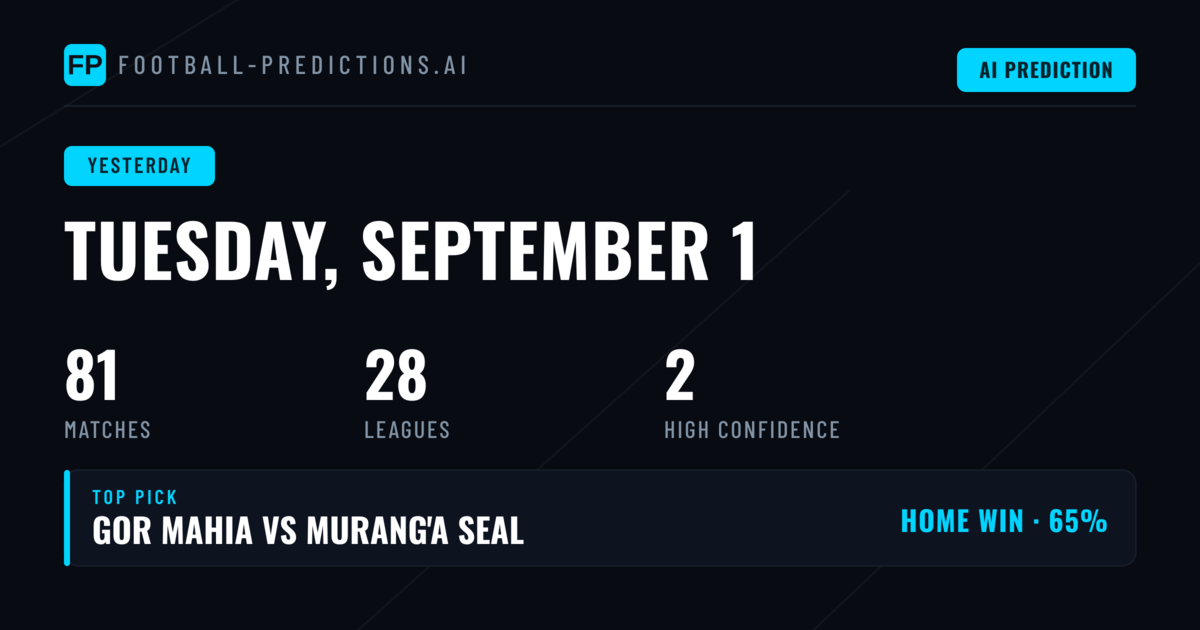
The first day of September 2026 brought a packed schedule of football across the globe, with 71 fixtures providing ample opportunities for predictions enthusiasts. However, the day's results proved challenging for those seeking consistent returns, with the accuracy metrics painting a picture of selective success. The 1X2 market delivered the toughest conditions, with predictions landing correctly in less than half of all matches—a clear reminder that the home/away/draw trifecta remains one of the most demanding markets to master consistently.
More encouraging signs emerged in the Over/Under market, where nearly seven in ten predictions proved accurate, suggesting that goal-based markets continue to offer more predictable patterns than match outcome selections. The BTTS market followed a similar trajectory, with correct predictions in 41 of 71 fixtures. These figures indicate that while individual match outcomes remain volatile, broader statistical tendencies—such as scoring frequency and clean sheet frequency—continue to provide a more reliable foundation for predictions across busy matchdays.
Our Pick Accuracy Analysis
Across the 71 matches analyzed, the "Our Pick" designation—which represents the highest confidence tip for each fixture—delivered mixed results. The Over/Under market emerged as the strongest performer, converting 49 of 71 predictions for a 69% success rate, a figure that comfortably outperformed the other markets. This suggests that goal-related predictions offered more reliable value than outright match outcome calls during this period.
The 1X2 market proved the most challenging, with only 33 correct predictions yielding 46% accuracy. This result falls below the break-even threshold for many punters and reflects the inherent volatility of predicting exact match outcomes, particularly in leagues where upsets and draws occur with regularity. The BTTS market occupied the middle ground at 58%, converting 41 of 71 picks—solid but not exceptional performance.
The overall picture indicates that the prediction model demonstrated stronger reliability when targeting statistical match characteristics (goals) rather than directional outcomes. The 69% Over/Under accuracy represents a genuinely useful hit rate for those following highest confidence selections, while the 46% in the 1X2 column serves as a reminder that even recommended picks carry significant risk in this market. These figures provide a realistic benchmark for evaluating future performance.
Five Predictions That Hit the Mark
Several standout calls across European and South American competitions demonstrated strong analytical judgment this round. The West Ham versus Wolves encounter produced a 4-2 scoreline that validated the Home Win projection at 47%, a probability that might have appeared close to a coin flip on the surface but reflected underlying tactical or form-based indicators that proved decisive. Similarly, the Swiss clash between FC Zurich and BSC Young Boys concluded 2-4 in favor of the visitors, confirming the Away Win selection at 61% confidence.
Across the Atlantic, the Argentine Primera Division delivered two notably tight predictions. Instituto Cordoba's narrow 1-0 victory over San Lorenzo and Tigre's goalless draw with Barracas Central both carried identical 52% Home Win probabilities, representing barely-there edges that nonetheless captured the actual outcomes correctly. These borderline cases underscore that even modest probability advantages can yield accurate calls when the underlying model captures the essential dynamics.
The Austrian Bundesliga encounter between Wolfsberger AC and LASK Linz showed the strongest conviction among the correct picks, with the Away Win backed at 64%. The eventual 1-3 scoreline in LASK's favor validated that confidence level, demonstrating how higher-probability selections often align with more comfortable margins of victory. Across all five matches, the common thread involved trusting probabilistic signals even when they fell short of overwhelming favoritism, suggesting disciplined adherence to model outputs rather than chasing perceived certainties.
The Tarnobrzeg Upset: When 72% Confidence Proved Misplaced
The most significant prediction failure of the review period occurred in the Polish Cup Round of 64, where Zaglebie Lubin traveled to face Siarka Tarnobrzeg. The model assigned a commanding 72% probability to an Away Win, yet Siarka Tarnobrzeg claimed a 3-2 victory that sent the higher-tier side crashing out of the competition. This represented the single largest divergence between predicted probability and actual outcome recorded throughout the review period.
Several factors likely contributed to this substantial miss. Cup competitions operate under fundamentally different dynamics compared to league fixtures. Lower-division clubs entering these tournament ties often approach the match with heightened motivation and zero pressure regarding league positioning, allowing them to express themselves freely against superior opponents. Conversely, higher-tier sides may struggle to replicate their domestic league intensity in one-off cup encounters, particularly when facing opponents from lower divisions. The sample size of competitive matches between these specific clubs may also have been insufficient for the model to account for contextual variables unique to knockout football.
The result serves as a reminder that probability does not equal certainty. A 72% likelihood still leaves 28% for alternative outcomes, and cup football amplifies those outliers. The failure also highlights potential gaps in how the model weighs competitive tournament fixtures versus regular league matches. Whether through insufficient weight given to cup-motivation factors or an overreliance on league-form indicators, the prediction framework underestimated the variables specific to knockout-stage encounters. Such results underscore the inherent unpredictability of cup competitions and the importance of acknowledging model limitations when presenting probability-based forecasts.
European and South American Cup Competitions Produce Mixed Outcomes
The Coppa Italia Round of 32 delivered surprising results, with both seeded Serie A clubs suffering elimination at this competitive tournament stage. Cremonese claimed a 0-2 victory over Parma while Monza upset Torino with a 0-1 win. Neither result aligned with pre-match expectations, indicating potential for upsets as Italian clubs navigate their cup ambitions.
In Romanian Cup Group Stage action across multiple fixtures, the outcomes proved inconsistent against predictions. Concordia secured a commanding 5-2 result against Progresul Spartac, while CFR 1907 Cluj overcame Sepsi OSK Sfantu Gheorghe 3-1 despite the upset tag. FC Voluntari recorded a narrow 1-0 victory over Chindia Targoviste and Universitatea Cluj edged Petrolul Ploiesti by the same margin, with both results validating the suggested selections.
South American and Swiss fixtures contributed additional correct predictions to the card. Instituto Cordoba's 1-0 home win over San Lorenzo in Liga Profesional play proved accurate, while BSC Young Boys delivered an emphatic 4-2 result against FC Zurich in Swiss Super League competition. Wolfsberger AC's 1-3 defeat to Lask Linz in Bundesliga action completed the set of correct outcomes, with both clubs demonstrating clear attacking intent in an open contest.
Looking Ahead
Tuesday's comprehensive review across 71 football matches revealed the inherent challenges of predicting match outcomes in a competitive landscape. The 1X2 accuracy rate of 46% demonstrates that bookmaker odds continue to present meaningful resistance, with underdogs and draws proving difficult to forecast consistently.
This performance underscores the importance of continuous refinement in analytical approaches and the value of maintaining disciplined stake management when the margin for error remains substantial. Further data collection will be essential for identifying emerging patterns and improving long-term accuracy.
 UEFA Conference League
 UEFA Europa League