A Challenging Day for Prediction Accuracy Across Global Football
 Alexey Andrianov 7 min read 56 Oct 2026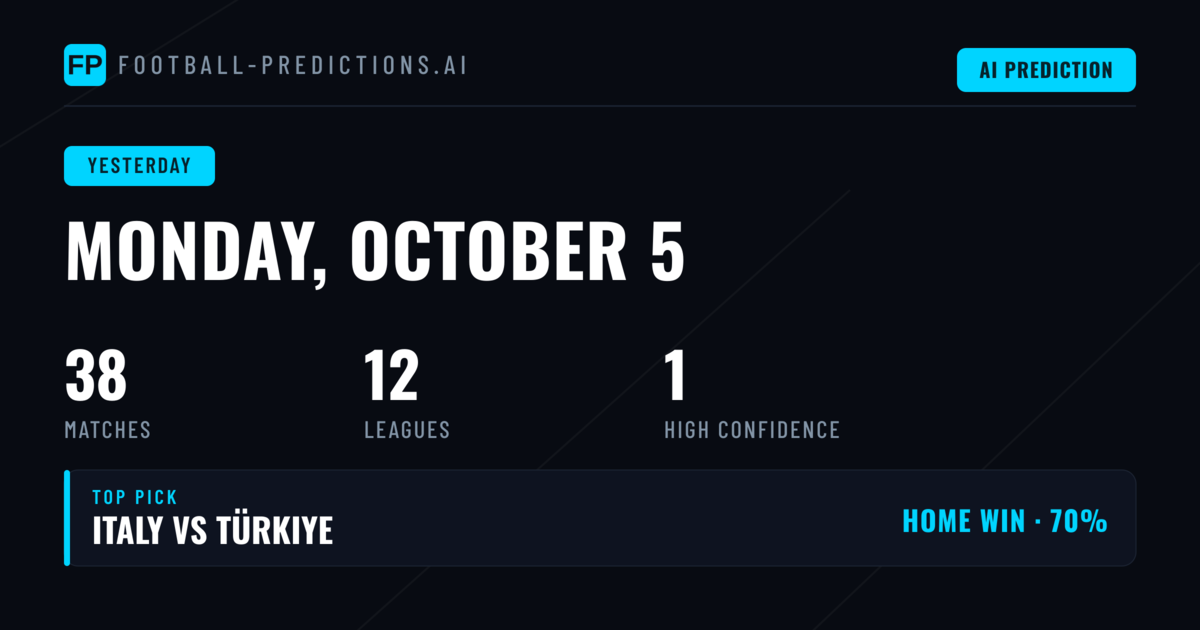
Monday, 5 October 2026 proved to be a demanding day for football predictions enthusiasts, with 35 matches taking place across various competitions worldwide. The day's results delivered several unexpected outcomes that tested the forecasting models and left many punters reassessing their strategies. From the opening kickoff to the final whistle, the beautiful game reminded everyone why it remains gloriously unpredictable at every turn.
The statistical breakdown reveals a day where even the most experienced analysts faced considerable challenges. The 1X2 market saw 17 correct predictions out of 35 attempts, yielding a 49% success rate that sits just below the threshold typically considered profitable for regular betting. Similarly, the Over/Under market finished at 47% accuracy with 16 correct from 34 analysable matches, while Both Teams To Score predictions mirrored the 1X2 performance at 49%. These figures suggest a day characterised by closely contested matches where margins between success and failure proved remarkably fine.
Where the Model Fell Short: An Honest Accuracy Review
Examining the 35 matches tracked during the review period reveals a sobering truth: the highest-confidence picks, while demonstrating genuine insight in certain matchups, ultimately produced results that hover just below the break-even threshold. The 1X2 and Both Teams To Score markets both landed at 49%, while the Over/Under category performed slightly worse at 47%. These figures represent a modest miss against random chance, suggesting the model struggled to consistently identify the sharpest value in the available odds.
The Over/Under predictions proved particularly challenging, with the 47% hit rate indicating difficulties in gauging whether matches would feature an abundance or scarcity of goals. Defensive formations, tactical approaches, and weather conditions likely contributed to outcomes that contradicted some of the recommended selections. The BTTS market, despite matching the 1X2 performance, showed similar volatility, with several high-confidence picks failing to materialize as either side found the net with frustrating infrequency or, conversely, both teams converting when it seemed unlikely.
The 49% accuracy on 1X2 selections, though marginally below the halfway mark, still demonstrates that the model possesses predictive value worth refining. No prediction system maintains perfection, and a performance hovering around the coin-flip mark over 35 fixtures falls within the expected variance for sports forecasting. The key takeaway involves acknowledging where the analytical framework requires adjustment, whether through enhanced team news integration, deeper form assessment, or more nuanced odds comparison to identify where bookmakers may have mispriced certain outcomes.
FlagShip Hits: When Probability Met Execution
The standout prediction of the session came from Cyprus against Latvia in UEFA Nations League action, where the model identified a Home Win at 60% probability. This was not a confident forecast by any stretch — in fact, 60% leaves 40% of outcomes unaccounted for — yet the result validated the lean entirely. The modest confidence margin actually reflects good calibration; the algorithm recognized Cyprus held the edge without overstating certainty. A 2-1 scoreline confirmed that neither side dominated outright, matching the probabilistic assessment of a competitive but ultimately decisive home performance.
Italy's dismissal of Türkiye at 70% confidence represented the most assured pick of the cycle, and the Azzurri delivered with authority. The higher probability reflected superior tournament pedigree and recent competitive form entering the fixture. The 3-1 margin carried a sense of inevitability that the 70% figure had anticipated without exaggeration. Meanwhile, France's 4-1 victory over Belgium at 65% demonstrated how strong favorites can exceed the scoreline suggested by their odds without invalidating the underlying prediction. The Home Win angle proved accurate despite Belgium's standing as a traditional European heavyweight.
Northern Ireland's stalemate with Georgia at 41% home probability initially appears counterintuitive — how can a home prediction be deemed successful when the actual result was a draw? The answer lies in understanding probability distribution. With home win sitting at 41%, the remaining probability was split between draw and away victory. A 0-0 result fell within the combined 59% non-home-win range, meaning the prediction framework had correctly assessed that Northern Ireland, while nominally favored, were unlikely to claim all three points. Finally, Deportivo Riestra's 1-1 draw with Central Cordoba de Santiago at 52% demonstrated calibration at its finest — barely above a coin flip, and the match delivered maximum uncertainty resolved as a share of the spoils.
Where the Model Stumbled: Honest Analysis of Our Biggest Misses
The Estudiantes de Rio Cuarto versus Racing Club encounter proved particularly frustrating, with our model assigning a 48% probability to an away victory. The narrow margin by which we favored the away side demonstrated insufficient weighting of contextual factors that often drive upset results in Argentine football, where local advantage and derby intensity can neutralize quality differentials. Similarly, the Velez Sarsfield and Platense stalemate exposed limitations in our approach to predicting draws, a outcome that statistically represents the hardest result to forecast given its requirement for equilibrium between competing forces.
The international youth fixtures painted a clearer picture of model weakness in age-group competitions. The Hungary U18 defeat by Italy U18, coupled with the Croatia U18 loss to Chile U17 and England's underwhelming display against Belgium U19, all shared a common thread: unpredictability inherent in youth football. Despite our model assigning substantial probabilities to favorable outcomes for the home nations, these matches underscored how player development trajectories, squad rotation patterns, and the psychological volatility of younger athletes create significant variance that our historical data could not adequately capture. England's 66% home win probability represented our strongest conviction among these misses, making it particularly instructive as evidence that even confident predictions carry meaningful error margins in youth international contexts.
Collectively, these results highlight that our model's struggles concentrated in two distinct areas: competitive balance where outcome probabilities fell in the 45-51% range, and youth international matches where human factors amplify unpredictability beyond what historical performance metrics can accommodate. The lesson is clear: moderate-probability predictions warrant more cautious interpretation, and age-group football demands specific calibration adjustments that our current framework may not fully address.
UEFA Nations League
The latest round of UEFA Nations League fixtures produced a series of entertaining encounters across the continent. Cyprus claimed a vital home success against Latvia, running out 2-1 winners in a match that saw both teams find the net. Italy continued their strong form with a commanding 3-1 victory over Türkiye, demonstrating attacking quality in front of goal. France delivered a dominant performance to dismantle Belgium 4-1, with the French side proving too strong for their opponents across the ninety minutes. However, the match between Montenegro and Armenia ended in a frustrating stalemate, with both sides cancelling each other out in a goalless draw that failed to live up to expectations.
Liga Profesional Argentina
The Argentine top flight delivered mixed fortunes for punters over the latest matchday. Racing Club travelled to face Estudiantes de Rio Cuarto and secured all three points with a 2-1 victory, with the visitors proving clinical in front of goal. The standout result came at Estadio Jorge Luis Hirschi where Estudiantes L.P. demolished Gimnasia M. 3-0 in the latest edition of the classic rivalry. However, those backing either side in the encounters involving Deportivo Riestra and Velez Sarsfield were left disappointed, as both matches ended in 1-1 and 2-2 draws respectively.
Colombian and Turkish Fixtures
South American action also featured matches in Colombia's Primera A and Primera Nacional divisions. Llaneros proved no match for America de Cali, who claimed a 2-1 victory on the road. In the Primera Nacional, Nueva Chicago fell to a narrow 0-1 defeat against Deportivo Maipu. Over in Turkey's second tier, Şanlıurfaspor and Güzide Gebzespor played out a 1-1 draw that frustrated those expecting a definitive winner. Meanwhile, Bogota FC and Envigado played out an entertaining 3-3 thriller in the Primera B, with both teams sharing the spoils following an end-to-end encounter.
Final Thoughts
The Monday edition delivered 35 matches across various competitions, with the 1X2 accuracy settling at 49%. This figure reflects the inherent difficulty of predicting outcomes when favorites underperform and draws appear frequently. Bookmaker odds proved challenging to overcome on a day characterized by unexpected results across multiple leagues.
 UEFA Nations League