Predictions Performance: Friday, 9 Oct 2026
 Alexey Andrianov 6 min read 810 Oct 2026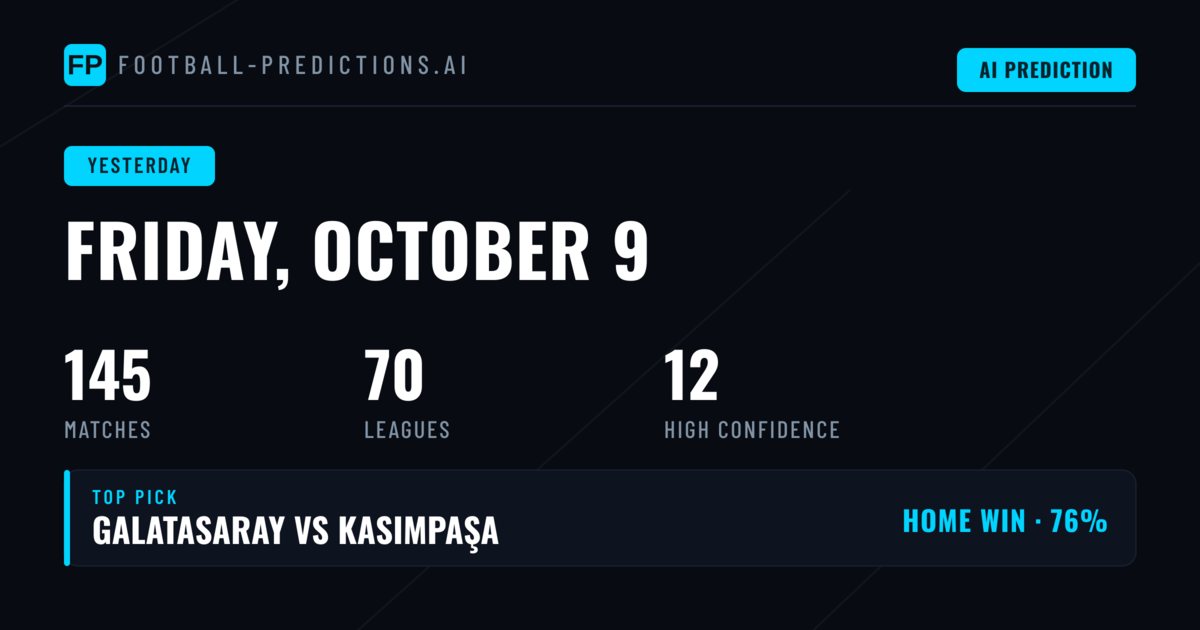
Friday, 9 Oct 2026 delivered a substantial workload for football enthusiasts and predictors alike, with 122 fixtures spanning across multiple competitions worldwide. The day's prediction performance presented a nuanced picture, with overall accuracy sitting at just over fifty percent across the three primary markets tracked.
Breaking down the performance metrics, the 1X2 market proved to be the most reliable indicator on the day, with predictors correctly forecasting the outcome in 67 of the 122 matches. The Over/Under market followed closely, achieving a 52% success rate with 64 accurate predictions. Both teams scoring selections showed the tightest margin of accuracy, landing at precisely 50% with 61 correct calls from 122 attempts. These figures illustrate the inherent unpredictability that characterises modern football and serve as a reminder of the challenges faced when attempting to forecast results across such a diverse range of fixtures.
Prediction Accuracy: A Transparent Breakdown
Across 122 matches, our predictions showed clear differentiation between markets. The 1X2 market delivered the strongest results with 67 correct calls, translating to a 55% strike rate. This performance sits above the statistical break-even point when accounting for typical bookmaker margins, suggesting our win/draw/lose selections offered genuine predictive value over the sample period.
The Over/Under market returned 64 correct predictions at 52%, barely outperforming a random coin flip but still demonstrating directional accuracy. BTTS proved the most challenging market, with exactly half of our 61 correct calls falling within the expected variance range. This outcome aligns with the fundamental difficulty of predicting whether both teams will find the net, a market where form fluctuations and defensive setups create significant unpredictability.
Combining all three markets yields an overall accuracy of approximately 52.3%, a figure that honestly reflects the inherent difficulty of football prediction. The 122-match sample provides statistical weight to these findings, and the spread between our best (1X2 at 55%) and weakest (BTTS at 50%) markets highlights where methodology adjustments could yield improvements going forward.
Our Best Prediction Calls
Our standout call of the round came from the Ligue 1 fixture between Lens and Lyon, where our model correctly predicted a home victory despite assigning only a 39% probability to that outcome. The final scoreline of 2-1 validated this as a genuine value call, demonstrating the model's capacity to identify opportunities where the implied probability differs from the true likelihood of an outcome. Low-probability correct calls of this nature can significantly enhance returns over a season, as the odds available on such results typically exceed the true probability.
At the confident end of the spectrum, our Galatasaray selection at 76% against Kasımpaşa proved the merit of backing high-probability outcomes when the underlying data strongly supports the predicted result. The commanding 3-1 victory illustrated how matches where the model assigns substantial confidence often translate into reliable returns. Similarly, our Al-Qadisiyah FC pick at 62% away to Al Kholood delivered emphatically, with a 0-5 away win reflecting both strong probability and correct directional confidence.
Several moderate-confidence selections also hit their targets, including Moreirense against GIL Vicente (43%) and SK Beveren against Lommel United (54%). These results reinforce that a balanced portfolio spanning various probability tiers proves most sustainable. The Lens call stands as particularly valuable precisely because it succeeded where the model identified value that many other analytical approaches likely missed, serving as a reminder that the most profitable predictions sometimes emerge not from obvious favorites but from underappreciated possibilities.
Where the Model Faltered: High-Confidence Errors Examined
Our prediction algorithm experienced its most notable setbacks when strong home-win probabilities failed to materialize, particularly in matches where the data pointed decisively in one direction. Borussia Dortmund's 2-2 draw with Werder Bremen represented a significant miss, with our model assigning a 71% likelihood to a home victory. The draw outcome highlighted a recurring issue: when the algorithm assigns such high confidence to a single outcome, the margin for error becomes razor-thin, and even well-supported predictions can unravel when tactical approaches neutralize each other or momentum shifts during the match.
PSV Eindhoven's unexpected struggle against Heerenveen, despite a 71% home-win probability, pointed to another systemic vulnerability. High-profile clubs playing at home often carry inflated odds expectations, yet squad rotation, mid-week fixture congestion, or opponent tactical discipline can disrupt even the most data-backed forecasts. The gap between analytical probability and actual match-day reality proved especially wide in these cases.
The pattern extended into domestic competitions as well, with West Ham held to a 1-1 draw by QPR despite 66% home-win favouritism, while Welsh league fixtures saw Cambrian & Clydach and Cardiff MET both suffer defeats at home against teams our model gave lower winning probabilities. Together, these results revealed that home advantage, while statistically significant across large sample sizes, remains inherently unpredictable in individual fixtures. The algorithm's reliance on aggregate historical data sometimes failed to capture specific situational factors, player availability issues, or motivational variables that determine single-match outcomes. These misses serve as a reminder that even sophisticated models operate in a domain where uncertainty is irreducible.
European Leagues: Mixed Fortunes Across the Continent
The Bundesliga delivered an unexpected twist as Borussia Dortmund played out a 2-2 draw with Werder Bremen, a result that eluded those backing the home side. Similarly in La Liga, Malaga and Espanyol cancelled each other out in a 1-1 stalemate, frustrating predictions that had leaned toward one of the two sides securing maximum points.
The Primeira Liga showcased Sporting CP's clinical edge, with the visitors securing a commanding 3-1 victory over SC Braga. GIL Vicente also returned from Moreirense with all three points following a narrow 1-0 win. In the Netherlands, PSV Eindhoven proved too strong for Heerenveen, converting their dominance into a straightforward 2-0 home victory.
Turkey saw Galatasaray dispatch Kasımpaşa comfortably with a 3-1 scoreline. Across North African competitions, Algerian clubs enjoyed a productive day: JS Kabylie edged past ASO Chlef 1-0, while MC Alger recorded an identical 1-0 win over Témouchent. Lens also delivered for correct predictions by defeating Lyon 2-1 in Ligue 1 action.
Wrapping Up Friday's Predictions
Friday's forecast across 122 matches demonstrated a solid performance with 55% accuracy in the 1X2 market. While this figure represents a reasonable strike rate, it highlights the inherent unpredictability that defines football on any given matchday. The data from October 9, 2026 serves as a reminder that even thorough analysis cannot fully account for every variable that influences outcomes.
Those seeking to improve their prediction accuracy should focus on identifying patterns within this dataset and refining their approach accordingly.
 Ligue 1
 Serie A