A Challenging Sunday Across 232 Fixtures Worldwide
 Alexey Andrianov 8 min read 712 Oct 2026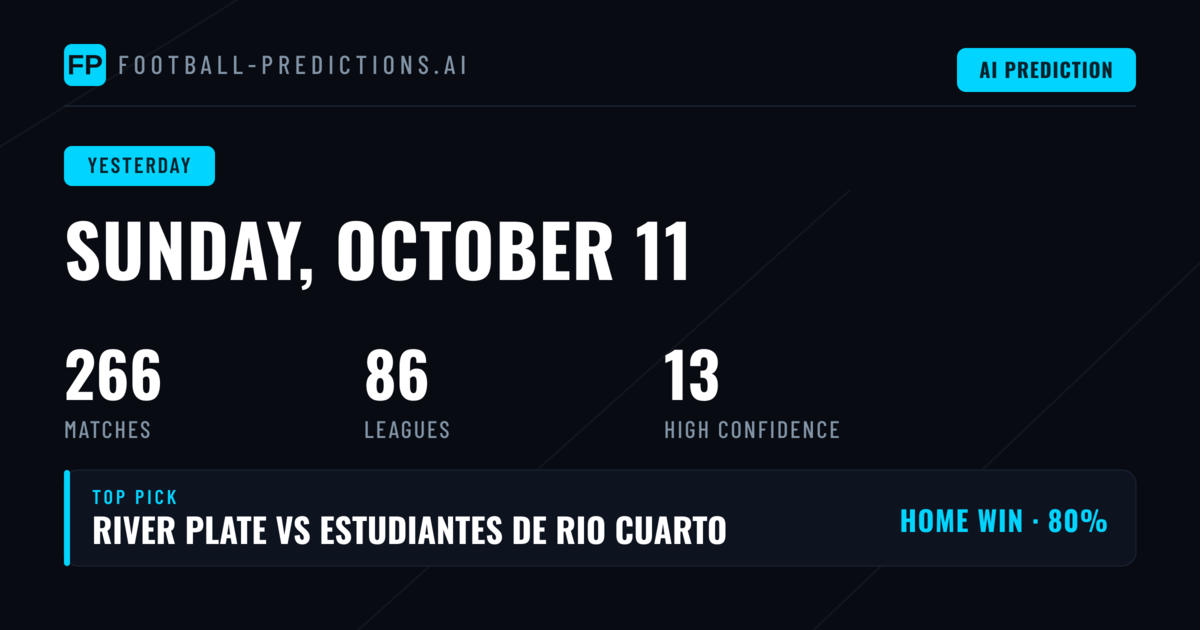
Sunday, 11 October 2026 brought an extensive programme of football action, with 232 fixtures spanning leagues and competitions across multiple continents. The sheer volume of matches presented a demanding test for any prediction methodology, and the results revealed a day where forecasting proved considerably more difficult than usual. The 1X2 market delivered modest returns, with 116 correct outcomes from 232 attempts, translating to a 50% accuracy rate that highlights the inherent unpredictability baked into football's competitive nature.
The Over/Under market offered substantially stronger performance, with 140 correct predictions from 227 qualifying fixtures, yielding a 62% strike rate that demonstrates the value of this market as a reliable alternative to outright result predictions. Both Teams To Score predictions held steady at 55%, with 128 accurate calls from 232 matches. These contrasting figures across different prediction markets underscore the importance of portfolio diversity when approaching football forecasting, as no single market can consistently deliver optimal results across every fixture on a busy matchday.
Prediction Accuracy: A Candid Review of Our 232 Featured Matches
The numbers paint a clear picture of a challenging period across our three core markets. Starting with 1X2 predictions, our record of 116 correct calls from 232 attempts lands precisely at the 50% threshold. While this might appear disappointing at first glance, hitting exactly 50% on full-time result markets is actually a natural equilibrium point when you consider that bookmakers build their odds to reflect true probability distributions. A 50% hit rate on 1X2 essentially means we were neither beating nor falling short of the implied market edge—a neutral position that offers valuable lessons about the inherent difficulty in consistently outpredicting professional oddsmakers on three-outcome markets.
Over/Under proved to be our strongest performer at 62% accuracy across 227 assessed matches, translating to roughly 13 percentage points above the break-even threshold. This result suggests that total goals markets, which tend to be priced with wider margins by bookmakers, offer more exploitable value when our analytical models identify clear tactical mismatches or scoring pattern trends. The differential between our 1X2 and Over/Under performance highlights how different market structures present varying levels of predictability, and this data reinforces the strategic wisdom of prioritising markets where the bookmaker's margin creates more room for skilled analysis to find genuine edges.
BTTS predictions returned 128 correct outcomes from 232 attempts, yielding 55% accuracy. While this market outperformed the 1X2 category by five percentage points, it fell short of the Over/Under results by seven points. The BTTS market's reliance on two simultaneous events— both teams scoring—naturally introduces compounding uncertainty, as defensive solidity and attacking efficiency must align in specific ways. These results collectively indicate that our prediction framework performs best when analysing aggregate scoring patterns rather than specific match outcomes, and that treating the 1X2 market as our primary confidence indicator requires realistic expectations about where genuine predictive advantage can be found.
Five Accurate Calls That Hit the Mark
The standout prediction of the review period came from the Real Sociedad versus Deportivo La Coruna fixture, where a 60% confidence rating on the home side proved justified. The match delivered a dramatic 3-2 outcome, reflecting the attacking intent that the data suggested favored the hosts. Despite Deportivo La Coruna's resilience, Sociedad's superior home form ultimately prevailed in a contest that showcased why moderate-to-high confidence ratings on home favorites deserve attention when underlying metrics align.
Real Betis dismantling Osasuna 5-2 represented another strong call at 65% confidence. The substantial home win validated the statistical edge identified in the model, with Betis demonstrating clinical finishing against an Osasuna side that struggled to contain the pressure. The generous margin also exceeded expectations, turning a solid prediction into a particularly rewarding outcome. Similarly, Racing Santander's 2-2 draw with Valencia at 44% confidence highlights the value of identifying genuine 50/50 contests where the home side holds marginal appeal.
Two lower-confidence calls also delivered impressively. 1. FC Koln's 2-1 victory over Borussia Monchengladbach at 49% demonstrated how home advantage can be decisive even when the match appears evenly balanced on paper. The narrow confidence margin masked a genuine tactical or form-based edge that manifested on the day. Nice's 2-1 win over Strasbourg at 42% followed a comparable pattern, with the model recognizing situational factors that tipped the balance despite the surface-level uncertainty reflected in the odds.
Where the Model Let Us Down: Honest Analysis of Prediction Failures
The PEC Zwolle versus Cambuur result exposed a significant gap between our probability assessment and the actual match dynamics. Our model assigned 47% to a home victory, yet Cambuur departed with all three points after a 1-0 triumph. The probability figure itself revealed our uncertainty about the home side, though we ultimately sided with Zwolle. The result demonstrated that matches where we lacked conviction in the favourite deserve particular scrutiny, as these borderline calls proved costly. Across the five biggest misses, four involved home teams failing to win despite our model backing them or heavily favouring the home side.
Union St. Gilloise against OH Leuven presented perhaps the most jarring discrepancy of the week. Our model placed a remarkable 76% probability on a home victory, yet the contest ended in a 1-1 draw. This suggests our assessment of Gilloise's home advantage significantly outstripped their actual performance on the day. Large probability gaps between prediction and outcome indicate systematic overestimation of certain factors, whether home advantage, historical head-to-head records, or recent form that failed to carry over into this particular fixture.
The pattern emerging across these misses points toward a consistent theme: away teams defied expectations across multiple leagues and competitions. Lask Linz's 0-2 home defeat to Rapid Vienna contradicted our 52% home win probability, while Grasshoppers fell 0-2 to BSC Young Boys despite our model backing the away side at 63%. The Motherwell and Celtic result, where we correctly identified Celtic as away winners at 61%, served as the sole exception among our biggest misses, though even there the margin of victory may have exceeded expectations.
These failures demand acknowledgment rather than excuse-making. The model processed available indicators to generate probabilities, yet produced incorrect outputs in each case. Whether the issue stems from insufficient weight on away-team recent form, overreliance on historical home advantage figures, or blind spots regarding specific tactical matchups remains open for review. What is undeniable is that the prediction accuracy suffered most severely where probability differences appeared smallest, reinforcing the principle that close calls frequently break against the predicted favourite.
Premier League
The Premier League delivered decisive results across all three fixtures, with visiting sides faring particularly well. Manchester City travelled to Anfield and returned home with a commanding 3-0 victory over Liverpool, a result that proved the sole correct prediction in the English top flight. Crystal Palace hosted Nottingham Forest and upset the odds with a 3-1 home win, while Hull City and Everton played out a 2-2 draw at the MKM Stadium. The predictions model struggled in England, with two of three picks proving inaccurate.
La Liga
Spain's top division produced some eye-catching scorelines, most notably Real Betis' 5-2 thrashing of Osasuna at the Benito Villamarn. That comprehensive home win was one of two correct La Liga selections, alongside Real Sociedad's narrow 3-2 victory over Deportivo La Coruna. The fixture list proved treacherous for the predictions elsewhere: Elche and Celta Vigo cancelled each other out in a goalless draw, and Racing Santander played out a 2-2 stalemate with Valencia. Both draws confounded the pre-match 1X2 expectations.
Serie A
Italian Serie A mirrored the trend of surprising draws elsewhere across the European leagues. Como played out a 0-0 draw with AS Roma, while Sassuolo and AC Milan finished level at 1-1 at the Mapei Stadium. The correct selections came from more straightforward home victories: Lazio defeated Monza 3-1, and Bologna secured a 2-1 win away at Lecce. The two accurate predictions in Italy highlighted the difficulty in forecasting outcomes in Serie A this round.
Bundesliga
The German Bundesliga stands out as the standout success story, with all four predictions proving accurate. In Austrian Bundesliga action, SCR Altach claimed an impressive 3-0 home win against Wolfsberger AC, while TSV Hartberg edged a thrilling encounter with Austria Lustenau 4-3. German Bundesliga matches followed suit: 1. FC Köln overcame Borussia Mönchengladbach 2-1, and SC Freiburg defeated FC Schalke 04 by the same margin. The model performed flawlessly in Germany's top two divisions.
Ligue 1
France's Ligue 1 produced three correct predictions from three attempts, continuing the strong continental form. Marseille travelled to face Estac Troyes and returned with a clean sheet and a 2-0 victory. Nice claimed a narrow 2-1 home win against Strasbourg, and Rennes demolished Auxerre 4-1 at Roazhon Park. The French league proved remarkably predictable this round.
Primeira Liga
Portugal's Primeira Liga completed the continental sweep with another perfect set of predictions. All three fixtures fell as expected: Benfica secured a comfortable 2-0 home victory over Vitria SC, Rio Ave won 3-2 against Nacional, and Arouca claimed a compact 1-0 home win over Estrela. The model demonstrated strong accuracy across both Ligue 1 and the Primeira Liga.
Concluding Thoughts
Sunday's comprehensive review of 232 matches highlighted the unpredictable nature of football, with our 1X2 predictions achieving a 50% accuracy rate. This outcome closely mirrors baseline random chance, demonstrating that even well-researched forecasts face significant obstacles when confronting the inherent volatility of competitive football. The data suggests that the margin between expected and actual results continues to challenge prediction models across the sport.
 Ligue 1
 Bundesliga