





HJK Helsinki and Ilves Battle for Suomen Cup Final Spot at Bolt Arena
The Suomen Cup semi-final stage arrives at the Bolt Arena on Wednesday with HJK Helsinki hosting Ilves in a fixture that carries significant weight for both clubs. The odds from Bet365 currently price HJK Helsinki at 1.67 to win in 90 minutes, with the draw at 3.9 and Ilves at 4.1, positioning the home side as clear favorites to progress to the final. However, the visitors arrive with nothing to lose against a side they have troubled in previous encounters.
Both teams enter this semi-final on equal rest, having played two matches within the last ten days. The symmetry in preparation suggests neither side holds a physical advantage heading into Wednesday's 17:00 BST kickoff. Ilves, though, face a tactical dilemma that could shape their approach—another competition awaits in just three days' time, potentially forcing difficult decisions regarding squad rotation and player selection that HJK will look to exploit.
High-Scoring Meetings Have Defined This Rivalry
The head-to-head record between HJK Helsinki and Ilves reveals a fiercely contested rivalry, with the two sides sharing 18 meetings across recent seasons. HJK Helsinki hold a narrow advantage in outright victories, securing nine wins compared to Ilves' five, while four encounters have ended level. The relatively balanced nature of this fixture is reflected in those four draws, suggesting neither side has dominated despite the apparent gap in overall league positioning.
When examining recent results from the last five meetings, the pattern becomes even more intriguing. The most recent encounter in May 2026 ended in a 2-2 stalemate, continuing a trend of closely fought battles. Prior to that, Ilves claimed a notable 3-1 victory in October 2025, while HJK Helsinki responded emphatically with a commanding 5-1 win in August of the same year. Earlier in April 2025, Ilves secured a 3-2 victory, and a 2-2 draw was recorded in September 2025, meaning four of those five most recent clashes finished all square or within a single goal margin.
The statistical profile of this matchup strongly favours over 2.5 goals and both teams to score. Across those 18 meetings, the average goal tally stands at an impressive 3.17 goals per game, while both teams have found the net in 72 percent of encounters. Given that the most recent fixtures have consistently produced multiple goals and tight finishes, this historical pattern suggests another entertaining and potentially high-scoring affair when the two sides meet again.
Clash of Contrasting Momentum as HJK and Ilves Battle for Final Spot
HJK Helsinki head into this Suomen Cup semi-final with a mixed recent record of LWDWW across their last five matches, a sequence that illustrates both their attacking prowess and occasional defensive vulnerability. The most alarming result came in a heavy 0-4 home defeat against KuPS, a result that would have concerned the coaching staff given the magnitude of the margin. However, that loss sits awkwardly alongside some genuinely dominant attacking displays, including a remarkable 7-1 victory away to Honka and a 5-2 win on the road against FF Jaro. Their 3-3 draw with Inter Turku further demonstrates a tendency to leave themselves exposed at the back while flooding forward, with the Veikkausliiga champions averaging 3.8 goals scored per match in their last ten games. The 60% BTTS percentage across that run signals that matches involving HJK tend to feature goals at both ends, though their clean sheet record of just 30% reveals the defensive frailties that could be exploited on Wednesday.
Ilves arrive at the Bolt Arena in considerably better overall momentum, carrying a DLWWW sequence that shows only one defeat in their last five outings. Their 3-4 away loss to KuPS mirrors HJK's struggles against the same opponents, though Ilves recovered strongly with consecutive victories over FF Jaro (5-0 at home), Turku PS (1-0 at home), and Lahti (5-2 at home). A 2-2 draw with SJK completed their recent schedule, and the Tampere-based side have proven themselves capable of both scoring freely and keeping opponents at bay when required. Their clean sheet record of 40% across the last ten matches represents a modest improvement on HJK's defensive solidity, while their BTTS rate of 50% suggests slightly more controlled performances. The scoring average of 2.2 goals per match indicates Ilves can hurt opposition defenses, though they lack the prolific output that has characterised HJK's best performances this season.
When examining the attacking dynamics between these two sides, the data heavily favours HJK Helsinki, with the comparison metrics indicating a 69% to 31% split in attacking capability. That gap reflects HJK's superior firepower and their tendency to blow opponents away on their better days, as evidenced by the 7-1 and 5-2 victories in their recent fixtures. Ilves, meanwhile, have shown their own goal-scoring ability particularly at home, where the 5-0 thrashing of FF Jaro and the 5-2 victory over Lahti demonstrate they can be clinical when opportunities arise. Defensively, both clubs sit at parity according to the comparison metrics, yet the raw statistics tell a slightly different story. HJK's average of 1.5 goals conceded per match is marginally superior to Ilves' 1.8, and the champions' higher clean sheet percentage of 30% versus Ilves' 40% is offset by HJK's greater frequency of allowing goals in matches they do keep clean sheets in terms of pure probability across their run.
The semi-final at the Bolt Arena pitches a high-scoring, occasionally porous HJK side against an Ilves team that has found consistency through the WWWW sequence in their last four matches. HJK's home advantage at the Bolt Arena combined with their superior attacking metrics makes them the clear favourites on paper, yet the manner of their recent results suggests this encounter could develop into a tense, cagey affair rather than a goal festival. Ilves have demonstrated they can grind out results when needed, as shown by the narrow 1-0 victory over Turku PS, and they possess enough attacking quality to trouble a HJK defense that has shipped four goals against KuPS and three against Inter Turku in recent weeks. The 50% defensive comparison parity suggests neither side holds a significant structural advantage, which points toward a tightly contested semi-final where the outcome may hinge on which team executes their game plan more effectively in the decisive moments.
How HJK Helsinki and Ilves Will Look to Control the Semi-Final
The Suomen Cup semi-final at the Bolt Arena pitches Finland's most decorated cup performers against a Ilves side carrying genuine motivation to reach a final. With Bet365 pricing HJK Helsinki at 1.67 and Ilves at 4.10 for the 17:00 BST kickoff on Wednesday, the market clearly favors the hosts, though the tactical dynamics promise a more nuanced contest than those odds suggest. Both teams arrive with identical rest periods following recent scheduling, but Ilves face a complicating factor: another fixture arrives in just three days, increasing the likelihood of squad rotation that could alter their strategic approach for this cup semi-final.
HJK Helsinki typically build their attacking play through controlled possession in the middle third, looking to stretch opposition defenses with wide positioning before delivering quality service into the box. Their defensive structure has historically been difficult to break down in cup ties at home, where the compact nature of the Bolt Arena amplifies the atmosphere. For Ilves, the route to an upset likely runs through disciplined defensive organization and a willingness to absorb pressure before hitting rapidly on the counter-attack. Their success will depend on winning the physical battles in midfield and forcing HJK into rushed decisions in the final third.
The rotation risk hanging over Ilves creates an intriguing tactical variable. Should the visitors prioritize fresh legs over consistency, HJK could face a more unpredictable defensive shape that lacks the usual cohesion needed to frustrate their attack. Conversely, if Ilves name a strong lineup despite the scheduling pressure, their freshness could become a weapon in the closing stages when fatigue often determines cup ties. HJK must establish control early while maintaining enough in reserve to respond to whatever approach Ilves brings to Helsinki.
HJK Helsinki Set to Progress as Goals Flow Expected in Suomen Cup Semi-Final
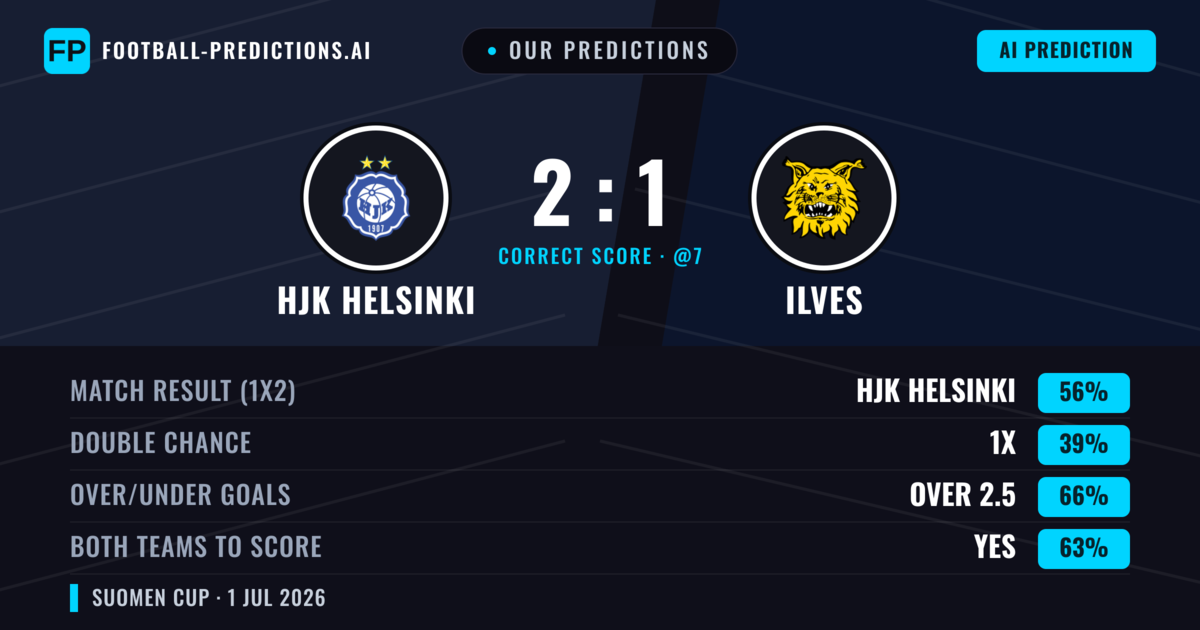
The Suomen Cup semi-final at the Bolt Arena pitches HJK Helsinki as clear favourites against Ilves, with the 1X2 odds reflecting that supremacy. Home odds of 1.67 imply approximately a 53.5% probability of a HJK victory, and the best available price of 1.69 at 1xBet offers punters marginally better value. The draw sits at 3.7 with Ilves priced at 4.0, suggesting the visitors face an uphill task despite their cup credentials. With HJK playing on home soil and possessing superior domestic form historically, backing the home win carries reasonable confidence at 56% according to our projections.
The over 2.5 goals market presents the strongest analytical conviction at 66% confidence. Both clubs arrive at this semi-final having demonstrated attacking intent throughout the cup campaign, and HJK's home record at the Bolt Arena typically features high-scoring encounters. The Suomen Cup has historically produced open, end-to-end fixtures at this stage, and with Ilves needing to take initiative to progress, we anticipate space opening up for both attacks. Pinnacle's best available odds for over 2.5 goals provide solid value for punters seeking the highest price on this selection.
The BTTS market at 63% confidence aligns with the expectation of an open contest. HJK's attacking quality should breach the Ilves defence on home turf, while the visitors possess enough forward capability to find the net themselves, particularly if they commit numbers forward in search of an equaliser. The defensive solidity that served Ilves well in earlier rounds may be tested by HJK's pace and creativity in the final third, making both teams scoring a plausible outcome worth considering alongside the over 2.5 goals angle.
For punters seeking lower-risk options, the double chance 1X at 39% confidence offers a safety net, though the odds will naturally be shorter. HJK remain formidable opponents at the Bolt Arena and a defeat would represent a significant upset. The best odds for this market should be compared across bookmakers before placing. Ultimately, HJK's home advantage, cup experience, and superior squad depth make them the most likely victors, with goals expected on both sides in what promises to be an entertaining semi-final encounter.
HJK's Edge Extends to the Side Markets at Bolt Arena
While the match result market offers a straightforward read on HJK Helsinki's home advantage, the Correct Score market presents the most analytically sound secondary opportunity for this Suomen Cup semi-final. Our model assigns 14% confidence to a 2:1 scoreline in favour of the home side, translating to decimal odds of 7.00. This valuation reflects the expected frequency of competitive semi-final encounters being decided by a single goal, with HJK's offensive capability giving them the edge needed to convert that final opportunity. Bettors seeking value beyond the moneyline should note that 2:1 remains the most probable outcome among all possible scorelines, despite the modest implied probability of around 14%.
When examining Asian Handicap markets, HJK Helsinki's classification as the clear home favourite suggests the handicap line will likely sit at a level that requires them to win by more than a single goal for full payout. The HT/FT market, combining half-time and full-time predictions, opens up combinations where HJK leading at the interval and ultimately prevailing emerges as the logical combination given their demonstrated ability to control matches at Bolt Arena. For corners and cards markets, the competitive nature of a cup semi-final typically produces elevated figures compared to league encounters, with both sides expected to commit numbers forward in pursuit of a place in the final.
HJK's Home Advantage Tilts the Scales in Helsinki Semi-Final
When HJK Helsinki and Ilves step onto the pitch at Bolt Arena on Wednesday afternoon, the hosts carry the weight of expectation. Their strong home form and cup pedigree give them the edge in this Suomen Cup semi-final. The data points toward HJK claiming all three points, with over 2.5 goals anticipated as both sides have shown attacking intent in recent competitive matches. The BTTS pick reflects the likelihood of Ilves finding the net even in defeat, given their goal-scoring record in cup competition.
For bettors seeking value, backing HJK to win alongside over 2.5 goals presents a solid option, while the double chance 1X provides a safer cushion for those cautious about upset potential. The semi-final stage adds pressure, but HJK's experience in knockout football should guide them through to the final. Expect a competitive affair with goals at both ends and the hosts progressing.