
Iraq Returns to World Stage as Norway Seeks Redemption at Gillette Stadium
When Iraq and Norway kick off at Gillette Stadium in Boston on Tuesday evening, it marks a meeting of two nations at vastly different stages of their World Cup journeys. Iraq are making their long-awaited return to the tournament after a 40-year absence, while Norway are competing in their first major international competition in 26 years under manager Ståle Solbakken, who according to The Guardian has led his country back to the world stage with a pragmatic philosophy built on tight zonal defending and aggressive attacking play. Both sides arrive with identical records of zero points from their opening matches in Group I, setting the stage for a pivotal encounter that could define their tournament ambitions.
The build-up to this fixture has been fraught with complications for Iraq. Ahmed Makenzi has been called up to replace Ahmed Yahya, who according to reports from Al Madina suffered a second-degree hamstring injury requiring a four-week treatment and rehabilitation period. Head coach Graham Arnold made the decision to summon Makenzi and register him in the final World Cup squad roster following medical evaluations. The emotional farewell of Yahya to his teammates was documented by the Iraqi national team as the squad continues its preparations on American soil, adding a human dimension to their pre-match preparations.
Fans in the Boston area have the opportunity to witness this historic encounter firsthand, with the match available to view on ESPN and NBC networks. For those seeking a communal atmosphere, the Harvard Square Business Association in nearby Cambridge is hosting a watch party featuring live music, food vendors, and family-friendly activities beginning at 5pm on Brattle Plaza. Group I also contains France and Senegal, making this opening phase of the tournament particularly competitive for all four nations vying for advancement.
Contrasting Trajectories Set the Stage for Group I Opener
When Iraq and Norway step onto the Gillette Stadium pitch on Tuesday evening, they will do so carrying markedly different psychological profiles despite identical records in Group I. Iraq enter this fixture having gone without a win in their last two matches, while Norway arrive with a more unpredictable but occasionally explosive run of results that suggests a side capable of producing moments of quality. The discrepancy in recent form could prove decisive in determining which team gains the early advantage in a group that also contains France and Senegal.
Iraq's preparation for this World Cup encounter has been characterised by defensive instability and a conspicuous lack of cutting edge in the final third. Their 1-1 draw away to Spain demonstrated that they can compete against established nations, but the result also highlighted vulnerabilities at the back that have become a troubling pattern. That draw followed a disappointing 0-1 defeat away to Andorra, a result that exposed significant concerns about their ability to convert chances into victories. With a goals scored average of just 0.5 per match and no clean sheets recorded in their recent outings, Iraq face an uphill task in breaking down opponents while simultaneously keeping them at bay.
Norway's recent record presents a more complex picture, one that offers both promise and cause for caution. Their impressive 3-1 victory over Sweden showcased an attacking potency that averages 1.5 goals per match across their last ten games, a figure that compares favourably with most sides in this competition. However, a 1-1 draw away to Morocco and a toothless 0-0 stalemate against Switzerland revealed inconsistencies that have prevented them from building meaningful momentum. Their 80% BTTS rate across recent matches indicates that games involving Norway tend to feature goals at both ends, a pattern that promises entertainment but also suggests defensive frailties that Iraq might exploit if they can rediscover their shooting boots.
The defensive records of both nations make for concerning reading for their respective coaching staffs. Iraq's inability to keep clean sheets and Norway's meagre 10% record in this department point toward a contest that could feature multiple goals. Iraq will need to address their profligacy in front of goal, having managed just one strike across their two most recent fixtures, while Norway must tighten up at the back if they are to take maximum points from a side they will expect to beat. The outcome may ultimately hinge on which team can impose their preferred tempo and whether Norway's superior firepower can overwhelm an Iraqi defence that has struggled to contain even modest opposition.
Contrasting Philosophies Collide as Norway's Structure Meets Iraq's Spirit
Norway arrive at Gillette Stadium under the guidance of Ståle Solbakken, a manager whose career trajectory became intertwined with this competition ever since he sat as an unused substitute shouting instructions during Norway's famous comeback victory over Brazil at the 1998 World Cup. According to The Guardian, Solbakken operates within the northern European football school where results always carry the most weight, deploying a 4-3-3 formation that offers significant tactical flexibility. His approach centers on tight zonal defending paired with aggressive attacking play designed to break through defensive lines. Antonio Nusa, a winger who loves to dribble, typically maintains width on the left flank, stretching opposition defenses and creating channels for teammates to exploit. This structured yet direct methodology represents Norway's first appearance at a major tournament in 26 years, lending extra significance to how they execute their game plan.
Iraq's preparations carry their own narrative of adaptation under Australian manager Graham Arnold. The squad has undergone a late adjustment following news that Ahmed Yahya was ruled out with a Grade 2 hamstring injury requiring approximately four weeks of recovery. According to reports from Al Madina and Asharq Al-Awsat, Ahmed Mahdi McKenzie has been called up to replace him in the final World Cup squad. This substitution forces Iraq to adjust their tactical options ahead of their return to the global stage after a 40-year absence from the tournament. The emotional weight of this moment—Yahya's heartfelt farewell to teammates in Chicago before departing for treatment—underscores the human element within Iraq's camp as they prepare to face a technically superior opponent.
The tactical confrontation presents an intriguing asymmetry. Norway possess clear structural advantages through their organized defensive shape and creative outlets, particularly if they can establish wide positions early and deliver crosses toward their attacking threats. Iraq, meanwhile, must rely on defensive discipline and opportunistic transitions, leveraging whatever unity their squad has built during preparations to neutralize Norway's possession-based approach. The battle will likely be decided in midfield, where Norway's zonal system attempts to control tempo against whatever compact shape Iraq adopts. Solbakken's side will look to dominate territory and create overloads in wide areas, while Iraq must remain compact, absorb pressure, and strike quickly when turnover opportunities arise.
Norway Look Poised to Claim Three Points Against Iraq in Boston
The World Cup Group I encounter at Gillette Stadium presents a significant contrast in pedigree as Iraq prepare to face Norway in their opening fixture. Both sides enter this match with identical records of no points, having not yet played in this qualification cycle, but the bookmakers have established a clear hierarchy in their odds. Norway arrive as overwhelming favourites with the best available odds of 1.22 at 1xBet, while Iraq face mammoth odds of 16.25 with Marathonbet for a home victory. The implied probability of 77.4% for a Norwegian success reflects the substantial quality gap between these two nations at international level.
Our analysis reaches 79% confidence on a Norway victory, and this conviction stems from their superior FIFA ranking position and recent competitive experience. Iraq sit 9th in the standings while Norway occupy 4th, suggesting the Iraqi squad lacks the firepower to compete with a Norwegian side that has demonstrated stronger attacking capabilities in recent campaigns. The midfield battle will prove decisive, and Norway's technical superiority should allow them to control the tempo and create clear opportunities against an Iraqi defence that may struggle to contain their forward movements.
The total goals prediction of over 2.5 carries 60% confidence, which appears reasonable given Norway's attacking intent and Iraq's likely defensive vulnerabilities. However, the BTTS prediction of no at 58% confidence introduces an interesting dynamic. While we anticipate Norway scoring freely, Iraq may find it extremely difficult to breach the Norwegian backline, which suggests clean sheet potential for the visitors. This combination points toward a potentially one-sided affair where the scoring may be limited to the favoured nation.
For punters seeking value, the double chance prediction of X2 at 46% confidence offers a safety net against a potential shock result. Those confident in a Norway victory can secure enhanced odds of 1.22 at 1xBet compared to the standard 1.2 available elsewhere. The draw option at 7.26 with Pinnacle presents an alternative for those cautious about a comfortable Norwegian success, though our analysis firmly favours the away victory. The substantial gap between implied probability and actual odds for a home win indicates that bookmakers consider an Iraqi upset extremely unlikely in these circumstances.
Secondary Value in Iraq vs Norway World Cup Wagering
The model identifies several supplementary markets offering compelling value for Tuesday's Group I fixture at Gillette Stadium. Norway's projected dominance extends beyond the match result, with the visitors priced at 1.56 to hold a half-time advantage and 1.57 for the Away/Away double in the Half-Time/Full-Time market. The 64% confidence rating on the HT/FT combination reflects the expectation that Iraq face an uphill battle against a Norwegian side expected to assert control early in proceedings.
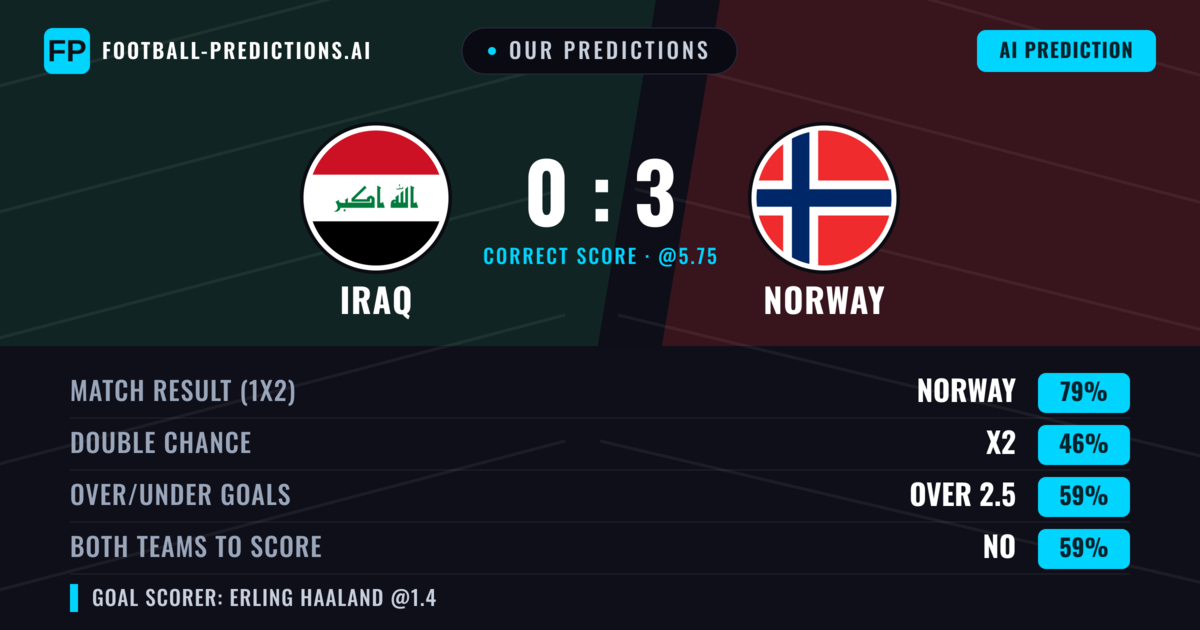
The most likely correct score outcome carries odds of 6.00 at 17% confidence, projecting a 0:3 victory for the Norwegians. While lower in confidence than some other markets, this reflects the significant quality gap between the nations. For those seeking higher-probability secondary options, the corners market shows 59% confidence on under 9.5 total corners at 1.57 odds, suggesting a structured, tactical encounter rather than an open attacking spectacle. The cards market leans toward under 3.5 total cards at 1.83 with 50% confidence, indicating expectations of a relatively disciplined contest.
Individual player markets present the strongest confidence reading across all available options. Erling Haaland carries odds of 1.40 to score anytime throughout the match, supported by a 71% confidence rating. Given Norway's attacking advantage and Haaland's finishing capability, the anytime goalscorer market represents the most statistically-backed selection beyond the standard three-way outcome for this World Cup qualifier.
Norway's Attacking Quality Should Prevail in Boston
The prediction model delivers a decisive signal for this Group I clash at Gillette Stadium, with Norway installed as the clear favorite at 79% confidence. Their superior firepower should unlock an Iraqi defense that will likely absorb pressure before attempting to strike on the counter. The BTTS prediction favoring "no" at 58% aligns with the expectation of a controlled Norwegian performance where they dominate possession and create quality chances while limiting Iraq's opportunities in dangerous areas.
For bettors, combining Norway to win with the over 2.5 goals line offers the strongest value given the 60% and 79% confidence levels respectively. The match should produce enough action to satisfy both markets without requiring a defensive collapse from either side. Iraq enter as heavy underdogs in Group I alongside France and Senegal, and securing any points from this fixture would represent a positive outcome for their campaign despite the statistical disadvantage.