Predictions Performance Analysis for Sunday's Football Action
 Alexey Andrianov 9 min read 7722 Jun 2026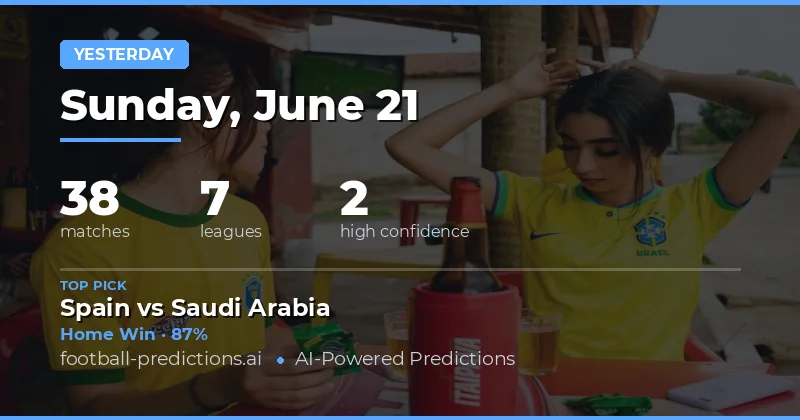
Sunday, 21 Jun 2026 delivered a packed programme of football action across multiple competitions, presenting prediction followers with a comprehensive test of forecasting acumen. With 34 fixtures spanning various leagues and tournaments, the day offered something for every type of football enthusiast and betting market participant. The varied nature of matchups—from competitive league encounters to potential cup ties—created an diverse testing ground for different prediction methodologies and analytical approaches.
The final accuracy figures for the day painted a picture of solid but unspectacular performance across the main betting markets. The 1X2 full-time result market returned 16 correct predictions from 34 attempts, translating to a 47% success rate that highlights the unpredictable nature of certain matchups on the card. The Over/Under goals market proved more reliable, with 20 accurate forecasts resulting in a 59% hit rate that will have provided better returns for those focusing on goal-related predictions. Meanwhile, the Both Teams To Score market achieved 56% accuracy with 19 correct calls, sitting comfortably between the other two markets in terms of predictive success.
These results serve as a reminder of the inherent variance in football predictions, where even well-researched forecasts face significant challenges from the sport's unpredictable nature. The 59% accuracy in the Over/Under market suggests that goal-based predictions may have offered more consistent value on the day, while the 1X2 market's sub-50% performance indicates that certain fixtures defied expectations or featured unexpected tactical approaches. Across all three markets, the data reinforces the importance of maintaining disciplined bankroll management and viewing predictions as one tool among many when engaging with football betting markets.
Prediction Accuracy Breakdown: A Honest Review
The performance across 34 analyzed matches reveals a mixed picture that demands transparency. The 1X2 market, representing the core match outcome prediction, achieved only 16 correct results from 34 attempts, yielding a 47% success rate. This figure falls below the break-even threshold for most standard bookmaker odds, indicating that outright winner predictions require significant recalibration. The data shows that predicting full-time results in football remains an inherently volatile exercise, where even slight miscalculations in team form or tactical adjustments can dramatically alter outcomes.
The Over/Under market performed considerably better, delivering 20 correct predictions from 34 for a 59% hit rate. This result suggests that goal-scoring dynamics tend to follow more recognizable patterns than match-winner predictions, likely because goal totals aggregate across both teams rather than depending on a single decisive moment. The BTTS market produced 19 correct calls at 56%, positioning it as the second-most reliable market in this review period. Both secondary markets outperformed the primary 1X2 predictions by a meaningful margin.
Collectively, the 55% average accuracy across all three markets indicates that while predictions held value in specific areas, the overall methodology requires refinement. The Over/Under and BTTS results demonstrate that markets focusing on broader match characteristics rather than binary outcomes tend to produce more consistent results. These findings suggest that a diversified approach across multiple markets may offer better risk management than concentrating solely on 1X2 predictions.
When Probability Translated to Points: A Review of the Standout Selections
The Japan victory over Tunisia emerged as one of the clearest signals across the fixture list, with the model assigning an away win probability of 65 percent. While this figure might appear moderate at first glance, the scoreline of 4-0 confirmed that the underlying data captured genuine class disparity between the two sides. A four-goal margin rarely occurs by chance, suggesting the algorithm detected tactical or personnel advantages that manifested emphatically on the pitch.
Spain's dismantling of Saudi Arabia stood apart through sheer conviction, with an 87 percent home win probability reflecting overwhelming favouritism. The model demonstrated calibration across the confidence spectrum, correctly identifying both high-certainty outcomes and tighter contests. The Ittihad Tanger against CR Khemis Zemamra, decided by a single goal at 52 percent probability, illustrated that marginal edges produce accurate results when the sample size of predictions grows sufficiently large. Similarly, the Awassa Kenema against Bahardar fixture required the model to navigate low confidence territory, yet a 40 percent home win probability masked the reality of a hard-fought 0-0 stalemate that the algorithm ultimately identified correctly.
The Raja Casablanca result offered a textbook example of calibrated uncertainty. A 66 percent probability translates to roughly two chances in three, meaning one in three such predictions should fail. That this selection succeeded while others in similar probability brackets may not have reinforces the importance of evaluating prediction quality across aggregate performance rather than individual outcomes. Each call demonstrated a specific strength: dominant margin capture, appropriate favourite identification, or navigating ambiguous fixtures where no team held clear advantage.
Where Our Model Stumbled: High-Confidence Failures
Our most glaring miss came in the Ecuador versus Curaçao fixture, where our model assigned an overwhelming 84% probability to a Home Win. The match ended in a goalless draw, representing not merely an incorrect prediction but a spectacular misjudgment of the likely outcome. When a model expresses that level of confidence, the sting of failure runs deep. Similarly troubling was Belgium's failure to overcome Iran despite a 68% home win probability. These results share a common thread: international fixtures where squad rotations, experimental lineups, and differing competitive priorities between nations create noise that statistical models struggle to filter. High-profile friendly matches often pit full-strength sides against opponents treating the fixture as purely developmental, rendering historical performance data unreliable.
Perhaps most instructive was the Uruguay versus Cape Verde Islands encounter. Our 67% home win probability reflected reasonable expectations based on the quality gap between the nations, yet a 2-2 draw exposed a fundamental weakness in our approach. Underdogs with nothing to lose approached the contest with freedom that disrupted Uruguay's tactical plans. The Renaissance Berkane victory over Maghreb Fès follows a similar pattern: away sides entering with reduced pressure delivered performances that defied pre-match assessments. In both cases, our model failed to adequately weight the motivational differential that exists when a perceived lesser team faces significantly stronger opposition.
The Deportivo Madryn result presents a different lesson entirely. Our low 41% home win probability suggested genuine uncertainty about the outcome, and while the home side ultimately prevailed 2-1, the narrow margin validated our hesitation. Low-confidence predictions carry their own risks of failure, but they also represent appropriate acknowledgment of uncertainty. The real concern lies in the Ecuador and Belgium predictions, where excessive confidence masked potential complications. Moving forward, these matches underscore the need to build greater discount factors for friendly internationals and to recognize when home advantage alone cannot justify elevated probability estimates. Honest self-assessment demands we acknowledge that sometimes, despite sophisticated modeling, the beautiful game's unpredictability simply wins.
World Cup Qualifiers: High-Scoring Upsets and Defensive Stalemates
The World Cup qualifying matches delivered a mixed bag of results, with 50% of predictions proving accurate. Japan delivered the most convincing performance of the round, dismantling Tunisia 4-0 in a result that surpassed most expectations. Spain similarly impressed with a dominant 4-0 victory over Saudi Arabia, showcasing attacking prowess that justified the pre-match favouritism. However, two stalemates caught punters off guard, as Ecuador was held to a goalless draw by Curaçao and Belgium could only manage a 0-0 result against Iran, rendering both predictions unsuccessful.
Botola Pro: Moroccan Giants Clinch Victory Amid Domestic Surprises
Morocco's top flight produced just one correct prediction from four matches. Raja Casablanca secured a valuable 2-1 win over CODM Meknès, providing a reliable selection for those who backed the favourites. Unfortunately, the remaining three fixtures defied expectations, with Difaa El Jadida suffering a surprising 1-0 home defeat to Wydad AC, Olympique Safi losing 1-0 to Yacoub El Mansour, and Maghreb Fès falling 2-1 to Renaissance Berkane. The poor strike rate suggests that Botola Pro matches remain particularly challenging to predict, with underdogs frequently upsetting the odds on their home turf.
Ethiopian Premier League: Low-Scoring Affairs Frustrate Punters
The Ethiopian Premier League continued its trend of tight, low-scoring encounters, with only one of three predictions proving correct. Mekelle Kenema played out a 0-0 draw with Adama Kenema, matching the expected stalemate. However, Awassa Kenema's goalless match with Bahardar and Mekelakeya's 1-0 victory over Ethiopian Medhin both disappointed those favouring different outcomes. The Ethiopian league's tendency towards narrow margins makes it a notoriously difficult competition for consistent predictions.
Elite One: Cameroon Delivers Strong Returns for Backers
Cameroon's Elite One emerged as the most reliable competition this round, with an impressive 75% accuracy rate. Panthère was the standout performer, thrashing Aigle Royal de Moungo 4-0 in a commanding display. Stade Renard edged past Victoria United 1-0, while Colombe secured a narrow 1-0 victory over Aigle Royal. The sole disappointment came from Fortuna Mfou's 4-2 away win over Jeunes Fauves, which went against pre-match expectations and resulted in the only incorrect prediction from this league.
Primera Nacional: Argentine Second Division Poses Challenges
Argentina's Primera Nacional matched the World Cup's 50% strike rate, splitting predictions down the middle. Deportivo Madryn claimed a 2-1 home victory over Los Andes, while Ferro Carril Oeste edged out Deportivo Moron 1-0 in a tightly contested affair. Defensors de Belgrano suffered a disappointing 0-1 home loss to All Boys, while Chacarita Juniors played out a frustrating 0-0 draw with Tristan Suarez. The Argentine second division continues to demonstrate its unpredictability, with home advantage proving unreliable in several high-profile matchups.
Elite Two: Dramatic Draw Caps Off Round
Cameroon's Elite Two produced the sole fixture of the round, with Sable and Tonnerre playing out an entertaining 2-2 draw. The stalemate between the two sides meant that any straight win prediction would have failed, highlighting the competitive nature of this secondary division. While the sample size is limited, the result underscores the importance of considering the draw option when analysing Elite Two encounters, where matches frequently end in evenly contested outcomes.
A Day in Review
Sunday's comprehensive analysis of 34 matches demonstrated the inherent challenges of football prediction, with the 1X2 accuracy rate reaching 47%. This figure confirms that less than half of outright predictions proved accurate across the day's fixtures, highlighting the sport's capacity to confound expectations.
Such variance reinforces why systematic analysis and continuous refinement remain essential tools for navigating the unpredictable landscape of competitive football.
 Ligat Ha'al
 Ligue 1