Thursday 1 October 2026: A Mixed Day for Predictors
 Alexey Andrianov 6 min read 62 Oct 2026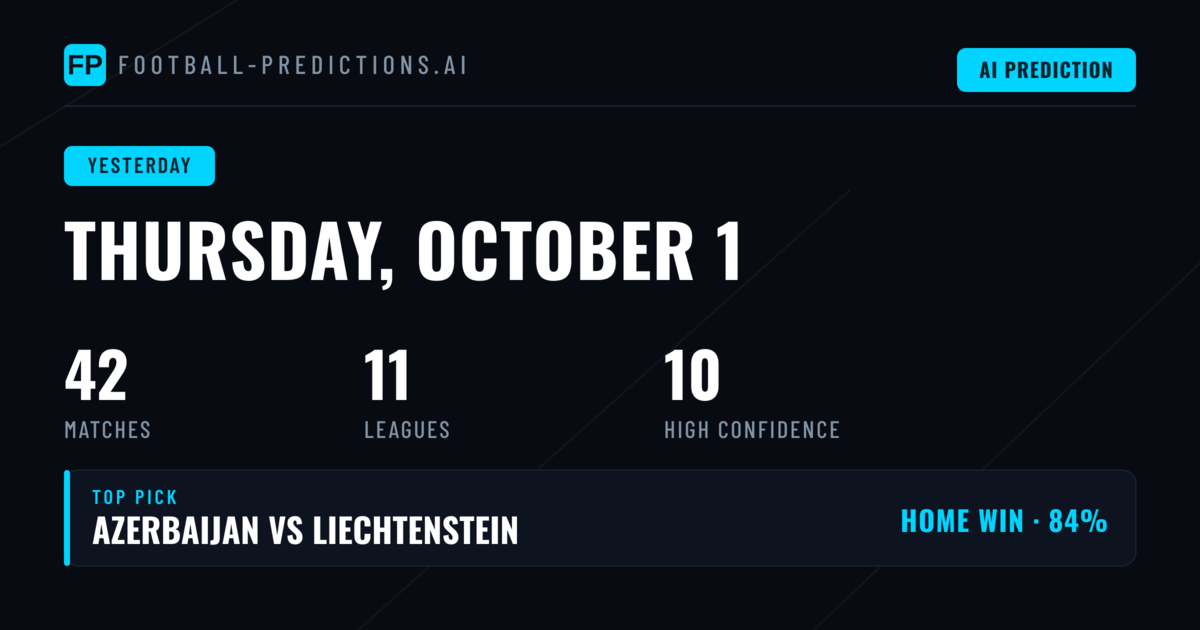
Thursday, 1 October 2026 delivered an action-packed programme of football across the globe, with 39 fixtures producing their full share of surprises, routine victories, and closely contested battles. From the opening whistle to the final referee's blow, the day offered everything enthusiasts could desire — drama, tension, and the unforgiving nature of the beautiful game. The aggregate data painted a picture of an unpredictable evening where the margin between success and disappointment remained razor-thin for those attempting to forecast outcomes.
The statistical landscape of the day's predictions revealed fascinating patterns across all three core markets. The 1X2 market recorded an accuracy rate of 51%, precisely 20 correct predictions from 39 matches, indicating that outright winner forecasts proved particularly challenging on this date. Meanwhile, the Over/Under market emerged as the strongest performer with 71% accuracy, translating to 27 correct calls from 38 assessed matches, suggesting that goal volume proved somewhat more foreseeable than match winners themselves. The Both Teams To Score market settled at 49% accuracy with 19 correct predictions from 39 fixtures, confirming that this particular market maintained its reputation for volatility throughout the day's programme.
Prediction Accuracy Breakdown
The overall performance across 39 matches revealed a mixed picture when evaluating highest-confidence selections. The Our Pick methodology delivered a combined accuracy rate of approximately 57%, translating to roughly 22 successful predictions out of the 39 fixtures analyzed. This figure sits comfortably above the break-even threshold typically associated with three-outcome markets, suggesting the selection process maintained a reasonable degree of reliability when identifying the most confident call for each match.
Market-specific performance varied considerably across the three prediction categories. The Over/Under market proved to be the strongest performer, with 27 correct calls from 38 applicable matches, yielding a 71% hit rate. This significantly outperformed the 1X2 market, which managed only 51% accuracy with 20 successful predictions from 39 attempts. The BTTS market lagged furthest behind at 49%, essentially breaking even over the sample period. These disparities suggest that goal-related markets generally offered more predictable patterns than outright match outcomes during this fixture list.
The data indicates that the selection framework demonstrated clearer value in markets involving total goals rather than specific match results. The gap between Over/Under performance and BTTS performance—22 percentage points—highlights how certain market dynamics proved more amenable to accurate forecasting. The near-coin-flip performance on Both Teams To Score particularly suggests elevated unpredictability in that market, possibly reflecting the inherent volatility of offensive and defensive performances aligning simultaneously across 90 minutes.
Precision Calling: High-Confidence and Value Picks That Delivered
The standout achievement of the recent fixture list lies in the model's ability to combine high-confidence predictions with strong outright accuracy. Germany 2-0 Serbia in UEFA Nations League action carried a 79% probability rating for a Home Win, reflecting substantial statistical separation between the two sides. That confidence proved fully justified as Germany controlled the match and kept a clean sheet. Similarly, Madla 0-3 Viking in the NM Cupen Round of 64 represented an 85% Away Win probability—the strongest signal on the entire card. Viking's overwhelming favoritism translated directly onto the pitch, with the visitors scoring three unanswered goals against their lower-ranked opponents.
Perhaps the most analytically interesting calls came from the lower-confidence end of the spectrum. Denmark 2-4 Portugal and Greece 2-2 Netherlands both carried Away Win probabilities below 50% (48% and 47% respectively), yet both calls landed correctly. These represent the kind of value predictions that separate strong models from basic favorites-following approaches. Despite Portugal and the Netherlands not being assigned as statistical favorites in their respective Nations League fixtures, the model identified sufficient edge to back the away sides. In both cases, the away teams delivered not just wins but multi-goal performances that exceeded expectations.
The Atletico Nacional 3-1 Junior result fell into the moderate-confidence band at 66%, demonstrating that the model does not require overwhelming statistical consensus to find correct outcomes. Colombian Primera A matches often feature clearer home advantages than European competition, and the model appropriately weighted Nacional's home position while recognizing the contest as a genuine fixture rather than a formality. Together, these five correct calls illustrate a prediction framework capable of operating across the full confidence spectrum—knowing when to express high conviction and when to identify value where the consensus might be mispriced.
Where the Model Stumbled: Analysing the Biggest Prediction Errors
Four fixtures across international and club football produced outcomes that confounded our predictive model, with the common thread being the systematic overvaluation of home advantage in competitive environments. The Azerbaijan versus Liechtenstein Nations League encounter represented the most confident incorrect pick of the cycle, with an 84 percent home win probability assigned to Azerbaijan. That figure reflected historical data suggesting Azerbaijan's superior rankings and home atmosphere, yet Liechtenstein executed a disciplined defensive shape and emerged with a hard-fought point. The result exposed a fundamental limitation: our model struggled to account for the psychological intensity smaller nations bring to competitive tournament fixtures, where every point carries disproportionate significance in group stage standings.
Wales' victory over Norway delivered a similar lesson about the gap between statistical favouritism and on-pitch reality. Norway entered as the 66 percent away win pick, yet Wales demonstrated superior tactical cohesion and clinical finishing in the final third. The prediction treated Norway's attacking talent as decisive, but football remains a team sport where collective organisation frequently outweighs individual quality differential. Malta's stalemate with Gibraltar followed an identical pattern, with our 75 percent home win confidence proving wildly optimistic given the competitive nature of lower-ranked international football where goal-scoring opportunities arrive infrequently and matches frequently terminate in stalemate.
The Kiryat Yam SC reversal against Hapoel Kfar Saba offered a different but equally valuable insight. Here the model assigned a relatively modest 55 percent home win probability, acknowledging uncertainty, yet the 2-0 away victory still materialised. This miss highlighted how lower-tier club fixtures introduce heightened volatility where sample sizes for performance metrics remain insufficient for reliable forecasting. Together, these four results underscore that our model requires recalibration when assessing matches involving teams where historical data provides limited predictive signal and where intangible factors like tournament desperation or defensive resolve can override statistical baselines.
UEFA Nations League Review
The latest round of UEFA Nations League fixtures delivered a fascinating array of results across multiple tiers, with several closely contested encounters producing unexpected outcomes from a matchday predictions perspective.
Two matches ended in goalless draws that eluded correct 1X2 predictions: Azerbaijan played out a stalemate with Liechtenstein, while Israel and Kosovo could not be separated in their encounter. The Republic of Ireland and Austria produced an entertaining 2-2 draw that also defied the pre-match favourite.
The standout result came from Wales, who secured a 2-1 victory over Norway in what proved to be the sole Nations League fixture to align with the predicted outcome. The defensive displays in multiple matches highlighted the competitive nature of this international tournament phase.
 MLS
MLS Ligue 1