


Pafos vs Riga: European Ambitions Collide at Alphamega Stadium in Crucial Conference League Encounter
The Cypriot coastal town of Kolossi transforms into a European football crossroads on Thursday evening when Pafos plays host to Riga at the Alphamega Stadium. With kickoff scheduled for 16:45 local time (17:45 BST), both clubs enter this second league stage fixture with vastly different narratives yet equally pressing imperatives. For Pafos, this represents a pivotal junction in their inaugural UEFA Conference League campaign—a chance to rescue what has thus far been a fruitless European adventure. For Riga, the visitors arrive as the marginally more comfortable side, having eked out a point in their opening fixture and carrying forward momentum from a productive run of results across recent competitions. The significance of this contest extends beyond mere three points; it represents a defining moment in each club's continental trajectory, where early-stage fortunes can quickly pivot toward either qualification optimism or premature elimination despair.
The Alphamega Stadium, a relatively modest venue by European standards yet brimming with partisan atmosphere when filled to capacity, offers Pafos a sanctuary of familiar surroundings. Home advantage in continental competition carries psychological weight that cannot be quantified through statistics alone—the comfort of sleeping in one's own bed, training on familiar pitches, and drawing energy from a supportive crowd create intangible benefits that often manifest in crucial moments. Yet this particular season has seen Pafos struggle to convert home comfort into tangible European success, with the opening league stage fixture resulting in defeat. Now, with the pressure mounting and their Conference League standing reflecting zero points from a single played match, the Cypriot outfit faces a situation where hesitation could prove catastrophic to their continental aspirations.
The Current European Landscape: Where These Sides Stand
UEFA Conference League standings paint a stark picture for those examining the continental hierarchy at this embryonic stage of the competition. Pafos currently occupies 32nd position in the overall Conference League rankings, having accumulated zero points from their solitary fixture played thus far. The mathematical reality is unforgiving: without a positive result in this encounter, their path toward qualification becomes exponentially more challenging with each passing matchday. The Cypriot club finds themselves in unfamiliar territory, desperately seeking their first points of the campaign while simultaneously attempting to reverse a form guide that reads LWLWD across recent competitions.
Riga, meanwhile, occupies a considerably more comfortable 22nd position in the same standings, having secured one point from their opening league stage fixture through a draw. While far from a commanding position, this foundation provides the Latvian side with marginally more breathing room as they navigate the early stages of this European campaign. Their recent form in the Conference League, while not spectacular, has demonstrated a degree of resilience that suggests they possess the organizational capacity to compete at this level. The trajectory of DWDDW across recent matches indicates a team that rarely capitulates, having converted draws into wins when opportunities have arisen while remaining difficult to defeat outright.
The statistical comparison between these two sides reveals interesting divergences in their respective approaches and capabilities. Pafos has managed three wins, three draws, and four defeats across their last ten competitive fixtures, translating to a goalscoring average of 1.1 goals per match while conceding at a rate of 1.3 goals per game. Their clean sheet percentage stands at 30%, with both teams finding the net in 40% of their recent encounters. Riga presents a slightly more positive defensive record, conceding at 1.1 goals per match while scoring marginally more frequently at 1.2 goals per game. Their clean sheet percentage matches Pafos at 30%, though they have seen both teams score in a higher percentage of their matches (50%), suggesting more open encounters when Riga are involved.
Recent Momentum: Form Analysis and Performance Trajectories
Dissecting the recent performances of both clubs reveals patterns that inform our understanding of what might unfold at Alphamega Stadium. Pafos arrives with a form guide reading LWLWD, a sequence that illustrates inconsistency and an inability to string together positive results. Their most recent outcome was a defeat, following two wins in their prior three fixtures. This stop-start pattern suggests a team struggling to find sustained rhythm, potentially lacking the conviction required to impose themselves consistently against opponents of Riga's caliber. The frequency with which they alternate between victory and defeat hints at mental fragility or tactical rigidity that opponents might exploit.
Riga's form guide of DWDDW presents an altogether different picture—one of steadiness and resilience rather than dominance. The Latvian club has not suffered defeat in their last five competitive fixtures, though they have settled for draws on three occasions. This undefeated streak represents a psychological asset heading into Thursday's encounter, providing confidence that they can compete and potentially frustrate opponents. However, the inability to convert multiple draws into victories raises questions about their clinical edge in crucial moments. A team that consistently draws suggests either tactical conservatism or a lack of finishing quality—both concerns that could prove significant in a match where breakthrough moments decide outcomes.
The offensive and defensive metrics further illuminate these trajectories. Pafos enters this fixture having scored zero goals across their Conference League season thus far—a concerning statistic that underscores their struggles in the final third at European level. Their domestic scoring average of 1.1 goals per match has evidently not translated to continental competition, suggesting either tactical adaptation issues or a step up in defensive quality among their European opponents. Riga, conversely, has demonstrated more encouraging attacking output with eight goals scored across their season campaign, though they have conceded four in return, indicating defensive vulnerabilities that Pafos might target.
Tactical Preview: Formation Philosophies and Strategic Approaches
The tactical landscape of this encounter presents fascinating contrasts in philosophical approach. Available data indicates Riga operates with a 3-5-2 formation—a system that emphasizes width through wing-backs while maintaining numerical superiority in central midfield areas. This formation choice reflects a balance between defensive solidity and attacking ambition, allowing the Latvian side to transition efficiently between defensive and offensive phases. The three-center-back structure provides defensive cover while the wing-backs offer width in attacking scenarios, creating overloads against opposition full-backs who must track their advances while also dealing with central threats.
For Riga, the 3-5-2 setup enables them to dominate midfield battles when opponents field narrower formations, while also providing defensive security against counter-attacking threats. The two-striker partnership creates partnership combinations that can stretch opposing defenses vertically while also dropping deep to link play. This tactical flexibility allows Riga to adapt their approach based on opponent strength, sometimes sitting deeper and absorbing pressure before striking on the transition, other times imposing themselves through territorial dominance.
Pafos faces the tactical challenge of breaking down an organized opponent while also managing their own defensive vulnerabilities. Without specific formation data available, their approach must be deduced from general tactical principles and the nature of their recent struggles. The Cypriot club will likely emphasize ball retention and controlled possession to prevent Riga from settling into their preferred defensive shape. However, their zero-goal Conference League tally suggests creative deficiencies that must be urgently addressed if they hope to threaten a Riga defense that, while not impenetrable, has demonstrated competence at this level.
The European Context: League Stage Dynamics and Stakes
Understanding this match requires appreciation of the Conference League's unique structure and how it shapes team behavior across its league stage format. Unlike traditional group stages where certain results can be written off as acceptable, the league stage creates sustained pressure where every fixture carries qualification implications. Each team plays multiple opponents in this league phase, with accumulated points determining advancement trajectories. For Pafos, currently marooned at the bottom of the standings with zero points, the margin for error has effectively evaporated—every remaining fixture becomes must-win territory.
Riga's position, while more comfortable, remains precarious enough that complacency would be dangerous. With just one point from their opening fixture and positioned 22nd overall, they understand that a positive result in Cyprus would consolidate their standing and potentially create separation from lower-placed competitors. The conference league's ranking system means that early advantages compound as the competition progresses—teams that establish strong positions early find themselves facing less desperate opponents in later fixtures, while those chasing qualification must repeatedly overcome motivated opponents fighting for survival.
The psychological dimension of league stage football differs significantly from knockout competition. Teams cannot afford to sacrifice one fixture entirely in pursuit of another, forcing coaches to balance immediate needs against broader campaign management. This creates tactical scenarios where conservative approaches might preserve status quo but fail to advance objectives. For Pafos, the zero-point deficit forces them toward aggressive approaches despite associated risks. For Riga, the single-point advantage provides flexibility to play percentages while remaining competitive for victory if opportunities emerge.
Betting Analysis: Odds, Probabilities, and Value Identification
The bookmaker odds for this encounter reveal interesting market sentiment regarding expected outcomes. Pafos enters as clear favorites according to the betting markets, with home victory priced at 1.52, translating to an implied probability of 61.2%. The draw sits at 4.1 (22.7% implied probability), while Riga's away victory is priced at 5.75 (16.2% implied probability). These odds suggest the market views Alphamega Stadium advantage as significant, potentially pricing in Pafos's desperate need for points alongside their home venue.
However, the AI analysis percentages present a contrasting viewpoint, suggesting Riga holds advantages in current form (73% vs 27%), attacking capabilities (64% vs 36%), and overall team strength (55% vs 44%). The only category where Pafos leads is defensive analysis (57% vs 43%), though this advantage is marginal. The divergence between market odds and analytical assessment creates intriguing value opportunities for bettors willing to trust statistical models over public sentiment.
Examining Asian Handicap markets reveals further nuance. The home side -1.25 is priced at 2.18, implying Pafos must win by at least two goals to generate full returns. The home -1.0 market sits at 1.89, suggesting even money returns for a single-goal home victory. Given Pafos's zero-goal Conference League tally and Riga's demonstrated scoring capability, the -1.0 market appears challenging to justify based on current form. Double chance markets offer safer approaches, with 1X (home win or draw) available at 1.11—low returns but reflecting the home favorite status. The X2 (draw or away win) at 2.41 presents more attractive odds for those skeptical of Pafos's ability to convert favoritism into victory.
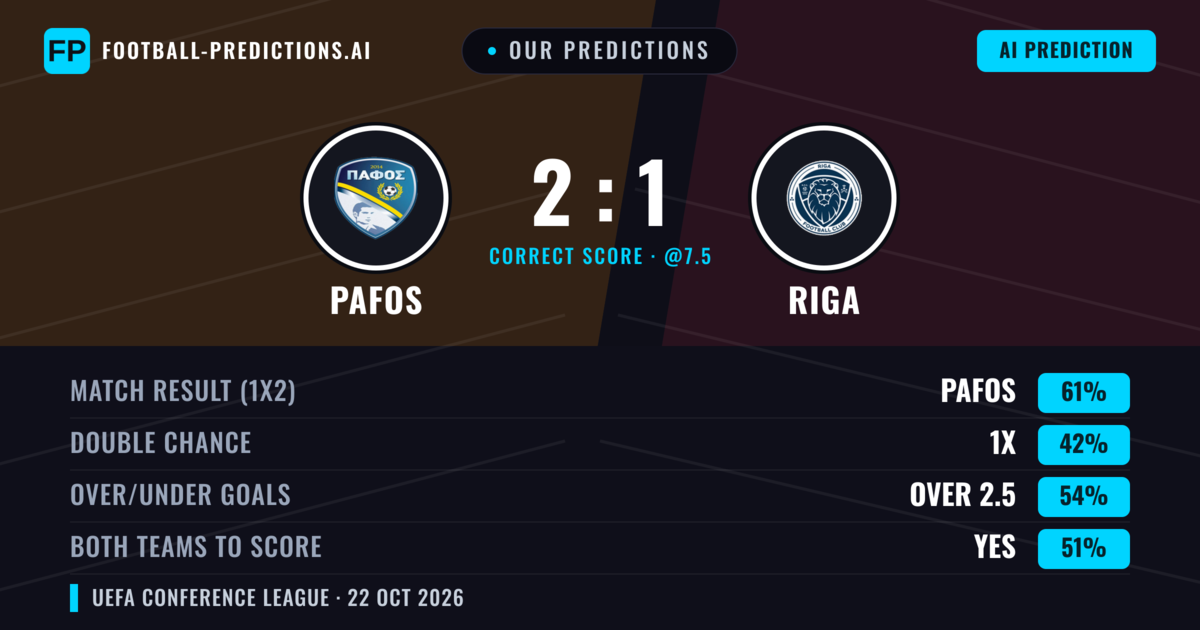
Our predictions place home victory at 61% confidence, aligning with market sentiment but conflicting with the AI form analysis. The over 2.5 goals market carries 54% confidence—a marginal endorsement suggesting this should be a competitive fixture likely to produce multiple goals. Both teams scoring receives 51% confidence, barely tipping into recommendation territory. The double chance prediction favors 1X at 42% confidence, indicating uncertainty about whether Pafos can secure maximum points.
Identifying value requires reconciling these competing signals. The gap between market odds (61.2% implied probability for home win) and AI form analysis (suggesting Riga should be favorites) indicates the market may be overvaluing home advantage and undervaluing Riga's current trajectory. The 5.75 away victory odds translate to approximately 17% actual probability according to the market, yet Riga's form and offensive output suggest they represent better value than these odds imply. For value-focused bettors, the away win or double chance X2 markets present opportunities where analytical evidence diverges from market pricing.
Correct score predictions provide additional avenues for consideration. The 1:1 draw appears prominently across prediction models, reflecting expectations of a closely contested encounter. The 2:0 home victory suggests Pafos finally breaking through offensively, though this requires faith in their attacking capabilities that current form does not support. The 1:0 home win, also priced competitively, indicates a scenario where defensive solidity decides the outcome rather than offensive flourishes.
Strategic Considerations for Thursday's Encounter
Both clubs enter this fixture having benefited from seven days rest since their last competitive fixtures—a factor that eliminates fatigue concerns and allows full squad availability (pending any undisclosed absences). The equal rest situation removes a potential tactical variable, forcing both sets of coaches to focus purely on strategic preparation rather than rotation considerations. This symmetry benefits teams with more established tactical identities, as they can prepare their approach without worrying about player freshness.
Pafos faces the unenviable task of breaking a European scoring drought while simultaneously preventing a Riga side that has found the net eight times this season. The Cypriot defensive unit, while conceding at 1.3 goals per match domestically, must elevate their performance level against opponents with continental experience and proven attacking capabilities. The pressure on Pafos's forward players to finally contribute to the scoring charts cannot be underestimated—psychological barriers often develop when teams go extended periods without goals, and breaking such droughts requires mental fortitude alongside technical execution.
Riga must approach this fixture with balanced ambition—aware that a positive result consolidates their position while recognizing that defeat would bring lower-placed competitors into striking distance. Their 3-5-2 formation provides tactical flexibility to adapt to Pafos's approach, whether that manifests as aggressive home pressure or cautious possession-based football. The Latvian club's ability to transition quickly between defensive and offensive phases could prove decisive against a Pafos defense that has shown vulnerability to pace and movement in behind.
The away goals rule abolition, implemented by FIFA in 2021, removes a strategic consideration that previously influenced two-legged competition tactics. Teams no longer face the mathematical imperative to score away from home, potentially leading to more cautious approaches in away fixtures. However, in league stage formats like the Conference League, cumulative points remain paramount regardless of venue, meaning teams should approach each fixture with intent to maximize returns rather than protect advantages through defensive attrition.
Prediction Synthesis and Recommended Approach
Synthesizing the available evidence reveals a match with genuine uncertainty despite Pafos's home advantage and favorite status. The divergence between market odds and analytical assessment creates compelling betting opportunities for those willing to challenge consensus views. Our confidence levels, while suggesting home victory as the most probable outcome, remain moderate enough (61%) to warrant caution against overcommitting to that result.
The over 2.5 goals recommendation at 54% confidence reflects expectations of a competitive fixture where both sides contribute to scoring. Riga's eight goals across their season demonstrates attacking capability that Pafos's defense should struggle to completely neutralize, while Pafos's desperation for points will force them toward offensive engagement rather than cautious containment. The BTTS recommendation at 51% confidence aligns with this assessment, suggesting both teams finding the target represents a realistic scenario.
For bettors seeking value beyond simple match result predictions, the Asian Handicap markets present nuanced opportunities. Given the uncertainty surrounding Pafos's ability to win by multiple goals, the away +1.25 line at 1.63 provides insurance against narrow defeats while maintaining returns if Riga achieves the upset. The double chance X2 at 2.41 offers similar protection with more attractive odds than the away win straight bet.
The most compelling betting approach balances respect for Pafos's home advantage against the statistical evidence favoring Riga's current form and attacking capabilities. A strategy combining the draw double chance with goals-based markets (over 2.5 and BTTS yes) provides multiple pathways to returns while acknowledging the genuine uncertainty surrounding this fixture's outcome. Those with higher risk tolerance might consider the away victory at 5.75 as a value play where analytical assessment diverges significantly from market pricing.
Thursday's encounter at Alphamega Stadium promises to be a defining moment in both clubs' Conference League campaigns. Pafos desperately requires points to revive qualification hopes, while Riga seeks to consolidate their position with a positive result on the road. The tactical battle between Pafos's need for victory and Riga's organizational resilience should produce an engaging contest whose outcome remains genuinely uncertain despite the home side's market favoritism. For spectators and bettors alike, this represents precisely the type of competitive European fixture that makes the Conference League an increasingly compelling competition.