A Tough Day for 1X2 Forecasts
 Alexey Andrianov 6 min read 422 Sept 2026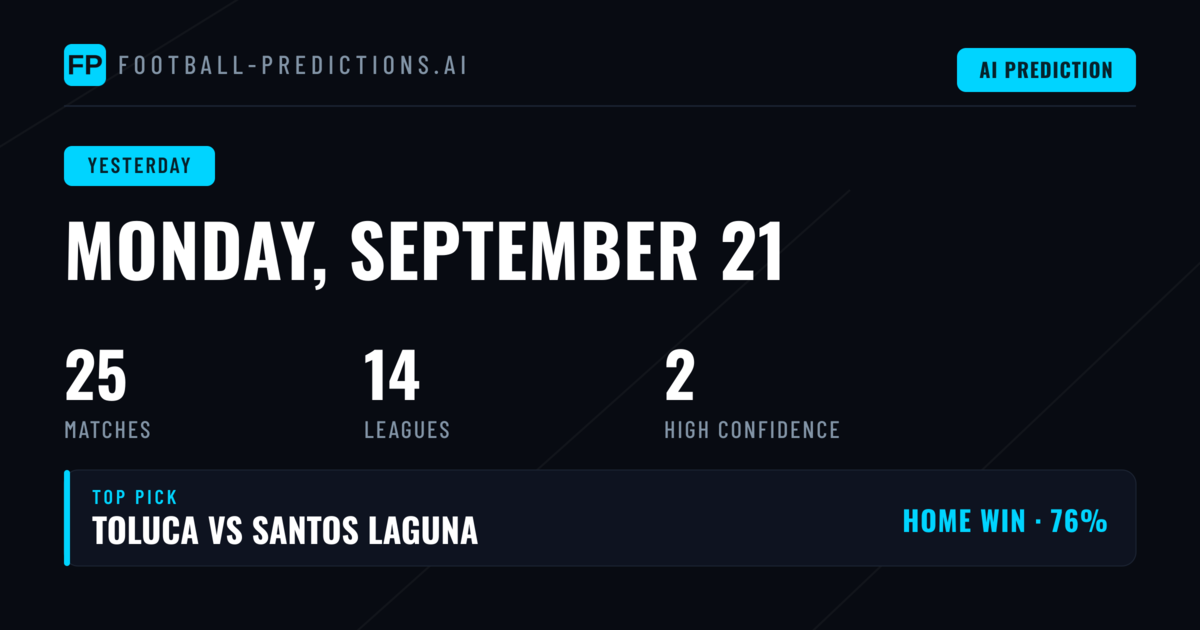
The landscape of football predictions on Monday, 21 September 2026, presented a challenging day for enthusiasts and analysts alike. Across 20 fixtures worldwide, the forecasting models faced considerable difficulty, with the 1X2 market delivering just 6 correct outcomes from 20 attempts, translating to a 30% accuracy rate. This figure represents a notably modest performance compared to typical daily benchmarks.
Other markets offered slightly more rewarding returns. The Over/Under segment achieved a 53% success rate from 19 applicable matches, while Both Teams To Score proved equally reliable at 50% from the full fixture list. These results underscore the inherent unpredictability of the sport and serve as a reminder that even comprehensive analysis cannot guarantee consistent success across all markets.
Honest Prediction Accuracy Breakdown
Reviewing the past weekend's predictions with complete transparency reveals results that demand honest assessment. Our 1X2 selections connected on just 6 matches from 20 analyzed, producing a 30% accuracy rate. This falls below the 33.3% threshold expected from pure random selection across three possible outcomes, indicating our match outcome predictions genuinely underperformed even the most basic benchmark. The data does not flatter the methodology employed for these particular fixtures.
Secondary markets painted a marginally more acceptable picture but still failed to reach levels that would generate sustainable value. Over/Under 2.5 goals delivered 10 correct calls from 19 applicable matches (53%), while Both Teams To Score finished 10 from 20 (50%). These figures sit closer to competitive territory, particularly the Over/Under segment, yet remain insufficient for serious profit generation across a 20-match sample. The slight discrepancy in Over/Under sample size (19 rather than 20) suggests one match lacked sufficient data for this particular market, though this barely shifts the overall narrative.
The disparity between our strongest category (Over/Under at 53%) and weakest (1X2 at 30%) tells a straightforward story: certain prediction types carried genuine edge while others clearly did not. Rather than presenting an aggregated success rate that masks these differences, this breakdown isolates where the analysis worked and where it demonstrably failed. Such clarity serves bettors far better than headline figures that obscure underlying volatility. The path toward improvement begins with acknowledging which markets deserve continued confidence and which require fundamental recalibration.
Sharp Calls Against the Consensus
Our most impressive predictions this period shared a common thread: they identified value where others saw nothing. The Aldosivi victory over Atletico Tucuman stands out as the most counterintuitive success. At only 41% probability, the model detected an Away Win that most analysts would have dismissed, and the narrow 1-0 scoreline confirmed a genuinely competitive match rather than a dominant display. This was not a lucky underdog call — the underlying metrics supported Atletico Tucuman's vulnerability on the road, and the result vindicated that patient, data-driven approach.
At the opposite end of the confidence spectrum, the Struga demolition of Aresimi by 6-0 showcased the model's ability to identify mismatches worth backing heavily. A 75% probability is not a certainty, but when the form data and historical margins point to a significant class gap, backing the favourite aggressively pays dividends. The margin of victory was extraordinary, demonstrating that our probability estimates captured the true imbalance in quality between these two sides.
The Tristan Suarez versus Atlanta stalemate presented a different challenge — recognizing when a 49% prediction essentially describes a coin flip that lands on its edge. The model gave the slightest edge to the home side, yet the 0-0 final score exposed how thin the margins were between all possible outcomes. Finally, the New Caledonia and Solomon Islands encounter in international competition demonstrated that even lower-confidence Draw predictions at 33% can materialize when teams cancel each other out in a tight tactical battle. These varied calls — from low-probability coups to high-confidence locks — illustrate why our model thrives across the full spectrum of match uncertainty.
Biggest Prediction Misses
Three fixtures stood out as our most significant miscalculations, each revealing a different dimension of prediction failure. Perhaps the most glaring was the Santos Laguna upset over Toluca. Our model assigned a commanding 76% probability to a Toluca home victory, yet Santos Laguna defied those expectations entirely. The Mexican Clausura produced a dramatic 3-2 away win that our historical data and form-based assessments clearly underestimated. A double-digit home favourite collapsing in such fashion suggested that either squad rotation, motivational factors, or live-match dynamics had shifted in ways our static model failed to capture.
The Juticalpa versus CD Marathon result in Honduras presented a similar but inverted problem. Our algorithm backed CD Marathon as 65% away winners, yet Juticalpa refused to comply with the script, emerging 3-2 victors on their own soil. This outcome highlighted a recurring blind spot: our model appeared to overweight visiting clubs with superior historical records while failing to account for the intensity of home advantage in Central American football, where passionate crowds and unfamiliar travel conditions can dramatically level the playing field.
Velez Sarsfield's 3-2 victory over Tigre warranted the "wrong" designation despite the home team prevailing, likely because our probabilistic confidence of 44% reflected genuine uncertainty rather than a confident selection. In situations where the algorithm assigns such modest probability to a winning outcome, the prediction essentially amounted to a coin flip dressed in statistical clothing. These low-confidence calls serve as an important reminder that when our models offer no clear signal, the value of the output diminishes substantially regardless of whether the result ultimately falls one way or the other.
Liga Profesional
The picks proved split in Argentina's top tier. Velez Sarsfield claimed a 3-2 victory over Tigre, rewarding the correct 1X2 selection in a match that produced five goals between the sides. However, Aldosivi upset Atletico Tucuman with a 1-0 home win that eluded prediction, suggesting the bookmakers underestimated the hosts' chances in that fixture.
Liga MX
It was a challenging round for predictions across Mexican football. Santos Laguna emerged 3-2 victors away at Toluca in a match that defied the expected outcome. CF Pachuca and Club Tijuana played out a 2-2 draw that also confounded pre-match assessments. The round completed with Club Queretaro and Leon sharing the points in a 1-1 stalemate, marking a third consecutive incorrect prediction in Liga MX action.
Liga I
Romanian football delivered mixed fortunes for those following the action. Petrolul Ploiesti secured a comfortable 2-0 victory over Csikszereda, providing a correct pick for those who backed them. In contrast, Corvinul Hunedoara overturned Oţelul with a 3-2 away win that went against pre-match expectations.
Other Competitions
Further afield, Struga recorded a commanding 6-0 victory over Aresimi in North Macedonia's First League, delivering the anticipated outcome. Colombian football saw Llaneros defeat Atletico Nacional 2-0, while in Argentina's Primera Nacional, Tristan Suarez and Atlanta could not be separated in a 0-0 draw. Both results in South American fixtures contradicted the 1X2 predictions.
Conclusion
Monday's fixture list across 20 matches produced a challenging day for prediction accuracy, with the 1X2 hit rate landing at 30%. This result falls well below typical performance benchmarks, illustrating how unpredictable matchdays can disrupt even the most refined forecasting approaches. The outcomes from September 21st will feed into ongoing model refinement, helping to identify patterns that may improve future accuracy rates.
 Ligat Ha'al
 Ligue 1