


 MLS
MLS

 Liga I
 UEFA Champions League Predictions
 KuPS
KuPS Sabah FA
 Dinamo Zagreb
 FC Thun
 Celje
Celje Egnatia Rrogozhinë
 Heart Of Midlothian
 Sturm Graz
 Shamrock Rovers
 Ararat-Armenia
 UEFA Conference League Predictions
 Apollon Limassol
 Dila
Dila Riga
Riga Vardar Skopje
 CSKA 1948
 Spartak Trnava
 FC Copenhagen
 Polessya
 Auda
Auda FCSB
FCSB UEFA Europa League Predictions
 FC Midtjylland
 Beşiktaş
 Hradec Králové
 Tromso
 Pafos
Pafos HNK Hajduk Split
 PAOK
PAOK Dynamo Kyiv
 CSKA Sofia
 Qarabag
Past Predictions
 CF Pachuca
 Club Queretaro
 Necaxa
 Monterrey
 Tigres UANL
 Atletico San Luis
 Santos Laguna
 Atlas
Atlas Los Angeles FC
 Sporting Kansas City
 San Jose Earthquakes
 Los Angeles Galaxy
 Portland Timbers
 Real Salt Lake
 San Diego
 FC Dallas
 Minnesota United FC
 Vancouver Whitecaps
 Houston Dynamo
 Austin
 St. Louis City
 Colorado Rapids
 CF Montreal
 Inter Miami
 Philadelphia Union
 Seattle Sounders
 Orlando City SC
 Nashville SC
 New York City FC
 Chicago Fire
 DC United
 Toronto FC
 Columbus Crew
 FC Cincinnati
 Guadalajara Chivas
 FC Juarez
 New York Red Bulls
 Charlotte
 Club Tijuana
 Leon
Leon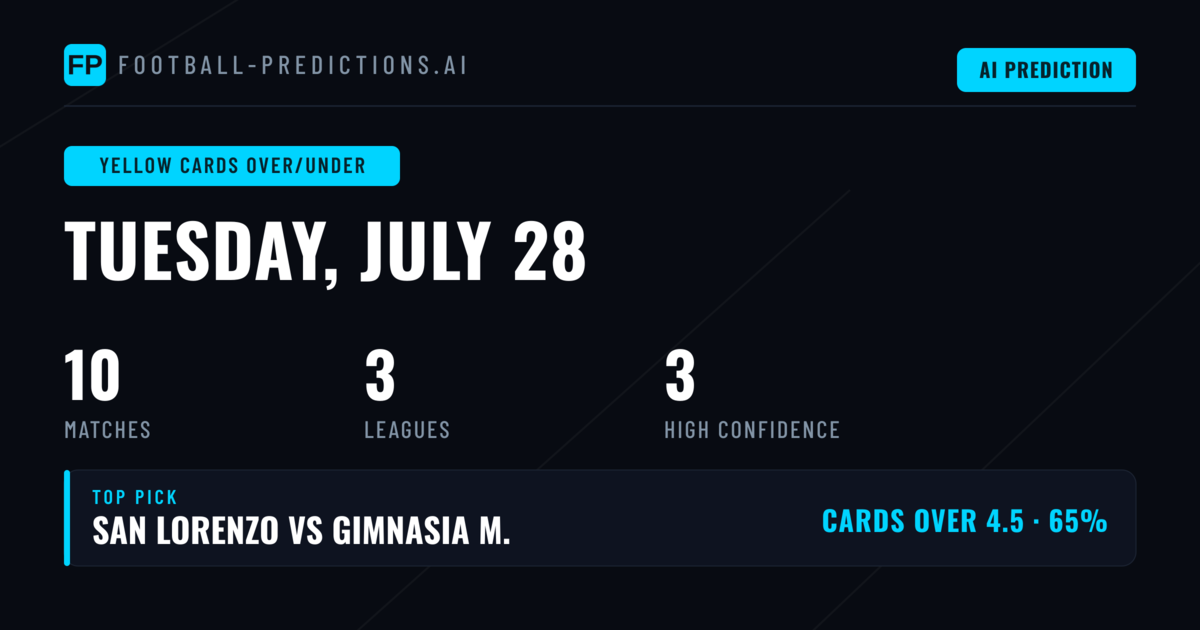

Football Predictions & Betting Tips: Jul 27 – Aug 2, 2026
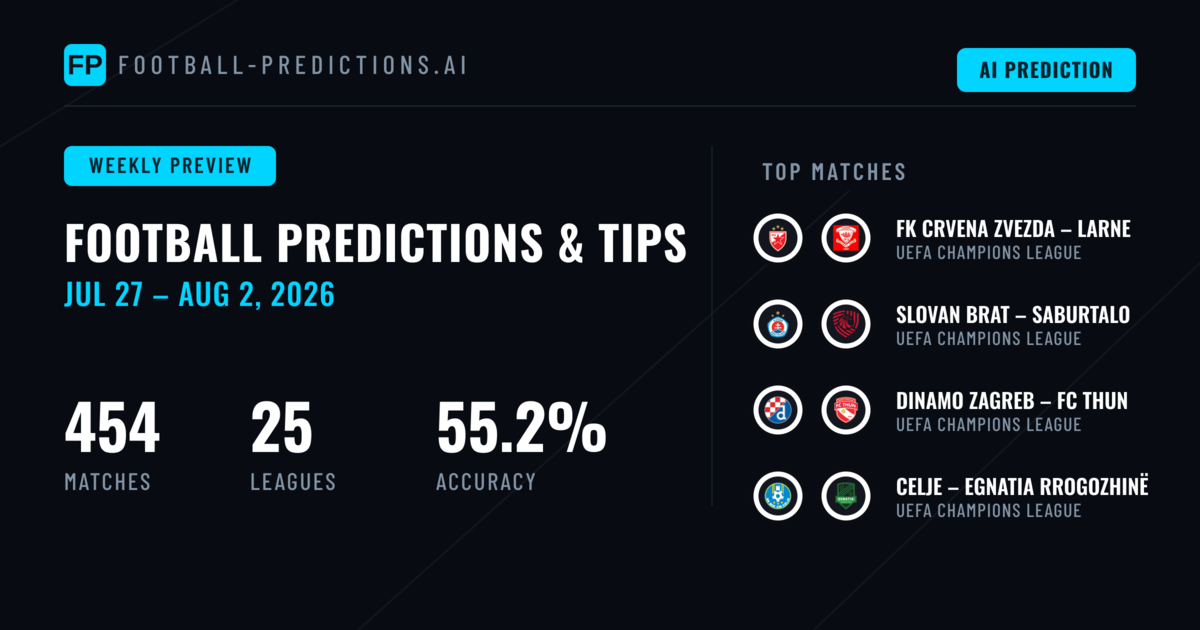
European Giants Enter the Arena as 454 Matches Light Up the Week
The European club season takes its first definitive steps this week as the UEFA Champions League and UEFA Europa League enter their qualifying rounds, headlining a staggering 454 fixtures across competitions worldwide. From the tension of knockout eliminators to league openers spanning multiple continents, the coming days deliver football's familiar rhythm returning to screens and stadiums alike.
Qualifying ties in European competition carry disproportionate weight. A single aggregate result can shape a club's entire financial and sporting trajectory for the season ahead, meaning teams approach these early rounds with measured caution. The Champions League path particularly demands attention, where clubs navigate compressed schedules against opponents who often specialize in disrupting favored opposition. The Europa League bracket runs concurrently, presenting its own tactical puzzles as teams balance domestic ambitions with continental survival.
Domestic action supplements the European calendar, with Scandinavian leagues and others entering early season phases. The volume—454 matches across seven days—creates a landscape where fixture density tests squad depth and tactical flexibility. Analysts tracking form across competitions face the challenge of separating genuine trends from limited sample sizes, particularly in leagues where clubs have completed only handfuls of competitive fixtures. The week ahead rewards systematic preparation and punishes assumptions based on last season's narratives.
Champions League and Europa League qualifiers dominate the midweek fixture list
Dinamo Zagreb Host FC Thun in UCL Second Round Qualifier
 vs
vs 
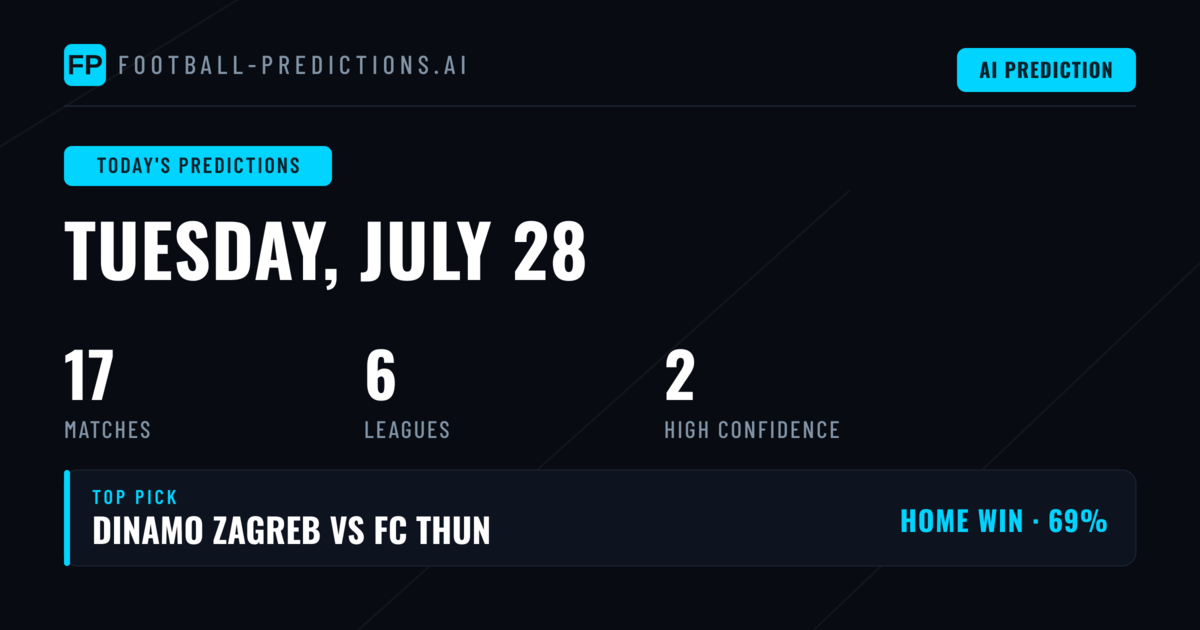
Tuesday's UEFA Champions League encounter sees Dinamo Zagreb, league rank #1 domestically, welcome FC Thun at Stadion Maksimir. The Croatian champions enter as clear favorites with a 69% confidence rating for a home win. The over 2.5 goals market carries 58% confidence while both teams scoring shows 51% — a coin-flip scenario. Dinamo Zagreb finished their domestic campaign as champions and will look to assert early dominance in this qualification round. Check the full Dinamo Zagreb vs FC Thun preview for detailed analysis.
Fenerbahçe Travel to Face Gornik Zabrze in UCL Qualifier
 vs
vs 
Gornik Zabrze, Poland's top-ranked side, face a stern test against Fenerbahçe on Wednesday. The Turkish visitors, sitting second in their league, are favored at 64% confidence despite playing away. Goals look likely with over 2.5 priced at 54% confidence and BTTS yes at 50%. The away side's quality in transition could prove decisive against a Gornik Zabrze defense that must be disciplined. For in-depth coverage, see our Gornik Zabrze vs Fenerbahçe betting tips.
PAOK Welcome Dynamo Kyiv in Europa League Qualifier
 vs
vs 
Thursday's Europa League action features a tightly contested matchup between PAOK and Dynamo Kyiv. Both clubs occupy identical third-place positions in their respective domestic leagues. PAOK hold a slim 53% edge for victory, with over 2.5 goals at exactly 50% and BTTS yes marginally ahead at 52%. The Greeks' home record will be crucial against a Dynamo Kyiv side accustomed to European competition. Read the complete PAOK vs Dynamo Kyiv prediction article.
Pafos FC Host HNK Hajduk Split in Europa League Clash
 vs
vs 
The Cyprus outfit Pafos FC, fourth in their domestic league, face Croatian second-placed side HNK Hajduk Split on Thursday. Despite the visitors' superior league position, Pafos are slight favorites at 53% confidence. The market suggests an open contest with over 2.5 goals at 50% and both teams scoring at 52%. Home advantage could prove pivotal for Pafos against an experienced Hajduk Split side. Access the full Pafos vs HNK Hajduk Split preview for our expert picks.
FC Midtjylland vs Beşiktaş — Thursday, July 30


FC Midtjylland finished second in their domestic league while Beşiktaş ended their campaign in fourth place. Both clubs enter this Europa League tie in qualification mode, with Thursday's first leg likely to set the tone for the aggregate. Midtjylland hold a 51% home win probability according to the model, marginally edging out a Beşiktaş side who must travel. The 56% confidence on over 2.5 goals and 58% for BTTS yes indicate expectations of an open contest. FC Midtjylland vs Beşiktaş
Anderlecht vs Hammarby FF — Thursday, July 30


Anderlecht ended their league season in fourth position, while Hammarby FF arrive in stronger form after finishing second. Thursday's Europa League qualifier pairs two clubs from contrasting domestic situations, making this a difficult tie to call. The model assigns just 42% confidence to a home Anderlecht victory, suggesting this remains genuinely competitive. Goals should flow freely with over 2.5 at 53% and BTTS yes at 57%. Anderlecht vs Hammarby FF
FK Crvena Zvezda vs Larne — Wednesday, July 29


The gap between these two clubs could hardly be wider. FK Crvena Zvezda enter as domestic champions following a first-place league finish, while Larne completed their season in ninth position. Wednesday's Champions League qualifier represents a significant step up in class for the visitors. An 88% home win confidence reflects the gulf in quality, with over 2.5 goals at 74% and a 64% no-BTTS pick supporting a one-sided outcome. FK Crvena Zvezda vs Larne
Hradec Králové vs Tromso — Thursday, July 30


This Europa League qualifier pairs fifth-placed Hradec Králové against a Tromso side who finished third in their own league, suggesting similar standards between the clubs. The model gives Tromso a 47% chance of taking an away victory, marginally ahead despite the travel involved. Over 2.5 goals sits at 51% with BTTS yes at 54%, pointing toward a close contest where small margins decide the outcome. Hradec Králové vs Tromso
European Football's Dual Narratives: Continental Competition Update
 UEFA Champions League
The 2025/26 UEFA Champions League season has reached its conclusion with Arsenal ascending to European football's highest throne. The Gunners' campaign delivered attacking football that kept supporters riveted throughout the competition, culminating in a historic triumph that marks a significant milestone for the club. Three clubs faced relegation from the competition following the conclusion of this season, underscoring the ruthless nature of elite European football where the margin between glory and disaster remains extraordinarily narrow.
 UEFA Europa League
The 2025/26 UEFA Europa League approaches its climax with 87 matches already played and just three fixtures remaining in what has been a compelling season. The competition has generated 225 goals at a rate that suggests attacking football has dominated the tournament, with dramatic late-stage encounters and fierce rivalries providing consistent entertainment. Those three remaining matches will determine the ultimate destination of the trophy and which club secures continental glory.
Simultaneously, the 2026/27 campaign is taking shape through qualifying rounds as clubs battle for places in the group stage. Six qualifying matches have produced 13 goals at an average of 2.17 per game, with home sides claiming nine of those goals compared to four for visiting teams. The early qualifying data indicates a pronounced home advantage in these preliminary rounds, a pattern that may influence how bettors assess first-leg matchups across the continent.
In-Form Sides Ready to Make Their Mark This Week
A handful of clubs enter the coming days carrying serious momentum, with their recent domestic league runs setting up intriguing assignments across multiple competitions.
 Inter Miami sit second in the MLS table with 37 points from 17 outings, boasting an enviable record of 11 wins, four draws and just two defeats. Their attack has fired 43 goals while conceding 30. A flawless run of five consecutive victories in their most recent league fixtures underlines their current trajectory. Lionel Messi leads their scoring charts with three goals across three appearances. The Herons will look to extend that sequence when they return to action this week.
 Belgrano Cordoba have turned heads early in the 2026/27 Liga Profesional campaign. One match played yields one win, two goals scored and one conceded, placing them second in the standings with three points. Their winning streak extends beyond that single fixture — five wins from their last five competitive matches overall. Lucas Gutierrez has been their most clinical outlet, finding the net twice across four appearances. They enter the new week with genuine belief after a statement start.
Dinamo Zagreb wrapped up the 2025/26 HNL campaign as runaway champions, accumulating 86 points from 36 matches with 27 wins, five draws and four defeats. They scored 93 goals and shipped just 28. Their recent domestic form showed one draw followed by four successive victories. Dinamo finished their league programme 24 points clear at the summit. Their attention now shifts to European competition, with a UEFA Champions League tie on the horizon. Dino Beljo finishes their season as their leading marksman with 11 goals from 21 appearances.
 FC Seoul wrapped their 2026/27 K League 1 season as deserving champions, sitting top of the table with 42 points from 19 matches. Their record read 13 wins, three draws and three defeats, complemented by 34 goals scored and 14 conceded. Across their final five league fixtures, they posted three wins, one draw and one defeat. With the domestic campaign concluded, they switch focus to the FA Cup for their next competitive assignment.
 Nashville SC have asserted themselves as the team to beat in MLS, occupying first place with 39 points from 17 games — 12 wins, three draws and two defeats. They have hit 33 goals while allowing only 12 at the other end. Their most recent league sequence shows one reversal followed by four wins on the bounce. Sam Surridge has been their sharpest weapon, contributing four goals from just two appearances. The Orange will back themselves to maintain their winning habit.
 Atletico Paranaense arrive in strong form for Serie A's latest round, positioned third with 36 points from 20 fixtures — 11 wins, three draws and six defeats. They have struck 28 times and conceded 19. A sequence of four wins and one draw from their last five league matches highlights their growing confidence. Sergio Mendoza leads their charge despite limited minutes, with one goal from a single appearance. They will aim to close the gap on those above them.
Premier Betting Picks: July 27 – August 2, 2026
Match Result (1X2)
The standout selection comes from the FK Crvena Zvezda vs Larne tie in the UEFA Champions League, where FK Crvena Zvezda win carries 88% confidence. Rapid Vienna faces FC Santa Coloma in the Conference League, with Rapid Vienna to win at 82% confidence. Both European heavyweights face opponents from lower-ranked nations.
Over/Under Goals
The FK Crvena Zvezda vs Larne Champions League fixture shows Over 2.5 goals at 74% confidence, suggesting attacking intent from the Serbian champions. In Argentina's Liga Profesional, Barracas Central vs Aldosivi leans toward Under 2.5 goals at 70% confidence, indicating a tighter contest.
Both Teams to Score
The Argentinos JRS vs Estudiantes de Rio Cuarto Liga Profesional clash shows Both teams to score: No at 66% confidence. Across the Atlantic, the Sporting Kansas City vs Houston Dynamo MLS fixture favors Both teams to score: Yes at 65% confidence in an anticipated high-scoring derby.
Double Chance
The FC Vaduz vs FC ST. Gallen Swiss Super League match offers draw or FC ST. Gallen (X2) at an exceptional 95% confidence. In South Korea, the Busan I Park vs FC Seoul FA Cup tie presents Busan I Park or draw (1X) at 95% confidence.
Asian Handicap
The FC Orenburg vs Zenit Russian Premier League match features Zenit -0.75 at a commanding 98% confidence. Zenit's quality advantage over Orenburg makes this the strongest single selection across all markets this week.
Half-Time / Full-Time
The Rapid Vienna vs FC Santa Coloma Conference League fixture projects Home / Home at 69% confidence. Rapid Vienna's anticipated dominance from the first whistle through to the final whistle reflects their significant class advantage over the visitors.
Correct Score
In the Argentinos JRS vs Estudiantes de Rio Cuarto Liga Profesional match, the Correct score prediction of 1–0 carries 26% confidence. This modest figure reflects the inherent difficulty of pinpointing exact margins in low-scoring encounters.
Half-Time Result
The Zira vs Paide UEFA Conference League qualifier shows Zira win at half-time at 59% confidence. Zira's early momentum positions them to hold an advantage at the interval against their Estonian opponents.
Corners
The Barracas Central vs Aldosivi Liga Profesional fixture favors Corners Under 9.5 at 70% confidence. Both Argentine clubs demonstrate disciplined defensive structures that limit corner-generating opportunities.
Cards
The CF Pachuca vs Club Queretaro Liga MX clash shows Cards Over 3.5 at 70% confidence. The rivalry between these Mexican clubs suggests an aggressive encounter with officials likely to produce multiple bookings.
Anytime Goalscorer
In the Cruz Azul vs Atlante FC Liga MX fixture, Gabriel Fernandez to score anytime carries 60% confidence. The forward's goal-scoring threat provides value in an anticipated attacking display from Cruz Azul at home.
Performance Review: Week of July 20–26
The week of July 20 produced solid results across most prediction categories. Our 1X2 selections returned 51.7% accuracy, landing 125 correct outcomes from 242 matches analyzed. The Over/Under markets proved more reliable, achieving 61.1% success with 143 correct calls from 234 matches, while BTTS predictions hit 60.7% accuracy (147 from 242). The average goal count across featured matches settled at 2.8 per game, with both teams scoring in 54.7% of fixtures.
When measured against our 90-day performance spanning 5376 predictions, last week slots into a broader pattern of variance and consistency. Our headline pick selections have delivered 61.6% accuracy over the longer sample, demonstrating that our filtering process identifies stronger signals than standard match result predictions alone (49.9%). The Over/Under channel at 61.1% last week marginally exceeded the 90-day average of 59.4%, while BTTS at 60.7% outperformed the 55.6% baseline. The standout remains Double Chance at 79.2% across 5376 predictions, illustrating the value in covering multiple outcomes when confidence warrants it.
The new week presents 454 upcoming matches across global competitions. Armed with these audited figures, our approach this cycle aims to replicate the Over/Under and BTTS strength while seeking improvement in match result precision. Each prediction category now carries verified performance data, allowing for sharper calibration as the fixture list unfolds.
Readers can study our complete track record across every bet type and tournament in the statistics section of our platform.
Card Betting Predictions — AI Analysis & Referee Insights
Table of Contents
- What Are Card Betting Predictions?
- How Our AI Predicts Cards
- Today's Card Predictions Overview
- Types of Card Bets
- Factors That Drive Card Counts
- Card Betting Strategies
- Best Leagues for Card Betting
- The Referee Factor
- Card Bets in Accumulators
What Are Card Betting Predictions?
Card betting is a specialized football market that focuses on the number of yellow and red cards shown during a match. It has become increasingly popular among experienced bettors because card patterns are surprisingly predictable when you understand the underlying drivers — referee tendencies, match intensity, team discipline records, and the stakes involved.
The standard card market uses a count system where you predict whether total cards will be over or under a specified line (typically 3.5-5.5). Some bookmakers offer a booking points system where each yellow card counts as 10 points and each red card as 25 points, with lines around 35.5-55.5. Our AI system generates predictions using the more common card count system, but the analysis applies equally to booking points markets.
What makes card betting particularly compelling is its relative inefficiency in bookmaker pricing. While goals and match results are priced with razor-thin margins, card markets often carry wider margins but also present more value opportunities because bookmakers invest less modeling effort in these secondary markets. Our AI exploits this gap by applying the same rigorous statistical analysis typically reserved for primary markets.
Cards are also one of the few markets where a single, identifiable individual — the referee — has an outsized impact on the outcome. This creates predictable patterns that persist across seasons and even careers, giving informed bettors a significant edge over those who ignore referee data. The information asymmetry is substantial: most casual bettors don't check referee assignments, while our AI treats it as the primary input.
How Our AI Predicts Cards
Our card prediction model integrates multiple data layers to generate accurate forecasts. The primary inputs include:
Referee Card Profiles
This is the single most predictive factor in card betting. Referees have remarkably consistent card-giving rates across seasons. A referee who averages 5 cards per match will continue to average close to that figure regardless of the teams involved. Our AI identifies the appointed referee and adjusts predictions accordingly. The database maintains card statistics for every referee across 5+ leagues, updated weekly.
Team Discipline Profiles
Every team has a distinct fouling pattern. Some teams press aggressively and commit many tactical fouls (accumulating cards), while others play a clean possession game. Our model tracks cards received per match for each team, adjusted for home/away splits and opponent quality. Teams that rely on counter-attacking football commit more tactical fouls in the opposition half, leading to systematic card accumulation.
Match Context and Rivalry
Derby matches, relegation battles, and title deciders produce significantly more cards than mid-table encounters. The model assigns a "tension multiplier" based on the match's competitive significance and historical rivalry intensity. A derby between two mid-table teams produces more cards than a match between the league leaders and a relegated team — the emotional stakes matter as much as the competitive stakes.
Playing Style Clash Analysis
Certain tactical matchups produce more fouls and cards. A fast counter-attacking team against a high-pressing opponent creates many transitional situations where tactical fouls are used to stop breaks. A physical direct team against a technical possession team produces fouls from mismatched challenges. Our AI identifies these clash patterns from historical data and adjusts card expectations accordingly.
Today's Card Predictions Overview
Today we are analyzing 16 matches across 5 leagues, with card predictions generated for 10 fixtures. Each prediction includes the recommended over/under pick, the specific line, confidence level, and available odds.
| Metric | Value |
|---|---|
| Total matches analyzed | 16 |
| Leagues covered | 5 |
| Card predictions | 10 |
| Over picks | 9 |
| Under picks | 1 |
| Top confidence pick | over 4.5 (San Lorenzo vs Gimnasia M.) |
| Highest confidence | 65% |
| Best odds available | 1.76 |
For comprehensive accuracy statistics across all prediction types, visit our prediction statistics page.
Types of Card Bets
Bookmakers offer several card-related markets, giving bettors multiple angles to exploit their analysis:
Total Match Cards (Over/Under)
The standard market — predict whether total cards will exceed or fall below a line. Lines typically range from 3.5 to 5.5. A match refereed by a strict official between two aggressive teams might have a line of 5.5, while a calm encounter with a lenient referee could be set at 3.5. Our AI selects the optimal line for each fixture by comparing probability distributions against odds for multiple lines.
Team Cards (Over/Under)
Bet on how many cards a specific team will receive. This is useful when one team is significantly more aggressive than the other. For example, a disciplined possession team might be expected to receive only 1-2 cards while their pressing opponents could receive 3-4. Team card lines are typically 1.5-3.5 and are often less efficiently priced than match totals.
Card Booking Points
In this market, yellows are worth 10 points and reds 25 points (a player sent off with two yellows = 35 points: 10+25). Lines typically range from 30.5 to 60.5. This format amplifies the impact of red cards, making it more volatile but also creating value when you correctly predict high-intensity matches. The key is that a single red card swings booking points by 15 extra points beyond a standard yellow.
Player Cards
You can bet on individual players to be carded. Defensive midfielders who make tactical fouls, full-backs who commit fouls on fast wingers, and central defenders facing quick strikers are frequent card recipients. This market requires deeper knowledge but offers excellent value because bookmakers can't efficiently price 22+ individual player card probabilities simultaneously.
First Card Timing
When will the first card be shown? Lines are typically set around 20-25 minutes. Matches with high intensity from kickoff see earlier first cards. Derbies and matches with pressing teams typically produce first cards before 15 minutes. This is an interesting market for those who study early-match patterns and referee behavior in opening minutes.
Red Card in Match (Yes/No)
A simple yes/no market on whether a red card will be shown. Red cards occur in approximately 8-12% of matches depending on the league. "Yes" odds are typically 5.00-8.00, making this a high-odds market. Target matches with rivalry intensity, strict referees, and physical mismatches for the best red card probabilities.
Factors That Drive Card Counts
Referee Tendencies
The referee is the single most important factor in card betting. Some referees consistently show 5-6 cards per match while others average 2-3. This isn't random variation — it reflects deep-seated officiating philosophies about game management. Strict referees set the tone early with cards, while lenient ones prefer verbal warnings. Our AI maintains detailed referee profiles and adjusts predictions by 20-40% based on the appointed official.
Referee consistency is remarkably stable season-over-season. A referee who averaged 4.5 cards per match last season will typically average 4.0-5.0 this season. This persistence makes referees the most reliable predictor in the entire card betting framework. Our database tracks not just overall averages but also how each referee behaves in high-stakes vs low-stakes matches and home vs away team card distribution.
Match Stakes and Rivalry
Local derbies produce 30-50% more cards than regular fixtures. Relegation six-pointers, cup semi-finals, and matches with personal feuds between managers or players all see elevated card counts. The emotional intensity translates directly into more aggressive challenges, more dissent, and more time-wasting — all card-worthy offenses. Even friendly-seeming matches between historically rival clubs produce elevated card counts.
Team Tactical Profiles
Teams that defend through fouling — typically counter-attacking sides that make tactical fouls to prevent opposition transitions — accumulate more cards. High-pressing teams also commit more fouls in advanced areas as their press gets bypassed. Possession-dominant teams that rarely need to foul receive the fewest cards. Teams in the bottom third of the table tend to receive more cards due to desperation and defensive fouling.
Pace and Physical Mismatch
When a physically imposing team faces a technically superior but smaller side, or when fast wingers face slower full-backs, the fouling rate spikes. These physical mismatches produce systematic fouls that lead to cards. Our AI captures these matchup-specific dynamics through player-level data analysis. The classic example: a tricky, quick winger being fouled repeatedly by an older, slower full-back who accumulates cards trying to cope.
VAR and Technology Impact
Video Assistant Referee has changed card patterns in leagues where it operates. There are fewer cards for diving and simulation (because VAR catches dives) but more for handball and technical offenses (because VAR identifies them). The net effect varies by league — some have seen overall card counts drop slightly, while others have seen increases in certain card types. Our model uses VAR-adjusted card rates for applicable leagues.
Card Betting Strategies
Winning Approaches
- Always check the referee assignment before placing card bets — it's the #1 factor
- Focus on matches with high rivalry intensity and competitive stakes
- Use booking points markets for higher variance/higher reward opportunities
- Track specific players with high card rates per 90 minutes
- Second-half card overs often offer better value than full-match overs
- Combine referee data with team discipline profiles for maximum accuracy
Mistakes to Avoid
- Don't bet cards without knowing the referee — it's the most predictable variable
- Avoid friendly/pre-season card bets — referees behave completely differently
- Don't assume physical leagues always produce more cards — it depends on refereeing culture
- Never use card averages from different referees interchangeably
- Don't ignore the impact of VAR — it has changed card distribution patterns
- Avoid card bets in matches with heavy squad rotation or end-of-season dead rubbers
The Referee-First Approach
The most profitable card betting strategy is simple: start with the referee, not the teams. Once you know the appointed referee, set your baseline expectation. Then adjust up or down based on the specific matchup. A strict referee in a derby match could push your expectation to 6-7 cards, while the same referee in a friendly encounter might only produce 4-5. This referee-first approach ensures your predictions are anchored to the most predictable variable.
Late-Game Card Value
If a match is tight heading into the last 20 minutes, in-play card overs become attractive. Teams chasing the game commit more fouls, substitutes are more likely to be carded for rash challenges, and time-wasting leads to bookings. Pre-match, targeting "second-half cards over 2.5" can capture this systematic pattern. The mathematical reality is clear: 60% of all cards in football are shown in the second half, and this percentage rises to 65-70% in closely contested matches.
The Derby Specialist
Specialize in derby and rivalry matches across multiple leagues. These fixtures produce 30-50% more cards than average, and this premium is often not fully reflected in the odds. Build a calendar of major derbies across the leagues you follow and systematically back over cards at each one. Even a simple "over 4.5 cards in every derby" strategy produces positive returns over a season.
Best Leagues for Card Betting
Card cultures vary dramatically across leagues, creating distinct betting opportunities:
| League | Avg Cards/Match | Character | Best Strategy |
|---|---|---|---|
| La Liga | 5.0-5.5 | Tactical fouls, systematic | Over 4.5 consistently |
| Serie A | 4.5-5.0 | Tactical discipline | Over 3.5 / Team cards |
| Eredivisie | 4.5-5.0 | Open play, variable | Derby overs |
| Premier League | 3.5-4.0 | Lenient referees | Under 4.5 / Selective overs |
| Bundesliga | 3.5-4.0 | Fast-paced, moderate | Under 4.5 in balanced matches |
| Ligue 1 | 4.0-4.5 | Physical with strict refs | Over 3.5 |
| Turkish Super Lig | 5.5-6.0 | Passionate, intense | Over 4.5 / Over 5.5 |
| Argentine Primera | 5.5-6.5 | Very aggressive | Over 5.5 |
Spanish and South American leagues are card-heavy cultures where tactical fouling is accepted and referees respond with frequent bookings. The Premier League, by contrast, has a tradition of "letting the game flow" — referees tolerate more physical play before reaching for cards. This cultural difference creates systematic pricing opportunities when bookmakers apply generic models across all leagues.
The Turkish Super Lig and Argentine Primera Division are the highest-card leagues globally, averaging 5.5-6.5 cards per match. If your bookmaker offers card markets for these leagues, over bets at reasonable lines provide consistent value. The intensity and passion in these leagues make high card counts a near-certainty in most fixtures.
The Referee Factor
We cannot overstate the importance of referees in card betting. Here's why this single variable matters so much:
Consistency: A referee's card rate is more consistent season-over-season than almost any team-level statistic. If a referee averaged 4.2 cards per match last season, they'll likely average 3.8-4.6 this season. This predictability is a bettor's best friend — it provides a stable anchor for your expectations.
Impact magnitude: The difference between the strictest and most lenient referees in a top league can be 2-3 cards per match. That's often the difference between over and under hitting. No team-level factor has this much individual impact on the card total. A single referee assignment can shift the optimal bet from over to under or vice versa.
Information asymmetry: Referee assignments are typically announced 2-3 days before the match. Bettors who check this information and adjust their analysis have a significant edge over those who don't — and over bookmakers whose models may not update in real-time. The odds are often set before referee assignments and may not adjust quickly enough.
Our recommendation: never place a card bet without checking who is refereeing. If the referee hasn't been announced, either wait or factor in the uncertainty by requiring higher value from the odds. This single habit will improve your card betting results more than any other adjustment.
Card Bets in Accumulators
Card bets work well in accumulators, particularly when combined with other match-specific markets. Since card outcomes are partially independent of goals and match results, they provide genuine diversification within a multi-bet.
Example Card Accumulator
| Match | Pick | Odds |
|---|---|---|
| La Liga Derby — Over 4.5 Cards | Over | 1.75 |
| Serie A — Over 3.5 Cards | Over | 1.80 |
| Turkish Super Lig — Over 4.5 Cards | Over | 1.70 |
Combined odds: ~5.36 — A card-focused treble targeting high-card leagues with strict referees.
When building card accumulators, prioritize matches where the referee assignment is confirmed and aligns with your over/under thesis. A three-leg card acca with confirmed strict referees in derby matches is significantly more reliable than a five-leg acca with uncertain referee assignments. Quality of selection matters more than quantity of legs.
You can also mix card bets with corner bets or goals markets for diversified accumulators. Cards, corners, and goals are only weakly correlated — a match can have many cards but few corners, or many corners but few cards. This independence makes mixed-market accumulators more robust than pure same-market accas. Our accumulator builder helps you combine selections across different markets while maintaining an optimal risk-reward balance.
For conservative card accumulators, use under lines in the Premier League and Bundesliga (where referee leniency keeps card counts low) combined with over lines in La Liga and Turkey (where card-heavy cultures push counts up). This mixed approach captures the systematic league differences that persist season after season.
Browse today's yellow card prediction for every football match. Our AI examines referee card averages, team discipline records and match intensity to deliver accurate cards predictions. The referee assignment is the single most important factor — some average 5+ yellow cards per match while others rarely reach 3. Our yellow card prediction today model also covers over 2.5 bookings predictions and total cards lines. Combined with team foul rates and match stakes, we identify the best card betting opportunities.
Cards Predictions FAQ
How are card predictions calculated?
Our AI combines referee card rates, team discipline records, match stakes, and rivalry intensity to predict card counts. We analyze 10 matches across 5 leagues today. Referee tendencies are the single most important factor, often shifting predictions by 1-2 cards.
What does Over/Under cards mean?
You bet on whether total cards in a match will exceed (Over) or fall below (Under) a set line. For example, Over 4.5 means 5+ cards are needed. Today we have 9 Over picks and 1 Under picks across 10 analyzed matches.
Why are referees so important for card bets?
Referees have highly consistent card-giving rates across seasons — the difference between strict and lenient refs can be 2-3 cards per match. This single factor often determines whether overs or unders hit. Always check the referee assignment before betting on cards.
Which leagues produce the most cards?
La Liga (5.0-5.5 per match), Turkish Super Lig (5.5-6.0), and Argentine Primera Division (5.5-6.5) are the highest-card leagues. The Premier League and Bundesliga (3.5-4.0) are notably more lenient. Our AI adjusts predictions by league.
Can I combine card bets with other markets?
Yes — card bets work well in accumulators because they are partially independent of match results and goals. A team can lose but still produce many cards. Mixing cards with corners or goals markets creates genuine diversification. Visit our accumulator tips page for suggestions.
How does VAR affect card predictions?
VAR has reduced cards for diving/simulation but increased cards for handball and technical fouls. The net effect varies by league. Our AI uses VAR-adjusted card rates for leagues where it operates, ensuring predictions reflect the modern refereeing environment.